
Is investing halal, or does growing your money always involve interest, gambling, or questionable businesses?
The reassuring answer is that investing can be halal. What matters is not whether money produces a return. The real concerns are where the money goes, how the return gets created, and which risks both sides accept.
In this guide, we will explain the major investment types one by one, as well as short- and long-term strategies.
The Short Answer: Is Investing Halal?
Under Islamic finance principles, investment becomes permissible when it promotes lawful activities, avoids prohibited sectors, and does not rely on riba, gharar, or maysir. A halal investment should meet three broad tests:
The business or asset itself must serve a permissible purpose.
The financial structure must avoid predetermined interest.
The investor should understand the asset, contract, risk, and source of profit.
Islam does not prohibit risk. A shop owner, farmer, property investor, or shareholder can earn a profit or suffer a loss.
The concern appears when one party receives a guaranteed gain while shifting nearly all meaningful risk onto someone else.
What Makes an Investment Halal or Haram?
A product does not become halal merely because its marketing uses Arabic terminology. Investors need to look beneath the label:
Test | More likely halal | Warning sign |
Source of revenue | Lawful products and services | Gambling, alcohol, adult content, and conventional lending |
Return structure | Shared business profit or asset growth | Guaranteed interest or fixed profit on a loan |
Ownership | Real shares, assets, or contractual participation | Synthetic exposure with no meaningful ownership |
Risk | Clear commercial risk is shared fairly | One-sided or hidden risk |
Contract | Transparent terms and responsibilities | Excessive ambiguity or undisclosed conditions |
Trading behavior | Research-led ownership | Leverage, compulsive speculation, or lottery-like bets |
Which Investments Are Halal and Which Are Not?
It depends on how each investment works, not just what it's called. Let's see the most common investment types:
Stocks: Halal if the Company and Method Pass Sharia Screening
Stocks are halal when the company’s main business is permissible, and the investor buys real shares without interest-based borrowing, short selling, or prohibited leverage.
The International Islamic Fiqh Academy says forming or buying shares in companies with permissible objectives and lawful activities is lawful.
The same resolution prohibits participation in companies whose main purpose involves riba-based transactions, forbidden products, or trading in prohibited activities.
A halal stock is not just “a stock.” It must represent ownership in a company that passes Sharia screening.
ETFs: Halal Only if the Holdings Are Halal
According to HalalWallet, an ETF is halal if it holds Sharia-compliant assets and avoids prohibited sectors, interest-based instruments, leverage, and speculative derivatives.
An ETF is a basket. If the basket holds haram assets, the ETF creates the same concern. A Sharia-screened ETF may work. A normal broad-market ETF needs review because it may hold banks, alcohol firms, gambling companies, conventional insurers, or bond exposure.
Mutual Funds: Halal if the Fund Screens Its Assets
A mutual fund is halal if it invests in halal assets, avoids interest-based instruments, applies Sharia screening, and provides purification guidance for non-compliant income.
The fund is only a vehicle. The ruling depends on what the fund owns. The International Islamic Fiqh Academy has addressed shares and investment units, while AAOIFI maintains standards for Islamic finance products and Sharia governance.
So Islamic mutual funds are halal. Conventional bond funds, money market funds, or mixed funds require careful screening.
401(k): The Account Is Neutral; the Investments Inside Decide the Ruling
A 401(k) is not halal or haram by itself. It is an account structure. The ruling depends on the funds or assets selected. The IRS defines a 401(k) as a feature of a qualified profit-sharing plan that lets employees contribute part of their wages to individual accounts.
From a Sharia perspective, the account is a container, so you assess the assets within it according to the rules for stocks, bonds, funds, and deposits.
So, a 401(k) with Sharia-screened equity funds may be acceptable. A 401(k) filled with bond funds, interest cash funds, or conventional target-date funds needs review.
Bonds: Conventional Bonds Are Generally Haram
Conventional bond investment generally conflicts with Islamic finance because a bond typically represents a loan that promises repayment plus a predetermined interest rate.
The International Islamic Fiqh Academy states that bonds that require repayment of principal plus interest or a predetermined profit are prohibited under Sharia.
It also says changing the name to “certificate,” “income,” “profit,” or “service charge” does not change the ruling.
Treasury bonds, corporate bonds, municipal bonds, savings bonds, and most bond funds usually fall under this concern.
Sukuk: Halal if the Structure Is Real, Not a Disguised Bond
Sukuk is considered halal when it links investors to real assets, services, leases, or business activities. They need to be reviewed because some structures may look too close to conventional bonds.
According to AAOIFI, the Islamic Fiqh Academy allows Sharia-based alternatives to usury-based bonds through structures such as mudarabah, in which holders receive a proportional share of project profits rather than a predetermined interest.
Sukuk are not automatically halal. You should check the asset, ownership rights, payment source, purchase undertaking, and Sharia supervision.
Investment Banking: Halal or Haram Depends on the Desk and Deals
According to Qardus, Investment banking may be halal or haram depending on the exact work. Advisory work for halal businesses may be acceptable.
Structuring interest-based debt, conventional bonds, derivatives, or deals for haram sectors creates serious Sharia problems.
The Islamic Fiqh Academy prohibits interest-bearing bonds and also prohibits certain financial market practices, such as options trading, under the conditions described in its financial markets resolution.
Real Estate: Usually Halal if the Use and Financing Are Halal
Real estate provides one of the clearest forms of Sharia-compliant investment because investors can identify the asset, its use, the rent it earns, and the expenses it creates.
Real estate can be halal when the property is used for a permissible purpose, the rental contract is fair, and the financing avoids riba.
Islamic finance allows leasing through ijarah when the structure follows Sharia rules. AAOIFI has a specific Sharia Standard No. 9 on ijarah and ijarah muntahia bittamleek.
Rental property can be halal. Problems appear with interest mortgages, tenants in haram sectors, unfair lease terms, or REITs with high debt and non-compliant income.
Gold and Silver: Halal When Ownership and Exchange Rules Are Clear
Gold and silver can be halal, but the trade must comply with Sharia rules governing possession and exchange. AAOIFI Sharia Standard No. 57 covers gold, gold trading rules, and gold-based financial products. It treats gold as a ribawi commodity and applies currency-exchange rules to gold transactions.
Physical gold with real possession is clearer. Gold CFDs, paper gold without ownership, leveraged gold trading, or delayed settlement may create Sharia issues.
Samim Abedi, Global Head of Portfolios, quoted by the World Gold Council:
“Gold is really important for us, as it is one of the few ways that we can diversify our portfolios and increase risk-adjusted returns.”
Forex: Spot Currency Exchange Can Be Halal; Margin Forex Is Usually Haram
Real spot currency exchange can be halal when both sides take possession without delay. Common retail forex trading with margin, leverage, swaps, or delayed possession is usually impermissible.
The International Islamic Fiqh Academy states that deferred currency sale is not permissible.
The Aliftaa explains that immediate possession must occur and states that margin trading raises concerns about riba because the broker’s loan provides a benefit. It also states that common “Islamic Forex” accounts can remain impermissible when they lack valid possession or use margin trading.
Exchanging currency for travel or business can be halal. Leveraged retail forex is a distinct product and usually raises Sharia concerns.
Crypto Investing: No Single Ruling Covers Every Coin
If you want to know, is crypto investing halal? We should say it has no single answer for every coin, protocol, or trading method.
Crypto investing needs a case-by-case review. Some scholars permit certain crypto assets under strict conditions, while others object due to uncertainty, volatility, weak use cases, anonymity, and speculation.
The International Islamic Fiqh Academy reviewed electronic currencies and classified them into coins, altcoins, and tokens.
It did not provide a single blanket ruling for every crypto asset; instead, it noted technical and Sharia questions regarding classification, use, ownership, and risk.
Crypto Trading: Spot Ownership Needs Review; Leverage and Futures Raise Major Problems
Spot ownership of a crypto asset still needs Sharia review. Leveraged crypto trading, perpetual futures, options, CFDs, and pump-and-dump trading usually raise strong Sharia concerns.
The Islamic Fiqh Academy prohibits options contracts as used in global financial markets because the object of the contract does not qualify as a valid sale object under Sharia.
Its financial markets resolution also raises concerns around trading contracts, indexes, and speculative structures.
Stablecoins: Possible as a Payment Tool; Fixed Yield Is the Problem
A stablecoin may be used as a payment or settlement tool after review, but stablecoin lending with fixed APY can create Riba concerns.
A stablecoin investment requires investigation. Investors should ask:
What backs the stablecoin?
Where do reserves sit?
Whether the issuer earns or distributes interest?
How does redemption work?
What happens if the peg breaks?
The Islamic Fiqh Academy’s electronic currencies resolution treats crypto and digital currency structures as a subject needing classification and review.
Its bank-deposit resolution also prohibits interest-paying deposits and treats them as usury loans.
Holding USDT or USDC for transfer is different from depositing stablecoins into a platform that promises a fixed yield.
Crowdfunding: Halal if the Campaign, Contract, and Business Are Halal
Crowdfunding can be halal when it funds lawful activity through a Sharia-compliant structure. It becomes problematic when it uses interest-based lending, makes deceptive claims, engages in haram sectors, or uses unclear contracts.
AAOIFI issued Governance Standard GS 14 on Islamic Crowdfunding Governance. The standard addresses Sharia compliance, stakeholder protection, information technology, data protection, transparency, disclosure, and governance for Islamic crowdfunding issuances.
Donation, reward, equity, or profit-sharing crowdfunding may work. Interest-based peer-to-peer lending under a crowdfunding label does not.
Peer-to-Peer Lending: Usually Haram When It Pays Interest
Conventional P2P lending is generally haram when users lend money and receive interest.
The International Islamic Fiqh Academy states that deposits for which interest is paid are prohibited because they are usury loans. The same principle of riba applies to loans in which the lender receives a fixed interest rate.
A platform that pays you interest for lending money is not the same as halal trade finance or profit-sharing.
Savings Accounts, CDs, and Money-Market Funds: Interest Products Are Generally Haram
Interest-paying savings accounts, CDs, and conventional money market funds are generally considered haram.
The IIFA prohibits deposits that pay interest, whether in current, term, notice, or savings accounts.
It also says that Sharia-compliant investment deposits may be structured through mudarabah, but the bank cannot guarantee mudarabah capital, unlike a normal investment account.
A normal bank savings account that pays interest is not the same as an Islamic profit-sharing account.
Options, Futures, and CFDs: Usually Haram in Their Common Market Form
Standard options, many futures, CFDs, and speculative derivatives are usually impermissible in their common market form.
The International Islamic Fiqh Academy states that options contracts, as used in global financial markets, are not permissible.
The IIFA financial markets resolution also addresses commodities, currencies, and indexes, and rejects structures that do not involve valid ownership or real delivery under Sharia rules.
If the product lets you bet on price without owning the asset or taking valid delivery, treat it as a serious red flag.
Commodities: Halal When Real Ownership and Delivery Exist
Commodity investment can be halal when the investor buys a real permissible commodity, owns it, and can take delivery under valid terms.
The Islamic Fiqh Academy’s financial markets resolution allows commodity transactions when the contract gives the buyer a right to immediate delivery and the commodity or warehouse receipt exists.
It rejects common contract forms that do not require real delivery and close through opposite contracts.
Buying real exposure to wheat, metals, or oil is different from trading commodity CFDs or futures for price bets.
Private Equity and Venture Capital: Halal if the Business and Terms Are Halal
Private equity and venture capital can be halal when the company’s activity is lawful, the investor owns equity, and the deal avoids guaranteed capital, fixed interest, and haram sectors.
International Islamic Fiqh Academy, Resolution No. 63 (1/7), Financial Markets permits shares in companies with lawful objectives and prohibits participation in companies whose main purpose is haram. It also rejects share structures that guarantee capital or fixed profit in ways that conflict with equity risk.
Equity risk can fit Islamic finance. Interest-heavy leveraged buyouts, preferred returns that act like debt, and haram-sector funds do not.
Insurance and Annuities: Conventional Structures Need Review; Takaful Is the Islamic Alternative
Major fiqh bodies generally prohibit conventional commercial insurance due to gharar, whereas cooperative insurance, or takaful, offers a Sharia-compliant alternative when properly structured.
IIFA Insurance and Reinsurance states that commercial insurance with fixed periodic premiums contains major deceit or uncertainty that voids the contract and is prohibited. It identifies cooperative insurance, grounded in charity and cooperation, as the Sharia-compliant alternative.
Takaful is the clearer Islamic model. Conventional annuities and investment-linked insurance need careful review because they may include interest, guarantees, and unclear risk transfer.
Robo-Advisors and Investment Apps: The Portfolio Decides the Ruling
A robo-advisor or app can be halal if it builds portfolios from Sharia-compliant assets and avoids bonds, interest, cash accounts, leverage, and haram sectors.
The app is only a tool. The Sharia ruling follows the assets inside the portfolio. This conclusion is based on the Islamic Fiqh Academy’s rulings on shares and bonds, as well as AAOIFI’s standards on shares and bonds.
A clean app design does not make a portfolio halal. Check the holdings.
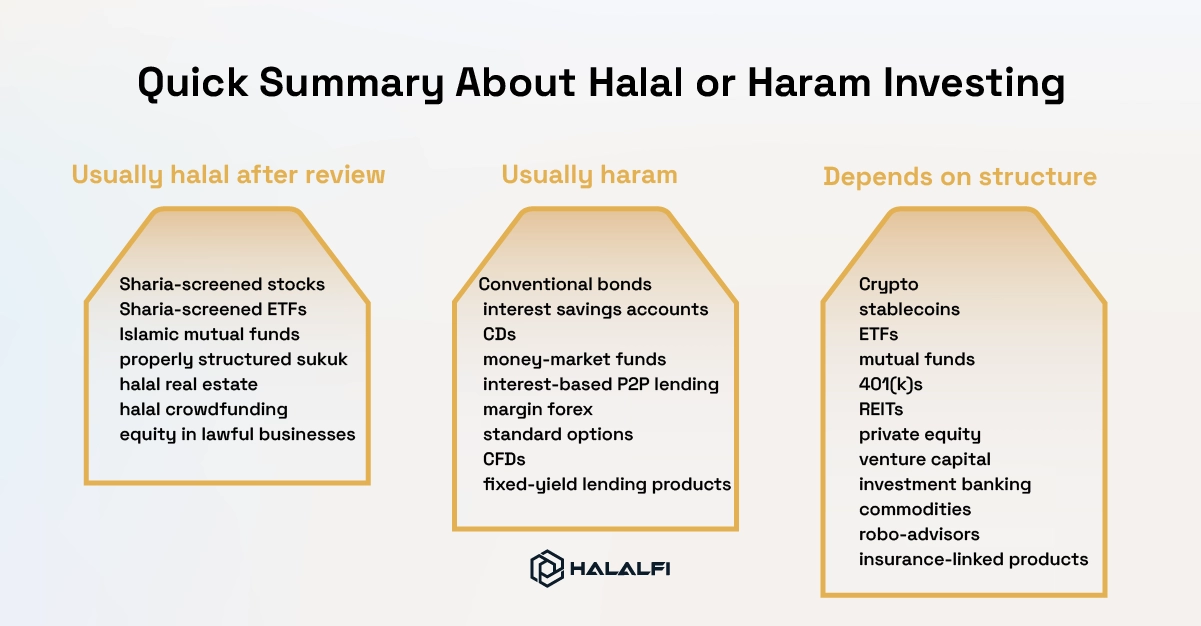
Quick Summary About Halal or Haram Investing
To be brief, we can categorize halal and haram investments as follows.
Usually halal after review: Sharia-screened stocks, Sharia-screened ETFs, Islamic mutual funds, properly structured sukuk, halal real estate, physical gold with valid possession, halal crowdfunding, and equity in lawful businesses.
Usually haram: Conventional bonds, interest savings accounts, CDs, money-market funds, interest-based P2P lending, margin forex, standard options, CFDs, and fixed-yield lending products.
Depends on structure: Crypto, stablecoins, ETFs, mutual funds, 401(k)s, REITs, private equity, venture capital, investment banking, commodities, robo-advisors, and insurance-linked products.
Examples of Halal and Haram by Investment Type
The table below shows how investment types may become halal or haram depending on their structure:
Investment type | When it may be halal | What can make it haram | Example |
Cash savings | You keep money in a non-interest account or a Sharia-compliant cash product. | The account pays fixed interest.t | A normal checking account may be acceptable, but an interest savings account raises RIBA concerns |
Stocks | You buy shares in a Sharia-screened company | The company’s main business involves riba, alcohol, gambling, or other prohibited sectors | A screened healthcare stock may pass, but a conventional bank stock usually does not |
ETFs and mutual funds | The fund holds Sharia-compliant assets | The fund holds bonds, bank stocks, alcohol stocks, or interest-based products | A Sharia-screened ETF may work, but a broad market ETF needs review |
Real estate | You earn rent from a lawful property with fair lease terms | Financing uses interest, or the tenant runs a prohibited business | Renting a home can be halal, but renting a property to a casino creates a problem |
Gold and silver | You own real metal or a valid allocated product | You trade paper contracts, CFDs, or leveraged products without real ownership | Buying physical gold is clearer than trading a gold CFD |
Startup equity | You own part of a lawful business and share real risk | The contract guarantees a fixed profit or hides a loan | Investing in a halal food startup may work, but a fixed monthly “profit” needs review |
Crowdfunding | The campaign funds a lawful project through a clear contract | The platform uses interest-based lending or unclear terms | Funding a trade project can work, but lending money for fixed interest does not |
Crypto assets | You own a reviewed asset with a lawful use case | You use leverage, futures, pump groups, or speculative trading | Holding a reviewed asset differs from betting on a meme token pump |
Forex | You exchange currencies on a real spot basis with possession | You use margin, leverage, swaps, or delayed settlement | Exchanging dollars for travel can be halal, but leveraged retail forex often raises Sharia concerns |
Does Holding Period Make an Investment Halal or Haram?
An investment does not become halal or haram only because you hold it for a short or long time.
A stock held for two weeks can be considered halal if the company, contract, and trading method comply with Sharia rules.
A stock held for ten years can still be haram if the company earns its main income from alcohol, gambling, interest-based lending, or another prohibited activity.
So, time matters, but it does not decide the ruling. What matters more is the structure. You should ask:
What do I own?
Where does my money go?
Does the income come from real trade, rent, ownership, or business activity?
Does the investment involve interest, gambling, extreme uncertainty, or prohibited sectors?
The holding period affects behavior. That is where many problems begin. A short-term investor may trade too often, follow rumors, use leverage, or chase fast price moves. These habits can turn investing into speculation.
For example, buying a token solely because social media says it may “pump” tomorrow looks more like gambling than patient ownership.
A long-term investor usually has more time to study the business. They may review the company, understand its products, check its debt level, and hold it as part of a real ownership plan. This approach may better fit Islamic finance, but it still needs screening.
Long-term does not automatically mean halal. Short term Investment does not automatically mean haram.
What Is the Best Halal Investment?
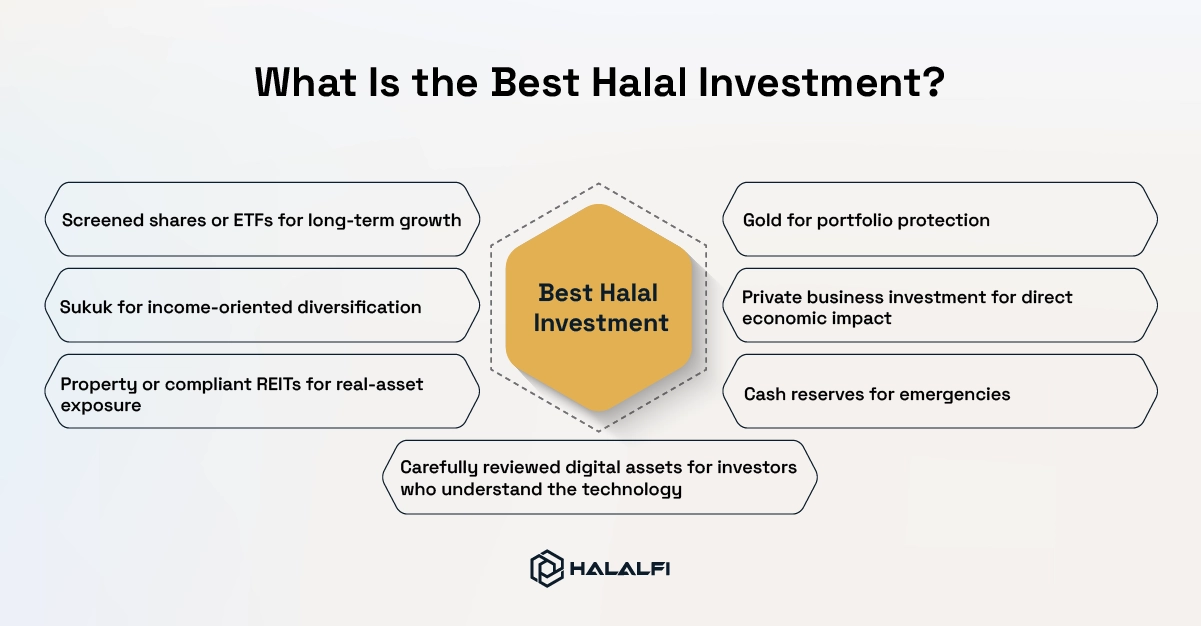
There is no “best” option. The better question is: Which halal investment matches the goal, risk tolerance, knowledge, liquidity needs, and timeline?
For the answer, we should say that a balanced approach may include:
Screened shares or ETFs for long-term growth
Sukuk for income-oriented diversification
Property or compliant REITs for real-asset exposure
Gold for portfolio protection
Private business investment for direct economic impact
Cash reserves for emergencies
Carefully reviewed digital assets for investors who understand the technology
Is investing in HalalFi Halal?
The answer depends on how the platform operates, not on what it is called. In Islamic finance, scholars examine the funding structure, contracts, business activities, and sources of profit before reaching conclusions.
HalalFi is a Sharia-compliant crowdfunding platform connecting conscious investors with real, cash-flowing businesses.
HalalFi’s proposed structure avoids a guaranteed interest payment. Investors receive an agreed share of actual performance rather than lending money at a fixed rate. That is closer to risk sharing than a fixed profit promise disconnected from revenue.
HalalFi also aims to reduce excessive uncertainty by establishing documented funding goals, business verification, team identification, smart contracts, timelines, and publicly visible transaction records.
Rather than centering the model on meme coins, leveraged perpetuals, or zero-sum price games, the platform focuses on companies with operating and cash-flow capabilities.
Final Takeaway: Halal Investing Starts With the Structure
Investing can be halal, whether it involves stocks, property, gold, sukuk, retirement accounts, or private businesses.
The name of the product offers only the first clue. The source of revenue, contract structure, ownership, debt, transparency, and investor behavior determine the fuller picture.
For those exploring values-aligned funding beyond conventional markets, HalalFi offers a new way to examine how a crypto crowdfunding platform could connect faith, measurable impact, and commercial profit without turning investing into a casino.
Frequently Asked Questions
Can dividends from a partly non-compliant company become halal through purification?
Some Sharia screening methodologies allow limited incidental non-permissible income and require investors to donate the relevant portion of dividends.
Is day trading automatically haram?
Not automatically, but frequent day trading can involve speculation, unclear ownership, leverage, margin interest, and mayhem-like behavior.
Can a Muslim invest in a startup that has not yet made a profit?
A startup can qualify if its activities and contracts comply with Sharia. Lack of current profit does not make it haram.
Is an employer’s company stock halal inside a retirement plan?
It depends on the employer’s core activity and financial screening results. Employees should also avoid investing too much of their retirement wealth in a single company, even if that company passes a Sharia screen.
Does a Sharia certificate guarantee that an investment will make money?
No. A certificate assesses religious compliance using a stated methodology. It does not guarantee business quality, market performance, liquidity, cybersecurity, or protection from loss.
Can zakat apply to an investment portfolio?
Yes, but the calculation can vary depending on the asset, investment intention, ownership period, and the scholarly method used.
Is crowdfunding halal when a platform charges fees?
A transparent fee for a genuine platform, audit, agency, or administrative service can be permissible.