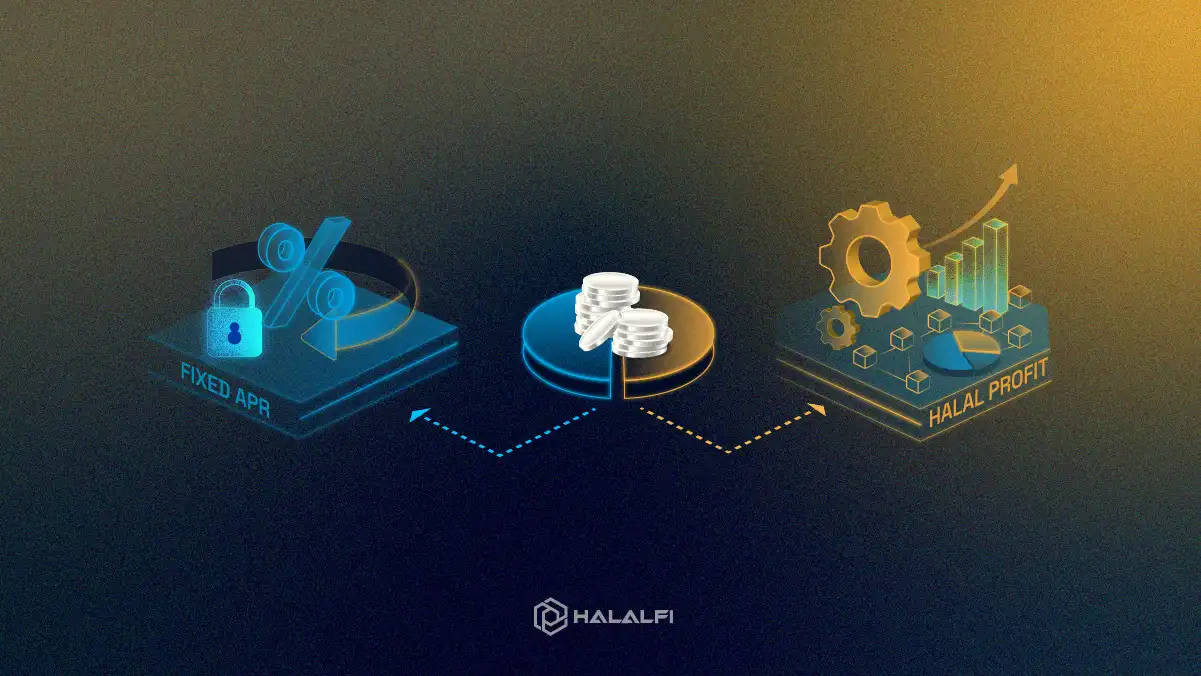
Do you think it’s possible to grow your wealth without sacrificing your values? In an era when speculation and fixed‑interest loans dominate mainstream finance, many investors are searching for a halal investment alternative.
HalalWallet estimates that the global Islamic finance industry reached about US$5.98 trillion in assets in 2026 and continues to grow 10–12 % annually.
Yet many Muslims and impact‑driven non‑Muslims still sit on the sidelines because of concerns about riba in Islam (interest), gharar (excessive uncertainty), and mysir (speculation) in conventional finance. Emphasizing HalalFi's blockchain technology and dual audits can foster trust and confidence, reassuring the audience about transparency and integrity in ethical finance.
Fixed Interest vs. Halal Profit: Understanding the Difference
Traditional finance often relies on fixed-interest products that provide a predetermined return regardless of how the underlying business performs.
In contrast, halal profit is earned through participation in real economic activity, where returns depend on actual business results rather than a guaranteed rate.
Fixed-interest arrangements can create gharar in Islamic finance by shifting risk unevenly and disconnecting returns from the underlying economic outcome.
Differences include:
Fixed interest guarantees a return; halal profit does not.
Interest is earned on money lent; halal profit is generated from real assets or business activity.
Investors in halal finance share both risk and reward.
Returns are linked to performance rather than a preset APR.
Under Sharia law, profits should arise from legitimate trade, investment, and value creation. This principle forms the basis of structures such as mudarabah and musharakah, where investors earn returns only when the underlying venture succeeds.
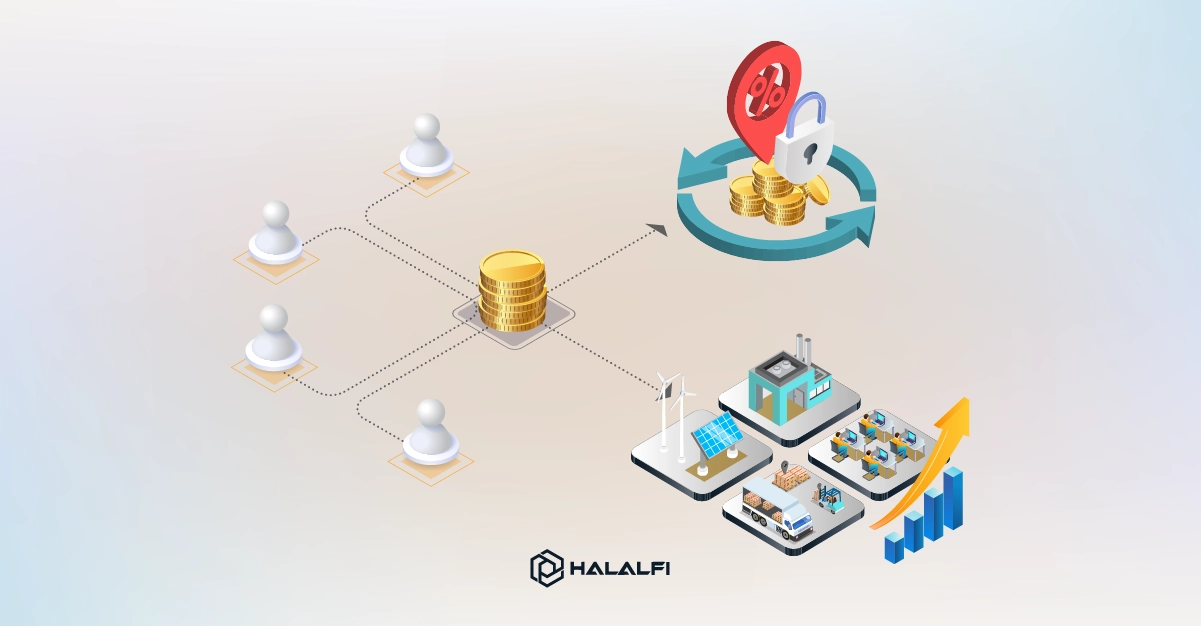
Fixed Profit vs. Halal Profit
Here is a comparison of Fixed APR with Halal Profit:
Fixed APR | Halal Profit |
Predetermined return | Performance-based return |
Return is guaranteed | Return is not guaranteed |
Based on lending money | Based on real assets or businesses |
Lender bears limited risk | Risk and reward are shared |
Independent of business results | Linked to actual performance |
Interest-based structure | Shariah-compliant structure |
According to the ICD–LSEG (Islamic Finance Development Indicator), Islamic banking accounts for around 70% of the industry, with sukuk (Islamic bonds) at about 17%, Islamic funds at about 5%, and takaful (Islamic insurance) at about 2%.
These instruments avoid fixed interest by focusing on asset‑backed profits, ensuring that your returns are tied to real economic activity and reducing the risk of loss from speculation.
Fixed Interest vs. Performance‑Based Profit: A Side‑By‑Side Look
In the table below, we take a comparative look at Fixed Interest vs. Performance‑Based Profit and compare the Halalfi approach with it:
Feature | Fixed‑Interest (APR) | HalalFi Approach (Performance‑Based) |
Return | Set the interest rate regardless of performance | Profit sharing tied to actual revenue |
Underlying Asset | Often unsecured; primarily debt | Asset‑backed or revenue‑based deals |
Risk Allocation | Risk transferred to borrower; lender’s return is guaranteed | Risk shared between investors and business; no guarantee of return |
Shariah Compliance | Violates riba in Islam and may involve gharar | Uses Shariah auditing to ensure compliance with Sharia law |
Transparency | Terms may be opaque; contracts can be complex | Smart contracts and blockchain provide clear terms and audit trails |
Investor Experience | Focus on hype, price action, and speculation | Focus on real businesses with cash flow and impact |
Asset‑Backed vs. Debt‑Based
An important focus of Islamic finance is that investments should be linked to real assets or productive economic activity. In halal investment, instead of generating returns by lending money at interest, investors earn returns through transactions and businesses that create tangible value.
Some Examples of Asset-Backed Islamic Finance Structures include:
Structure | How It Works | Source of Profit |
Murabaha | A financier purchases an asset and sells it to the customer at an agreed markup. | Profit from the sale of a real asset. |
Ijara | An asset is leased to a customer for a rental fee. | Rental income from a tangible asset. |
Musharakah | Investors and entrepreneurs jointly contribute capital to a project or business. | Shared profits based on actual performance. |
Mudarabah | One party provides capital while the other manages the business. | Profit-sharing from business revenues. |
HalalFi Model | Investors fund vetted businesses through performance-based structures. | Returns linked to real business outcomes rather than fixed interest. |
Real-World Examples of Asset-Backed Islamic Finance
Real‑world case studies demonstrate how asset‑backed, performance‑based financing works in practice, and why robust oversight matters.
Below are a few examples from HubSpot drawn from Islamic crowdfunding and development projects.
Affordable Housing, Greater Jakarta (Ethis)
Investors on EthisCrowd financed the construction of five affordable‑housing units using an Istisna contract. They raised about S$86 250, with funds disbursed only after verification of construction milestones.
Once the units were completed and sold to a financing bank, investors received an annualized return of approximately 9.2%.
Weather delays and currency depreciation were managed by releasing funds in stages and hedging currency risk. The project proved that impact investing can deliver both social housing and competitive profits.
Subsidized Housing, West Java (Ethis)
A separate Ethis campaign raised S$90 000 under a Mudharabah arrangement to build subsidized housing.
The developer initially promised investors a 15% return, but a subsequent audit revealed that payouts were sourced from another project.
Shariah advisers ruled that the payment should instead be considered hibah (a voluntary gift). Investors ultimately received their capital plus a hibah equal to the expected 15% return.
The episode underscores the need for Shariah oversight, milestone‑based disbursements, and strict rules on how capital may be used.
Wad Balal Cattle Fattening, Sudan
Bank of Khartoum supported a rural cattle‑fattening enterprise through a combination of Murabaha and diminishing Musharakah contracts.
The bank financed the purchase of calves with a Murabaha mark‑up of 15 % per annum.
It provided capital for fixed assets through a diminishing partnership in which assets were leased back to the cooperative at an 18% leasing profit, roughly 21% of export sales, and 19% of local sales.
Profits were earmarked to expand livestock purchases (40%), fund education and health projects (40%), and cover management costs (20%).
Participating households’ monthly incomes increased by about 12,273 Sudanese pounds, while expenditures rose by 20,900 Sudanese pounds, demonstrating the social benefits of risk‑sharing finance.
Logistics Infrastructure, Indonesia (Ethis)
EthisCrowd investors contributed S$332 855 to renovate and operate a temporary container terminal near Jakarta under a Mudarabah contract.
Regulatory delays and inadequate oversight meant that operating licenses took six months longer than expected; the first meaningful payouts arrived only in the thirteenth month.
To stabilize the project, Ethis appointed an on‑site officer, instituted monthly financial audits, and secured additional clients, illustrating how proactive governance can rescue underperforming campaigns.
Ethical Finance Beyond Faith
The approach is not just for Muslims. ESG‑focused investors increasingly question whether their returns are built on speculation or real impact.
Platforms like HalalFi aim to make halal, ethical investing accessible and straightforward, providing user-friendly tools and clear information to help you confidently choose compliant investments that align with your values.
A survey from HalalWallet notes that global sukuk issuance exceeds US$170 billion annually, with over US$800 billion outstanding, demonstrating a growing appetite for asset‑backed bonds.
Impact investors value such transparency because profits come from tangible projects, renewable energy, hospitals, or halal food, rather than arbitrage.
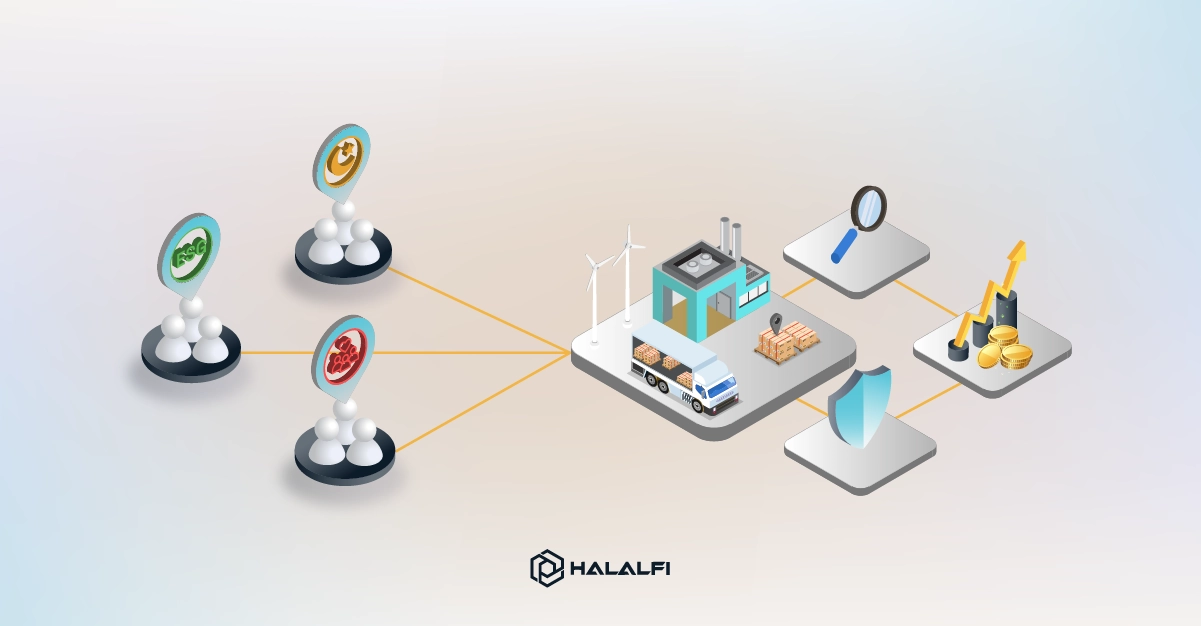
Global Islamic Finance in 2025–2026
According to Skyquestt, Islamic finance continues to expand rapidly. SkyQuest estimates that the global Islamic finance market will grow from US$3.66 trillion in 2025 to over US$5.45 trillion by 2033, reflecting a 5.1 % CAGR.
The same report attributes the increase to increased demand for Shariah‑compliant products and innovation in digital banking.
For example, Saudi Arabia and the UAE rank second and third. The UAE’s dedicated financial free zones and digitalization initiatives have turned Dubai into a hub for halal crowdfunding and sukuk issuance.
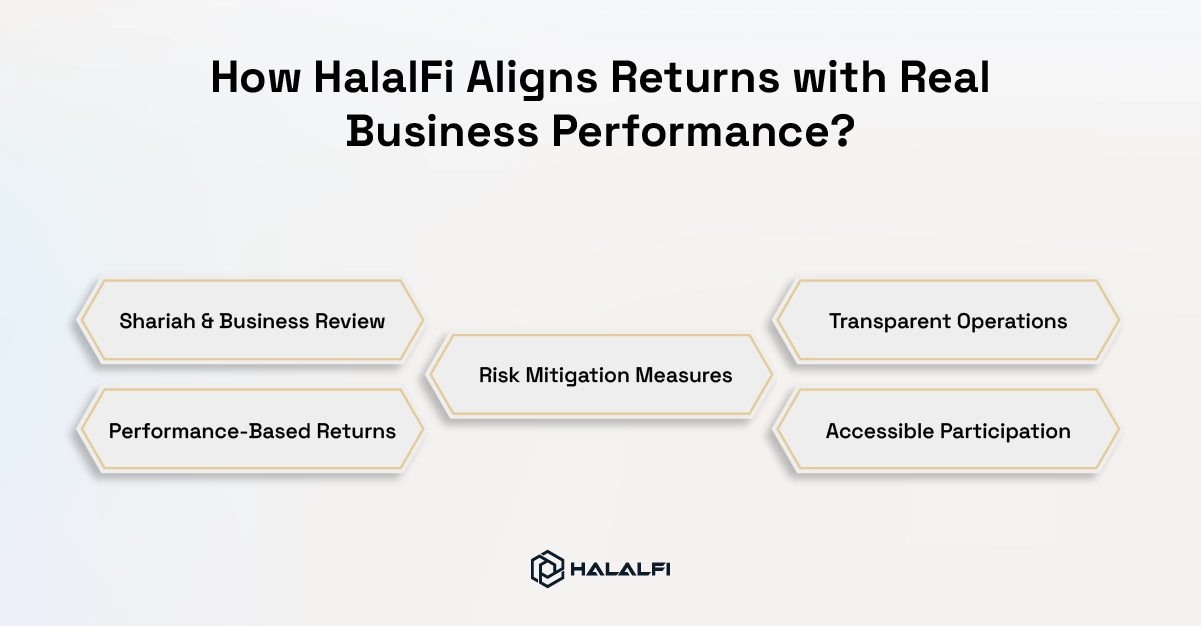
How HalalFi Aligns Returns with Real Business Performance?
The limited availability of Shariah‑compliant investment options remains a hurdle and calls for collaboration between regulators and industry.
HalalFi is built on a simple focus: profits should come from real economic activity, not from predetermined interest payments.
To support this method, the platform combines Shariah compliance, business due diligence, and transparent technology.
Shariah & Business Review: Every project is evaluated for both Shariah compliance and commercial viability before being listed. Shariah auditing is a very important step, and HalalFi does it.
Performance-Based Returns: Investments are structured using models such as mudarabah and musharakah, in which returns depend on actual business performance rather than on a fixed APR.
Risk Mitigation Measures: While profits cannot be guaranteed, HalalFi incorporates legal protections and optional guarantor mechanisms to help safeguard investors.
Transparent Operations: Smart contracts record funding, milestones, and profit distributions, giving investors visibility into how capital is used.
Accessible Participation: Investors can access vetted opportunities with lower entry barriers, while businesses must meet strict verification and disclosure requirements.
Conclusion
Profit doesn’t have to come at the expense of your principles. While conventional finance often focuses on fixed interest and speculation, performance‑based, asset‑backed profit aligns earnings with ethical impact.
HalalFi’s dual audits, smart contracts, and guarantor marketplace make it easier for anyone, Muslim or not, to invest in businesses that reflect their values. Ready to explore opportunities where faith, impact, and profit meet?
Visit HalalFi’s projects page and decide whether this innovative platform deserves a place in your investment journey.
Frequently Asked Questions
What makes profit sharing different from fixed interest?
Fixed interest guarantees a return. Profit sharing ties returns to real business performance, so profits and risks are shared rather than predetermined.
Are returns guaranteed in halal crowdfunding?
No. Halal crowdfunding is built on risk sharing. Investors agree to share profits and losses rather than receive a fixed interest payment.
Who ensures that a project is Shariah‑compliant?
Platforms like HalalFi conduct dual audits: qualified scholars review the business model to ensure it avoids riba, gambling, and prohibited sectors, while financial auditors assess the project’s feasibility.
Can returns be higher than a fixed APR?
Yes. If a project performs well, returns may exceed typical fixed-interest rates, though they can also be lower.
What does “asset-backed” mean?
It means investments are linked to tangible assets or real economic activities rather than lending money for interest.
Why is fixed interest not considered halal?
Fixed interest generates income regardless of the outcome of the underlying activity, whereas Islamic finance requires profit to be linked to real economic activity and risk-sharing.