
Can your money grow without compromising your beliefs? For many Muslims, that question comes up every time investing enters the conversation.
The reality is, most conventional options don’t quite fit. Interest-based returns, heavy speculation, and vague financial structures are hard to avoid, and harder to justify.
That’s where Shariah-compliant investing offers a different path. It’s about how that profit is made. The focus shifts to fairness, transparency, and real economic activity. There is no interest, no excessive uncertainty, and no involvement in harmful industries.
This means choosing investments that align with clear ethical guidelines while still allowing your wealth to grow steadily.
It may take a bit more thought, sure, but it also brings peace of mind. That balance between financial growth and staying true to your values is what makes it worthwhile.
What Are Shariah Compliant Investments?
Shariah-compliant investments follow Islamic guidelines on what is halal (permissible) and haram (forbidden).
Shariah, which means “a clear path,” shapes how Muslims approach everyday life, including their handling of money. When it comes to investing, it provides a framework for making ethical and responsible financial choices.
This means avoiding interest-based earnings and industries considered harmful, while focusing on fairness, transparency, and real economic activity. Investments must be tied to tangible assets or genuine business efforts.
This is where things start to feel different from conventional finance. Instead of fixed interest, investors share in actual profits and losses. There’s a sense of participation, not just passive gain.
For many, it’s more than a financial strategy; it’s a way to grow wealth without losing sight of personal values.
Standard Chartered suggests that total Islamic finance assets could climb to $7.5 trillion by 2028 and even approach $9–10 trillion by the end of the decade.
Islam, Wealth, and the Basic Ideology Behind Halal Investing
There is a common misconception that Islam discourages wealth creation. But muslims are encouraged to find income, care for property, and expand assets.
Wealth, in this view, is not something shameful. It can support families, strengthen communities, help those in need, and improve the wider economic position of Muslims.
According to Riwayat al- Baihaqi (10983), Prophet Muhammad PBUH once said:
ابتغوا في مالِ اليتيمِ، أو في مالِ اليتامى لا تُذهِبُها أو لا تَستَهْلِكُها الصدقةُُ
This means idle wealth can shrink, but productive wealth can serve a purpose. That gives Halal Investment its deeper meaning. It is not merely about avoiding prohibited sectors. It is about stewardship.
In broad terms, the requirements for being halal in finance include:
Avoiding Riba in Islam, or interest
Avoiding gharar in Islamic finance, meaning excessive uncertainty
Avoiding mysir in Islamic finance, or gambling/speculative behaviour
Avoiding businesses connected to haram sectors
Ensuring transparency and fairness in the transaction
Structuring returns in a permissible way, often through shared risk or ownership
These principles sit at the core of Shariah law in finance and explain why Shariah-compliant investments are often described as both faith-based and socially responsible.

Important Terms Every Investor Should Know
One reason this subject can feel intimidating is the terminology. Let’s make it simpler.
Term | Meaning | Why It Matters? |
Riba | Interest | Prohibited in Islamic finance |
Husna | A godly loan where the same amount is returned | No wealth is generated through interest |
Mudharabah / Mudarabah | Profit-sharing contract | One party provides funds, another provides expertise |
Ujrah | Fee paid to an agent or service provider | Used in certain halal arrangements |
Wakalah | Agent-principal contract | Allows an agent to provide services for a fee |
Sukuk | Investment certificate representing ownership in assets | Often called Shariah-compliant bonds |
Gharar | Excessive uncertainty | Avoided in halal financial structures |
Mysir / Maysir | Gambling or speculative gain | Prohibited under Shariah |
These terms are more than jargon. They shape how real products are designed to be.
For example, wakalah can support service-based investment arrangements. At the same time, murabaha and musharakah are often part of the broader vocabulary of Islamic finance, particularly when people compare trade-based and partnership-based models.
Likewise, any investor exploring Shariah audit processes or Islamic fintech platforms will quickly come across these concepts.
What Makes an Investment Halal?
A halal investment is not judged solely by branding. It is judged by substance. Anything discouraged or banned by Shariah is considered haram, while activities deemed suitable are halal.
Mufti Taqi Usmani says in his book “فقه البيوع” says:
“الأصل في المعاملات الإباحة، إلا ما دل الدليل على تحريمه.”
“Islamic finance is not merely about avoiding interest; it is about establishing justice.”
In investing terms, that means an investment should not involve or materially support prohibited sectors such as:
Conventional finance
Alcohol
Pork-related products and non-halal food production, packaging, or processing
Gambling
Adult entertainment
Tobacco
Weapons and defence
This screening process is one of the defining features of Islamic finance. A company may look profitable on paper, but if its business activities conflict with Islamic values, it would be excluded from a Shariah-compliant fund.
There are also accounting and financial-screening rules. According to LSEG, companies must generally maintain a debt-to-equity ratio below 33%, which tends to filter out heavily leveraged businesses.
It also states that halal-compliant companies must generally have accounts receivable and cash of less than 50% of total assets.
Related Article: Halal Investing for Beginners
Standards of Shariah Compliant Investments
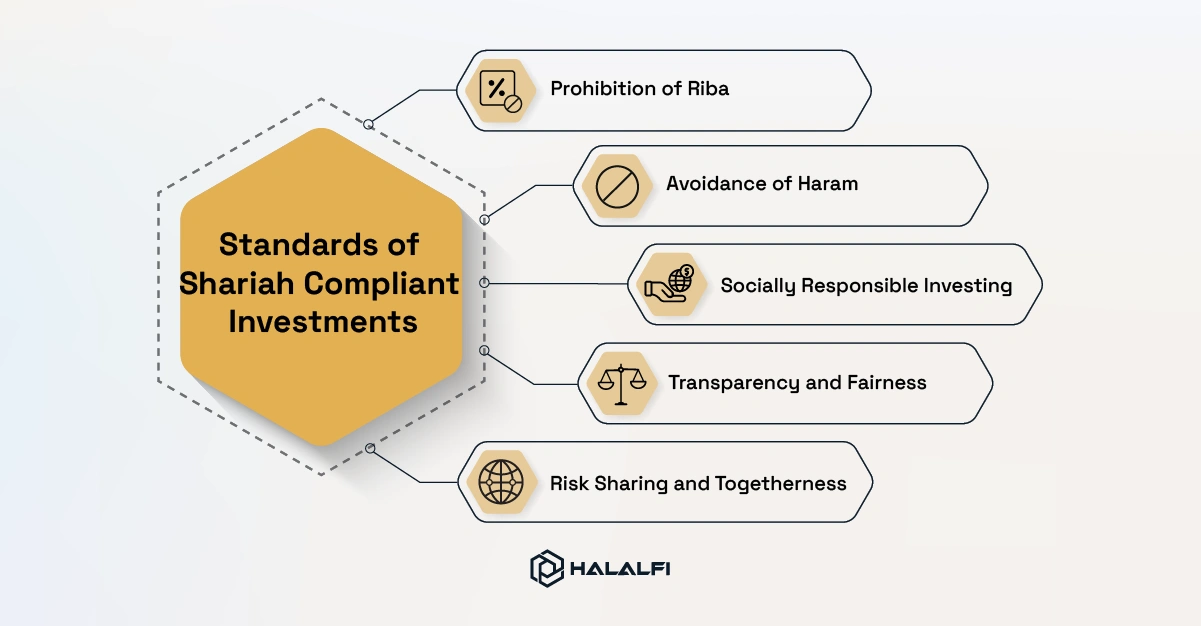
The core standards of Shariah Compliant Investments include:
1. Prohibition of Riba
Riba is the Islamic term for interest, and it is prohibited. This is one of the best-known rules in Shariah finance and one of the most misunderstood.
In conventional finance, interest is often treated as normal, even inevitable. In Shariah-compliant investments, it is not. That is why conversations around Riba in Islam are so central to this subject.
2. Avoidance of Haram
The second principle is avoiding haram activities and sectors. In social investment contexts, this includes not only interest-bearing agreements but also investments tied to gambling, alcohol, weaponry, and certain meat-based trading.
This is where Shariah-compliant investing overlaps with broader ethical investment thinking. Both care about where money goes. Both care about consequences. The difference is that Islamic investing applies a distinct faith-based legal framework.
3. Socially Responsible Investing
Shariah investing naturally lends itself to social investment because it emphasises both financial return and social impact. That’s one reason Sharia-compliant finance appeals beyond Muslim communities.
4. Transparency and Fairness
For repayable finance to be halal, transparency and fairness must be visible at every stage of the investment process. This is not optional. It is part of permissibility.
In real life, this can require organisations to rethink how they communicate fees, profit-sharing, and the cost of capital for businesses entering this space.
5. Risk Sharing and Togetherness
Social investment, by its nature, adopts Mudharabah or Mudarabah, in which profit, loss, and risk are shared among stakeholders.
This reflects the Islamic value of togetherness. No one party should gain at the unfair expense of another.
Shia and Sunni Perspectives on Shariah-Compliant Investments
There isn’t a single, universal rulebook for Shariah-compliant investing, and that’s important to understand early on.
While both Sunni and Shia traditions broadly agree on key principles like avoiding riba (interest), staying away from haram industries, and maintaining ethical responsibility, the details can differ in practice.
Where things get interesting is in interpretation. Different scholars and Shariah boards may assess the same financial structure in slightly different ways.
That’s why two funds can both be labelled “Shariah-compliant” while applying different screening criteria.
A simple example: some Shia scholars have raised concerns about certain types of sukuk (Islamic bonds), particularly those that closely replicate conventional debt structures or guarantee fixed returns. They may view these as too similar to interest-based instruments.
On the other hand, according to the World Bank, many Sunni scholars accept widely used sukuk structures, such as ijarah sukuk, as long as they are backed by tangible assets and structured on a profit-sharing basis rather than interest.
Another example is that some Sunni scholars are more flexible on certain equity screening thresholds, such as allowing a small percentage of non-compliant income in a company.
In contrast, according to guidance attributed to scholars such as Ayatollah Sistani, some Shia guidelines can be stricter on financial ratio screening or purification requirements.
None of this is a flaw; it’s how faith-based legal reasoning naturally works. So, when it comes to halal investment options, don’t rely on labels alone. Read the fund’s methodology, check who sits on the Shariah board, and make sure their approach aligns with your own beliefs.
How the Shariah Screening Process Works?
Shariah screening generally has two layers.
Qualitative Screening
This looks at the company’s business activities. If a significant part of its revenue comes from non-compliant sectors such as gambling or alcohol, it fails the screen.
Quantitative Screening
This looks at financial ratios and accounting metrics:
Debt-to-equity ratio below 33%
Accounts receivable and cash are generally below 50% of total assets
Together, these filters help create a cleaner investment universe. They are not perfect, and they do not remove every grey area, but they do establish a disciplined framework.
This is also where Shariah audit and ongoing review become important. Since businesses evolve, compliance is not a one-time stamp. It needs monitoring. And that’s where Shariah boards come in.
According to Amalinvest, companies like Apple are often classified as Shariah-compliant by major screening providers, but only after passing both screening layers.
Apple’s core business (technology products) is considered permissible, and its financials are reviewed to ensure ratios such as debt and non-compliant income remain within accepted thresholds.
The Role of Shariah Boards, Scholars, and Certification
A Shariah-compliant fund does not simply claim compliance on its own. Such funds have a Shariah board composed of Islamic scholars who decide or review which companies meet the rules.
This board plays a powerful role. It reviews structures, screens investments, and provides oversight. Some organisations, including AAOIFI, are helping set standards for greater consistency in the market.
Still, consistency is not always perfect. Different scholars can interpret rules differently. That can make management more complex and more expensive. This complexity increases costs and can slow decision-making.
It’s a reminder that Islamic finance principles are not only moral ideals. They also require governance. This means investors should pay close attention to:
Who sits on the Shariah board?
How often is compliance reviewed?
Whether prohibited income is purified through charitable donation
How the fund explains its methodology
That level of transparency matters, especially for anyone comparing principal-protected investment structures, equity funds, Sukuk, or newer Islamic fintech offerings.

Types of Shariah Compliant Investments
There isn’t a single model for halal investing; it’s more like a flexible framework with several commonly accepted instruments. Each comes with its own structure, use case, and level of familiarity among investors.
Sukuk (Asset-Based Certificates Designed as a Shariah-Compliant Alternative to Conventional Bonds)
Sukuk are investment certificates that represent ownership in tangible assets or projects. While they’re often described as “Islamic bonds,” the key difference is that returns are linked to asset performance, like rental income or project profits, rather than fixed interest payments.
For example, Ijarah sukuk generate returns through leasing arrangements, which many scholars consider permissible when properly structured.
Equity Investments (Shares in Companies That Pass Shariah Business and Financial Screening Criteria)
Investors can also participate in the stock market by buying shares in companies that meet Shariah requirements.
This involves screening both the company’s core activities (avoiding sectors like alcohol, gambling, or conventional finance) and its financial ratios (such as limiting excessive debt or interest-based income).
In practice, this is one of the most widely used approaches in modern Islamic investing, especially through screened equity funds.
Real Estate (Tangible Property Investments Aligned with Permissible Use and Financing Structures)
Real estate is often seen as a natural fit for halal investing for beginners because it is asset-backed and relatively straightforward.
As long as the property is used for permissible purposes, such as residential or commercial (non-haram) activities, and financed in a Shariah-compliant way, it is generally acceptable.
Many investors appreciate real estate for its stability and clear link to physical assets.
Where Does HalalFi Fit in?
So, where does a platform like HalalFi sit within these categories?
HalalFi is a Sharia-compliant crowdfunding platform that connects investors with real, cash-flowing businesses.
Instead of focusing on speculative trading or fixed returns, it uses performance-based profit-sharing, supported by blockchain transparency, audits, and structured oversight.
Think of it this way: instead of buying a stock on a public exchange or purchasing a sukuk certificate, you’re directly funding a real business that needs capital to grow.
Here’s how it works:
Businesses apply for funding and submit detailed operational and financial data
Each project goes through a dual audit (Sharia compliance + business viability)
Approved opportunities are listed for investors
Investors participate through smart contracts, contributing funds transparently
Returns are generated through actual business performance, not fixed interest
HalalFi doesn’t sit neatly in a single traditional bucket, and that’s kind of the point.
It’s not sukuk, because there’s no fixed-income structure tied to predefined payments
It’s not public equity, because investments are made directly into private businesses
It shares similarities with real estate or private equity, especially in its focus on tangible, cash-flowing assets
You could think of it as a hybrid model that combines elements of equity investment, profit-sharing partnerships, and modern crowdfunding infrastructure.
Read More: How HalalFi Is Different from Other Crowdfunding?
Shariah-Compliant Mutual Funds and ETFs
These funds pool money from multiple investors and invest in a range of compliant assets. They offer diversification and are often one of the most accessible ways to start.
Let's see some examples:
HSBC Islamic Global Equity Index Fund
iShares MSCI USA Islamic UCITS ETF
iShares MSCI World Islamic UCITS ETF
iShares MSCI Emerging Markets Islamic UCITS ETF
Trust Funds and ETFs
Trust funds are actively managed based on the fund manager’s objective and skill. ETFs, by contrast, are passively managed and try to mimic an index.
Takaful-Linked Structures
In takaful protection plans, contributions may be divided into funds such as a tabarru fund, a wakalah fee, and a Shariah-compliant investment account. That makes takaful relevant not just for protection, but as part of a broader financial ecosystem.
Sharia-Compliant Crowdfunding Platforms
A newer category of Shariah-compliant investments has emerged through crowdfunding platforms designed for ethical capital allocation.
Platforms like HalalFi are exploring how modern technology and Islamic fintech can connect investors directly with real businesses while maintaining strict compliance with Islamic finance rules.
HalalFi, for example, is a Sharia-compliant crowdfunding platform that allows investors to support cash-flowing businesses using performance-based profit sharing rather than fixed interest.
Instead of relying on traditional lending models, the platform focuses on partnership-style financing aligned with structures such as Mudarabah and Musharakah.
By combining crowdfunding with decentralised governance and transparent verification, platforms like HalalFi represent an emerging evolution of halal investment options.
They allow investors to participate in the growth of real-world businesses while maintaining alignment with Islamic values.
In contrast to many speculative financial products, the emphasis is placed on real economic activity, verified business performance, and ethical capital deployment.
Shariah Compliant Funds vs Conventional Funds
Here’s where the difference becomes clearer.
Feature | Shariah-Compliant Funds | Conventional Funds |
Interest-based income | Prohibited | Common |
Sector exclusions | Alcohol, gambling, tobacco, weapons, etc., are excluded | Often included |
Shariah board oversight | Required or expected | Not required |
Debt screening | Generally stricter | Usually not faith-based |
Profit model | Ownership, trade, risk-sharing | May include interest and broader speculation |
Ethical basis | Islamic law and values | Varies by manager or fund mandate |
This comparison matters because many investors assume the difference is only about religion. It is also about structure, governance, and risk philosophy.
And yes, there can be performance implications. Excluding financials, such as banks,s can significantly affect returns because those sectors often make up a large portion of broader market indices.
Shariah-screened portfolios often show a sectoral bias toward healthcare and information technology. That’s not a small detail. It shapes the investment profile in very practical ways.
Steps for Choosing the Right Shariah-Compliant Investment
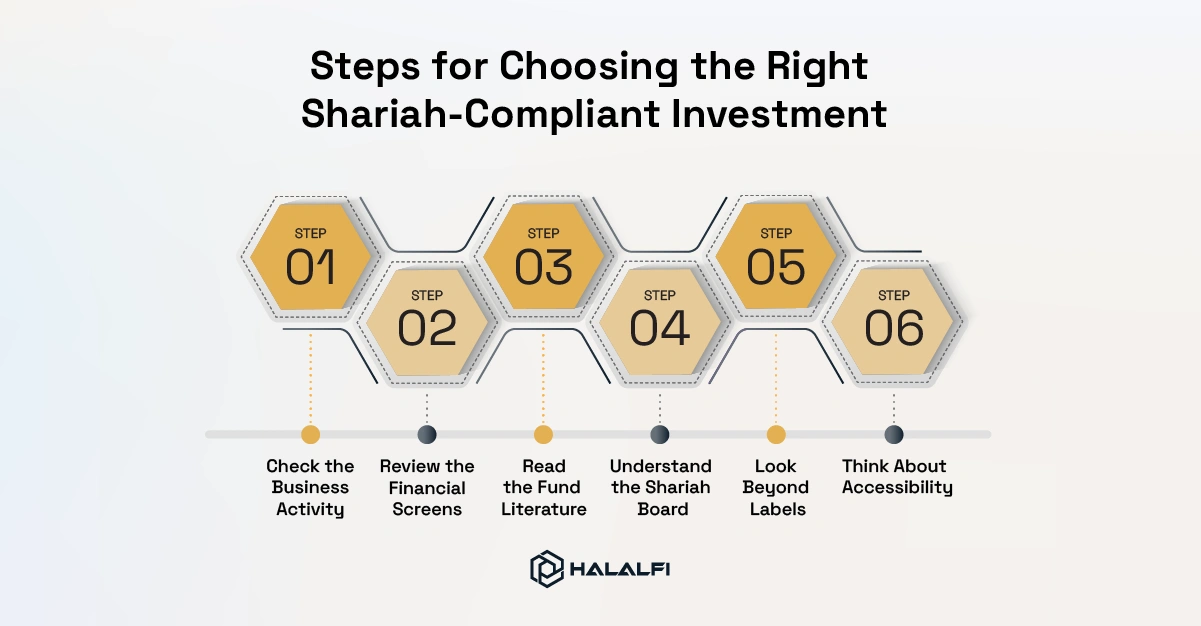
If someone is just starting, the process can feel complicated. But it becomes manageable when broken down. Follow these steps for choosing the right shariah-compliant investment:
Check the Business Activity: Does the company or fund avoid haram sectors? Visit the company’s website or fund overview and check what they actually do. Look at their primary source of revenue and make sure it doesn’t involve prohibited industries such as gambling, alcohol, or conventional finance.
Review the Financial Screens: Does it meet the debt and asset thresholds described in the screening process? Look at financial reports or summaries (often in the fund factsheet). Check if debt levels are reasonable (typically below 33%) and ensure the company isn’t heavily reliant on interest-based income.
Read the Fund Literature: Your material recommends reviewing the prospectus and other fund documents to ensure they align with your own principles. Download and skim the prospectus or Key Information Document (KID). Focus on how profits are generated, how risks are managed, and whether the structure avoids interest costs.
Understand the Shariah Board: Who oversees compliance? How transparent is the methodology? Check if the fund or platform has a Shariah advisory board. Look at who the scholars are and whether they regularly review and certify the investment.
Look Beyond Labels: Words like “Islamic,” “Shariah,” “Sukuk,” and “murabaha” can be useful indicators, but investors still need to verify the structure and policy. Dig deeper into how the investment actually works, especially how returns are generated.
Think About Accessibility: Some halal funds may have high minimums or limited access, particularly for private investors in the UK. That makes platform choice usability important. Check minimum investment amounts, platform access, fees, and ease of use. Choose platforms that make investing simple, transparent, and aligned with your needs.
Common Misconceptions About Shariah Compliant Investments
Some misconceptions about Shariah Compliant Investments include:
Shariah-Compliant Investing Is Only for Muslims
This one comes up a lot. But the ethical focus of Shariah investing attracts both Muslims and non-Muslims. That makes sense. Plenty of investors want to avoid sectors like gambling, tobacco, or weapons, no matter what their motivation is, not religious.
Islamic Finance Does Not Care About Profit
This is another big one. Some people assume Islamic investing is purely charitable or unconcerned with return. That is not true. Much like social investment, Islamic finance considers both profit and social return.
That balanced approach is one reason the category continues to grow. It does not force investors to choose between values and performance as if those two things can never coexist.
Benefits of Shariah Compliant Investments
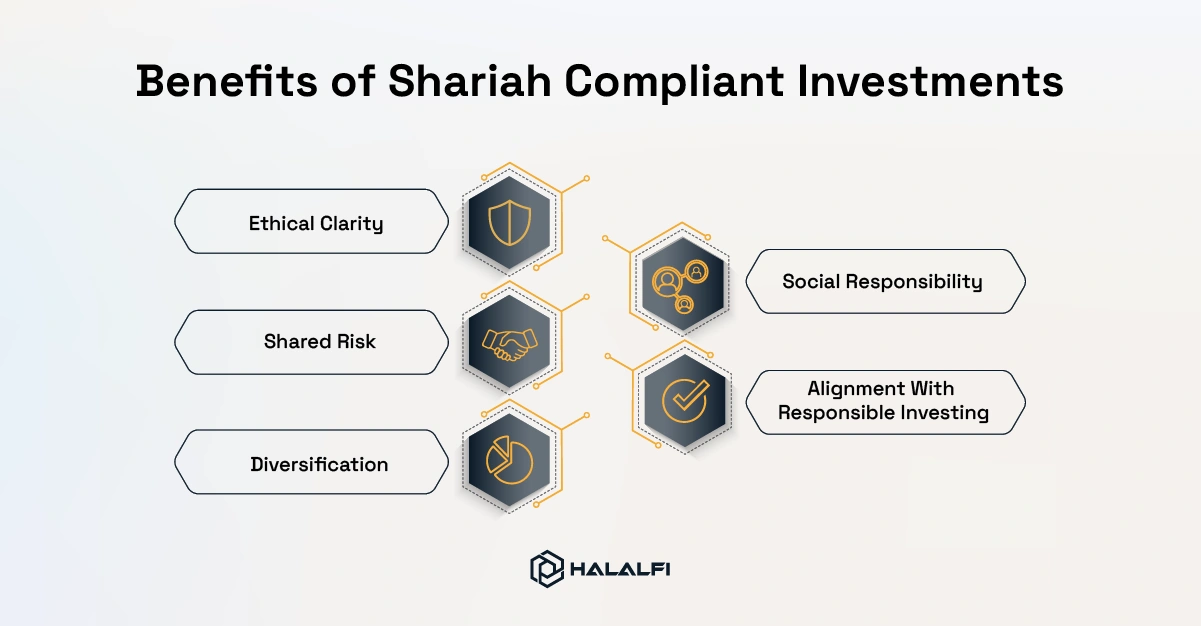
The benefits are not only theological, but they are also practical:
Ethical Clarity: For Muslim investors, the biggest benefit may simply be confidence that their financial choices align with faith. That is no small thing. Peace of mind has value.
Shared Risk: Because structures such as mudarabah involve profit-and-loss sharing, risk is not unfairly pushed onto one side. That encourages a stronger sense of partnership.
Social Responsibility: Preventing social harm and protecting the individual are important. High-interest lending, for example, is described as impermissible because of the risks of debt, inflation, and concentration of benefit among high-end investors.
Alignment With Responsible Investing: There are clear parallels between Shariah investing and broader responsible investing, including strong corporate governance, environmental stewardship, and societal good.
Diversification: Funds, ETFs, Sukuk, and real estate all give investors different ways to diversify within a halal framework.
Challenges and Limitations Investors Should Know
Still, it is not all smooth sailing; some challenges include:
Shariah investing is still not fully mainstream
Public exposure remains limited in some markets
Regulation may be underdeveloped in certain areas
Compliance requirements can reduce investment choices
Scholar interpretations can differ
Some funds may have high minimum investment thresholds or be difficult for UK private investors to access
This matters because enthusiasm alone is not enough. A good halal investment strategy still requires realistic expectations.
There is another subtle challenge, too: because screening often removes entire industries, investors may end up with concentrated exposure in areas like technology and healthcare. That can help in some market conditions and hurt in others.
So yes, Shariah-compliant investments are compelling. But they are not magic. They require understanding, discipline, and careful product selection.
That’s exactly where structured platforms can make a difference. Instead of leaving investors to navigate fragmented markets, varying interpretations, and limited access on their own, solutions like HalalFi aim to simplify the process through curated opportunities, built-in screening, and clearer participation models.
By lowering entry barriers and providing a more guided environment, they help reduce confusion without removing the need for personal judgment.
It’s not about eliminating these challenges, but about making them more manageable so investors can focus less on navigating complexity and more on making informed, value-aligned decisions.
How Shariah Investing Compares With ESG and Ethical Investment
There is a strong overlap between Shariah-compliant investing and ESG-style ethical investment. Both may exclude harmful sectors. Both may focus on responsible business behaviour. Both may appeal to investors seeking value-aligned finance.
But Shariah investing goes further in some respects because it is not only values-based but also legally and religiously structured. It includes specific prohibitions on interest, screens debt levels, and relies on scholarly oversight.
That means an ESG fund and a halal fund can overlap, but they are not always interchangeable.
Some broader responsible funds may still suit certain investors where values overlap, but Investors should read the Key Information Document, Prospectus, and any sustainability or impact reports carefully.
Why Shariah-compliant investing Matters in the World?
Finance content often feels dry, full of numbers and jargon, but lacking meaning. Shariah-compliant investing is different because it connects money to real-life impact. People aren’t just asking about returns; they’re asking if their investments align with their values.
That’s where platforms like HalalFi help, by simplifying complex ideas and making halal investment options easier to understand. Because let’s be honest, terms like wakalah, mudarabah, or gharar in Islamic finance can feel overwhelming at first.
You don’t need to be an expert. You just need clarity and the right guidance to make confident, value-driven decisions.
How HalalFi Simplifies Shariah-Compliant Investing
HalalFi builds on this need for clarity by turning complex principles into something you can actually use.
Instead of leaving you guessing whether an opportunity aligns with Islamic values, the platform brings Sharia considerations directly into the selection and management of investments.
There’s a built-in layer of both business evaluation and Sharia screening, with a clear focus on real, cash-flowing projects, not abstract ideas or speculative plays that look exciting but lack substance.
What makes a noticeable difference is the transparency. By using blockchain infrastructure and clearly defined participation models, you’re not just “trusting” the system; you can see how funds move, how deals are structured, and where returns come from. That alone removes a big chunk of the uncertainty that keeps many people on the sidelines.
For newer investors, especially, HalalFi doesn’t feel like a typical trading platform. It’s closer to a guided environment, something that helps you make decisions without dumbing things down. You still understand what you’re investing in, but you’re not left alone trying to decode every detail from scratch.
That said, if you really want to understand how the model works, the mechanics behind profit-sharing, the audit process, risk controls, and even the token structure, you shouldn’t stop here. The full picture is in the details.
Take the time to go through the HalalFi whitepaper. It’s where the platform lays everything out clearly:
how projects are vetted, how funds are protected, and how returns are actually generated. If you’re considering putting money into something like this, reading that document isn’t optional; it is the smartest next step.
Read More: What is HalalFi?
The future of Shariah Compliant Investments
This market has been growing. The UK, especially London, is described as a hub for Islamic finance in the West. Malaysia is highlighted for its structured oversight through bodies such as the Securities Commission and the Majlis Penasihat Shariah.
Global assets under management have increased. New funds, indexes, and ETFs have emerged. And the overlap with responsible investing suggests that the category may continue to evolve.
At the same time, growth does not remove the need for caution. This niche remains limited in some respects, and additional layers of rules can affect both access and returns. That tension is healthy and keeps the space disciplined.
Also, it makes educational brands even more important. Investors do not just need more products. They need better explanations.

Conclusion
Shariah-compliant investments are more than a niche corner of finance. They are a disciplined approach to wealth building rooted in faith, ethics, fairness, and accountability.
They prohibit interest, avoid harmful sectors, emphasise transparency, and often rely on shared risk rather than one-sided gain. For some investors, that is a religious necessity. For others, it is a compelling ethical framework. For many, it is both.
This market has been growing, quietly at first, then all at once. A decade ago, Islamic finance was still often described as “niche.” Today, that label feels outdated.
There are still challenges. Choices can be narrower. Interpretation can vary. Access can be uneven. But the direction is clear: this is a serious and growing area of modern finance, with room for funds, ETFs, real estate, Sukuk, takaful-linked structures, and other forms of Sharia-compliant finance.
If you’re serious about growing your wealth without compromising your values, it’s time to move from learning to action.
HalalFi gives you direct access to vetted, real-world businesses built on profit-sharing, not interest, so your money works in a way that truly aligns with your beliefs.
Don’t just understand halal investing, start investing with purpose. Explore HalalFi today, review live opportunities, and take your first step toward building ethical, Shariah-compliant wealth with confidence.
Frequently Asked Questions
Are Shariah-compliant investments always low risk?
No. They are structured to meet Islamic principles, but they still entail market, business, and product-specific risks. Compliance does not guarantee profit.
Can non-Muslims invest in Shariah-compliant funds?
Yes. The ethical focus of these investments attracts both Muslims and non-Muslims.
Why are banks often excluded from Shariah-compliant funds?
Conventional banking is largely interest-based, and interest is prohibited under Shariah principles.
Do all Shariah scholars agree on every investment product?
No. Different scholars and advisory boards can interpret certain issues differently, which is why investors should review the prospectus and methodology carefully.
Are Shariah-compliant funds only about avoiding haram sectors?
No. They also involve rules around financial ratios, governance, transparency, and the structure of returns.
Is halal investing profitable?
Yes, it can be. Shariah-compliant investments aim to balance ethical responsibility with financial returns. While they avoid certain sectors, many halal funds and assets have shown competitive performance over time.
How can you verify if an investment is truly Shariah-compliant?
Start by checking whether a Shariah board has reviewed the investment. Look at the fund’s prospectus, screening criteria, and financial ratios. Some platforms also include Shariah audits to ensure ongoing compliance.