Money moves quietly. It pays salaries, builds homes, and funds businesses. Sometimes, it also supports things people never intended to support.
But can wealth grow without compromising values?
For millions worldwide, Islamic finance offers a system rooted in fairness, real economic activity, and ethical responsibility, fostering trust and confidence.
And today, the system is no longer confined to Muslim-majority countries.
By combining Islamic finance with blockchain transparency and real-world business funding, some platforms aim to solve problems that both traditional finance and speculative crypto often struggle to address.
Let’s explore how Islamic finance principles, grounded in fairness and transparency, are driving global growth and innovation today.
What Is Islamic Finance?
Islamic finance is a financial system built around principles derived from Sharia law that emphasise fairness, ethical responsibility, and real economic activity.
But describing it as merely “religious banking” misses the point. Islamic finance is about how money should behave.
The system argues that money itself should not automatically generate profit without participating in genuine economic activity.
It means finance should be linked to:
Real assets
Productive business activity
Shared responsibility
Ethical investment
Transparent agreements
The concept is often misunderstood as simply “interest-free banking.” The reality is broader.
Islamic finance governs how contracts are structured, how risk is distributed, and even what kinds of businesses can receive capital.
The Bank of England explains Islamic finance as a model that avoids interest and seeks financial arrangements grounded in trade, partnership, and ethical use of money.
Similar concerns about usury and unethical profit appear across traditions, showing Islamic finance's universal relevance and ethical foundation.
Islamic finance simply developed these principles into a structured financial framework.
According to IFSB report, Islamic finance has become a global industry worth nearly USD 3.9 trillion, attracting investors, banks, governments, and fintech innovators across Europe, Asia, and the Middle East.
How Is Islamic Finance Different From Conventional Finance?
The easiest way to understand Islamic finance is through comparison.
Principle | Conventional Finance | Islamic Finance |
Interest | Common and central | Avoided |
Risk | Often transferred | Shared |
Profit source | Debt + lending | Trade + participation |
Asset backing | Not always required | Required |
Speculation | Often accepted | Restricted |
Ethical screening | Optional | Core principle |
This difference affects everything. A conventional bank may profit primarily from lending money at interest.
The profit should come from real economic activities such as trade, leasing, manufacturing, or business partnerships.
So halal investment structures involve ownership, trade, leasing, or partnership rather than purely financial lending.
Consider two businesses:
One receives a loan with guaranteed interest payments regardless of performance. The other receives growth capital through a partnership in which profits and losses are shared. The second model creates aligned incentives.
Success becomes mutual. Failure is not automatically pushed aside. That philosophy is Islamic finance.
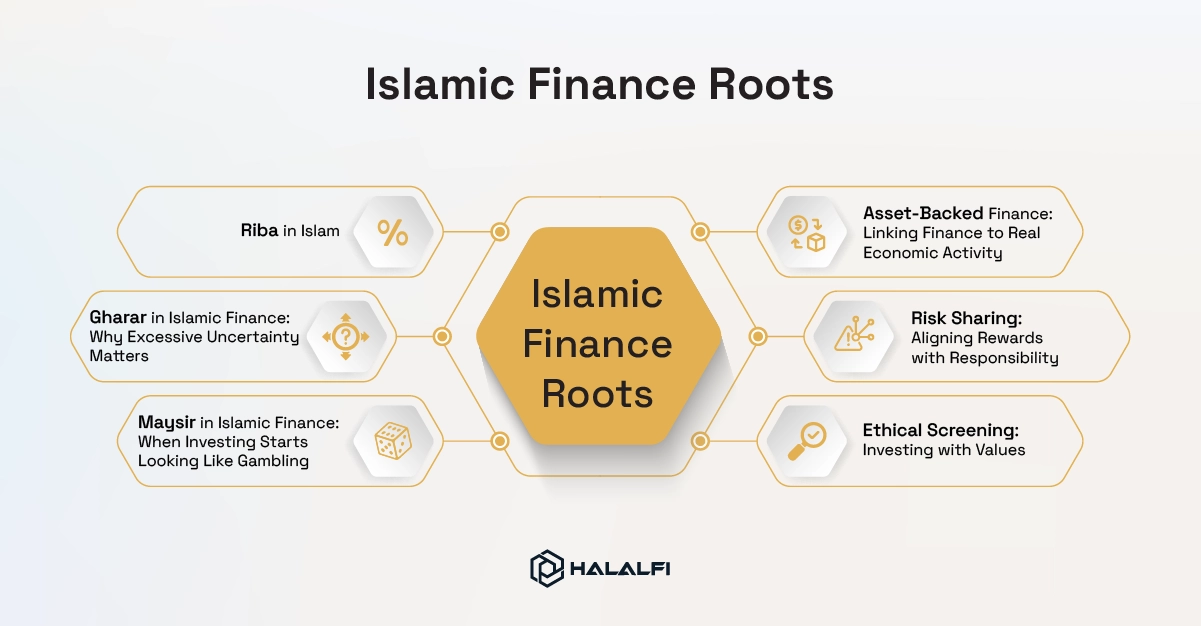
Islamic Finance Roots
Islamic finance rests on several interconnected foundations. These roots explain why many modern financial products require redesign before becoming Shariah-compliant investments.
1. Riba in Islam
The most recognised root in Islam concerns riba. Riba in Islam is interpreted as predetermined or unjustified gain arising from lending money.
The Qur’an at Surah Al-Baqarah 2:275 addresses this:
ٱلَّذِينَ يَأْكُلُونَ ٱلرِّبَوٰا۟ لَا يَقُومُونَ إِلَّا كَمَا يَقُومُ ٱلَّذِى يَتَخَبَّطُهُ ٱلشَّيْطَـٰنُ مِنَ ٱلْمَسِّ ۚ ذَٰلِكَ بِأَنَّهُمْ قَالُوٓا۟ إِنَّمَا ٱلْبَيْعُ مِثْلُ ٱلرِّبَوٰا۟ ۗ وَأَحَلَّ ٱللَّهُ ٱلْبَيْعَ وَحَرَّمَ ٱلرِّبَوٰا۟ ۚ.
“Those who consume interest cannot stand [on the Day of Resurrection] except as one stands who Satan is beating into insanity. That is because they say, “Trade is just like interest.” But Allah has permitted trade and forbidden interest. So whoever receives an admonition from his Lord and desists may have what is past. His command rests with God. And whoever returns [to disbelief] - those are the companions of the Fire; they will abide therein eternally. “
Trade involves effort, ownership, and commercial risk. An interest guarantee provides a return regardless of the outcome.
Islamic finance, therefore, avoids structures where profit is fixed and independent of performance. Instead, value should emerge through:
Business activity
Trade
Leasing
Investment participation
Shared enterprise
It means profit should be connected to productive contribution.
2. Gharar in Islamic Finance: Why Excessive Uncertainty Matters
Another root in Islamic finance is Gharar. Gharar in islamic finance refers to excessive uncertainty, ambiguity, or unclear contractual conditions.
Every business carries risk. The concern is with agreements where essential information is hidden, unclear, or impossible to understand.
Imagine buying something without knowing:
What is being delivered
Whether it even exists
When will the delivery happen
How payment obligations work
Islamic finance argues that this creates unfairness. Financial agreements should be transparent enough for both parties to understand what they are entering into.
It explains why Islamic finance discourages highly uncertain derivatives or poorly defined financial contracts.
The goal is simple:
clarity before commitment.
3. Maysir in Islamic Finance: When Investing Starts Looking Like Gambling
A related root is Maysir in Islamic finance. Maysir refers to gambling or zero-sum speculative activity. Not every risky investment is gambling:
Opening a restaurant is risky
Building a company is risky
Funding innovation is risky
But those activities create value. Gambling merely transfers value; one person wins because another loses.
So many Islamic scholars view casino-style speculation, excessive leverage, and purely hype-driven trading as problematic.
This concern feels modern. A quick look at speculative digital markets shows why; Memecoins rise and collapse within hours.
Leverage products promise rapid gains while destroying capital just as quickly. The market noise grows louder, while genuine business funding often struggles quietly in the background.
Islamic finance asks a difficult question:
Does this transaction contribute to the real economy or merely move money between winners and losers?
It shapes the entire system.
4. Asset-Backed Finance: Linking Finance to Real Economic Activity
A core principle of Islamic finance is that financial transactions should be connected to tangible assets or genuine economic activity. Rather than creating returns from money alone, Islamic structures are typically linked to:
Real estate
Equipment
Inventory
Commodities
Business ventures
5. Risk Sharing: Aligning Rewards with Responsibility
Islamic finance encourages a closer relationship between risk and reward. In many conventional lending arrangements, the lender receives a fixed return regardless of the outcome. Islamic finance seeks a different balance.
Parties involved in an investment should share both potential gains and potential losses. So Those who expect profit should also bear an appropriate share of risk.
6. Ethical Screening: Investing with Values
Islamic finance also considers where money is invested. Businesses that derive substantial income from prohibited activities are generally excluded. Common examples include:
Gambling
Alcohol
Tobacco
Adult entertainment
Interest-based financial services
Ethical Investing: Not Every Profit Is Equal
Islamic finance also places ethical boundaries around capital. Profit matters, but how profit is generated matters too.
This is why many industries are excluded from Shariah-compliant investments. Typically prohibited sectors include:
Gambling
Alcohol
Tobacco
Pornography
Weapons linked to harmful activity
Interest-based financial models
The difference is that Islamic finance developed these ethical screening standards decades before the rise of modern ESG and socially responsible investing frameworks.
The AAOIFI describes its mission as developing accounting, governance, ethics, and Sharia standards for the industry.
Without standards, ethical investing becomes subjective. With standards, investors gain clearer frameworks.
Islamic Finance Is Growing
According to the Islamic Financial Services Board (IFSB), global Islamic finance assets reached approximately USD 3.88 trillion in 2024, representing nearly 15% annual growth. Islamic banking and insurance both recorded double-digit expansion.
The industry now spans more than 90 markets worldwide. Islamic banking alone represents over 70% of total Islamic finance assets. Growth is visible in:
Saudi Arabia
Malaysia
UAE
Pakistan
Indonesia
Bahrain
United Kingdom
Parts of Africa and Central Asia
Malaysia offers a strong example.
The country developed an integrated ecosystem of Islamic banking, education, regulation, and capital markets over several decades.
Saudi Arabia has become one of the world’s largest Islamic banking markets.
The UAE continues to position itself as a global hub through Islamic banks, takaful insurance, and sukuk issuance. So, ethical finance is moving from alternative to mainstream.
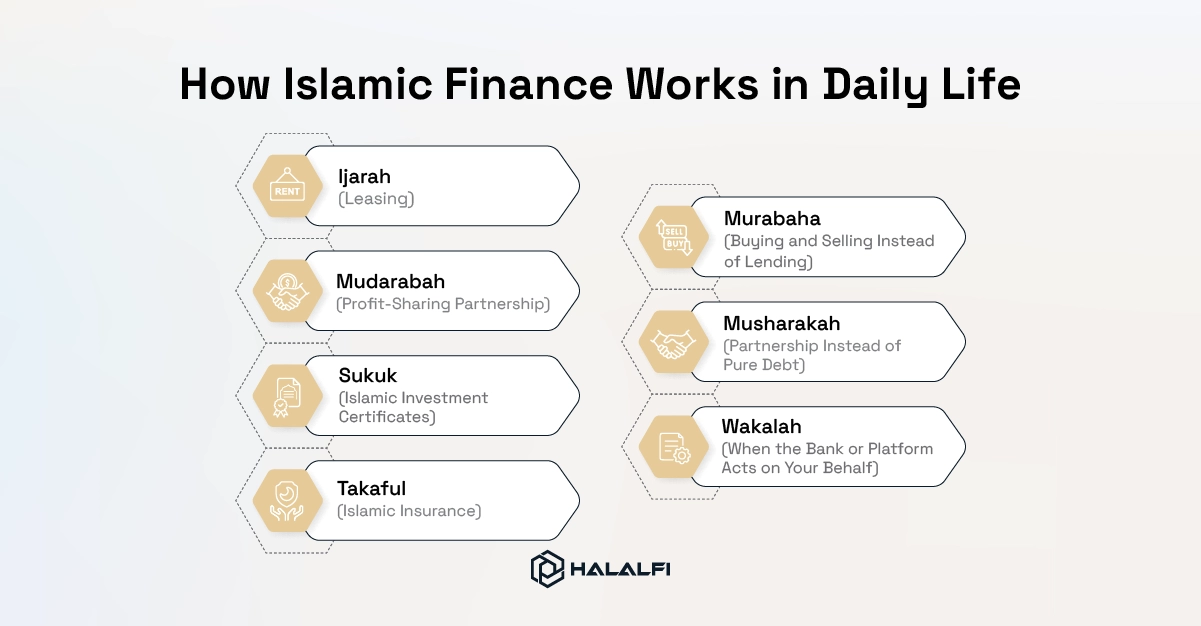
How Islamic Finance Works in Daily Life
If interest is avoided, how do Islamic financial products work? The answer surprises many people.
Islamic finance does not eliminate profit; it restructures how profit is earned.
Islamic finance, instead of relying primarily on lending money for fixed interest, uses contracts linked to trade, leasing, partnership, or agency.
Ijarah (Leasing)
Ijarah is one of the most common Islamic finance structures. A bank or financial institution purchases an asset and leases it to the customer in exchange for agreed rental payments. In many cases, ownership may eventually transfer to the customer.
The key difference is that the transaction is tied to a real asset rather than an interest-bearing loan.
Mudarabah (Profit-Sharing Partnership)
In a mudarabah arrangement, one party provides capital while another provides expertise and management.
Profits are shared according to a pre-agreed ratio, while financial losses are generally borne by the capital provider unless negligence or misconduct occurs.
Sukuk (Islamic Investment Certificates)
Sukuk are often described as Islamic alternatives to conventional bonds. Rather than representing a debt obligation, sukuk are typically linked to ownership interests in underlying assets or projects that generate income.
According to Aramco, In 2024, Saudi Aramco raised US$3 billion through an international sukuk issuance. Investors received returns linked to the sukuk structure rather than conventional bond interest payments.
Takaful (Islamic Insurance)
Takaful operates on mutual cooperation rather than risk transfer. Participants contribute to a common fund that helps compensate members who experience covered losses.
Murabaha (Buying and Selling Instead of Lending)
One of the most common structures is murabaha. Think of someone buying a home or business equipment.
In a conventional arrangement, a bank lends money and charges interest. In a murabaha structure, the institution purchases the asset and sells it to the customer at an agreed markup.
The price is transparent from the start; the profit comes from trade, not from interest in money alone. This structure is used in:
Property finance
Equipment purchases
Trade financing
Business assets
Musharakah (Partnership Instead of Pure Debt)
Another major structure is musharakah. The word means partnership. Here, rather than the lender and borrower standing on opposite sides, both parties contribute capital and share the results.
If the project succeeds, profits are shared. If it struggles, Profits are shared according to a pre-agreed ratio, while losses are generally allocated in proportion to each party’s capital contribution. This model is used in:
Property partnerships
Business expansion
Joint ventures
Project finance
Wakalah (When the Bank or Platform Acts on Your Behalf)
Another important structure is wakalah. The term refers to agency.
In simple terms, someone appoints another party to act on their behalf under agreed instructions. This structure often appears in:
Savings products
Investment accounts
Asset management
Certain Islamic banking arrangements
How does Islamic Banking work?
Islamic banking is often presented as theoretical. In reality, it already operates across many countries.
Many Islamic banks, rather than promising fixed interest, invest deposits in approved commercial activities and distribute the expected profits. This involves:
Murabaha trading structures
Wakalah Investment Agency Models
Leasing
Asset-backed financing
Islamic banks do not eliminate finance; they redesign it. Islamic finance is anti-guaranteed profit, disconnected from economic activity.
According to the Bank of England, the Alternative Liquidity Facility (ALF) officially opened in 2021, allowing UK Islamic banks to place funds with the central bank in a Sharia-compliant manner. The UK became the first major Western central bank to provide such a non-interest facility.
So Islamic finance is not operating outside the financial system; it is increasingly being integrated into it.
A Missed Lesson From the 2008 Financial Crisis
The 2008 crisis exposed weaknesses that Islamic finance scholars had warned about for years:
Complex derivatives
Excessive leverage
Poor transparency
Risk pushed through layers of financial engineering. Islamic banks were not immune to economic pain.
But many avoided toxic debt structures and speculative derivatives because gharar and maysir in Islamic finance already discouraged those practices.
According to INAIA Finance, Former German Finance Minister Wolfgang Schäuble publicly acknowledged the growing relevance of Islamic finance, stating:
“Islamic Finance is becoming increasingly important for the global economy.”
Why does Shariah Auditing Matter?
Who decides whether a financial product is genuinely compliant? Here, Shariah auditing becomes essential.
Without oversight, almost any product could claim ethical legitimacy. Organisations such as AAOIFI provide governance standards intended to create consistency across Islamic finance. AAOIFI develops accounting, auditing, governance, ethics, and Sharia standards for the industry.
Its standards influence numerous jurisdictions worldwide, including Bahrain, Pakistan, Malaysia, and other Islamic finance markets.
The important point is, Shariah compliance is not a one-time approval granted before a product launches.
Effective Shariah auditing is an ongoing process that includes continuous monitoring, periodic reviews, and post-implementation assessments to ensure that actual operations remain consistent with the approved structure.
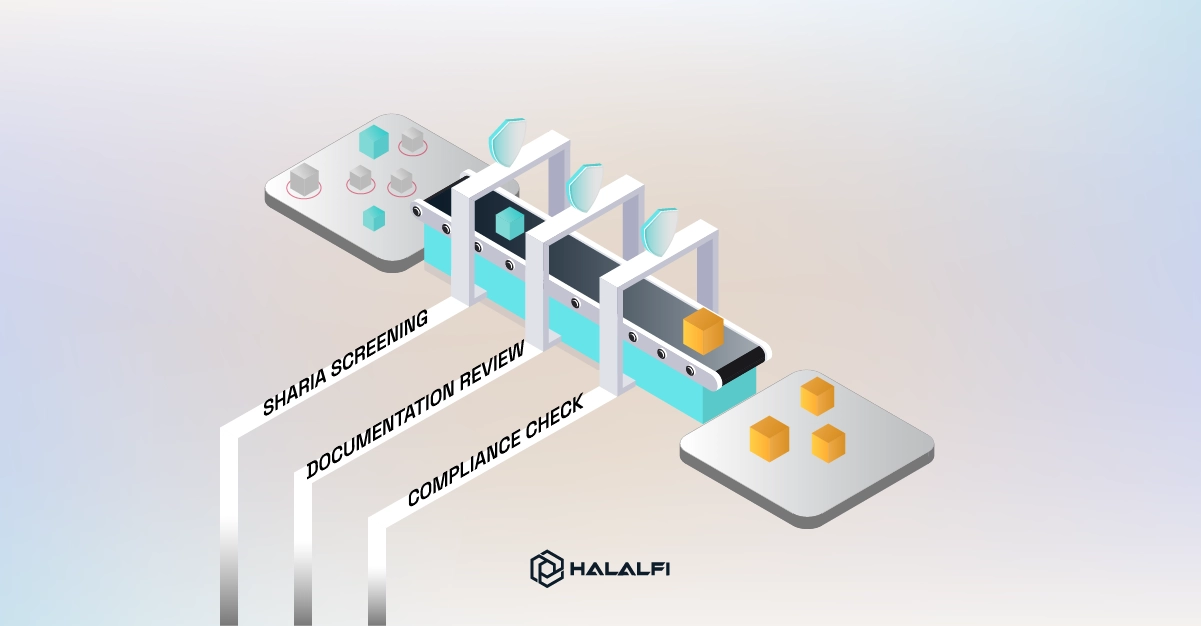
The Shariah screening process and Shariah boards play an important role. The screening process evaluates whether a product, investment, or business activity complies with Islamic principles, while a Shariah board, composed of qualified Islamic scholars, reviews structures, issues guidance, and provides ongoing oversight throughout the product's lifecycle.
Islamic Finance vs Speculative Digital Markets
See this comparison; The table below compares the core characteristics of speculative markets and Islamic finance:
Feature | Speculative Markets | Islamic Finance |
Core driver | Price movement | Economic activity |
Profit source | Trading volatility | Business participation |
Transparency | Often limited | Contract-based |
Asset backing | Not required | Usually required |
Risk approach | Often transferred | Shared |
Ethical screening | Rare | Core principle |
Long-term alignment | Variable | Structural |
This does not mean every blockchain project conflicts with Islamic principles. Technology is neutral. The question is how the system is designed.
Islamic Finance Risks and Limitations
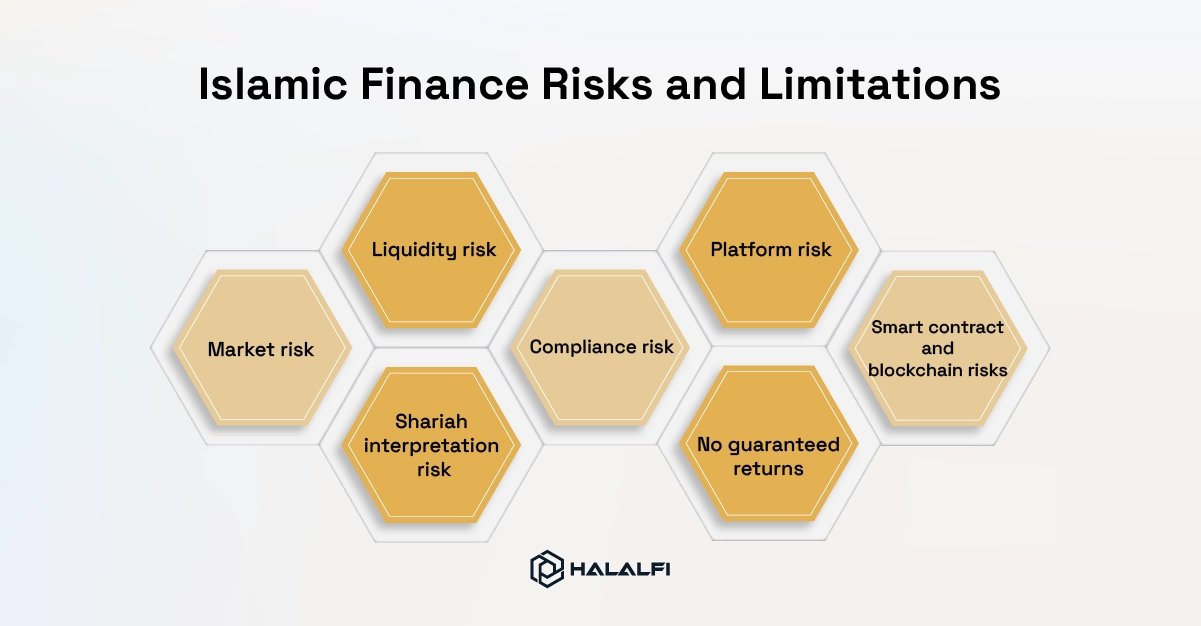
Islamic finance, like any investment approach, carries risks that investors should understand. Some risks include:
Market risk: Asset values and project performance can decline.
Liquidity risk: Investors may not always be able to exit or sell their positions quickly.
Shariah interpretation risk: Different scholars may reach different conclusions about whether a structure is compliant.
Compliance risk: A product that is initially approved may later be found to deviate from its intended Shariah structure.
Platform risk: Operational failures, governance issues, or poor management can affect outcomes.
No guaranteed returns: Profits depend on actual business performance, and losses remain possible.
Smart contract and blockchain risks: Coding errors, security vulnerabilities, network failures, or cyberattacks can lead to unexpected losses.
The Gap Between Islamic Roots and Modern Investing
According to WorldPopulationReview There are nearly 2 billion Muslims worldwide. Yet many remain underserved or uncomfortable with conventional finance. The issue is trust. Many investors hesitate because they encounter:
Fixed-interest structures
Unclear contracts
Excessive speculation
Weak ethical screening
Limited access to verified halal crowdfunding
Also, real businesses often struggle to secure ethical capital, and Speculation becomes abundant. Productive businesses remain underfunded. HalalFi fills the gap.
Islamic Finance Is No Longer Only a “Muslim Market”
People Islamic Finance operates only inside Muslim-majority countries. Reality looks very different. Some of the strongest adoption stories now involve both Muslim and non-Muslim markets.
London is one example. The UK hosts Islamic banks, sukuk listings, and Sharia-compliant financial products while positioning itself as a Western Islamic finance hub. Luxembourg, Hong Kong, and South Africa have also issued sukuk, recognising both investor demand and the system’s stability advantages.
Islamic finance is increasingly adopted for its economic and ethical logic, not simply because of religion.
Saudi Arabia remains one of the largest Islamic banking markets. Malaysia continues to lead in regulation, digital innovation, and sukuk development.
The UAE is expanding its Islamic finance strategy while positioning itself as a fintech and sustainable finance hub. Pakistan offers another important example.
Islamic banking has grown steadily there, with digital Islamic banking services and fully Sharia-compliant institutions expanding access and adoption.
So Islamic finance is no longer peripheral; it is becoming part of the global financial infrastructure.
HalalFi in Islamic Finance
So where exactly does HalalFi is in the broader Islamic finance landscape?
HalalFi is a blockchain-based crowdfunding and investment platform designed around Shariah-compliant financing principles.
Rather than offering conventional interest-bearing products, the platform states that investors participate in project-based commercial activities and receive returns linked to project performance.
That said, evaluating any Islamic finance platform requires looking beyond marketing language.
In HalalFi projects are reviewed for Shariah compliance, that investment flows are managed through smart contracts, and that investors can review project information, financial projections, and compliance documentation before investing.
Smart contracts in the platform have undergone security audits and that transactions can be verified on-chain. HalalFi is investment infrastructure or marketplace rather than a single Islamic finance product.
That structure reflects some ruls already discussed:
Avoidance of riba in islam
Reduced gharar in Islamic finance through transparency
Avoidance of maysir in Islamic finance through real-business participation
Conclusion
Islamic finance is often introduced as an alternative. Today, it is increasingly a global framework for thinking differently about money, ownership, and responsibility.
Platforms like HalalFi represent the next stage of that conversation.
If you read the HalalFi Whitepaper, you can see the platform. By combining blockchain, shariah-compliant investments, business audits, and profit-sharing models, it tries to answer a question:
Can capital grow without losing its conscience?
The answer ultimately belongs to investors themselves.
But for those exploring ethical finance, halal investment, or transparent business funding, HalalFi offers a model worth closer examination.
Explore the platform, review the projects, study the framework, and decide whether this approach deserves a place in your own financial story.
Frequently Asked Questions
Is Islamic finance only for Muslims?
No. Anyone can use Islamic financial products. Many non-Muslim investors choose Islamic finance because of its ethical screening, transparency, and asset-backed structures.
Is Islamic finance completely risk-free?
No. Islamic finance does not eliminate risk. Instead, it structures risk through clearer contracts, real assets, and shared responsibility.
Are all crypto investments considered non-compliant?
Not necessarily. Islamic scholars differ. Compliance depends on structure, utility, transparency, and whether the activity involves excessive speculation or prohibited practices.
What is the difference between Islamic finance and ESG investing?
Both emphasise ethics. Islamic finance incorporates legally and religiously derived rules, including sharia law, contract structures, and financial prohibitions such as riba and certain forms of speculation.
Can Islamic finance support startups and innovation?
Yes. Islamic finance supports entrepreneurship through partnership models, crowdfunding, venture participation, and asset-backed investment structures.
What role does blockchain play in Islamic finance?
Blockchain can improve transparency, contract execution, auditability, and transaction verification, making it increasingly relevant to modern Islamic fintech solutions like HalalFi.