
Have you ever stopped and asked yourself what halal investing really means beyond the buzzword? Not just in theory, but in real life, in your portfolio, in your financial decisions?
Maybe you’re just starting to explore investing and want to make sure your money aligns with your values.
Or maybe you’ve been investing for years, and you’re now questioning whether there’s a more ethical, purpose-driven way to build wealth. Either way, you’re in the right place.
Halal investing isn’t simply about avoiding certain industries. It’s a complete approach rooted in Islamic investment principles, centred on fairness, shared risk, real economic activity, and long-term impact.
And interestingly, it’s attracting not only Muslim investors, but also non-Muslims who care about transparency, social responsibility, and building wealth without compromising their principles.
For many first-time halal investors, the real challenge begins after they’ve bought their first few stocks.
Most people start with stocks, while younger people may buy a coin or token. Screening a portfolio sounds simple in theory, but in reality, it's rarely that simple.
When portfolios are reviewed carefully, line by line, revenue source by revenue source, it’s not unusual to find minor but non-compliant income streams. They’re often small enough to go unnoticed, yet significant enough to require purification.
That process can feel frustrating at first. But for many investors, it becomes a turning point: a reminder that halal investing is due diligence, intention, and staying attentive to the fine print.
In this guide, we’ll break it all down in clear terms. You’ll learn the core rules that define halal investing, the main halal investment options available today, the real risks and realistic benefits and how to evaluate opportunities confidently. Let’s begin.
What Is Halal Investing?
At its heart, halal investing means putting your money into opportunities that align with Shariah law, the ethical framework in Islam governing fairness, transparency, and social welfare.
In simple terms, it’s about investing in rational value and steering clear of systems that derive profit from interest, speculation, or industries that harm society.
Islamic principles define halal investing as channelling wealth into ventures that do good, avoid harm, and share both profits and losses fairly.
That makes it feel less like gambling and more like forming partnerships in real economic activity, where everyone shares in the outcome, good or bad.
Halal Investing vs. Conventional Investing
Think of halal investing as values-based finance. Conventional investment often focuses solely on returns, even if those returns come from fixed and promised interest (riba) or from industries such as alcohol, gambling, or arms manufacturing.
Halal investing rejects these upside-only payoffs and instead emphasises real assets, shared risk, and businesses that produce tangible goods or services in society where human lives are lived.
This distinction isn’t just spiritual; it affects how portfolios are built, how returns are generated, and even how risks are managed in volatile markets.
According to Dinarstandard, the global Islamic finance and halal investing landscape continues to expand rapidly, with recent industry reports estimating Islamic finance assets will grow to roughly US$7.5 trillion by 2028, underscoring strong investor demand for Shariah-compliant products and ethical capital allocation.
Also, according to Cityam, fintech platforms are broadening access to halal investment channels worldwide.
For example, Musaffa recently announced a new Global Halal Investment Platform offering regulated access to U.S. markets for over 600,000 investors across more than 200 countries, reflecting rising participation in faith-aligned asset growth.
Meanwhile, IBS Intelligence projects that Islamic fintech transaction volumes will reach about US$341 billion by 2029, driven by digital adoption and Sharia-compliant innovations.
How Faith-Driven Investment Strengthens Local Economies?
Around the world, Islamic finance that empowers halal investing isn’t just transforming portfolios, it’s transforming lives and communities. To walk you into the world of Islamic finance, you need to get to know some Islamic financial instruments first.
One striking example beyond mainstream banking is the noble finance tool of generosity-based lending, which is the foundation of many Islamic organisations and fintech platforms.
Al-Qard Al-Hasan Association is a nonprofit micro-loan group that operates on the Islamic principle of interest-free lending. Rather than profit from interest, Al-Qard Al-Hasan provides small, ethical loans to individuals and entrepreneurs who might otherwise struggle to access traditional credit.
In 2019 alone, the association granted 200,000 loans, helping families cover essentials like weddings, education, and small-business start-ups without the burden of interest-based debt.
These kinds of community-centred models reflect a much broader trend in Islamic finance’s contribution to social welfare.
Islamic social finance tools, including zakat (obligatory charitable giving), waqf (endowments), and profit-sharing investment structures, are increasingly recognised as powerful mechanisms for economic inclusion and poverty alleviation.
According to the United Nations Development Programme (UNDP), directing zakat, waqf, and similar funds into locally driven programs can significantly address marginalization and vulnerability while empowering communities toward economic independence.
In Malaysia and other parts of Southeast Asia, Islamic microfinance has become a cornerstone in lifting low-income families into sustainable economic activity.
By offering Shariah-compliant microcredit, Islamic finance institutions give small businesses and entrepreneurs access to capital without the unfair trap of interest, helping to spur job creation, increase household incomes, and strengthen local economies in underserved areas.
These real examples show that halal investing and Islamic financial models extend far beyond theoretical principles; they actively weave economic growth with social well-being, all while respecting Shariah compliance.
Core Principles of Islamic Investment
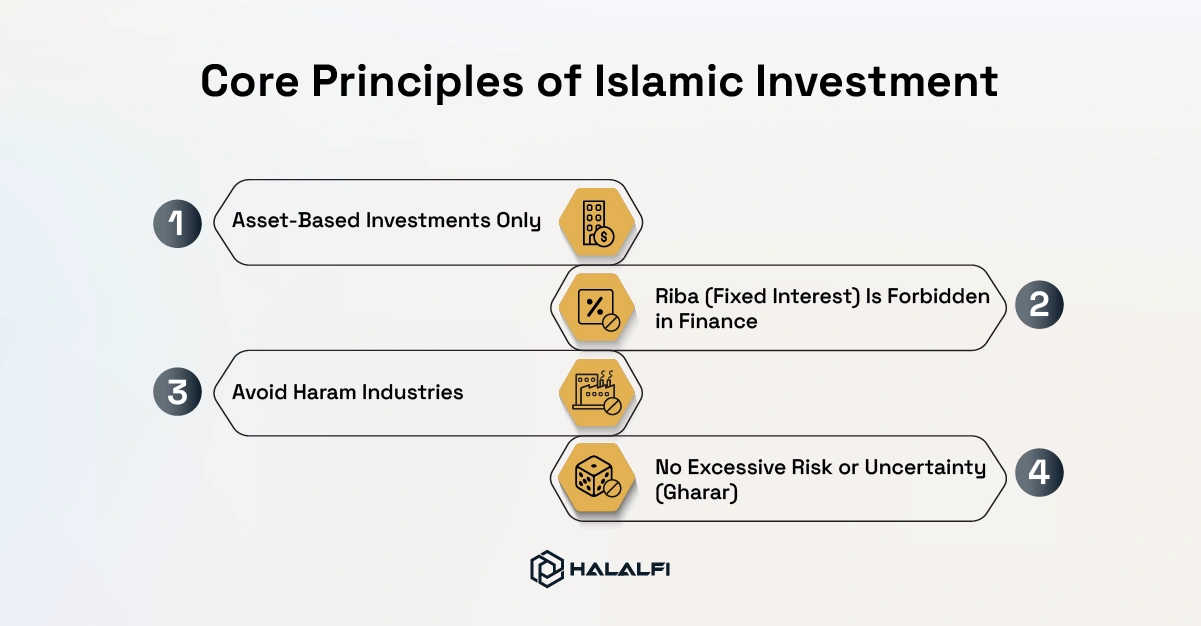
To make sure you’re investing in a truly compliant way, there are four pillars every halal investor should understand:
1. Asset-Based Investments Only
In halal investing, money should be earned through real economic activity, not merely by collecting interest.
That’s why stocks, real estate, precious metals, and business equity are preferred, because they’re tied to assets that hold actual value. Earning income from these can be halal when done right.
For example, owning a slice of a tech company means you benefit as it grows and serves people, a very different story from earning passive fixed interest on a savings account.
So, basically, that is the reason and the foundation: many Islamic scholars, while welcoming BTC, ETH, and other utility-based tokens or coins, strongly oppose meme coins and future markets because of their volatility.
2. Riba (Fixed Interest) Is Forbidden in Finance
Interest or riba in islam, whether on loans or bonds, when fixed or promised, irrespective of what happens in the real world and business, is considered unfair because it rewards one side without a meaningful exchange of probabilities, which is the essence of every trade and commerce activity.
Also, taking collateral in loans is forbidden, as it makes one side totally risk-free. From an Islamic finance perspective, halal investing promotes profit-and-loss sharing, where returns reflect actual performance and shared risk.
In the Islamic finance framework, you may forecast the exact amount of interest in a financing activity, but it is permissible as long as it is expected. When you fix it, or you cover one side's losses with collateral, you are against the principle of Islamic finance.
3. Avoid Haram Industries
Halal investors don’t put money into sectors that Islamic law and jurisprudence deems harmful, such as:
Alcohol, cigarettes, and pork products
Gambling or pornography
Conventional banking and interest-based financial services
Weapons and controversial technologies
Causes against public order and health
This helps ensure your money supports ethical business activity.
4. No Excessive Risk or Uncertainty (Gharar)
Investments loaded with unclear terms, speculation, or derivative bets fall into gharar in islamic finance and are considered impermissible. Think of this as a call for clarity and fairness in every contract you sign.
By applying these principles, Islamic finance creates a transparent environment for those who wish to adhere to Islamic jurisprudence.
Top Halal Investment Options
Let’s break down some halal ways for beginners to invest money to receive profit while staying principled.
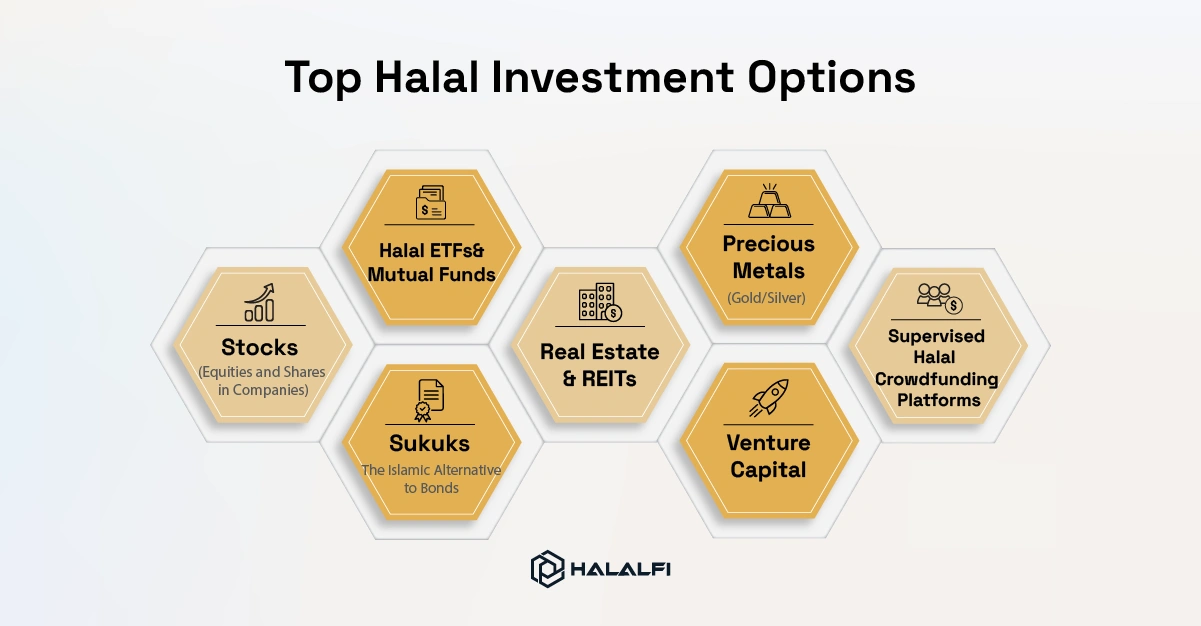
1. Stocks (Equities and Shares in Companies)
When you buy stocks, you own part of a company. Stocks are halal if the company’s core business is compliant with Sharia-accepted activities and its financials don’t rely heavily on interest or debt. Tech, healthcare, and ethical consumer goods often qualify.
Just remember: you’ll need to screen for compliance based on criteria such as revenue sources and debt levels.
2. Halal ETFs and Mutual Funds
Sometimes, when people want to buy stock, they do not know what to buy. There are many cases in which people have bought two or three types of stocks, only to see them all suddenly drop.
So, to address the problem, new financial tools have emerged that diversify investment risk.
Exchange-traded funds (ETFs) and mutual funds that hold Shariah-compliant securities let you invest in a diversified portfolio without picking individual stocks—scholars screen certified halal ETFs to ensure that all holdings comply with Islamic guidelines.
For instance, some halal ETFs exclude companies that earn interest and focus on ethical sectors, such as technology and consumer goods.
3. Sukuks, The Islamic Alternative to Bonds
Traditional bonds pay interest, so they’re haram. Sukuks, however, represent ownership in an asset, and returns come from profit-sharing rather than interest.
This makes them a popular fixed-income equivalent in halal portfolios.
Related Article: What is Sukuk?
4. Real Estate & REITs
Property is one of the oldest halal investment choices. Real estate holds intrinsic value, appreciates, and can generate rental income, so long as interest-laden mortgages aren’t involved.
Even among Muslim communities with land and property, one of the most ancient and traditional ways to store value, many people still like to have real estate in their portfolios.
Real estate investment trusts (REITs) can also be halal if they earn primarily through rent and don’t depend on interest-based financing.
For example, tokenisation of real estate through RWA (Real-World Assets) enables digital tokens to represent ownership of tangible property.
5. Precious Metals (Gold/Silver)
Gold, silver, and other tangible precious metals are classic halal assets. They serve as inflation hedges and maintain value over the long term, making them reliable stores of wealth.
6. Venture Capital
Experienced halal investors sometimes participate in venture capital or halal-approved crowdfunding platforms.
These models allow money to flow into startups or projects with shared risk and profit, an approach that mirrors ethical equity participation.
7. Supervised Halal Crowdfunding Platforms
While venture capital and crowdfunding can align with halal principles through shared-risk and profit-sharing models, one of the biggest concerns for Muslim investors is the structure and supervision.
It’s one thing for a startup to claim it operates ethically.
It’s another thing for the funding mechanism itself to be designed around Sharia-compliant principles.
This is where supervised halal crowdfunding platforms, such as HalalFi, come into play.
Unlike generic crowdfunding environments, HalalFi positions itself as:
Halal by Design: embedding Islamic finance principles directly into the platform structure and mechanism design procedures.
Accessible finance: allowing everyday investors to participate without elite barriers
Inclusive: opening opportunities beyond closed investment circles
Transpatent: Run by smart contracts on blockchain
Supervised: incorporating oversight mechanisms to reduce ambiguity and mismanagement
For many Muslims, the real hesitation around crowdfunding isn’t ambition, it’s uncertainty.
They ask:
Is there a hidden interest in the structure?
Is risk being shared fairly?
Is this genuine equity participation, or speculation in disguise?
Platforms like HalalFi aim to reduce that uncertainty by providing structure and oversight, so investors don’t have to audit every project to feel confident about alignment independently.
In that sense, supervised halal crowdfunding represents a bridge between traditional equity participation and modern fintech access, combining shared risk, real economic activity, and ethical screening within one framework.
Benefits and Challenges of Halal Investing
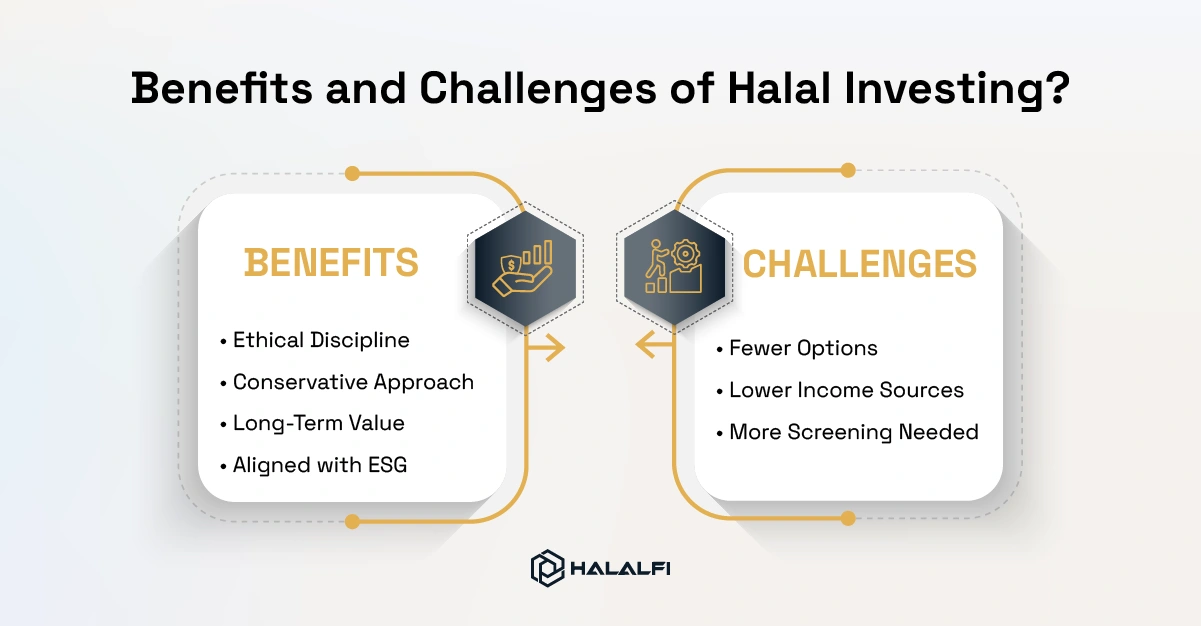
Why People Choose Halal Investing? These are the reasons:
Ethical Discipline: Halal investing encourages deep research and clarity before committing capital.
Conservative Approach: Less emphasis on high leverage or speculation can mean steadier performance over cycles.
Long-Term Value: By avoiding short-term trading and excessive risk, many halal portfolios naturally focus on durable growth.
Aligned with ESG: Halal investing often overlaps with environmental, social, and governance goals, appealing to a broader audience.
Drawbacks You Should Know about Halal Investing:
Fewer Options: Excluding certain sectors limits diversification.
Lower Income Sources: No interest income means relying on equity growth or profit sharing.
More Screening Needed: Compliance analysis requires extra work or tools.
Still, many investors find these trade-offs worth it for conscience-based wealth growth.
One of the most powerful aspects of halal investing is the discipline it demands. You can’t simply open an app, buy a trending stock, and call it a day.
Every investment needs to pass a set of Sharia compliance checks, like avoiding companies heavily involved in alcohol, gambling, interest-based finance, and other prohibited industries.
Halal investing also naturally avoids some of the riskiest parts of modern finance. High leverage, excessive debt, and speculative instruments like certain derivatives are generally not considered compliant.
As a result, halal portfolios often lean toward companies with stronger financial health and lower debt ratios.
Another interesting side effect of halal investing is the focus on long-term growth.
Frequent trading, short selling, and purely speculative bets are discouraged. Instead, investors are encouraged to participate in real economic activity by owning shares in businesses that create value. That shifts the mindset from trading to investing.
Here’s something many people don’t realise.
Halal investing often overlaps with ESG investing, the global movement focused on Environmental, Social, and Governance standards.
Halal investing is powerful in theory, but navigating it alone can feel complicated, even risky.
And that’s exactly why platforms like Halalfi were created. Instead of leaving investors to handle these obstacles themselves, solutions like Halalfi are designed to remove the friction:
Automated Sharia compliance screening
Curated halal investment opportunities
Simplified portfolio building
Tools that reduce the research burden
Crypto Crowdfunding: A New Frontier for Halal Capital Formation
Over the last few years, something interesting has happened in the world of fundraising. Crowdfunding didn’t just move online; it moved onto the blockchain to access on-chain liquidity.
Instead of raising capital through traditional equity platforms, some businesses now issue digital tokens that represent ownership stakes or revenue-sharing rights. Payments, contracts, distributions, everything can be recorded on-chain. Transparent. Traceable. Borderless.
At first glance, this sounds like another crypto trend. But look more closely, and you’ll notice something familiar: profit-sharing structures, asset-backed, shared risk.
In other words, mechanisms that, if structured correctly, can resemble classical Islamic partnership contracts like Musharakah. That’s where crypto crowdfunding becomes relevant to halal investing.
For Muslim investors living in regions without robust Islamic banking infrastructure, blockchain-based fundraising can remove geographic barriers.
A halal bakery app in Indonesia could raise capital from investors in the UK or Canada without relying on interest-based intermediaries.
But, and this is important, the technology itself is neutral. Blockchain doesn’t automatically make something halal. Structure does, which brings us to the bigger question.
Is Crypto Halal or Haram?
If you ask five scholars whether cryptocurrency is halal, you might get five slightly different answers, as there is currently no consensus on emerging technologies.
Some argue that cryptocurrencies like Bitcoin function as digital assets with market value and, therefore, can be permissible if used responsibly.
Others raise concerns about volatility, speculation, lack of intrinsic value, and excessive uncertainty (gharar). And honestly, the confusion is understandable.
Early crypto markets were heavily speculative. Meme coins. Pump-and-dump schemes. Anonymous founders are disappearing overnight.
That kind of environment naturally triggers concerns about maysir (gambling-like behaviour). However, many contemporary scholars now differentiate between:
Pure speculation with no underlying economic activity
Blockchain tokens representing real assets or real business ownership
Utility tokens used for services
Asset-backed or equity-linked tokens
In other words, the debate is shifting from “Is crypto halal?” to “What exactly is this crypto representing?”
If a token represents ownership in a real business, profits are shared transparently, risks are disclosed, and no interest is embedded in the structure, many scholars consider the discussion very different from leveraged day trading on a volatile exchange.
So the answer isn’t black-and-white. It depends on structure, intention, and execution.
Related Article: Is Crypto Halal?
Blockchain Transparency and Profit-Sharing Models
One practical advantage of blockchain-based crowdfunding is transparency.
Traditional private investments can be opaque. Investors often rely entirely on quarterly reports. With properly designed smart contracts, distributions and ownership records can be visible and auditable in real time.
Most of the time, the platform may claim the investee has distributed investment or shared performance profit, but no one can rely on this if it is not on the blockchain.
That kind of transparency actually aligns well with Islamic finance principles, which emphasise clarity in contracts and avoidance of hidden uncertainty.
But transparency doesn’t eliminate risk. A project can still fail. A startup can still miscalculate. Markets can still turn. And no technology removes business risk, nor should it.
Risk-sharing is part of the ethical foundation of Islamic investing, but we are addressing vad behaviours here, where profit is made, but the bad actor has refused to pay.
What blockchain can potentially reduce is ambiguity in execution. For halal investors, the real question becomes:
Does real economic activity back the token or fractional investment?
Is profit-sharing clearly defined?
Is there any embedded RIBA?
Has the project gone through Sharia and business audit?
Has this project returned profits in previous projects?
If those boxes are thoughtfully addressed, crypto crowdfunding may serve as a modern tool built on very old principles. Not a replacement for traditional Islamic finance, but an extension of it.
How Halal Investments Are Screened?
When you first start looking into halal investing, one thing that surprises many people is just how structured the screening process is.
It’s not a gut feeling or a quick checklist someone made up; there’s an actual methodology behind it, and at its heart is an international standards body called AAOIFI.
AAOIFI stands for Accounting and Auditing Organisation for Islamic Financial Institutions, a non-profit that sets guidelines used widely across Islamic banks, investment funds, and Islamic indices around the world.
Think of it as the referee in a soccer match: it doesn’t play the game, but its rules determine who’s on the field.
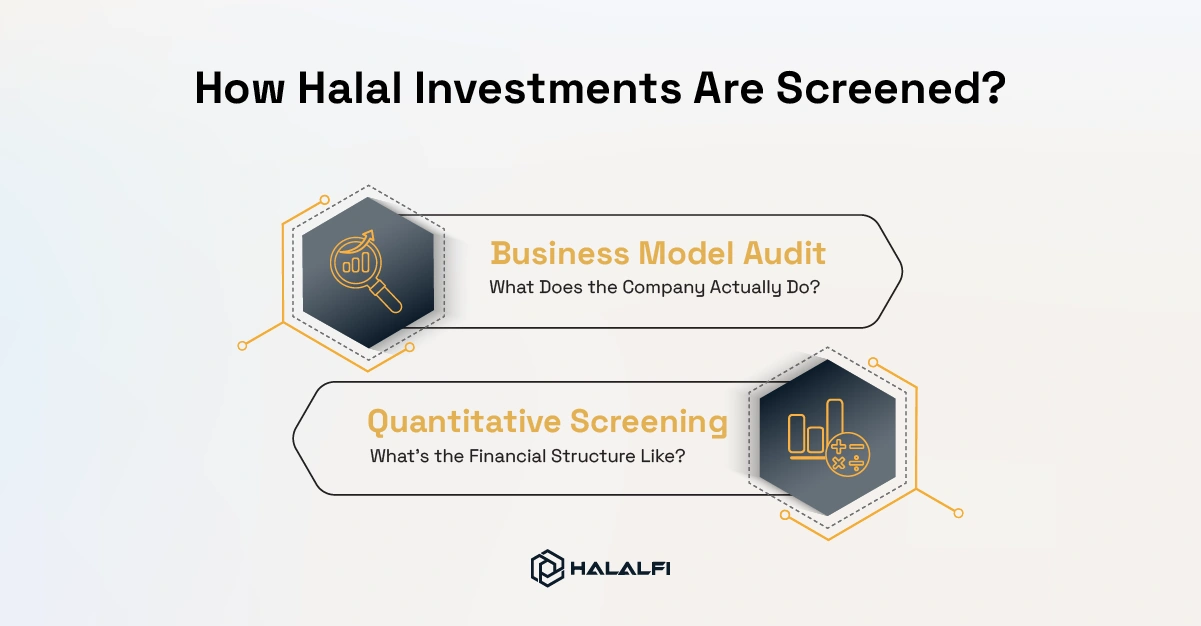
So how does the screening work? In practice, halal asset screening is usually a two-stage process: one part examines what the company does, and the other examines how it does it.
1. Business Model Audit: What Does the Company Actually Do?
Before any numbers are crunched, analysts check the company’s core business. This is where the “halal” in halal investing really comes from.
Here’s the idea: some activities are simply incompatible with Islamic law, you don’t invest in them, period. That means things like:
Banks or financial institutions that make money from interest (riba),
Alcohol producers or sellers,
Gambling and casinos,
Pork or non-halal food companies,
Adult entertainment and, in many cases, weapons and tobacco.
If a company’s main business falls into one of these categories, it fails the screening right away, no matter how healthy the balance sheet looks. It’s like checking the ingredients on just a food package before anything else.
Many big companies have a tiny amount of income from non-permissible activities. AAOIFI and most Islamic indices accept that as long as this incidental income remains very small, typically less than about 5% of total revenue, the company can still be considered halal. It’s a practical concession in a complex world.
2. Quantitative Screening: What’s the Financial Structure Like?
Once a company passes the qualitative test, the screening turns to numbers. Even if a business doesn’t sell alcohol or operate casinos, it might still be financially structured in a way that conflicts with Islamic principles, especially if it relies heavily on borrowing or earns significant income from interest.
This part of the screening looks at key financial ratios. AAOIFI’s standards set thresholds for things like:
Debt levels: Total interest-bearing debt generally shouldn’t exceed a certain percentage of the company’s market value.
Interest-earning assets: Cash and other assets that generate interest are capped, so an investor isn’t unintentionally profiting from riba.
Non-compliant income: Even incidental revenue from forbidden sources must stay under a small, agreed-upon threshold.
These limits aren’t random: they’re based on centuries of Islamic jurisprudence adapted for modern capital markets.
The idea is that you can invest in modern financial markets and stay true to Islamic ethics, but only if you avoid both forbidden activities and forbidden returns.
Why AAOIFI Is Widely Used?
AAOIFI’s standards, especially Shariah Standard No. 21, have become a kind of global reference point.
Many well-known Islamic stock indices, such as the Dow Jones Islamic Market Index, use criteria aligned with AAOIFI’s methodology to determine which equities to include.
That’s important because without a standard like AAOIFI, each bank or fund might apply its own rules, leaving investors with a confusing patchwork of interpretations.
With a recognised standard, you get consistency, you know what “halal” really means in this context, and different institutions are speaking the same language.
Related Article: Shariah Compliant Investments
Types of Investments to Avoid
Knowing what not to invest in is just as important. Within the AAOIFI framework, the following are mainly haram. But consider that some specific aspects of certain categories might be accepted on occasion in some Islamic scholars' views.
Still, since they are too few, they are not considered worth mentioning here.
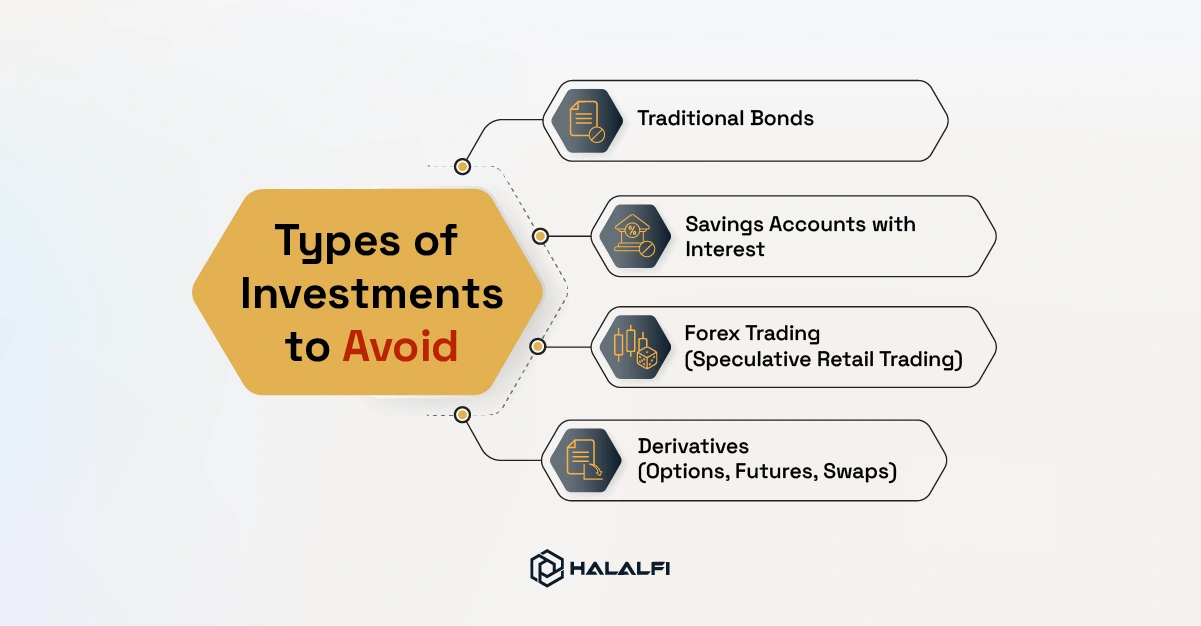
Investment Type | Halal or Haram? | Why |
Traditional Bonds | Haram | Involves interest (riba) |
Savings Accounts with Interest | Haram | Earns passive interest |
Forex Trading | Haram | High speculation and uncertainty |
Derivatives | Haram | Excessive risk and opacity |
These options don’t align with Shariah principles on risk, transparency, and the generation of ethical value.
Now, let’s explain more:
Traditional Bonds
Bonds are structured around lending money in exchange for fixed interest payments.
The return is guaranteed regardless of the issuer’s business performance.
This directly contradicts the prohibition of riba (interest) in Islamic finance.
Even government bonds fall into this category because the core mechanism is still interest-based lending.
Savings Accounts with Interest
The bank pays you a fixed or variable interest simply for depositing money.
There is no risk-sharing or real asset transaction involved.
The income is purely money generated from money, which is not permissible under Shariah.
Many halal investors instead look for Islamic banking alternatives that use profit-sharing structures.
Forex Trading (Speculative Retail Trading)
While currency exchange itself is permissible under strict spot conditions, most retail forex trading platforms involve leverage, margin trading, and delayed settlement.
High leverage magnifies uncertainty and resembles gambling-like behaviour.
Rapid short-term speculation, especially without underlying commercial need, introduces elements of gharar (excessive uncertainty).
Derivatives (Options, Futures, Swaps)
These instruments often derive value from underlying assets without actual ownership.
Many are highly complex and opaque.
They frequently involve excessive uncertainty and speculative risk.
The majority of conventional derivatives are not backed by tangible asset exchange in the way Shariah requires.
These instruments conflict with three major Islamic finance principles:
Avoidance of riba (interest)
Avoidance of gharar (excessive uncertainty)
Avoidance of maysir (gambling-like speculation)
How to Evaluate Halal Investments?
Before you commit your money, ask yourself:
What exactly does the company do?
Are there any prohibited income streams?
Where do returns come from?
Are the terms clear and fair?
These questions aren’t just philosophical; they’re practical checkpoints that protect you from unknowingly investing in haram ventures.
Halal Investing in Today’s World
The Islamic investment world isn’t small or static. In fact, global Islamic finance markets are booming:
in early 2025, global Islamic finance assets were estimated at nearly US $5.98 trillion, and industry analysts project they could grow to around US $9.7 trillion by 2029, reflecting continued strong expansion of Shariah-compliant finance worldwide.
Shariah-compliant ETF markets alone have grown into a multi-billion-dollar category with strong yearly performance.
According to Islamicfinancenews, in Saudi Arabia, Islamic finance is hugely significant in national finance: the sector’s assets exceed SAR 3 trillion (about US $800 billion), with imposing sukuk issuance and Islamic banking dominance.
That tells you something: halal investing isn’t just for a niche market anymore, it’s part of the ethical finance wave attracting investors worldwide.
While many are still trying to take tech into the traditional Islamic finance instruments, we would like to build the future of Onchain finance on top of blockchain in HalalFi.
What Is HalalFi And What Does It Offer?
HalalFi is positioned as a Sharia-compliant crowdfunding platform. Its core idea is simple:
Instead of lending money at a guaranteed interest rate, investors participate in performance-based profit sharing with real businesses, while HalalFi offers sharia-aligned insurance plans that unlock up to 40% Annual profit while principal investment is insured.
That distinction is important. HalalFi proposes:
Funding real, revenue-generating businesses with a proven record
Structuring returns around actual performance (not fixed interest)
Applying Sharia screening before projects go live
Using blockchain transparency to record transactions
Embedding audit layers into project approvals
Offering third-party guarantors for safety
It’s not presented as a speculative token marketplace. And it’s not framed as a fixed-yield savings product. It’s closer to structured crowdfunding, but built around Islamic finance principles.
Let’s be honest. Many platforms promise high returns. Few explain how those returns are generated. Even fewer clearly separate guaranteed interest from profit-sharing.
HalalFi attempts to differentiate itself by focusing on:
Sharia audit (screening business models for compliance)
Business audit (reviewing fundamentals, revenue, sustainability)
Transparent smart contract execution and on-chain proof of payments
That doesn’t eliminate risk. It does create structure. Structure is often what halal investors are really looking for, not just labels.
HalalFi does not guarantee profits. Returns are described as performance-based and tied to actual business outcomes.
The platform emphasises principal protection mechanisms and filtering processes, but investing still involves risk.
While we may ensure that investment terms are enforced by imposing liquidated damages if the investee becomes a bad actor and breaches defined terms, projects can still underperform. Markets can change. Transparency and compliance screening reduce certain types of risk, but they don’t remove economic reality. That distinction matters for credibility.
Related Article: What is HalalFi?
What Makes HalalFi Relevant to Halal Investing?
HalalFi positions itself at the intersection of:
Faith-aligned capital raising
Real-world business growth
Blockchain transparency
Community-driven oversight and governance
Free risk, profit-generating, while principled
For Muslims seeking halal investment exposure, the appeal is obvious: a system that tries to avoid riba while structuring participation around profit-sharing.
For non-Muslims, the appeal may be different, access to impact-oriented, ethically screened businesses with transparent funding mechanics.
It’s less about religion as branding and more about financial architecture aligned with specific ethical rules.
Halal investing is evolving. Traditional Islamic finance institutions paved the way decades ago. Now, newer digital platforms are experimenting with how to bring those principles to decentralised environments.
HalalFi is one such attempt. Whether it becomes a major infrastructure layer or remains niche will depend on execution, governance, and long-term consistency.
If you’re exploring halal investment pathways, it may simply be worth understanding how models like this operate, how they structure profit-sharing, how they approach compliance, and how they manage transparency. No rush or pressure, just an informed evaluation.
Because ultimately, halal investing isn’t about chasing platforms. It’s aligning capital with conviction, and choosing tools that make that alignment possible.

Your Next Step: Build a Responsible Portfolio
If you’re excited about halal investment options and want to start incorporating halal ways to invest money into your financial journey, now’s the time to act.
Explore tools like HalalFi to build a portfolio that’s both compliant and growth-oriented. Consider balancing asset classes like stocks, real estate, sukuk, and precious metals. Ethical wealth building doesn’t mean sacrificing returns; it means investing with integrity and long-term vision.
Ready to take the next step? Start building your halal investment plan today and let your money reflect your values.
Frequently Asked Questions
Is investing in stocks halal?
Yes, if the company’s business and financial practices avoid riba, prohibited industries, and excessive debt.
Can non-Muslims practice halal investing?
Absolutely. Many non-Muslim investors adopt Shariah-compliant investing for ethical and socially responsible reasons.
Are all ETFs halal?
Not automatically. Only ETFs certified as Shariah-compliant or manually screened qualify.
What’s the difference between halal and conventional investing?
Halal focuses on real value, shared risk, and ethical principles, while conventional may rely on interest-based returns.
How do I calculate zakat on my investments?
Use a reliable zakat calculator to assess eligible zakatable assets and determine your annual obligation.
Is Cryptocurrency Halal or Haram?
Cryptocurrency is halal if it functions as a legitimate digital asset and avoids speculation, fraud, or prohibited activities. However, it is potentially haram due to high volatility and uncertainty (gharar), so each project should be carefully evaluated for Shariah compliance.