
What if Sharia law is not a single rigid global rulebook but a broad ethical framework that takes shape across homes, banks, contracts, and courts?
Search results often reduce Sharia to criminal punishments or political slogans. In daily life, however, people encounter it through marriage, charity, food, honest trade, debt, investing, and personal conduct.
In this guide, we explain what Sharia means, what it prohibits, which countries use it, and how Muslims view it.
What Is Sharia Law?
Sharia refers to the moral and religious path that Islam asks people to follow. The word carries the sense of a clear path or way. It covers worship, family relationships, business ethics, food, charity, contracts, personal behavior, and justice.
Sharia does not function as a single statute book. Muslim jurists interpret its principles through fiqh, or Islamic jurisprudence. Sharia represents the divine ideal, while fiqh represents the human effort to understand and apply it.
The Quran and the teachings of the Prophet Muhammad form the primary foundations. Sunni scholars also use scholarly consensus and legal analogy.
Ja‘fari Shia scholars use the Quran, the Prophet’s teachings, traditions from his family, scholarly consensus, and reason. Both traditions contain several schools and many internal debates.
According to CFR, Khaled Abou El Fadl, UCLA law professor, says:
“On any legal issue, there are ten different opinions.”

Rules of Shariah Law
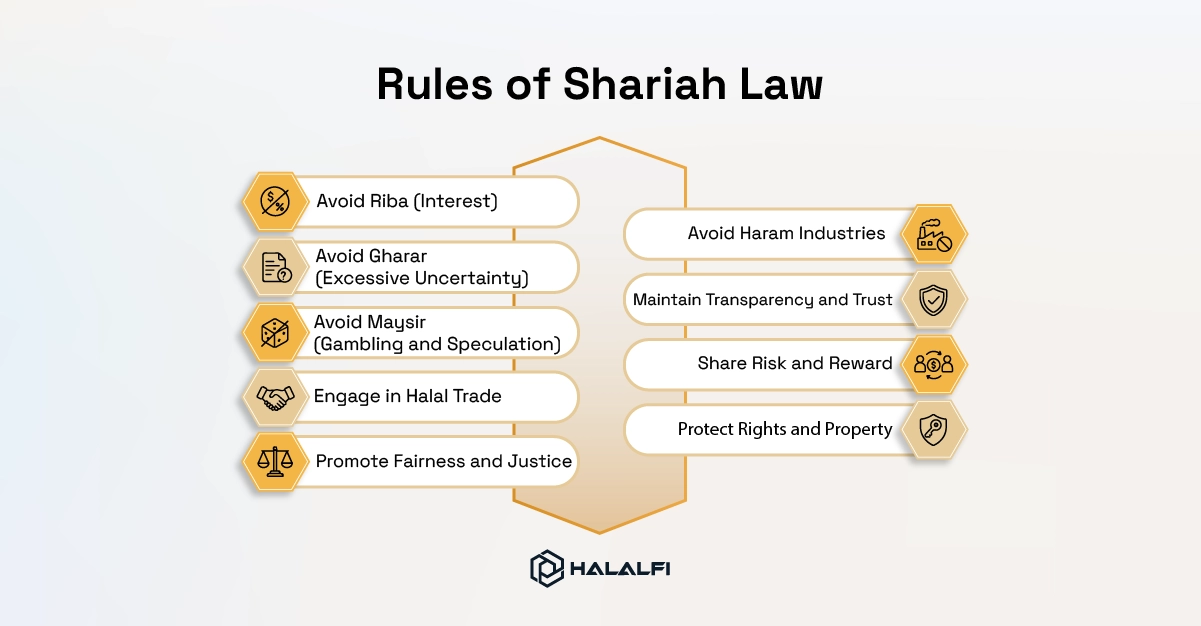
Shariah law provides a framework for Muslims to guide personal behavior, business dealings, finance, and social responsibilities. Some Shariah law rules include:
Avoid Riba (Interest): Prohibits earning guaranteed returns from lending money without participating in real economic activity.
Avoid Gharar (Excessive Uncertainty): Requires that contracts and transactions be clear, transparent, and free from significant ambiguity.
Avoid Maysir (Gambling and Speculation): Prohibits activities in which outcomes depend primarily on chance rather than on productive effort or value creation.
Engage in Halal Trade: Encourages business activities based on legitimate goods, services, ownership, and real economic contribution.
Promote Fairness and Justice: Requires honest dealings, fair contracts, and protection against exploitation or deception.
Avoid Haram Industries: Prohibits investment or involvement in activities such as alcohol, gambling, pornography, and other sectors considered harmful.
Maintain Transparency and Trust: Encourages accurate information, ethical agreements, and responsible financial behavior.
Share Risk and Reward: Supports investment models in which profit is tied to performance and parties share appropriate levels of risk.
Protect Rights and Property: Prohibits fraud, theft, corruption, and actions that harm individuals or communities.
What Does Sharia Law Prohibit?
Halal investing for beginners has many mysteries, and one of them is the Sharia prohibitions.
Sharia prohibits conduct that creates clear harm, exploitation, injustice, or moral corruption. Yet people often confuse a religious prohibition with a criminal offense.
For example, a Muslim may regard receiving loan interest as religiously forbidden. That does not mean every country treats interest as a crime.
Governments choose which religious principles, if any, to include in their civil or criminal codes. Below are some of the prohibitions:
Prohibition | Meaning | Financial or practical example |
Riba | An unjust or guaranteed increase connected to lending | A loan that requires repayment of the principal plus predetermined interest |
Maysir or qimar | Gambling and games of chance for money | Betting platforms or contracts built mainly on chance |
Excessive gharar | Serious uncertainty, concealment, or ambiguity | Selling an asset that nobody can clearly identify or deliver |
Fraud and unjust gain | Deception, theft, bribery, or abuse of trust | Hiding a company’s debt before asking investors for money |
Prohibited industries | Trade involving products that Islam forbids | Alcohol, pork, gambling services, and certain adult businesses |
Harm and coercion | Conduct that violates rights or causes unjust injury | Forcing someone into a contract or withholding material information |
The Quran permits trade while prohibiting riba. It also condemns intoxicants and gambling. Sharia also prohibits ordinary wrongdoing such as theft, assault, false testimony, and breach of trust.
These rules overlap with laws found in almost every legal system. The biggest differences appear in interpretation, evidence standards, penalties, and the role of government.
Shariah Law Examples
Shariah is not one universal legal code applied identically everywhere; its interpretation through Islamic jurisprudence, or fiqh, can differ among scholars, schools of thought, and countries. Common examples include:
Worship: Guidance on daily prayers, fasting during Ramadan, zakat, and pilgrimage.
Food and drink: Eating halal food and avoiding pork, alcohol, and other prohibited products.
Family matters: Rules and guidance concerning marriage, divorce, child support, and inheritance.
Business conduct: Requiring honest advertising, mutual consent, clear contracts, fair prices, and accurate disclosure.
Finance: Avoiding riba (interest), maysir (gambling), and excessive gharar (uncertainty), while supporting trade, ownership, and risk-sharing linked to genuine economic activity.
Charity and social responsibility: Supporting people in need through obligatory zakat and voluntary charitable giving.
Personal conduct: Encouraging honesty, modesty, responsibility, respect, and the protection of others’ property and rights.
Legal application: Some countries apply Sharia-derived rules mainly to marriage and inheritance, while others give them a broader role. The exact application varies considerably by legal system.
What Countries Follow Sharia Law?
No simple yes-or-no list can answer this question. Countries use Sharia in very different ways.
Some place it near the center of the national legal system. Others limit it to family matters. Several Muslim-majority countries maintain largely secular courts, while some non-Muslim countries recognize limited Islamic family arrangements.
Saudi Arabia sharia law
Saudi Arabia places Sharia at the center of its legal system. The Basic Law states that the Quran and the Sunnah govern the state, while courts apply Islamic principles alongside government-issued regulations.
Iran sharia law
Iran’s constitution requires civil, criminal, financial, political, and other laws to comply with Islamic criteria.
The Guardian Council reviews legislation to determine whether it is consistent with the constitution and Islamic principles.
The Maldives sharia law
Islam is the official religion of the Maldives and a constitutional foundation of its laws. Parliament cannot enact legislation that contradicts a tenet of Islam, making Sharia principles an important part of the national legal framework.
Egypt sharia law
Egypt uses a mixed legal system based primarily on written legislation and civil courts. However, its constitution identifies Islamic Sharia as the primary source of legislation, thereby giving it an important constitutional role.
Iraq sharia law
Iraq’s constitution describes Islam as the official religion and a foundational source of legislation. It prohibits laws that contradict established Islamic provisions, democratic principles, or constitutionally protected rights and freedoms.
Morocco shariah law
Morocco is a constitutional monarchy with a codified national legal system. Islam is the state religion and influences institutions and areas such as family law, while legislation and state courts remain responsible for legal enforcement.
Malaysia sharia law
Malaysia operates parallel civil and Syariah court systems. Civil courts handle federal and general legal matters, while state Syariah courts deal with defined Islamic matters involving Muslims, particularly personal status, marriage, divorce, and religious obligations.
Nigeria sharia law
Nigeria does not apply Sharia uniformly across the country. Several northern states operate Sharia courts and have adopted broader Islamic civil and criminal rules. Their jurisdiction generally applies to Muslims, although non-Muslims may voluntarily consent in certain cases.
Bangsamoro, Philippines shariah law
The Philippines recognizes Muslim personal law, particularly in Bangsamoro and other areas where Sharia courts operate.
It covers matters such as marriage, divorce, family relations, succession, and inheritance rather than replacing the country’s general criminal and constitutional system.
Lebanon sharia law
Lebanon does not have one national Sharia legal system. Instead, recognized religious communities administer aspects of personal status, including marriage, divorce, and inheritance. Muslim communities may therefore use Islamic rules in these defined areas.
Singapore shariah law
Singapore has an official Syariah Court established under national legislation. Its jurisdiction is limited mainly to marriage, divorce, and related family disputes involving Muslims or couples married under Muslim law.
India sharia law
India is a secular constitutional state, but it recognizes Muslim personal law in certain private matters.
The Muslim Personal Law (Shariat) Application Act provides for the application of Muslim personal law in specific areas, including family relationships, succession, and personal status.
Türkiye shariah law
Türkiye is constitutionally defined as a secular state. Sharia courts do not form part of its national judicial system, although Muslims remain free to follow Islamic teachings voluntarily in their private and religious lives.
Albania sharia law
Albania has no official religion. Its constitution requires the state to remain neutral in matters of belief and recognizes the equality and independence of religious communities. Sharia has no authority as state law.
Azerbaijan shariah law
Azerbaijan’s constitution separates religion from the state and declares all religions equal before the law. Although most citizens are Muslim, the national court and legislative systems are secular.
Senegal sharia law
Senegal is a constitutionally secular republic that respects different religious beliefs. Islamic values may influence private conduct and community practices, but Sharia is not the country’s official state legal system.
United Kingdom shariah law
Sharia councils in the United Kingdom may offer religious advice or mediation, particularly concerning Islamic marriage and divorce. They are not state courts; their decisions are not legally binding, and domestic law always takes priority.
United States sharia law
Sharia has no independent authority as public law in the United States. Muslims may voluntarily follow Islamic rules in worship, food, finance, marriage agreements, and estate planning, but the Constitution and federal and state laws control legal enforcement.
Is Sharia Law Legal in the USA?
Yes, people may follow Sharia privately in the United States. But, Sharia cannot replace the Constitution, federal law, state law, or the authority of American courts.
The First Amendment protects religious exercise and prevents the government from establishing an official religion.
A Muslim may therefore follow halal dietary rules, pray, give zakat, write an Islamic will, or select shariah-compliant investments, as long as those choices comply with ordinary American law. The same protection applies to other faiths.
American courts may also enforce private contracts that refer to religious standards. They apply neutral legal rules involving consent, capacity, fairness, public policy, and due process.
A religious arbitration clause cannot cancel statutory rights or force a court to enforce an illegal outcome.
The Cornell Legal Information Institute’s First Amendment guide provides a useful starting point. It explains the constitutional balance between free religious practice and the ban on government-established religion.
Texas adopted HB 4211 in 2025 after a public controversy involving a proposed development that officials associated with a “Sharia city.”
The measure targeted discriminatory and fraudulent housing practices. It did not create a nationwide ban on personal Islamic observance, and federal constitutional protections still apply.
Sharia Law by Country: Quick Comparison
Here is a Comparison of Sharia Law by Countries:
Legal approach | Country examples | How Sharia operates |
System-wide or strongly Sharia-based | Saudi Arabia, Iran, the Maldives | Islamic principles play a central role in constitutional, legislative, or judicial processes. |
Mixed national system | Egypt, Iraq, Morocco, Malaysia | Codified laws and civil courts operate alongside Sharia-derived constitutional or personal-status rules. |
Limited regional system | Northern Nigerian states, Bangsamoro in the Philippines | Sharia institutions operate in specific regions or within clearly defined areas of jurisdiction. |
Mainly personal-status law | Lebanon, Singapore, India | Islamic rules may govern matters related to the Muslim family, marriage, divorce, succession, or inheritance. |
Secular Muslim-majority system | Türkiye, Albania, Azerbaijan, Senegal | National law is secular, although individuals may follow Islamic teachings privately. |
Private or advisory use | United Kingdom, United States | Religious guidance may be followed voluntarily, but it cannot override national law or court authority. |
These categories describe broad legal patterns, not every local exception. According to Islamic law, Malaysia, for example, gives state Syariah courts jurisdiction over defined matters involving Muslims.
Those courts do not hold general jurisdiction over non-Muslims. Northern Nigerian states also combine Sharia institutions with federal and state court structures.
Singapore offers a useful example of a non-Muslim country. Its Syariah Court handles specific Muslim marriage and divorce matters under national legislation.
India also recognizes certain aspects of Muslim personal law, while the state’s ordinary courts and the Constitution remain supreme.
The United Kingdom allows Sharia councils to offer religious advice or mediation. These councils cannot replace British courts or issue decisions that override domestic law.
Do All Muslims Believe in Sharia Law?
No. Muslims do not share one interpretation of Sharia or one view about the role of the state.
Many practicing Muslims accept Sharia as a source of personal moral guidance. That does not mean they support one political system, one criminal code, or the enforcement of religious rules against people from other faiths.
The largest major cross-national study on this question remains the Pew Research Center’s global survey, published in 2013. The survey found enormous differences.Support for making Sharia the official law reached 99% in Afghanistan, 86% in Malaysia, 84% in Pakistan, and 82% in Bangladesh. It fell to 29% in Lebanon, 10% in Kazakhstan, and 8% in Azerbaijan.
The survey measured views at a specific time, and “Sharia” meant different things to different respondents.
Many supporters focused on family law or moral guidance rather than classical criminal penalties. In many surveyed countries, most supporters also opposed applying Sharia rules to non-Muslims.
Public discussions show the same uncertainty in finance. There are concerns about how an Islamic bank earns money without interest, whether a “100% Sharia-compliant” label deserves trust, and how Muslims in North America can invest without relying on conventional interest-bearing products.
These comments reveal a practical problem: people want more than a religious label; they want evidence.
Why Sharia Matters in Modern Finance?
For millions of people, the most frequent contact with Sharia does not happen in a courtroom. It happens inside a banking app.
Growth creates opportunity, but it also creates a trust problem. A product can use Arabic contract names and still hide high fees, weak governance, poor risk controls, or questionable assets.
Good Islamic finance, therefore, needs clear contracts, qualified scholars, commercial analysis, and honest risk disclosure.

How HalalFi Is Building a New Model for Sharia-Compliant Investing?
HalalFi is a blockchain-based, Sharia-compliant crowdfunding platform. It connects investors with screened businesses that need working capital.
The platform uses stablecoin funding, smart contracts, project reviews, and performance-based returns rather than conventional interest-bearing loans.
Small investors often cannot access private trade-finance opportunities. Businesses may also struggle to obtain affordable capital without taking on interest-bearing debt. HalalFi aims to bring both sides together in a single digital marketplace.
HalalFi focuses on halal investment and screens out riba, gambling, and prohibited industries. Its documentation also describes mudarabah-style funding, guarantor arrangements, collateral, and on-chain vaults.
These features can improve visibility and discipline when the platform implements them consistently.
Conclusion
Sharia law does not constitute a single global criminal code. It describes a wide moral and legal tradition that Muslims interpret through different schools, cultures, institutions, and national systems.
Countries apply it in sharply different ways. American law protects voluntary religious practice but gives no religious system authority over the Constitution.
In finance, Sharia encourages lawful enterprise while rejecting interest-based exploitation, gambling, serious uncertainty, and dishonest trade.
HalalFi, as a crypto crowdfunding platform, enters this story at an important point. It aims to open real-business crowdfunding to investors who care about faith, transparency, and shared commercial outcomes.
The idea matches a growing global market. The next step should combine interest with careful verification.
Explore HalalFi’s current projects, then compare each opportunity against its contract, Sharia review, audit evidence, collateral, legal terms, and actual business performance. A halal label can begin the conversation. Good evidence should complete it.
Frequently Asked Questions
What does Sharia law mean?
Sharia refers to the moral and religious framework of Islam. It covers worship, personal conduct, family matters, business ethics, contracts, charity, food, justice, and social responsibility.
Is Sharia law the same in every country?
No. Countries interpret and apply Sharia in very different ways. Some use it as a central source of law, while others limit it to marriage, divorce, inheritance, or private religious practice.
Is Sharia law a single legal code?
No. Sharia is broader than a single statute book. Islamic jurists interpret its principles through fiqh, and different schools of law may reach different conclusions on the same issue.
Does Sharia law apply to non-Muslims?
That depends on the country and legal system. In many places, Sharia-based personal laws apply only to Muslims. In secular countries, non-Muslims are generally not subject to Islamic religious rules.
Does Sharia law only deal with punishments?
No. Criminal penalties form only a small and highly debated part of the wider tradition. Sharia also addresses prayer, charity, marriage, inheritance, trade, debt, food, contracts, honesty, and personal conduct.
Do all Muslims agree on Sharia law?
No. Muslims differ in their interpretations, schools of thought, political views, and opinions about how governments should apply religious principles.
What is the difference between Sharia and fiqh?
Sharia refers to the divine moral path in Islam. Fiqh is the human effort to understand and apply that path through legal reasoning, interpretation, and scholarly debate.