
Can principal-protected notes really deliver market growth without risking your original money?
They can protect capital under specific conditions, but understanding what 'protected' truly means is essential before signing any agreement.
In this guide, we explain how the notes work, when they may make sense, and why issuer failure, inflation, fees, and an early sale can still hurt.
What Are Principal Protected Notes?
Consider an investor with $50,000 in cash who wants market exposure but fears a major downturn.
An adviser offers a five-year note that promises to return the principal at maturity while providing potential upside from an index.
The real decision, however, depends on the issuer’s credit strength, payoff formula, fees, lockup period, and what the protection actually covers.
Principal-protected notes (PPNs) are a type of structured note issued by banks or financial institutions as unsecured debt. They typically combine:
A bond component that supports the future principal payment
A derivative component that creates potential gains from an index, stock basket, commodity, or currency
The investor does not directly own the underlying asset. The issuer promises repayment based on the note’s terms, not because the principal sits separately in a protected account.
Learn more about how principal protected investment structures work and what risks investors should consider.

How Do Principal-Protected Notes Work?
The easiest way to understand the structure is to follow the money.
Suppose an investor invests $10,000 in a hypothetical five-year note.
The issuer allocates about $8,000 to a zero-coupon bond that grows to roughly $10,000 over five years at an annual rate of about 4.56%, illustrating how the principal is protected through the bond's components.
The issuer can use the remaining $2,000 for options, hedging, distribution costs, and profit.
Those options create exposure to an equity index. The contract gives the investor 70% of the upside from positive index growth, but caps her total gain at 18%.
Let's see a $10,000 principal-protected note example:
Index result after five years | Contract calculation | Investor receives at maturity |
Index falls 30% | Full principal protection applies | $10,000 |
Index remains flat | No market-linked gain | $10,000 |
Index rises 10% | 10% × 70% participation | $10,700 |
Index rises 25% | 25% × 70% participation | $11,750 |
Index rises 40% | Gain reaches the 18% cap | $11,800 |
What Does “Principal Protection” Protect?
The protection normally covers the note’s nominal principal at maturity.
It does not automatically cover purchasing power, early-sale losses, missed income, issuer failure, taxes, or every possible market condition.
An investor can therefore receive back every original dollar and still end up with a disappointing result.
At 3% annual inflation, $10,000 received five years later has the purchasing power of roughly $8,626 today. But Issuer credit risk sits behind the promise.
Investor.gov states:
“This principal protection is subject to the credit risk of the issuing financial institution.”
On the other side, protection may disappear before maturity.
Most issuers create these notes for investors who can hold them until the final date.
Are Principal Protected Notes a Good Investment?
Principal-protected notes can suit a narrow group of investors.
A suitable buyer understands the payoff formula, trusts the issuer’s credit, accepts limited liquidity, and values nominal protection more than full market participation.
They do not offer a universal answer for cautious investors.
A diversified portfolio of cash, high-quality bonds, equities, and other transparent assets may offer simpler pricing and easier access to funds.
Are Principal Protected Notes Halal?
The answer to the question is important because the Islamic Financial Services Board reported that global Islamic financial assets reached about $4.4 trillion in 2025, a 13.4% annual increase.
Islamic banking accounted for nearly 70% of the total, while outstanding sukuk surpassed $1 trillion.
Many conventional PPNs raise serious Sharia questions. Their bond component may rely on interest-bearing debt, while their derivative component may introduce excessive uncertainty or speculative exposure.
A note may also guarantee a predetermined financial increase without connecting profit to genuine trade, ownership, or productive activity.
Those features conflict with Islamic finance principles concerning riba, gharar, and maysir.
Still, the label alone cannot settle the ruling. Scholars must examine the legal contract, the underlying asset, the derivative, the payment formula, the guarantee, and the use of funds.
An investor should seek product-specific review from a qualified Sharia adviser rather than assume that every protected structure carries the same status.
Principal-Protected Notes vs. Shariah-Compliant Principal-Protected Investment
While both structures focus on protecting capital, the source of protection and return makes the key difference:
Principal-Protected Notes (PPNs) | Shariah-Compliant Principal-Protected Investment |
Often uses interest-based debt and derivatives | Links returns to real assets, trade, or business activity |
Protection usually comes from the issuer’s repayment promise | Protection may come from collateral, guarantees, or asset-backed structures |
Investor does not own the underlying asset | Investor may have ownership or economic exposure to a real project |
Returns may depend on complex formulas and derivatives | Returns should follow Shariah principles such as risk sharing and profit participation |
How HalalFi Creates a More Transparent Alternative to Principal-Protected Notes?
HalalFi is the world's first Sharia-compliant crowdfunding platform built on blockchain. It does not place an Islamic label on a conventional structured note.
HalalFi projects connect investors with specific business projects and base profits on commercial performance rather than on interest from an issuer’s debt.
Here, investors participate with USDT through smart contracts.
HalalFi also reviews projects for business feasibility and Sharia alignment, then shows the project’s duration, expected return, funding needs, and guarantee status before an investor commits funds.
That structure tackles the PPN problem from a different direction.
Instead of asking a bank to manufacture index exposure through bonds and derivatives, HalalFi, with its principal-protected investment strategy, directs capital toward identifiable trade, sourcing, distribution, or other commercial activities.
Principal-protected notes vs. HalalFi
In the table below, we compare HalalFi with principal-protected notes:
Feature | Conventional PPN | HalalFi |
Source of return | Formula tied to an index or asset | Performance of a real business project |
Investor relationship | Unsecured creditor of the issuer | Participant in a project-based funding structure |
Principal support | Issuer’s payment promise | Project-level guarantor, collateral, or insurance conditions |
Profit | May follow a capped formula | Depends on actual project performance |
Transparency | Prospectus and issuer valuation | Smart-contract records and project updates |
Main liquidity issue | Often requires holding to maturity | Funds remain locked until the project ends |
Sharia approach | Product requires individual review | The platform states that it screens projects and structures |
Digital settlement | Usually, conventional securities rails | USDT and blockchain transactions |
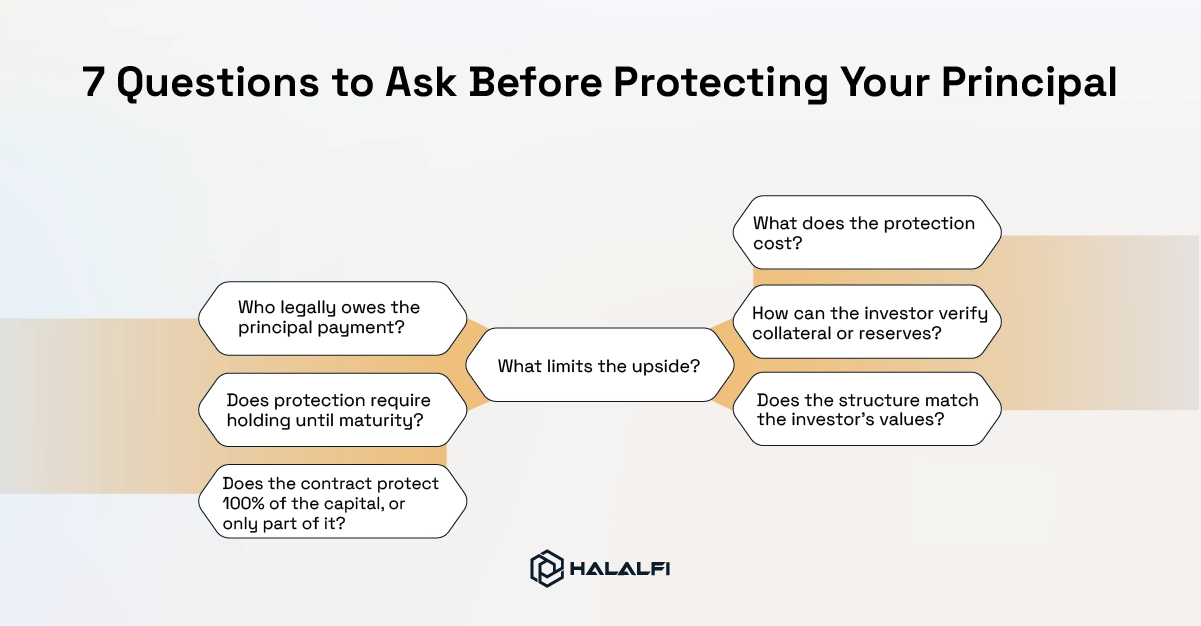
7 Questions to Ask Before Protecting Your Principal
A sales pitch can make protection sound simple. A useful review goes further:
Who legally owes the principal payment? Check the bank, guarantor, insurer, or project counterparty.
Does protection require holding until maturity? Ask what happens during an early exit.
Does the contract protect 100% of the capital, or only part of it? Look for barriers and conditions.
What limits the upside? Review caps, participation rates, averaging, calls, and excluded dividends.
What does the protection cost? Compare fees and opportunity costs with simpler choices.
How can the investor verify collateral or reserves? A claim without evidence offers little comfort.
Does the structure match the investor’s values? Whether it is a stablecoin investment or anything else, examine the source of profit, underlying activity, and contractual risk.
Protection Should Clarify Risk, Not Hide It
Principal-protected notes can serve a specific purpose, but they cannot erase risk.
They often exchange liquidity and full upside for a promise that depends on an issuer, a maturity date, and pages of contractual conditions.
HalalFi takes another route. It links profit to identifiable business activity and adds project-level guarantees, collateral, screening, and on-chain records for halal investment.
Here, investors still need to examine every project, but they can see more clearly where the money goes and what supports the capital.
The next step is to compare the protection mechanism, not the marketing phrase.
Then review HalalFi’s projects structure and current opportunities through its crowdfunding platform.
Frequently Asked Questions
Are principal-protected notes FDIC-insured?
No. US regulators treat structured notes as investment products rather than insured bank deposits. Buying a note from an FDIC-insured bank does not give the note deposit insurance.
Can a principal-protected note show a loss before maturity?
Yes. Interest-rate changes, volatility, issuer credit concerns, and the value of embedded options can push the quoted price below the original investment.
Do investors receive dividends from the underlying index?
Usually not. A note often measures price movement without accounting for dividends that direct shareholders or index funds may receive.
How does the US tax principal-protected notes?
Tax treatment varies with the contract. Some structures can create taxable imputed income before the investor receives cash.
Can an issuer redeem the note early?
Some notes include call or automatic-redemption provisions. The issuer may end the investment when a specified market event occurs.
What happens to a note when its owner dies?
The estate or beneficiary generally receives the security rather than an automatic cash payment. The holder may need to keep the note until maturity or accept the available secondary-market price.