Is crowdfunding halal, or can one hidden clause turn a promising campaign into riba? The crowd does not decide; the contract does.
A campaign may help a family cover medical bills, pre-sell a new product, fund business inventory, or offer investors a share of future profit.
Each model creates different rights. That means each one needs its own Sharia review.
Is Crowdfunding Halal or Haram?
Crowdfunding is not automatically halal or haram. Its ruling depends on the funded activity, contract, source of return, and risk structure.
A campaign can be halal when it supports lawful business, avoids riba, excessive uncertainty, and speculation, and clearly explains how money and risk move.
As Mufti Muhammad Taqi Usmani explains:
“Islamic finance is based on the principle that money should not be treated as a commodity for earning profit. Profit should come from trade, investment, and sharing the risk of real economic activity.”
Crowdfunding can become haram when it finances prohibited activity or disguises an interest-bearing loan as an investment.

Crowdfunding Is a Funding Method, Not One Financial Product
The word crowdfunding covers several models. A contributor may give money, buy a future product, lend funds, acquire equity, or participate in business profit. That is more than the campaign’s branding.
Let's examine each model:
Crowdfunding model | What the contributor receives | Possible halal route | Main warning sign |
Donation | No financial claim | Sadaqah, charitable gift, waqf support | Fraud or a prohibited cause |
Reward or pre-sale | Product, service, or benefit | Clear sale, salam, or service agreement | Vague product or uncertain delivery |
Equity | Ownership in a business | Musharakah or lawful share ownership | Prohibited revenue or unclear shareholder rights |
Profit sharing | Agreed share of actual profit | Mudarabah or musharakah | Fixed return based on invested capital |
Debt or P2P lending | Repayment from the borrower | Interest-free loan or a valid trade structure | Interest, time-based fees, or late-payment increases |
Crypto campaign | Token, digital right, equity, reward, or project return | Depends on the asset and contract | Speculation, unclear rights, or anonymous fund use |
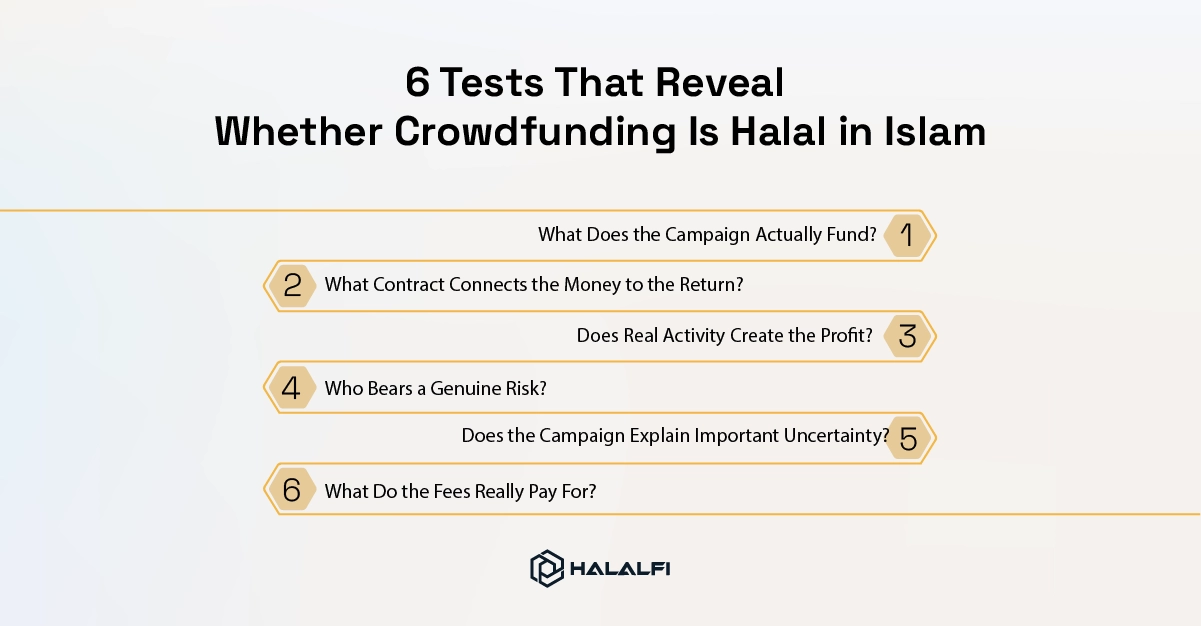
6 Tests That Reveal Whether Crowdfunding Is Halal in Islam
Not every crowdfunding campaign follows the same structure. In Islamic finance, the key issue is what the money supports, what contract connects investors and businesses, and how the return is generated.
The following tests help evaluate whether a crowdfunding model aligns with Sharia principles based on muqtasid.iainsalatiga review:
What Does the Campaign Actually Fund? Start with the business or cause. A lawful contract cannot rescue a prohibited activity. Check what the business sells, and how it earns.
What Contract Connects the Money to the Return? A campaign should identify whether the contributor acts as a donor, customer, lender, shareholder, business partner, or token holder.
Does Real Activity Create the Profit? Islamic finance does not reject profit. It asks where the profit comes from.
Who Bears a Genuine Risk? Halal Investment does not require reckless risk. It does require an honest connection between reward and responsibility.
Does the Campaign Explain Important Uncertainty? Business always involves uncertainty. Sharia does not demand perfect prediction. It rejects uncertainty so severe that people cannot understand what they buy or what they owe.
What Do the Fees Really Pay For? A platform may charge for screening, payment processing, legal work, administration, reporting, or smart-contract infrastructure. A genuine service fee does not automatically count as riba.
Are Donation and Reward Campaigns Always Halal?
Donation crowdfunding often offers the simplest structure. A donor gives money without expecting a financial return.
The campaign still needs a lawful purpose, honest representation, proper handling of funds, and clear platform fees.
When Equity and Profit-Sharing Crowdfunding Can Work
Equity crowdfunding gives investors ownership. A halal structure requires a lawful business, clear share rights, fair disclosure, and acceptable financial practices.
Investors should check the company’s revenue sources and interest-bearing debt. They should also understand dilution.
A new funding round may reduce an early investor’s ownership percentage, even when the company grows.
When Debt Crowdfunding Crosses Into Riba
Conventional P2P lending usually allows contributors to lend money and collect principal plus interest. That structure conflicts with the prohibition of riba.
A murabaha provider, for example, must purchase and own the goods before selling them at an agreed price. It cannot transfer cash, add a markup, and call the loan a sale.
Is Crypto Crowdfunding Halal?
Crypto crowdfunding can be halal, but blockchain does not provide a Sharia shortcut.
A strong crypto crowdfunding campaign should answer:
What legal or economic right does the token create?
Does the holder own equity, a product claim, or only a tradable symbol?
Where will the stablecoins go?
Which real activity creates the return?
Can the team change supply or contract rules?
Does the project encourage investment or short-term gambling?
Who controls the treasury and upgrade keys?
Which court or arbitration process handles disputes?
Is Crowdfunding Illegal?
Crowdfunding is not automatically illegal. Its legal status depends on the country, campaign type, investor location, and the financial rights offered.
Donation and reward campaigns follow charity, tax, payment, and consumer rules. Equity, lending, revenue-sharing, and token campaigns may trigger securities, AML, and crypto regulations.
In the U.S., Regulation Crowdfunding allows eligible companies to raise to $5 million within 12 months through an SEC-registered intermediary. The SEC’s Regulation Crowdfunding guide explains the current framework.
Legal registration does not make a campaign halal. Sharia approval does not replace legal compliance. A responsible platform needs both.
Is HalalFi a Halal Crowdfunding Model?
Crowdfunding is not automatically halal or haram. The ruling depends on the funded activity, contract, return source, and risk structure.
HalalFi focuses on real business projects, not token speculation. It uses USDT for funding and reviews each project from both business and Sharia perspectives before listing it.
The structure focuses on:
Real business activity: Returns come from the performance of the funded project, not from interest payments.
Clear investment terms: Investors can review the purpose, duration, expected return, and project details before participating.
Risk-sharing principles: The model avoids fixed interest and links profit to commercial outcomes.
Additional protection mechanisms: HalalFi describes collateral and guarantor structures that may support principal protection after a confirmed default.
USDT acts as a settlement tool, not the source of profit. The investment return should come from the underlying halal business activity.
Like any investment, HalalFi does not remove all risks. Business failure, delays, legal disputes, stablecoin issues, and smart-contract risks can still affect outcomes.
A Halal Crowdfunding Checklist Before You Commit Funds
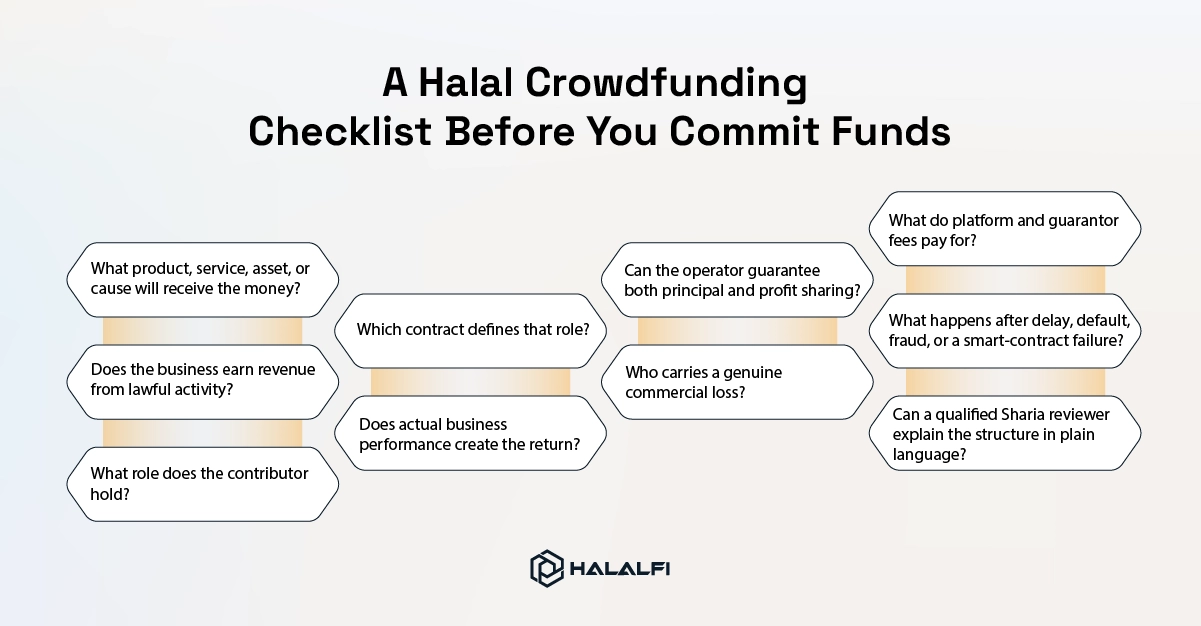
Pause before approving the wallet transaction. Then answer these ten questions:
What product, service, asset, or cause will receive the money?
Does the business earn revenue from lawful activity?
What role does the contributor hold?
Which contract defines that role?
Does actual business performance create the return?
Can the operator guarantee both principal and profit sharing?
Who carries a genuine commercial loss?
What do platform and guarantor fees pay for?
What happens after delay, default, fraud, or a smart-contract failure?
Can a qualified Sharia reviewer explain the structure in plain language?
Conclusion
So, is crowdfunding halal? Sometimes. A donation may support a lawful cause. A reward campaign may finance a real product. Equity and profit-sharing models may connect investors with genuine business growth.
The same funding method can also hide interest, prohibited revenue, misleading guarantees, or speculation with no clear economic purpose.
Do not judge the crowd. Judge the contract, business, fund flow, risk, and source of profit.
We suggest you visit HalalFi Projects and test a project against the checklist above. Read the documents, trace what the USDT funds, and then decide whether the opportunity fits both personal risk limits and Sharia principles.
Frequently Asked Questions
Does a flat crowdfunding fee make the campaign halal?
Not automatically. A platform may charge a genuine fee for screening, administration, payments, or legal work. The fee becomes questionable when it functions as an increase on a cash loan, especially when the amount rises with the loan size or duration.
Can a non-Muslim-owned business raise halal crowdfunding?
Yes. The owner’s religion does not decide the ruling. The business activity, contract, revenue, financial conduct, and use of funds matter.
Can investors sell a crowdfunding position before the project ends?
Only when the contract, platform rules, asset type, and law permit it. Many private investments lack an active secondary market.
Does a Sharia board guarantee that a project will stay halal?
No. A Sharia review examines the structure and available information. The business must continue following the approved terms after funding.
Does an unsuccessful reward campaign create a debt?
The answer depends on the campaign terms and why delivery failed. The creator may owe a refund when the agreement requires one.
Is real estate crowdfunding automatically halal?
No. Investors must inspect the property use, financing, ownership structure, leases, debt levels, income sources, and return model.