
What started as a niche experiment is now a serious alternative to traditional finance, opening doors for entrepreneurs who might otherwise struggle to access capital.
Crypto investment has become a powerful fundraising engine for startups, creators, and mission-driven projects worldwide.
But here’s the real question: is blockchain-based crowdfunding simply hype, or is it a smarter, more transparent way to raise funds, especially for those seeking halal investment opportunities?
Over the years, early crypto campaigns have skyrocketed, and others have collapsed just as quickly. The difference is in structure, transparency, and alignment.
When designed properly, crypto crowdfunding can unlock global capital faster than traditional platforms ever could, while also offering faith-conscious investors new ways to participate in ethical, real economic activity.
So let’s break it down clearly: how it works, where the risks lie, and how it connects to the growing demand for halal-by-design fundraising models.
How Crypto Crowdfunding Became a Mainstream Capital Engine?
In blockchain finance, crypto crowdfunding and fundraising aren’t those quirky side experiments people used to whisper about in Telegram groups anymore.
They’ve grown up. What once felt like a niche playground for tech enthusiasts is now a full-blown capital machine with serious money moving through it.
According to the latest annual overview of crypto capital markets, the combined crypto and Web3 fundraising ecosystem, covering token sales, decentralised funding rounds, and blockchain-backed crowdfunding, raised an eye-opening $50.6 billion across 1,409 individual deals in 2025.
That figure is more than double what we saw in prior years. It’s not a gentle uptick. It’s a surge.
What makes it even more interesting is the transparency. At least 1,005 of those deals disclosed actual funding amounts.
In a space that critics often label opaque or chaotic, that level of data visibility tells a different story. This isn’t shadow capital quietly shifting around. It’s structured, reported, and increasingly institutional in tone.
If you’ve been around crypto long enough, you probably remember when raising funds meant whitepapers, Discord hype, and a hopeful roadmap.
Now the landscape feels different, more deliberate and more data-driven. Investors aren’t just chasing shiny tokens; they’re allocating capital through increasingly sophisticated mechanisms.
Platforms designed to bring institutional-grade crypto crowdfunding to the mainstream are gaining real traction, too.
Some of the major marketplaces targeting accredited investors and large global crowds have already attracted millions of participants and supported more than 30 projects worldwide.
That’s venture-scale energy, just routed through blockchain rails rather than traditional banks.
Venture-style raises, once confined to boardrooms and tightly guarded pitch decks, are steadily migrating toward decentralised, blockchain-based capital sourcing.
The crypto investment industry is now funnelling tens of billions of dollars into blockchain projects every year.
Data source: Crypto Fundraising Report 2025, crypto-fundraising. Read the full report and trending stats (crypto‑fundraising.info)
What Is Crypto Crowdfunding?
Let's see first what crowdfunding is. At its simplest, crowdfunding is a way to raise money by collecting small contributions from many people, usually through an online platform.
In this way, instead of a bank loan, a single investor, or personal savings, creators, startups, and organisations pitch their ideas and invite the public to support them.
This support can take many forms, such as donations, rewards, equity, or future products. It depends on the type of campaign.
Crowdfunding became popular because it lowers the barrier to entry. You don’t need deep pockets or powerful connections to get started; you need a clear idea, a story people believe in, and a way to reach them.
Over time, it has funded everything from indie films and tech gadgets to social causes and small businesses.
This traditional model sets the foundation for understanding what Crypto Crowdfunding is. Here, blockchain technology reshapes how funds are raised, tracked, and protected.
Blockchain crowdfunding is a method of raising funds using blockchain technology and digital assets instead of traditional fiat payment systems.
Rather than relying on banks or centralised intermediaries, campaigns often use smart contract crowdfunding mechanisms to collect, manage, and distribute funds.
At its core, it’s still crowdfunding, but with transparency, automation, and borderless access built in.
According to Crypto Fundraising, the decentralized finance ecosystem remained active in 2025, with tens of billions of dollars moving through DeFi protocols, and early-stage crypto projects raising over $50 billion globally via decentralized and venture funding channels, while decentralized launchpads alone helped funnel several billions of dollars in new capital into emerging protocols.
Related Article: Risks in Traditional Crowdfunding
Transparency and the Financial Fingerprint
Imagine you’re in a crowded café. Your friend is excitedly showing you her phone. She’s backed a new board game project, not on Kickstarter, but on a blockchain platform.On her screen, you see rows of numbers, wallet addresses, and timestamps. Every payment she and others made is there. Public. Precise. Permanent.
This isn’t a screenshot she saved. It’s live data pulled directly from the blockchain. Anyone can check it. Not just backers. Not just the project team. Anyone with an internet connection.
That’s the real meaning of transparency here, not just “we promise we raised this much.”
In traditional crowdfunding, you usually see a total like “$250,000 raised” and a progress bar. But you can’t independently verify it, You can’t see each transaction, You have to trust the platform’s internal database.
And honestly, there’s no simple way for you to audit it yourself.
Blockchain works differently. Every contribution is recorded on a public ledger that cannot be quietly edited or manipulated.
Once a transaction is confirmed, it cannot be changed without enormous computational power.
In practice, that makes fraud extremely difficult. The record becomes a kind of financial fingerprint, unique, traceable, and tamper-resistant.
So the transparency here isn’t just visual. It’s verifiable. You don’t have to believe someone’s report. You can check the money trail yourself. And that changes the game.
Let’s see an example from history:
Case Study: The DAO (2016)
According to Wikipedia, one of the earliest and most famous blockchain fundraising campaigns was The DAO. In just the first few weeks:
It raised over $150 million in Etherium from more than 11,000 investors.
All of this was done in a fully transparent way: every investment and token allocated was recorded on Ethereum’s public ledger.
Anyone, not just backers, could use a blockchain explorer to watch funds flow to the smart contract in real time.
That transparency was revolutionary. You could literally type in the smart contract’s address and see:
How much Etherium was raised
who sent what (anonymised only by address)
and whether any funds were moved afterwards
But here’s the twist in the story: because everything was on-chain and public, the moment something went wrong, as it did when hackers found a loophole, everyone saw it instantly, too.
That public footprint meant the issue couldn’t be hidden, and the incident became a global lesson in transparency and security risks.
So yes, the blockchain doesn’t magically stop fraud. But it raises the bar instantly.
In the traditional world, you might never know if funds were mismanaged until months later, if ever. In the blockchain, it’s right there for anyone to check. You don’t need an insider login; you just need an internet connection.
No KYC & Inclusivity
Imagine your friend lives in a small country where his bank won’t let him open an investment account without tons of paperwork.
Meanwhile, another friend, in another country, doesn’t qualify for accounts on major crowdfunding sites due to regional restrictions.
But both can open a simple crypto wallet app on their phones; no passport scans or proof of residence required, and no waiting weeks for verification.They tap “Contribute” on a blockchain fundraising page, and a few seconds later, they’re in.
That’s the core idea behind many crypto crowdfunding systems: participation that doesn’t hinge on traditional KYC barriers.In many parts of the world, that’s not about dodging rules; it’s about access.
Sure, it means someone without a formal bank account can participate. But it also speaks to something deeper, structural limits in traditional finance.
In some countries, opening an international investment account is complicated, slow, or simply impossible for ordinary people. You might need a high minimum balance, You might face currency controls, Or you might be blocked entirely because of where you live.
Then there’s taxation. Traditional cross-border investing can expose people to complicated and sometimes unfair tax burdens.
For example, certain platforms automatically report earnings to tax authorities in ways that may not reflect local economic realities.
In some cases, small investors can end up facing high withholding taxes or double taxation simply because they invested through a foreign intermediary. For someone investing a modest amount, the compliance costs alone can be discouraging.
Crypto crowdfunding changes that dynamic. By allowing peer-to-peer participation without relying on centralized financial institutions, it reduces the layers that often trigger automatic reporting, brokerage fees, or cross-border tax complications.
It doesn’t eliminate tax obligations; laws still apply, but it can remove some of the structural friction that disproportionately affects smaller or international investors.
For many participants, it’s less about escaping rules and more about avoiding systems that were never designed with them in mind.
According to Crowdfundinsider, by 2025, over 740 million people worldwide will have access to digital assets, many in places where access to traditional investments is limited or nonexistent.
That means hundreds of millions of people could, in theory, participate in global crowdfunding campaigns with nothing more than a wallet and internet access.
Now, it’s important to be honest; not all blockchain fundraising stays free of KYC forever. Some do layer it in later when regulatory obligations kick in, especially for anything that looks like equity or token trading.
The idea isn’t that KYC is “bad”, it’s that crypto crowdfunding can offer a sliding scale of accessibility that traditional platforms simply cannot match.
Let’s bring in another real example:
AssangeDAO: A Global, Inclusive Fundraiser
According to Wired, in early 2022, a grassroots community formed around a cause, putting pressure on legal support for Julian Assange. They didn’t go through a bank or a traditional fundraising service.
Instead, they built a DAO (decentralised autonomous organization) and raised over $50 million in Ethereum through the sale of NFTs and governance tokens. Backers came from all over the world, from Europe, Asia, Africa, wherever there was a crypto wallet, there was accessibility.
Sure, legal teams and governments later stepped in for compliance. But in the moment of participation, there were no borders, no bank hoops, no region blocks.
For countless others who’ve been shut out of traditional financial participation, that feels like a big shift.
Why the Combination of Blockchain and Crowdfunding Works
Traditional crowdfunding platforms require trust in a central authority. Blockchain for crowdfunding flips that model.
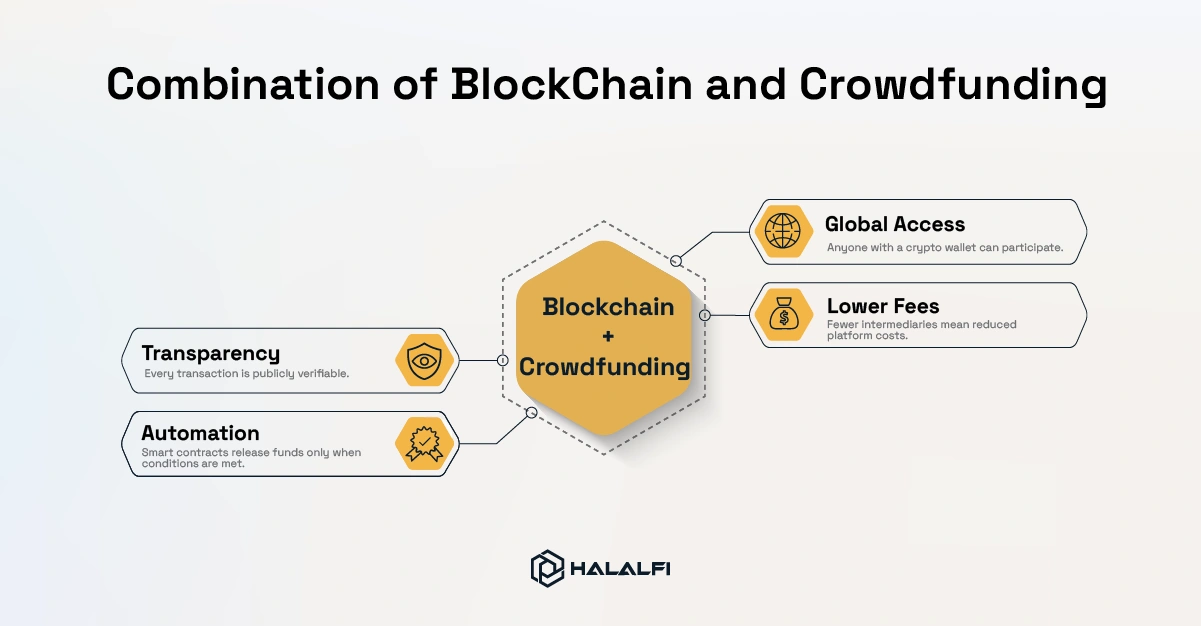
Here’s what blockchain brings to crowdfunding and why web3 crowdfunding has gained traction among startups building decentralised products.
Transparency: Every transaction is publicly verifiable.
Automation: Smart contracts release funds only when conditions are met.
Global access: Anyone with a crypto wallet can participate.
Lower fees: Fewer intermediaries mean reduced platform costs.
Crypto Crowdfunding Risks
Crypto crowdfunding sounds exciting. Anyone can invest and raise money; there are no banks and no paperwork. Just a website and a digital wallet. But it also has real risks.
One big risk is scams. Some projects look professional. They have nice websites, big promises, and active social media pages. But after raising money, the founders disappear. This is often called a “rug pull”, where founders run away with exit liquidity.
According to Wikipedia, one rug pull project is Argentine cryptocurrency $LIBRA earlier in 2025.
After the president of Argentina shared information about the token on social media, its price rocketed from nearly nothing up to several dollars in just minutes.
But then the project's founders sold most of their holdings when the price was high, causing it to crash back down to less than a dollar and wiping out significant value for everyday investors.
That sudden liquidity squeeze and price collapse led many analysts to classify it as a rug pull.
Another risk is price volatility. Crypto prices can change very fast. A token you buy for $1 today might drop to $0.20 next week. Even if the project is real, the market can still crash.
According to Chainup, in October 2025, the entire cryptocurrency market was hit by a massive crash driven by rapid liquidations of leveraged positions.
Over $19 billion in crypto trades were forced sold within hours, and major coins like Bitcoin and many smaller tokens plunged sharply in value over a very short period.
Some altcoins dropped by 40% or more within minutes, then partially recovered later. This event showed how quickly prices can swing, even if a project is legitimate, and why you can lose a lot of money fast simply because the market moves violently.
There is also no strong regulation in many countries. If something goes wrong, it is hard to get your money back. Unlike a bank, there is usually no insurance.
Related Article: Typical Problems in Crypto Crowdfunding
What Is Crowdfunding in the Crypto World?
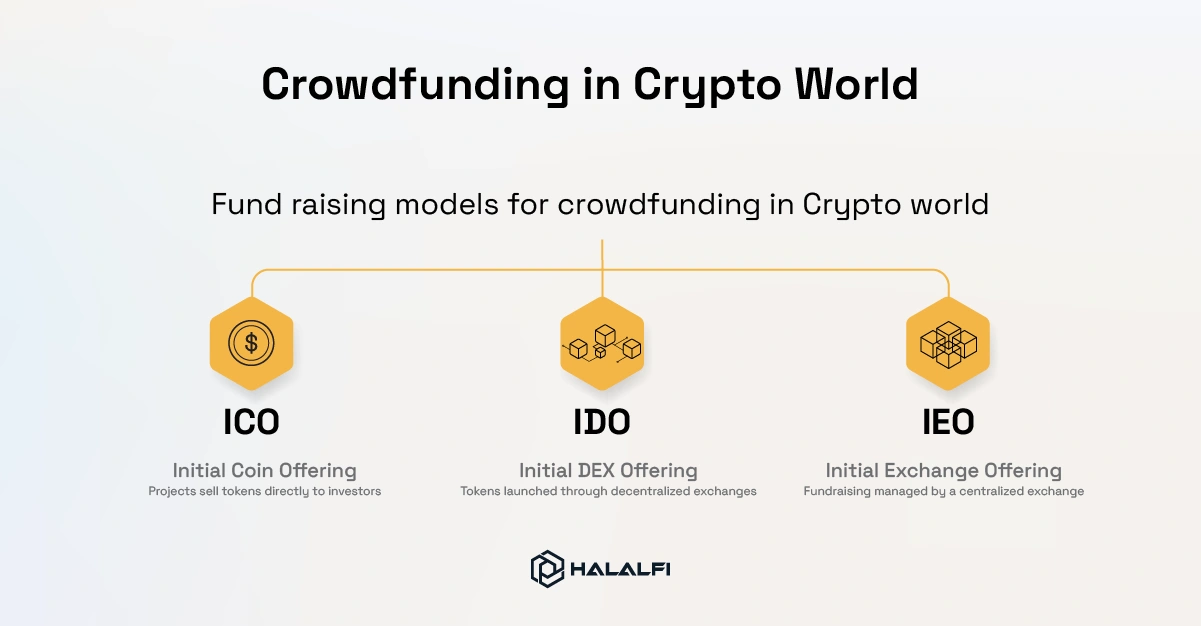
Crowdfunding in crypto often overlaps with fundraising models like:
ICO (Initial Coin Offering)
IDO (Initial DEX Offering)
IEO (Initial Exchange Offering)
Each model differs in structure, regulatory oversight, and levels of investor protection, yet all are built on the same blockchain-based crowdfunding foundation.
The fundamental shift from traditional crowdfunding is this: contributors aren’t just backing an idea; they typically receive tokens that play an active role within the project’s ecosystem, rather than simple rewards or equity shares.
What is an ICO?
ICO is an early-stage fundraising method in which a project issues its own tokens and sells them directly to supporters in exchange for cryptocurrency. See what is ICO for more information.
One of the earliest ICO success stories was Ethereum, which raised funds by selling ETH tokens before the network launchedو and today, ETH is one of the largest cryptocurrencies by market cap.
Beyond the big names, many smaller ICOs continue to pop up on platforms that list new offerings in 2026, showing that this model is still in use.
In the last few years, we have seen terms like initial token offering (ITO), which stands for Initial Token Offering, as tokens have largely dominated the space and replaced the coin concept.
What is IDO?
On the other hand, IDO is a newer approach in which tokens are launched and distributed via decentralised exchanges, enabling greater transparency and immediate liquidity. See what is IDO for more information.
According to Qubit, in 2024, the IDO fundraising market expanded significantly, and crypto startups raised over $16.1 billion through IDOs and similar token launch mechanisms.
This shows how much capital is now flowing into decentralised token sales compared with older fundraising styles.
Launchpads like Polkastarter and others focused on IDO token pools are among the platforms shaping this trend heading into 2026, helping projects access community funding and immediate trading.
What is IEO?
An IEO takes place on a centralised exchange (CEX) such as Binance or KuCoin. In this model, the exchange acts as an intermediary, vetting the crypto project, managing the token sale, and often listing the token directly on its platform after the sale ends.
Because the exchange has a reputation to protect, an IEO may be seen as more trustworthy than a raw ICO or ITO.
According to Kucoin, one of the most notable IEO platforms has been Binance Launchpad.
By April 2024, it had helped over 90 crypto projects raise more than $188 million from millions of participants, with tokens like Fetch.AI and STEPN launched this way, giving early investors access before public trading.
What Are the Payment Options on Leading Crypto Crowdfunding Sites?
Most crypto crowdfunding platforms support multiple payment methods, including:
Ethereum (ETH)
Bitcoin (BTC)
Stablecoins (USDT, USDC)
Platform-native tokens
Stablecoins have become especially popular because they reduce volatility risk during fundraising.
According to Yahoo Finance, stablecoin transaction volume continued to expand rapidly in 2025, with overall stablecoin transfers reaching record levels, surging by roughly 80–83% year over year as total annual volume climbed into the trillions of dollars.
And honestly, this growth makes sense. The very nature of stablecoins differs from that of assets like Bitcoin or Ethereum. They are typically pegged to relatively stable assets such as the U.S. dollar.
That stability matters a lot in crowdfunding. Business already carries enough risk: operational, market, and and execution. Adding price volatility on top of that can distort everything.
Imagine raising $1 million for a project in ETH. If the market drops 20% in two weeks, your working capital suddenly shrinks. Nothing about your business changed. The team is the same. The plan is the same.
But now you have less runway simply because the crypto market moved. That kind of risk shouldn’t spill over into business financing.
Stablecoins help separate fundraising from the volatility of speculative price swings. They allow entrepreneurs to plan budgets more accurately and give investors clearer expectations about capital allocation.
In a world where trade and commerce already face uncertainty, reducing unnecessary volatility is not just convenient, it’s rational. And that’s why stablecoin usage in crowdfunding is likely to keep expanding.
How to Create a Campaign on a Crypto Crowdfunding Platform
Creating a campaign is more technical than launching a traditional page, but not by much anymore.
Step-by-Step Guide to Raising Funds via Crypto Crowdfunding
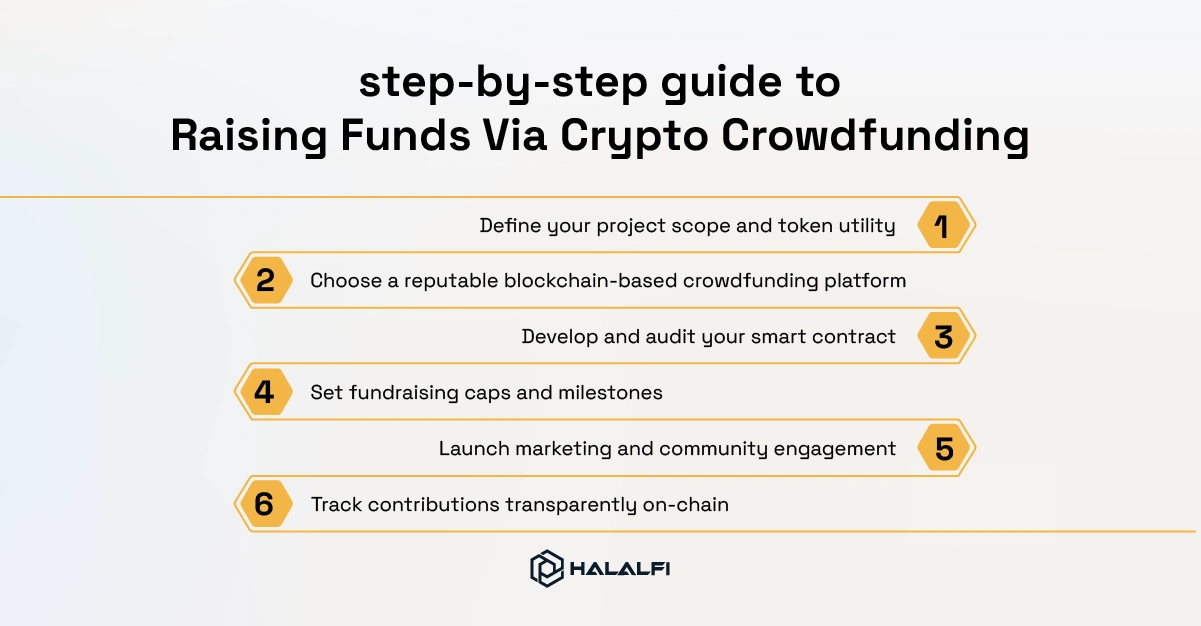
Let's see how to raise funds via blockchain crowdfunding:
Define your project scope and token utility
Choose a reputable blockchain-based crowdfunding platform
Develop and audit your smart contract (Many founders underestimate this step. Some promising campaigns stall simply because smart contracts weren’t properly audited)
Set fundraising caps and milestones
Launch marketing and community engagement
Track contributions transparently on-chain
Now, here’s something important.
Most blockchain crowdfunding discussions focus heavily on token-based, fully digital projects. That makes sense. Tokens are central in crypto ecosystems.
But in HalalFi models, the structure can be different.
In HalalFi, tokenisation is often used to represent real, off-chain investment opportunities such as property, equipment, or physical businesses. The token is not just a speculative digital asset.
It represents ownership or participation in something tangible. That changes the dynamic. The focus shifts from pure token utility inside a digital ecosystem to asset-backed participation linked to real economic activity.
So while the technical steps may look similar, the underlying philosophy can be very different.
How to Track Crypto Crowdfunding Contributions Securely
Tracking contributions is one of crypto crowdfunding’s most substantial advantages. Blockchain explorers like Etherscan provide real-time visibility.
Also, smart contracts automatically log transactions, and Contributors can independently verify how funds are used. Don't forget, transparency isn’t a feature in blockchain crowdfunding; it’s the default.
Security in blockchain crowdfunding isn’t just “keeping hackers out.” It’s about programmable rules, the kind that don’t depend on someone’s mood, memory, or manual approval. With smart contract crowdfunding, you can hard-code protections like:
Milestone-based releases (funds unlock only after specific goals are met)
Refund logic (if the campaign fails, contributors can reclaim funds)
Spending limits (prevent large withdrawals without conditions)
Multi-signature controls (more than one trusted party must approve transfers)
Are There Crypto Crowdfunding Platforms That Offer Investor Protection?
Yes, but protection varies. Crypto investments still carry risk. The World Bank has repeatedly emphasised that investor education is critical in decentralised finance ecosystems. Some platforms now include:
Escrow-based smart contracts
Refund mechanisms if milestones fail
Third-party code audits
Smarter Risk Management in Crypto Crowdfunding
Before we talk about reducing investor risk, let’s pause for a second and clarify what HalalFi actually does.
HalalFi is not a hype-driven token launchpad. It’s a Sharia-compliant blockchain crowdfunding platform designed to connect investors with real, revenue-generating businesses. Not pitch decks. Not speculative charts. Actual operations with cash flow.
Every project goes through a dual filter before it ever appears on the platform. First, a Sharia review ensures the business model avoids riba (fixed interest), excessive uncertainty, and prohibited sectors.
Then comes a business audit that evaluates financial sustainability, revenue history, operational structure, and the feasibility of growth. If a project fails either review, it doesn’t get access to community capital. Simple.
On top of that, HalalFi uses smart contracts to manage contributions transparently on-chain. Funding targets, timelines, profit-sharing ratios, and terms are clearly defined before participation begins.
Investors are not funding vague promises; they are entering structured, performance-based agreements.
This foundation matters. Because once you understand that HalalFi focuses on real businesses, structured audits, and performance-linked profit-sharing, the conversation about risk becomes more intelligent.
And that brings us to the real question: How to Reduce Investor Risk Without Killing Opportunity?
For investors, the point is not to avoid crypto crowdfunding altogether; it’s to learn how to evaluate risk intelligently. Here’s what materially lowers exposure:
Platforms that use milestone-based fund releases instead of immediate lump-sum transfers
Transparent documentation of token economics and fund allocation
Independent smart contract audits are published publicly
Clear communication of project timelines and deliverables
And then there’s another model, the one we use, which adds an extra layer of protection.
In this structure, users invest in a project, but the platform requires collateral (security/guarantee assets) from the project owner.
In simple terms, the founder must lock assets up as collateral. If the project fails to deliver or does not meet agreed conditions, the funds can be returned to investors using that collateral.
This changes the psychological balance. The founder now has something at risk, too. It’s not a one-sided bet.
Traditional crowdfunding usually doesn’t work this way. If a project fails, backers often just lose their money. But with a collateral-backed model, risk is shared more fairly. It doesn’t remove all uncertainty; business is never 100% safe, but it creates accountability.
Risk in crypto crowdfunding often comes from opacity, not volatility alone. When oversight, verification, and structured safeguards are in place, the probability of catastrophic failure decreases, even if market risk persists.
Investor protection in crypto crowdfunding involves designing systems that make misuse harder and accountability clearer.
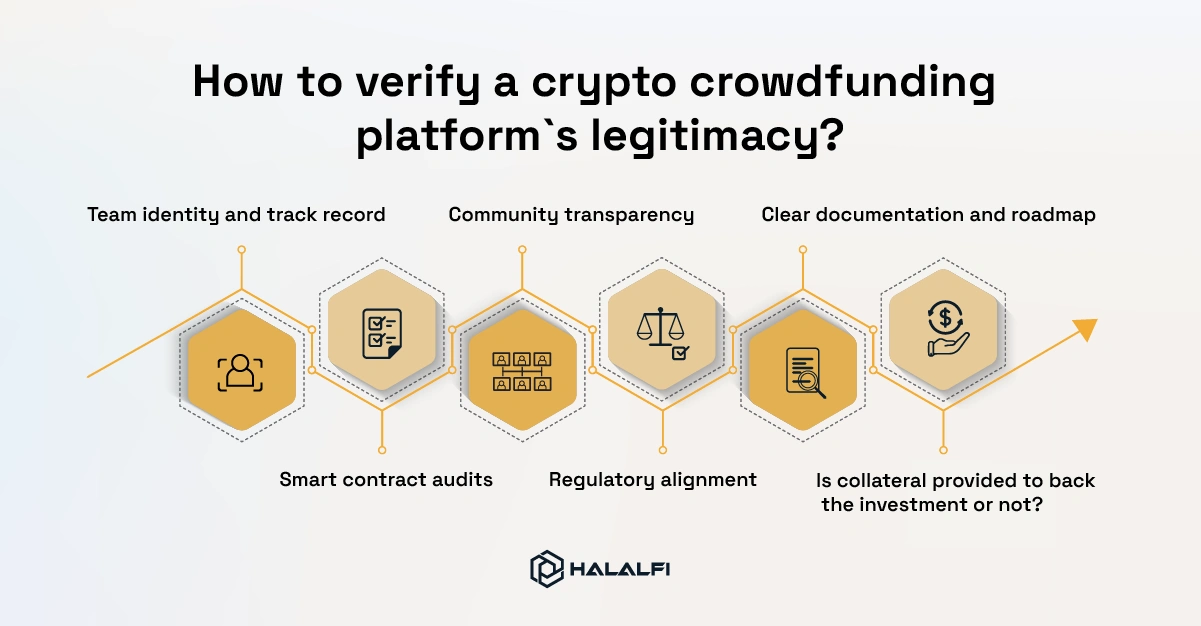
How to Verify a Crypto Crowdfunding Platform’s Legitimacy
Before investing or launching a campaign, always check the options below. Besides, if a platform avoids answering basic questions, that’s usually your cue to walk away.
Team identity and track record
Smart contract audits
Community transparency
Regulatory alignment
Clear documentation and roadmap
Is collateral provided to back the investment or not?
When Crypto Crowdfunding Meets Ethical Finance: Is it Opportunity or Red Flag?
Crypto crowdfunding has exploded in recent years. Blockchain technology allows startups to raise capital globally, instantly, and without traditional intermediaries.
Investors can participate early, often with small amounts, and gain exposure to innovative projects that might otherwise be inaccessible.
On paper, it sounds revolutionary. But here’s the part many investors eventually pause at: Just because something is technologically advanced… does that make it structurally sound?
Crypto crowdfunding removes intermediaries, but it can also remove oversight. It increases speed, but sometimes reduces clarity. It expands opportunity, but may amplify speculation.
So “Is this profitable?” “Is this ethical?” And, more specifically, for Muslim investors: “Is this halal?”
Halal Investment in the Age of Crypto Crowdfunding
For investors focused on halal investment, crypto crowdfunding presents both serious opportunities and legitimate concerns.
On one hand, blockchain technology enables transparency through public ledgers. Smart contracts can automate agreements and reduce the risk of manipulation. Tokenisation can represent ownership in real assets.
On the other hand, some token models resemble speculation rather than real economic participation.
Certain fundraising mechanisms blur the line between equity and interest. Many projects lack proper screening or structured supervision.
This is why Sharia-compliant crowdfunding platforms are becoming increasingly relevant in the crypto era. They don’t reject innovation; they structure it.
Sharia-aligned crypto crowdfunding models typically emphasise:
Ethical project screening before listing
Avoidance of interest (riba) in funding mechanisms
Clear profit-and-risk sharing structures
Instead of treating crypto as a trading playground, they attempt to use blockchain as infrastructure for real participation.

How HalalFi Approaches Crypto Crowdfunding
To understand how this works in practice, consider HalalFi as a master case. HalalFi positions itself at the intersection of:
Blockchain technology
Crowdfunding accessibility
Sharia-compliant financial structure
Rather than simply launching token sales, the platform frames itself around:
Halal by Design
Supervised Procedure
Asset-Linked Participation
Accessible Participation
For many Muslims, the hesitation around crypto crowdfunding isn’t about fear of innovation. It’s about fear of crossing a boundary unknowingly.
Is this structured like an interest? Is the token backed by real activity or just hype? Is the risk shared fairly?
Platforms like HalalFi aim to address those concerns structurally by combining blockchain transparency with supervised, Sharia-compliant frameworks.
In that sense, the real evolution isn’t “crypto replacing traditional finance.” Its structure replaces ambiguity.
Sharia Governance in Crypto Crowdfunding
Sharia governance or screening is not legally compulsory for crowdfunding platforms in most jurisdictions worldwide, except in a few where regulations align with Islamic principles.
In most countries, regulatory frameworks issued by securities commissions primarily focus on investor protection, transparency, and financial stability rather than mandating compliance with Islamic principles.
So, platforms can operate without it, relying on general laws for equity or debt crowdfunding. This makes Sharia adherence a strategic choice rather than a regulatory requirement.
Instead, Sharia governance functions as a supplementary layer that projects voluntarily add to attract Muslim investors, strengthen credibility in halal-focused markets, and differentiate themselves in competitive Islamic fintech spaces.
This layer often includes a Shariah board, continuous supervision, asset-backed validation, and a clearly defined profit-loss-sharing structure. This boosts user acquisition and credibility, as seen in platforms like HalalFi.
Where HalalFi Fits Into Blockchain Crowdfunding?
Interestingly, new models are emerging that combine crowdfunding with ethical frameworks.
HalalFi positions itself as a supervised, inclusive model built on halal investment and accessible finance.
The emphasis on structured oversight and transparency reflects crowdfunding's ability to adapt to values-based communities. It’s a reminder that crowdfunding isn’t a one-size-fits-all approach. It evolves.
Crowdfunding has always been about connecting entrepreneurs with the crowd. HalalFi’s angle is to connect them through a faith-aware lens, so participation feels inclusive, accessible, and supervised rather than “you’re on your own, good luck.”
If you’re a Muslim investor who wants real participation in projects (not just chart-watching), the appeal is both emotional and practical: you want to support real economic activity, accessible participation, and a supervised process, so you’re not alone in evaluating legitimacy.
Picture the kind of person who’s been watching from the sidelines for years. They see opportunities. They want diversification. They’d like to participate early in high-potential projects.
But they pause, because they don’t want the spiritual stress of “maybe this isn’t clean.” That person isn’t behind. They’re careful. A supervised, halal-by-design approach speaks directly to that careful investor.

Industry Perspectives on Crypto Crowdfunding
Crypto crowdfunding isn’t replacing traditional finance overnight. It’s giving founders options and giving investors visibility. That balance between innovation and responsibility is where the industry is heading.
Comparing Startup Crowdfunding Models
This comparison explains why many early-stage startups are shifting toward blockchain-based crowdfunding models:
Feature | Traditional Crowdfunding | Crypto Crowdfunding | Shariah-Aligned Crowdfunding (Halal Model) |
Payment Options | Credit cards, bank transfers | Crypto & stablecoins | Fiat, crypto & asset-backed structures (where applicable) |
Transparency | Platform-level reporting | Fully on-chain, publicly verifiable | Transparent reporting + contractual clarity |
Global Access | Often geographically restricted | Borderless participation | Global access within a compliance framework |
Automation | Manual processing & payouts | Smart contract automation | Structured agreements with defined profit-sharing terms |
Fees | Platform & payment processor fees | Network & platform fees (generally lower) | Competitive fees with compliance oversight |
Risk Structure | Often reward-based or equity | Token-based; market volatility risk | Risk-sharing models (e.g., profit-loss sharing) |
Regulatory Clarity | Established in many markets | Evolving and jurisdiction-dependent | Structured within Islamic finance principles |
Shariah Screening | Not applicable | Rarely applied | Built-in Shariah screening & compliance review |
Conclusion: Is Crypto Crowdfunding Worth It?
Crypto crowdfunding isn’t meant to make easy money; it is a powerful fundraising tool when used responsibly. Transparency, automation, and global access give it clear advantages over traditional models.
If you’re exploring blockchain-based crowdfunding or halal-aligned crypto investments, the most brilliant move is to start with a trusted, well-structured crowdfunding platform that prioritises compliance, transparency, and user education.
Explore a secure blockchain crowdfunding platform today and see how decentralised crowdfunding can work for your project.
If you’re a Muslim entrepreneur or investor looking for opportunities that truly align with Shariah principles, don’t settle for surface-level claims.
Take the time to carefully examine the structure of each offering: how the contracts are structured, how profits are generated, how risks are shared, and whether the model genuinely avoids riba, gharar, and involvement in unethical industries.
Look at the governance framework. Review the risk disclosures. Ask how capital is deployed and how returns are calculated. Clarity isn’t optional in Islamic finance; it’s essential.
Before committing your capital, evaluate the business model, underlying assets, exit strategy, and reporting transparency.
Who oversees Shariah compliance? How are disputes handled? What protections are in place for investors? A halal label alone is not enough; true alignment requires due diligence.
Once you’ve reviewed these structural and risk considerations, explore platforms built specifically around Islamic finance principles.
HalalFi is one such platform designed to facilitate halal crowdfunding opportunities. It focuses on Shariah-compliant investment structures, transparent deal presentations, and clear risk disclosure, allowing you to assess opportunities with confidence.
If you’re serious about investing with integrity and intention, don’t rush; study the model, review the documentation, and understand the risks.
Then explore available opportunities on HalalFi at your own pace so that you can participate with clarity, conviction, and full alignment with your values.
Frequently Asked Questions
1. Is crypto crowdfunding legal everywhere?
Each country has its own rules, and compliance depends on the platform's structure and token design.
2. Can beginners participate in crypto crowdfunding?
Yes, but they should start with a small capital and focus on education first.
3. How long does a typical crypto crowdfunding campaign last?
Platforms usually offer timelines of 30-90 days. Some can go up to 120 days. Anyway An average crowdfunding campaign takes 45 days.
4. Are crypto crowdfunding returns guaranteed?
No. Like all crypto investments, returns are never guaranteed.
5. Can crypto crowdfunding be used for non-crypto businesses?
Yes, especially for tech-forward and global projects, blockchain based crowdfunding platform works.