
What if profit sharing made business growth feel fair, practical, and easier to understand? That is the real appeal. A company wins, employees or investors share in the upside, and everyone has a clearer reason to care about results.
The idea sounds simple. The details need care. A profit-sharing plan for employees does not work like a normal bonus.
A crowdfunding profit-sharing deal does not work like a loan, and a values-based model makes everything better by linking capital to actual business performance rather than to a fixed profit promise.
What Is Profit Sharing?
Profit sharing means a company distributes part of its profits to people who helped create or fund them. In an employee setting, the company usually contributes money to eligible workers through a formal retirement or incentive plan.
The IRS gives the clearest profit-sharing definition: “A profit-sharing plan accepts discretionary employer contributions.” That matters because the employer can decide how much to contribute each year, within plan rules and legal limits. The company does not need to make the same contribution every year.
How Does Profit Sharing Work?
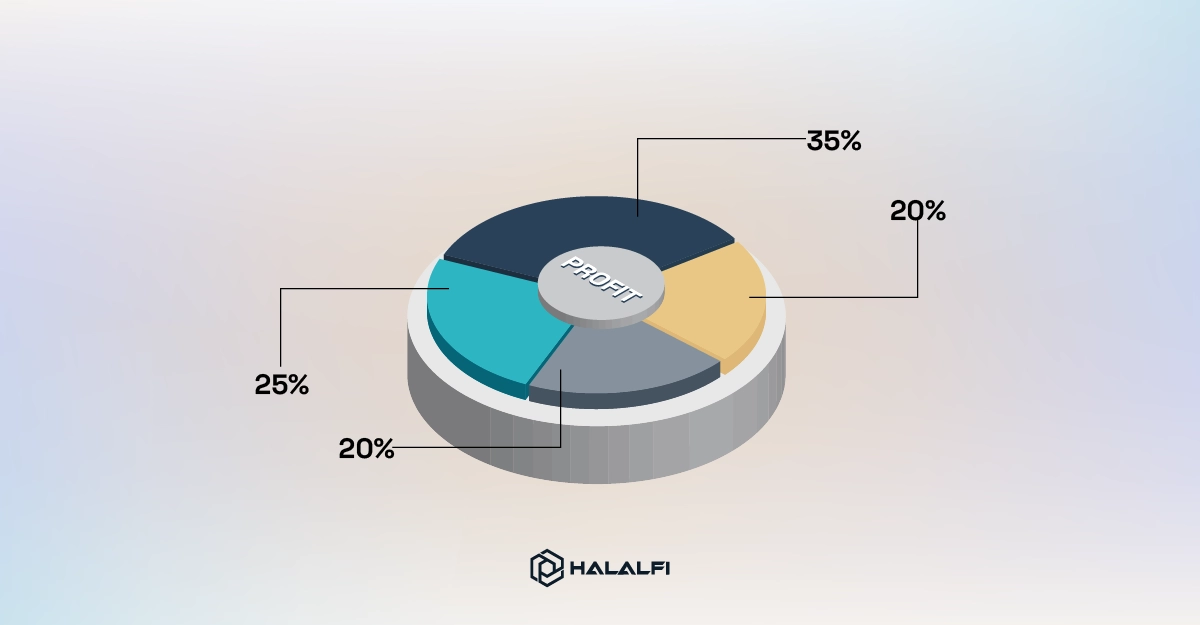
Profit sharing works through a formula. The business chooses a contribution amount and then allocates it among eligible participants.
Some companies use salary as the basis. Others use age, job class, years of service, or a flat amount.
Imagine a design studio earns $400,000 in profit. The owner shares 10%, so the pool equals $40,000. If one employee earns $80,000 and the total eligible payroll equals $200,000, that employee gets 40% of the pool, or $16,000.
What Is a Profit Sharing Plan in a Company?
A profit-sharing plan in a company usually means an employer-sponsored retirement plan. The employer funds it. Employees do not usually contribute directly to the profit-sharing part.
According to the DOL, the U.S. Department of Labor, businesses can deduct contributions up to 25% of compensation paid to plan participants. It also states that contributions are subject to an annual per-participant limit.
For 2026, the IRS sets the overall defined contribution limit at the lesser of 100% of compensation or $72,000, before catch-up amounts. That number matters for owners, executives, and high earners who already max out other retirement contributions.
The 7 Types of Profit Sharing Plans
Here are the 7 types of profit-sharing plans:
Type | Best for | What makes it useful |
Cash profit sharing | Immediate rewards | Employees receive direct cash payments |
Deferred profit-sharing plan | Retirement savings | Money grows tax-deferred until withdrawal |
401(k) profit sharing | Existing retirement plans | Employers add discretionary contributions |
ESOP-style sharing | Ownership culture | Employees receive company stock |
Pro-rata allocation | Simple fairness | Shares follow compensation levels |
New comparability plan | Different employee classes | Owners reward groups differently, within rules |
Age-weighted plan | Older workforce | Contributions favor employees closer to retirement |
Revenue Sharing vs Profit Sharing
With revenue sharing, a business shares part of its sales revenue before paying expenses. With profit sharing, the business first pays its operating expenses and then shares a portion of the remaining profit.
That difference can change everything because a company can grow revenue while losing money.
Model | Based on | Main advantage | Main risk |
Revenue sharing | Sales income | Easier to track | Ignores costs |
Profit sharing | Net profit | Reflects real performance | Needs clean accounting |
Equity sharing | Ownership value | Gives long-term upside | Dilutes control |
Profit Sharing vs Bonus, Gain Sharing, and Equity
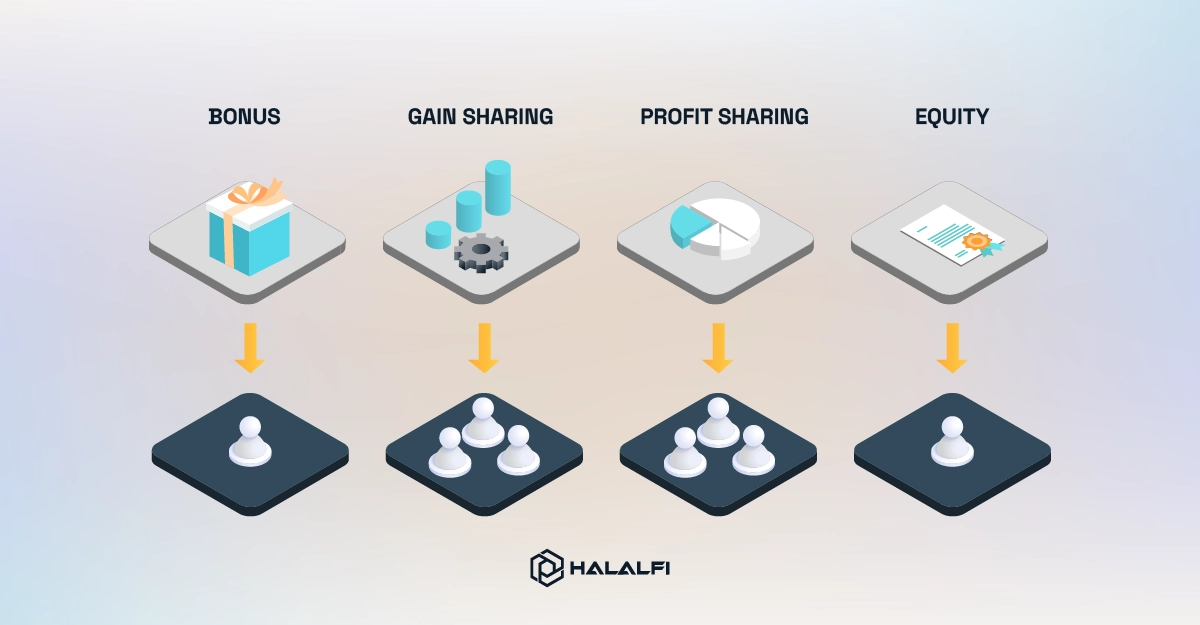
A bonus usually rewards individual or team performance. Profit sharing rewards company-wide results.
Gain sharing focuses on measurable improvements, such as lower waste or better productivity. A factory might share savings after employees reduce material loss. Profit sharing waits for the broader financial result.
Equity gives ownership, and Profit sharing gives a share of profit without necessarily giving ownership.
So, in the equity vs. profit-sharing debate, founders often choose profit-sharing when they want loyalty but do not want to change control of the company.
Unlike a principal-protected investment, which aims to reduce the risk of losing the original capital, traditional employee profit-sharing plans focus on sharing business success rather than protecting invested funds.
Owners often like profit sharing because it motivates teams, but they worry about administration, taxes, and whether a bonus plan would be simpler.
Critical Differences in a Look:
Profit Sharing: Shares a portion of company profits with employees or investors based on overall business performance. It focuses on long-term success and shared results.
Bonus: Rewards individual or team achievements based on specific targets, performance metrics, or short-term results.
Gain Sharing: Rewards measurable improvements, such as increased productivity, reduced costs, or operational efficiency.
Equity: Gives ownership rights in a company, allowing holders to benefit from company growth and value appreciation, but often involves a change in ownership structure.
Profit sharing = share the profits.
Bonus = reward for specific performance
Gain sharing = reward improvements
Equity = share ownership and company value
Is Profit Sharing Taxable?
Yes, tax rules usually apply. But timing matters. Cash profit sharing normally counts as taxable income when employees receive it. Deferred retirement-style profit sharing usually grows tax-deferred until withdrawal.
The IRS treats profit-sharing plans as retirement plans, with corresponding reporting and disclosure requirements. Annual Form 5500-series filing usually applies, and participant disclosures also matter.
Participants should receive plan information, including a summary plan description, so they understand what the plan provides and how it works.
Profit Sharing Advantages and Disadvantages
Profit sharing can help a small business feel more grown-up, especially when it uses a crowdfunding platform. It gives employees a stake in the outcome. It can also reduce turnover when people see real money building over time.
But it can frustrate people, too. Employees may not control profit directly. A bad pricing decision, a delayed client payment, or a supply chain issue can shrink the pool even when the team works hard.
Advantage | Disadvantage |
Encourages long-term thinking | Can feel unfair after a weak year |
Helps retain employees | Requires administration and records |
Employers manage cash flow | Needs clear formulas |
Supports retirement savings | Can confuse employees without education |
What Is a Profit Sharing Ratio?
A profit-sharing ratio determines how businesses divide profits among participants. Companies may base the ratio on salary, age, job class, or a flat allocation, while partners can agree to split profits using ratios such as 50/50 or 60/40.
A change in profit-sharing ratio can happen when partners add capital, change responsibilities, or admit a new partner. The “new profit sharing ratio” then replaces the old one for future profits.
In Islamic finance, a mudarabah agreement uses a pre-agreed profit-sharing ratio between the capital provider and the manager.
Both parties agree on the ratio before the investment starts. If the business suffers a genuine loss, the capital provider bears the loss unless the manager caused it through negligence, misconduct, or a breach of the contract.
That idea matters beyond religious finance. It reminds investors to assess whether the contract rewards actual performance or hides a fixed profit behind softer wording.
Profit Sharing Investment and Crowdfunding Opportunities
Profit sharing no longer belongs only inside employee benefits. Crowdfunding has pushed the idea into business funding. A founder can raise capital from many supporters, then share revenue or profit according to clear campaign terms.
The U.S. SEC allows eligible companies to raise to $5 million in 12 months under Regulation Crowdfunding, but the company must use a registered funding portal or broker-dealer.
ESMA also reported that 181 EU crowdfunding service providers raised about €4.25 billion in 2024. Retail investors accounted for 88% of investors, and loan-based projects accounted for 58% of funding.
For founders, it creates a new route. They can offer structured participation without chasing venture capital. For investors, it creates access to real businesses. Still, access does not remove risk.

How HalalFi Connects Profit Sharing to Crowdfunding
Many investment platforms promote returns before they explain business quality, risk, or cash flow.
platforms like HalalFi take a different strategy by connecting investors with real, cash-flowing businesses through a performance-based profit-sharing model rather than fixed returns.
Before any project reaches investors, HalalFi, for those seeking halal investment, leads structured reviews to enhance transparency and accountability.
Performance-based profit sharing instead of fixed-interest returns.
Dual screening, including Sharia compliance and business due diligence.
Project verification, with financial records, operational proof, and KYB checks before listing.
Blockchain transparency through smart contracts and on-chain records.
Risk mitigation with a guarantor marketplace and legal-agent support to help reduce fraud and counterparty risk.
Balanced access, where investors enjoy a simple onboarding process while businesses must meet stricter verification standards.
The structure cannot eliminate investment risk or guarantee profits. Instead, it aims to improve trust, reduce information gaps, and connect investors with businesses that demonstrate genuine commercial activity rather than speculative opportunities.
Conclusion
Profit sharing gives people a practical way to participate in growth. It can reward employees, support small businesses, and create crowdfunding opportunities tied to real performance instead of empty hype.
For investors who want ethical access to real businesses, HalalFi offers the next step: review projects, study their structures, and look for profit-sharing opportunities where transparency, audits, and values are central to the deal.
Frequently Asked Questions
What is profit sharing?
Profit sharing means a company gives eligible people a share of its profit.
How does a profit-sharing plan work if the company has no profit?
A traditional employer plan can still allow discretionary contributions, depending on the plan terms. Many companies skip or reduce contributions during weak years.
Is profit sharing better than a bonus?
Profit sharing works better for company-wide alignment. A bonus works better for individual performance.
Can profit sharing replace equity?
Sometimes, yes. Profit sharing can reward employees or investors without giving away ownership.
What should investors check in a profit-sharing crowdfunding deal?
Investors should check the profit-sharing ratio, business financials, platform rules, risk disclosures, payment timeline, fees, legal rights, and whether returns depend on actual profit or a disguised fixed promise.