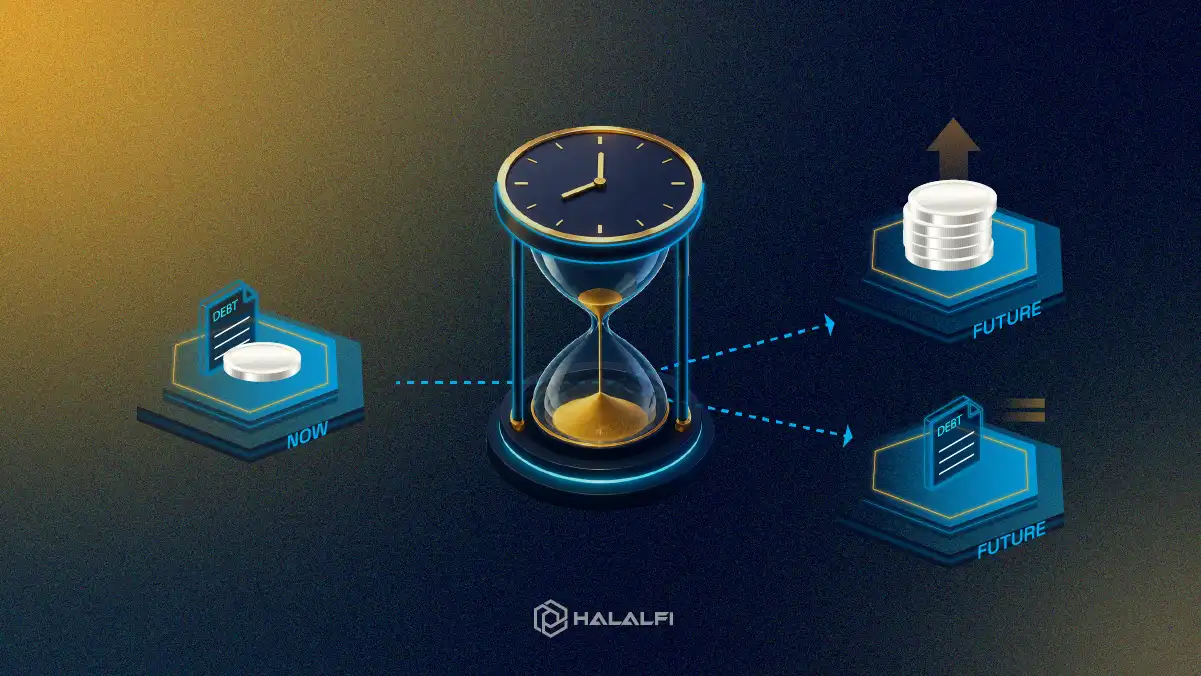
The time value of money is the financial idea that money available today is worth more than the same amount received in the future.
So can $10,000 today and $10,000 received one year from now really carry the same value? Time:
The time value of money in Islam is important, but does the means of payment give someone the right to earn more?
Islam does not ignore time, inflation, opportunity cost, or business risk. It draws a line between earning through lawful commercial activity and charging an automatic increase on a loan.
A deferred sale can cost more than a cash sale. A partnership can generate profit over time, whereas a cash loan cannot grow simply because the calendar turns.
Confused? Read this article to explain more.
Does Islam Recognize the Time Value of Money?
Yes. Islam recognizes that time can affect a commercial decision. For example:
A merchant may prefer payment today because immediate cash can fund inventory, wages, or another trade.
A buyer may value extra time because installment plans make a purchase more affordable.
Business owners also compare future revenue with present costs when deciding whether a project makes sense.
However, Islam does not treat time as a separate commodity that a lender can sell. The return must come from an asset, service, lease, trade, or risk-bearing investment.
Time can influence the price of a transaction, but time alone cannot produce a guaranteed gain on money.
According to Mcca, Mufti Muhammad Taqi Usmani says:
“Money itself has no intrinsic utility in Islam. It is only a medium of exchange and a measure of value. Profit is justified when money participates in trade, investment, or risk-bearing activity.”
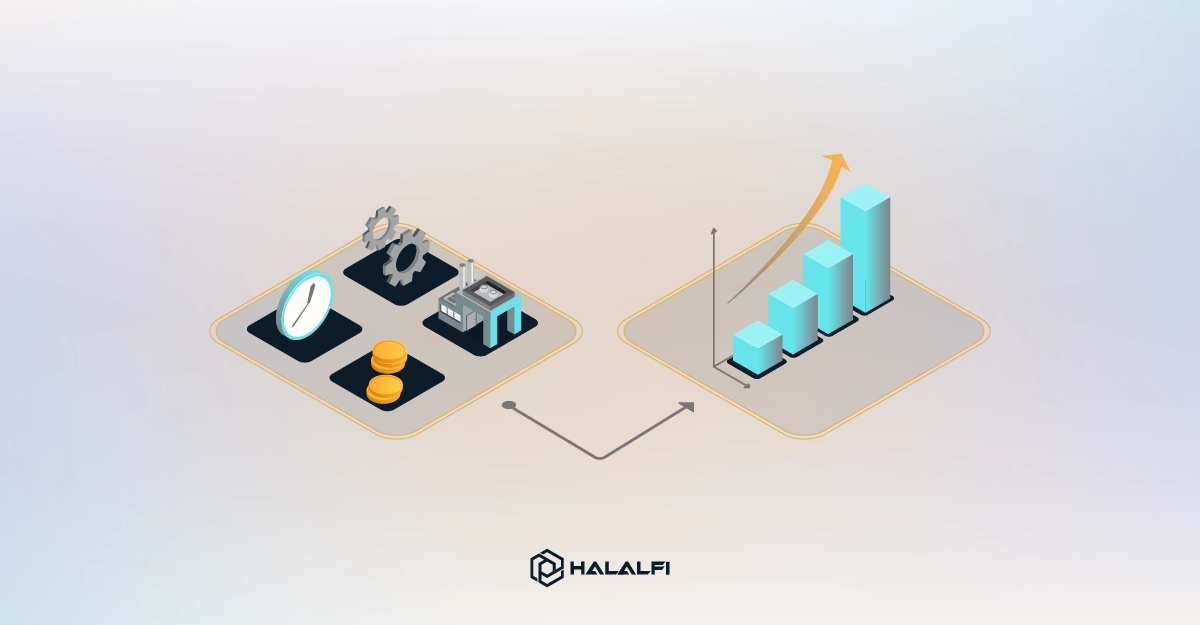
Time Value of Money in Islamic Finance: What Changes the Ruling?
The calculation alone does not determine whether a transaction complies with Sharia principles. The contract does.
Two transactions may produce similar cash flows on a spreadsheet while creating very different legal and economic relationships.
One may involve a sale with ownership risk, another may involve a cash loan with a predetermined increase.
The table below shows when time can legitimately affect value in Islamic finance and when linking extra payment to the passage of time becomes impermissible:
Transaction | Can time affect the amount? | Why? |
Cash loan | No automatic increase | Time alone cannot justify a gain on debt |
Deferred sale | Yes | The seller transfers an asset under one agreed sale price |
Lease | Yes | Rent pays for the use of an asset over a defined period |
Business partnership | Yes, through actual results | Investors share commercial profit and risk |
Existing overdue debt | No added charge for more time | Increasing debt after delay creates riba |
Project valuation | Yes, as an analytical tool | Analysis can compare future outcomes without creating a loan charge |
Let's have an example to understand the concept in Islamic Finance. Consider a furniture-shop owner named Sara.
She needs equipment that carries a cash price of $10,000. The supplier also offers a twelve-month deferred sale for $11,200.
Sara studies both choices. The higher-de higher-deiwiw may, when fortiat aatee on final 11,200fore price, complete the contract. The supplier sells a real asset.
Sara receives the equipment, and both sides know the total price and installment schedule.
Now imagine that Sara misses the final payment. The supplier cannot change the debt from $11,200 to $11,700 in exchange for an additional 6 months.
The original sale created a fixed debt. Adding $500 because the debt remained unpaid would connect the increase to time.
How Islamic Banking Accounts for Time Without Selling Time
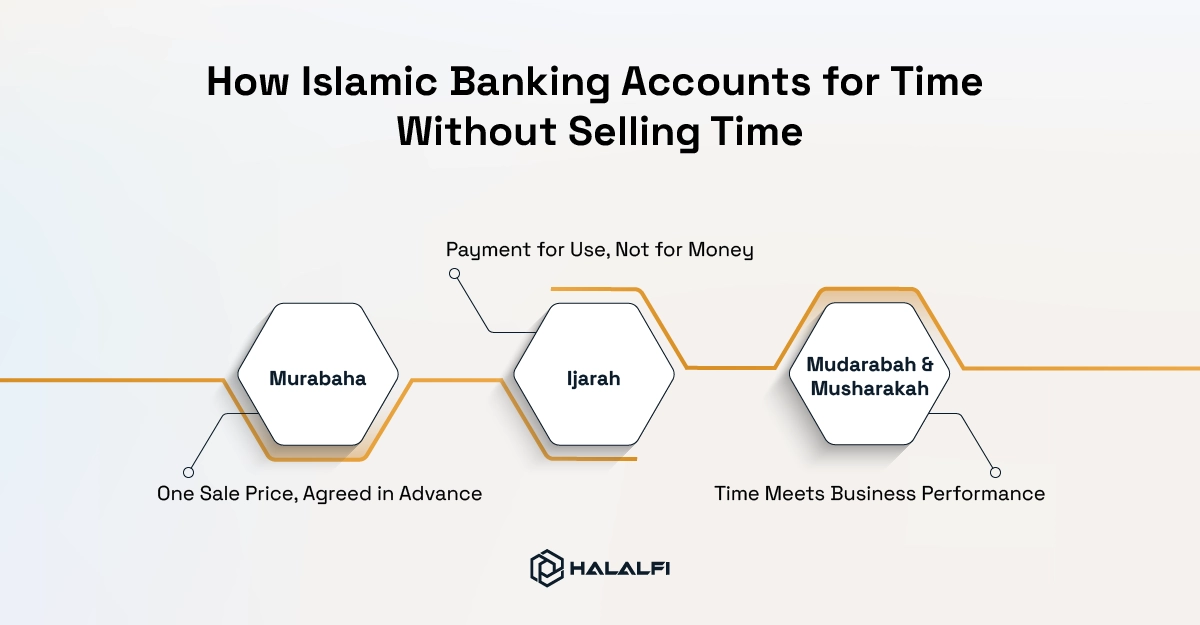
The time value of money in Islamic banking is reflected in net financing linkages, service or business performance.
Islamic banks still consider duration, credit risk, operating costs, inflation expectations, and market conditions. They must express those considerations through a valid contract.
Murabaha; One Sale Price, Agreed in Advance: In a murabaha transaction, a bank purchases an asset and sells it to the customer at an agreed markup. The customer may pay later or through installments.
Ijarah; Payment for Use, Not for Money: Ijarah works through leasing. The financier owns an asset and allows the customer to use it in exchange for rent. Time matters because the customer receives the asset’s benefit for a defined period.
Mudarabah and Musharakah; Time Meets Business Performance: Mudarabah and musharakah connect capital with enterprise. The parties agree on how they will divide the agreed-upon plan. Actually, through an agreed-upon plan. When Money Loses Purchasing Power?
Inflation creates one of the most challenging concerns in this debate. Someone who lends $10,000 may receive the same nominal amount years later, yet that money may buy less.
The IIFA requires parties to settle a currency debt in the same currency amount rather than automatically linking it to a price index.
For hyperinflation, the parties may agree on a fair settlement when the debt matures or seek arbitration or judicial review.
They should not prearrange an inflation-linked increase when creating the debt, since that could turn the obligation into an indexed interest arrangement.
How HalalFi Separates Time From the Source of Profit
HalalFi addresses the time-value problem by directing capital toward defined commercial projects rather than treating USDT as an interest-producing asset.
A business may seek working capital for inventory, sourcing, distribution, or another trade cycle.
HalalFi says it reviews the commercial case and Sharia structure before listing a project. Investors then examine its purpose, duration, expected performance, and protection status.
USDT moves and settles the funds. It does not create the return. The underlying project must generate profit through real business activity.
Smart contracts record funding and distributions, making the capital path easier to review.
The table below shows how HalalFi separates the passage of time from the actual business activity that must create profit:
The time-value question | HalalFi’s stated approach |
Why should capital earn a return? | A real project must generate commercial profit |
Does time guarantee an increase? | No; profit depends on project performance |
What does USDT do? | It acts as the funding and settlement asset |
How can investors trace activity? | Smart contracts record on-chain transactions |
What happens after default? | Principal Protection may apply after confirmed investee-caused default |
Does protection guarantee profit? | No; expected profit remains unguaranteed |
HalalFi also describes on-chain and off-chain protection routes. An approved guarantor may lock USDT in a vault, while another project may use accepted legal or asset-based collateral.
The platform applies Principal Protection only after a review confirms that the investee caused the default. It does not guarantee the expected profit.
Don’t Invest Yet: Check These Sharia Rules First
Before entering any Islamic banking product, crowdfunding campaign, private deal, or digital investment, trace the return to its source.
Ask these questions for halal investment:
Does the transaction involve a loan, sale, lease, or partnership?
Which asset, service, or business activity creates value?
Do the parties agree on a single clear price at the start?
Does the return depend on actual performance?
Who owns the asset and carries its risks?
Can the provider add money to an overdue debt?
What happens after loss, delay, misconduct, or default?
Does an independent Sharia reviewer examine the complete structure?
Can investors verify off-chain claims, not only wallet transfers?
Could an investor tolerate illiquidity or a delayed settlement?
Conclusion
Islam does not deny that time changes economic choices. A business values cash today.
The decisive issue involves the source of the gain. A lawful sale may include a higher deferred price.
A lease may charge for months of asset use, a partnership may reward an investor when a business performs well, and a lender cannot claim an automatic increase merely because the borrower used the money for a longer period.
So time can shape a transaction, but lawful trade, assets, services, and risk must justify the return.
You can now visit HalalFi's Projects. Review the business activity, contract, project risks, expected duration, and protection terms before making any decision.
Frequently Asked Questions
Does Islam completely reject the time value of money?
No. Islam recognizes that time affects prices, business choices, inflation, and opportunity cost. It rejects a guaranteed increase on a cash loan because repayment happens later.
Does using gold remove the time-value problem?
Gold may reduce some fiat-currency concerns, but it does not remove Sharia rules for loans, exchanges, possession, or deferred settlement.
Can Islamic banks consider time when setting prices?
Yes. Islamic banks may consider duration, costs, credit risk, and market conditions when pricing a valid sale, lease, or investment contract. They cannot turn those factors into interest on a cash loan.
Does a longer investment period justify a guaranteed return?
No. A longer period may increase expected business profit, but it does not justify a guaranteed gain. The return must still come from trade, rent, services, ownership, or actual business performance.
Can time alone justify profit in Islamic finance?
No. Time may influence pricing and commercial decisions, but profit must come from a valid sale, lease, service, asset, or business activity rather than from the mere passage of time.