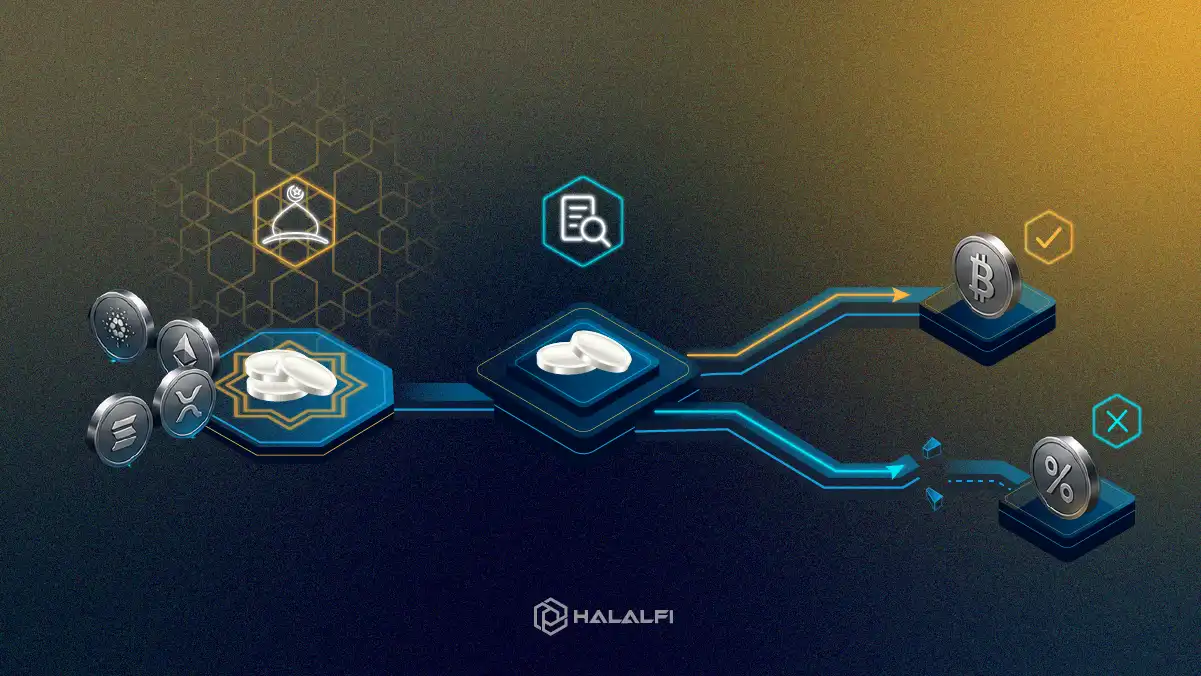
Can a coin appear on a halal crypto list and still become haram in someone’s wallet? While a cryptocurrency may have lawful technology and real utility, understanding that the 'coin matters' helps investors evaluate its compliance.
The contract, platform, intention, and trading method are equally important for halal considerations.
In this guide, we examine prominent halal cryptos through an official Sharia framework and highlight the grey areas around staking, stablecoins, DeFi, and meme coins, helping investors identify potential risks.
The Truth Most Halal Crypto Lists Leave Out
No single worldwide authority maintains a permanent list of halal cryptocurrencies for every investor, exchange, and country.
Scholars still disagree about how Islam should classify decentralized cryptocurrencies. Some view them as valuable digital property.
Others focus on volatility, speculation, uncertain valuation, and the absence of government backing.
The International Islamic Fiqh Academy took a cautious institutional position in its 2019 resolution.
It identified Bitcoin, Ethereum, XRP, and other digital assets, but concluded that their nature and risks required further research rather than issuing one blanket ruling.
How Does a Cryptocurrency Qualify as Halal?
Have you ever asked, "Is crypto halal or haram?" A digital coin does not need a mosque-themed name or an “Islamic” label.
It needs a defensible economic purpose and a structure that respects the principles of Islamic finance.
A Sharia review usually examines the asset and the way people use it.
No single checklist can guarantee that a cryptocurrency is halal. Still, these questions help investors separate projects with stronger Sharia characteristics from those that rely on speculation, prohibited income, or unclear structures:
Screening question | Stronger halal signs | Warning signs |
Does the token have utility? | Payments, network security, data services or governance | No purpose beyond price promotion |
Where do project funds go? | Development and lawful operations | Gambling, pornography, interest lending or fraud |
What does the holder own? | A defined coin, right or network function | Vague promises with no enforceable rights |
How does the investor trade? | Spot purchase with actual ownership | Margin, perpetual futures or unsupported short selling |
Where does yield come from? | Network validation or genuine business activity | Interest-bearing loans or guaranteed APY |
How transparent is supply? | Public token rules and verifiable issuance | Hidden minting rights or uncontrolled dilution |
What drives demand? | Real network use | Manipulation, artificial hype or gambling behavior |
According to IIFA, Professor Koutoub Moustapha Sano, Secretary General of the International Islamic Fiqh Academy, offered a useful starting principle:
“The general principle is permissiveness.”
Halal Crypto List: 11 Prominent Coins With Official Support
The following table uses the current classification from the Securities Commission Malaysia. Its ruling covers approved assets traded through registered Malaysian digital asset exchanges.
Investors in other countries should check local laws and seek qualified Sharia guidance. A regulator’s approval also cannot protect anyone from volatility, hacking, poor custody, or business failure.
In the table below, we introduce the coins and see why they can be halal:
Coin | Why it may pass Sharia screening | When its use may become impermissible |
Bitcoin (BTC) | Offers decentralized ownership and peer-to-peer value transfer without built-in interest | Leveraged futures, gambling-like trading, theft, fraud or unlawful purchases |
Ethereum (ETH) | Powers network transactions, applications and validator activity | Interest-based DeFi, prohibited applications, derivatives or deceptive tokens |
XRP | Supports payments, settlement and cross-currency transfers | Unlawful transfers, leveraged speculation or interest-based yield products |
Solana (SOL) | Pays network fees and supports validators and blockchain applications | Meme-coin gambling, leveraged perpetuals or prohibited applications |
Cardano (ADA) | Supports network governance, fees and proof-of-stake validation | Manipulative trading, unlawful dApps or lending products based on riba |
Chainlink (LINK) | Pays for oracle services that connect blockchains with external data | Pure price manipulation or yield generated through interest-based lending |
Uniswap (UNI) | Provides governance rights within a decentralized exchange protocol | Liquidity pools involving prohibited tokens, interest products or extreme speculation |
Avalanche (AVAX) | Supports fees, staking and application networks | Prohibited dApps, leverage, fraudulent token launches or unlawful financial products |
Polkadot (DOT) | Supports network governance, security and blockchain interoperability | Interest-based lending, derivatives or speculative schemes with no clear ownership |
Stellar (XLM) | Supports payments and digital-asset transfers | Prohibited transactions, interest wrappers or leveraged trading |
Tether (USDT) | Supports stable-value payments, settlement, and lawful trade when users obtain proper possession | Interest-based lending, guaranteed-yield products, prohibited transactions, or unclear reserve and custody arrangements |
Malaysia’s current official list also includes Litecoin, Bitcoin Cash, Polygon, Cosmos, and Worldcoin. The council approved each asset at different meetings between July 2020 and December 2024.
Bitcoin: A Halal Coin Does Not Make Every Bitcoin Trade Halal
Bitcoin’s original design introduced peer-to-peer electronic cash. The network lets users transfer value without a bank or central operator.
Still, someone can turn Bitcoin trading into maysir. A trader who uses 50-times leverage, chases anonymous signals, and risks rent money on a ten-minute price candle does not create a responsible halal investment. The asset may pass; the behavior may not.
Ethereum: Network Utility With a Complicated Ecosystem
Ether pays transaction fees, helps secure Ethereum through staking, and supports smart-contract applications.
Owning ETH does not mean approving every application on Ethereum. Using a lawful network resembles using the internet: the infrastructure and the chosen activity require separate judgments.
XRP and Stellar: Payment Utility Does Not Remove Conduct Risk
XRP can act as a bridge asset during cross-currency payments on the XRP Ledger. The system may route a transaction through XRP when that path offers a cheaper exchange.
Stellar also focuses heavily on digital payments and asset transfers. Malaysia’s Shariah council currently classifies both XRP and XLM as Shariah-compliant.
Solana and Cardano: Is Staking the Same as Interest?
Solana and Cardano use proof-of-stake systems. Token holders can support validators and help secure each network.
Here, the word “staking” has become dangerously broad. Some exchanges call a lending account “staking” even when they lend the customer’s coins and promise a fixed yield.
Investors need to inspect the mechanism rather than trust the product name.
Crypto Lending Creates a Clearer Riba Concern
A platform may take Bitcoin or USDT, lend it to another party, and promise the depositor a fixed annual return. The lender expects more of the same asset over time.
That arrangement creates a direct riba concern, even when the app calls the payment “rewards,” “earn,” or “passive income.” Marketing language cannot change the contract.
The same principle applies when considering is investing halal or not. Start with the source of the return. Then examine risk, ownership, and the obligations between the parties.
Is USDT a Halal Cryptocurrency?
USDT aims to track the U.S. dollar. Tether backs the circulating tokens with a reserve portfolio.
Professor Sano explained that a cryptocurrency backed by a paper currency generally follows the Sharia rules of the currency it represents.
This means currency-exchange requirements, possession, and transaction timing may apply.
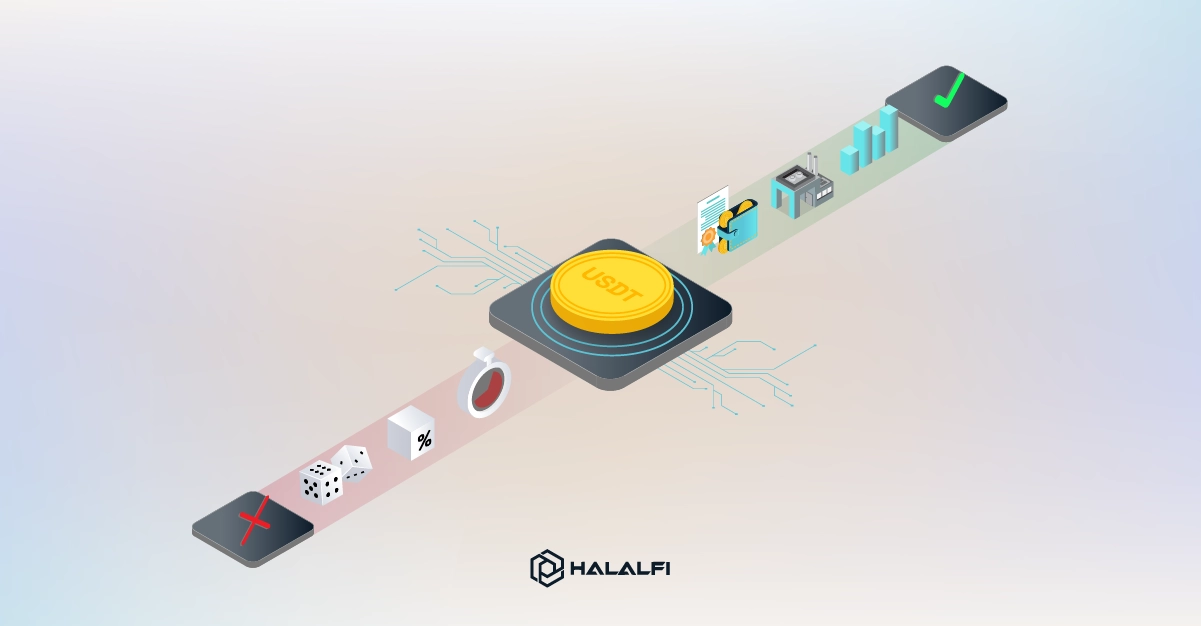
That framework does not approve every USDT product. The user must distinguish between:
Holding USDT for payment or settlement
Exchanging it with proper possession
Using it to fund lawful trade
Lending it for a predetermined return
Depositing it into an opaque “guaranteed yield” account
The first three may support a permissible use after proper review. The last two can create riba, custody, reserve, or contract concerns.
A stablecoin investment review should also consider de-pegging, redemption, issuer, reserve, network, wallet, and regulatory risks. Stable does not mean risk-free.
How HalalFi Avoids the “Halal Token” Trap
HalalFi does not currently ask investors to buy a speculative HalalFi token. Its model uses USDT as a funding and settlement asset for individual commercial projects.
Here, Investors can examine the funding target, duration, expected performance, project purpose, and protection status.
Smart contracts record funding and distributions on-chain. Actual business activity should determine the available profit sharing, rather than a fixed payment for lending USDT.
The structure addresses the central weakness of a generic halal crypto coin list. Investors do not need to hope that token appreciation will create value.
They can inspect which real business receives the USDT, why it needs funding, and which activity must generate profit.
Conclusion
A halal crypto list helps narrow thousands of assets into a more sensible research group. It cannot judge the trade that someone places five minutes later.
Bitcoin bought on the spot market differs from a leveraged Bitcoin perpetual. Native staking differs from lending coins at a fixed interest rate.
USDT used for settlement differs from USDT placed in an opaque guaranteed-yield account.
Investors who prefer project-level business activity over token-price speculation can review HalalFi’s Projects.
Examine the project, contract, USDT flow, protection terms, and commercial assumptions before committing funds.
Frequently Asked Questions
Are Ethereum gas fees considered riba?
No. A gas fee generally pays for transaction processing and network computation. It does not represent an increase on a cash loan.
Can a crypto airdrop be halal?
An airdrop may qualify when the recipient receives a lawful token without deception or prohibited obligations.
Is Bitcoin mining halal?
Mining can qualify if miners lawfully obtain electricity, comply with local regulations, secure the network, and avoid theft or environmental abuse. The miner receives compensation for computational work.
Can a halal cryptocurrency lose its compliant status?
Yes. A project may change its token utility, governance, revenue model, treasury activity, or underlying applications.
Does storing crypto in a hardware wallet affect its halal status?
A hardware wallet does not change the asset’s underlying ruling. It changes custody and security.
Must Muslims pay zakat on cryptocurrency?
Many scholars treat qualifying crypto holdings as zakatable wealth when the owner meets the nisab and holding-period requirements.
Can someone buy a halal coin with an interest-bearing loan?
The coin’s classification does not clean up the financing method. Borrowing through an interest-bearing agreement creates a separate riba problem.