Once we understand that capital is more than money and that every financial decision carries consequences beyond profit, a more important question emerges: what should guide those decisions in the first place?
It’s not only about how much you earn, but it’s also about how you raise it, how you structure it, and who you align with.
For investors, that means ensuring returns don’t come at the cost of values. For founders, it means building and financing a venture in a way that preserves integrity from day one. Profit is important.
But the profit that comes with peace of mind, earned through clear ethical alignment, carries a value altogether different.
Crowdfunding allows businesses to raise money, and individuals to invest, through small contributions from a large group of people, mostly online. But it’s more than just pooling funds.
It can provide access, transparency, community validation, and, in some cases, structures compatible with Islamic finance principles, depending on the model used.
In this comprehensive guide, we’ll break down what crowdfunding really means, how it works, the different models (including which ones may be more suitable for halal investing), its advantages and risks, key regulations, and real-world examples.
What Is Crowdfunding?
Let’s begin with the basics. The meaning of Crowdfunding is raising small amounts of money from many people to finance a project, business, or cause.
A clearer crowdfunding definition might be: raising money for a business or project through small contributions from many individuals, typically via online platforms and social networks.
Unlike traditional funding, where you pitch to a small group of finance guys, banks, or institutional investors like VCs, crowdfunding lets you tap into the collective power of the internet.
Crowdfunding leverages small contributions from many individuals to connect entrepreneurs with a diverse pool of potential investors.
It gained momentum after the 2008 financial crisis, when access to bank credit tightened, and startups needed alternative financing. And it hasn’t slowed down.
A 2025 imarcgroup report estimates that the global crowdfunding market reached about USD 20.4 billion in 2025.
It’s projected to grow at an annual rate of 15.82% from 2024 to 2033.
Kickstarter alone has funded more than 250,000 projects with over $8 billion pledged. That’s not a trend. That’s a structural shift.
What Is Characteristic of Crowdfunding?
One defining characteristic is collective participation, another is transparency, Campaigns are public, Goals are visible, Progress is tracked, And that visibility can either amplify success or magnify failure.
Collective participation means capital doesn’t come from a single large institution but from many individuals contributing smaller amounts. The power lies in numbers, not concentration.
Transparency means campaigns are public, financial goals are clearly stated, and terms are openly accessible before anyone commits funds.
Visibility is built into the system. Funding targets, timelines, and progress updates are displayed in real time, allowing everyone to track momentum.
When Did Crowdfunding Start?
Many assume crowdfunding is a digital-age invention. But its roots go back way earlier. One early example occurred in 1997, when a UK band raised money from fans online to fund a tour. The first formal crowdfunding site, ArtistShare, launched in 2000.
However, the modern surge happened after the 2008 financial crisis, when banks tightened lending. Entrepreneurs needed alternatives, and the internet delivered.
The U.S. later introduced the JOBS Act in 2012, which created a legal framework for equity crowdfunding and expanded participation beyond accredited investors.
Today, crowdfunding regulations exist in multiple countries to protect investors and ensure transparency. All models rely on the same fundamental principle: collective participation.
The difference lies in what investors receive in return: structured financial rights or ownership stakes.
How Does Crowdfunding Work?
The process looks like this:
A founder creates a campaign or Funding Circle on a crowdfunding platform.
They define a funding goal and timeline.
They promote it via social media and networks.
Individuals contribute money, sometimes as little as $10.
If the goal is reached, funds are released (depending on platform rules).
Platforms typically charge a fee. For example, Kickstarter charges 5% of funds raised, plus processing fees. And here’s something important: many platforms operate on an “all-or-nothing” model.
If you don’t reach your goal, funds are returned. That can feel stressful, but it also protects contributors.
On the contrary, some platforms introduced a soft cap model, meaning that if investment reaches that cap, even if the project does not meet its fundraising goal, the funds are transferred to the investee.
Related Article: How does Crowdfunding Work?
Comparing the traditional crowdfunding with the crypto crowdfunding
Crowdfunding has evolved. What started as online community funding has now expanded into blockchain-based participation models. But the “traditional crowdfunding” and the “crypto crowdfunding” behave very differently.
Traditional crowdfunding participants usually focus on products, businesses, or social causes. Their mindset is often long-term and utility-driven; they want to receive a product, support a founder, or participate in structured financing.
The crypto crowdfunding, on the other hand, is typically faster-moving. Many participants are comfortable with volatility, token-based models, and digital-native investments.
Speculation cycles, liquidity, and token price movements often influence behaviour more heavily.
That doesn’t mean one is better than the other; it just means they differ in psychology, expectations, and risk tolerance.
Related Article: Risks in Traditional Crowdfunding
Here’s a simple comparison:
Aspect | Traditional Crowd | Crypto Crowd |
Motivation | Product support or structured return | Token appreciation or protocol growth |
Risk Appetite | Moderate | Often high |
Time Horizon | Medium to long-term | Short to medium-term |
Transparency Focus | Business model clarity | Tokenomics & smart contracts |
Volatility Tolerance | Lower | Higher |
Who Crowdfunding Is For?
Crowdfunding is not for “everyone.” It works best for specific profiles of founders and investors. If you see yourself in one of these categories, it may be worth serious consideration.
1. Early-Stage Founders Who Need Market Validation
If you’re building a new product and want proof that people are willing to pay before you manufacture at scale, reward-based crowdfunding can act as both funding and validation.
It’s especially useful for hardware, creative products, and tech prototypes.
2. Founders Without Access to Traditional Capital
If banks have declined your loan or you don’t have connections to venture capital, crowdfunding gives you access to a broader audience.
It removes the “closed door” problem that many small founders face.
3. Businesses With Strong Storytelling Ability
Crowdfunding works when you can communicate clearly and emotionally. If you can articulate why your product matters and why now is the right time, you have a real advantage.
4. Investors Seeking Early Access Opportunities
If you’re interested in participating in early-stage projects before they reach institutional investors, equity-based crowdfunding can provide that exposure.
It offers diversification opportunities for those comfortable with startup risk.
5. Social Entrepreneurs and Cause-Driven Leaders
If your mission is community-focused or humanitarian, donation-based crowdfunding may be a perfect fit. It allows supporters to back a cause without expecting financial returns.
6. Muslims Seeking Structured, Supervised Participation
If you’re Muslim and concerned about interest, excessive uncertainty, or gambling-like speculation, structured models such as supervised or Sharia-aware crowdfunding environments may feel more aligned with your values.
In that case, you’re not just looking for capital, you’re looking for clarity and alignment.
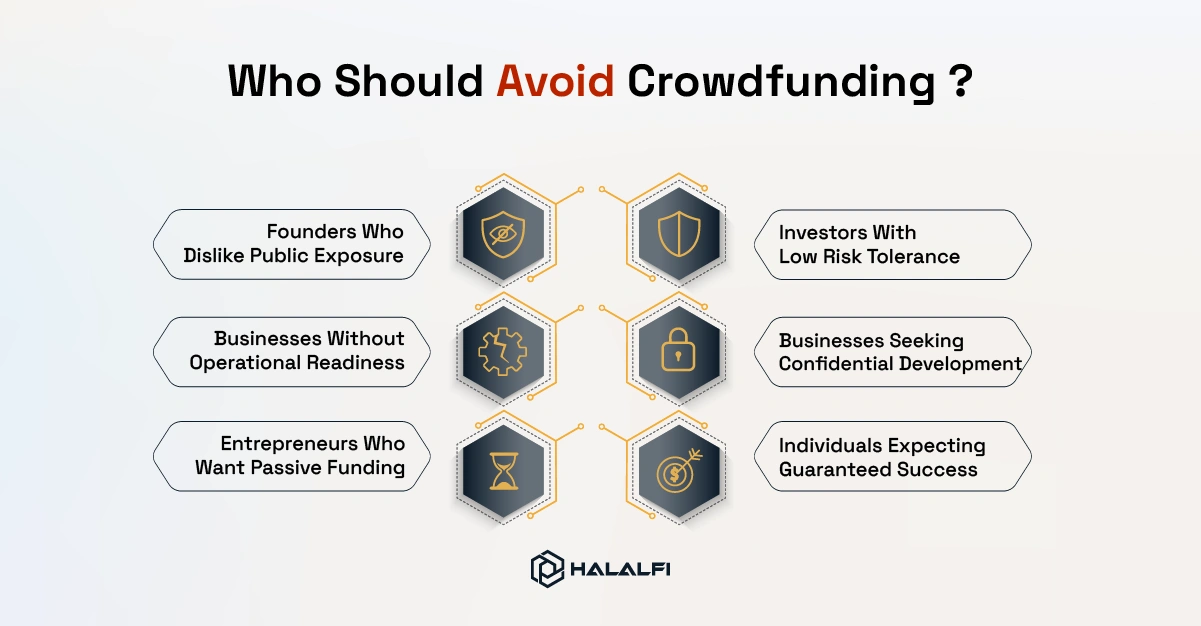
Who Should Avoid Crowdfunding?
Just as important as knowing when crowdfunding fits is knowing when it doesn’t.
1. Founders Who Dislike Public Exposure
Crowdfunding is public. Your idea, timeline, funding goal, and execution ability are visible. If you’re uncomfortable sharing your concept publicly, this model may create stress rather than momentum.
2. Businesses Without Operational Readiness
If you cannot realistically deliver rewards, manage investor communication, or handle reporting obligations (in equity campaigns), crowdfunding can damage your credibility.
3. Entrepreneurs Who Want Passive Funding
Crowdfunding is not “set it and forget it.” It requires marketing, engagement, updates, and accountability.
If you’re not prepared to actively manage your campaign, results will likely disappoint.
4. Investors With Low Risk Tolerance
Startups fail frequently. Equity-based crowdfunding involves the risk of losing your principal.
If you need guaranteed returns or short-term liquidity, this may not be appropriate.
5. Businesses Seeking Confidential Development
If your competitive advantage depends on secrecy, public crowdfunding campaigns may expose too much too early.
6. Individuals Expecting Guaranteed Success
Not all campaigns reach their funding goal. On some platforms, if you don’t hit the target, funds are returned. Crowdfunding is an opportunity, not a certainty.
Before deciding whether crowdfunding is right for you, pause and evaluate your goals:
Are you looking for validation or just capital?
Are you prepared for public accountability?
Does the model align with your values and long-term strategy?
Take time to review your business plan, assess your readiness, and carefully explore different crowdfunding structures.
The right decision isn’t the most popular one; it’s the one that fits your stage, risk tolerance, and principles.
What Is the Purpose of Crowdfunding?
Now you know how does crowdfunding work, the question is: what's the purpose of crowdfunding?
The purpose is simple: to connect ideas, business operations, or cash flow management with capital through collective belief.
Sometimes that belief is financial, sometimes it’s emotional, and sometimes it’s both.
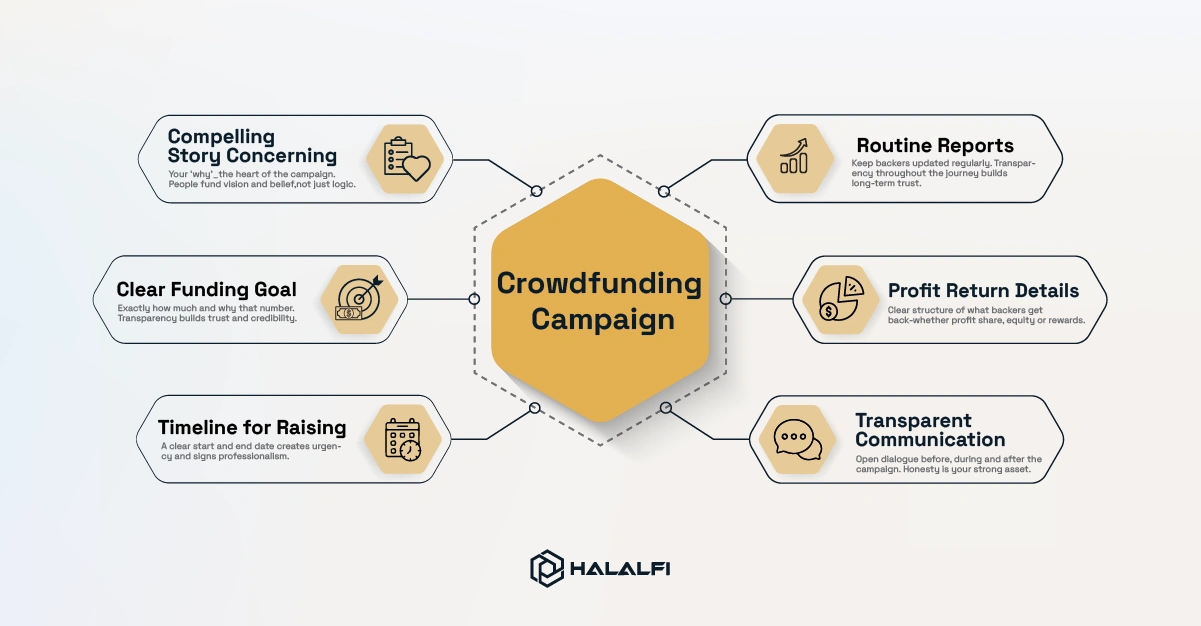
What Is a Crowdfunding Campaign?
A crowdfunding campaign is your public pitch to the world. It usually includes:
Compelling story concerning why you are doing this
Clear funding goal and why it's that much
Timeline for raising
Routine Reports
Profits return or equity transfer details
Transparent communication
The campaign isn’t just raising money. It’s also marketing, validation, and audience building rolled into one.
What Is Crowdfunding Used For?
Crowdfunding serves multiple purposes:
Launching startups
Product development
Cash Flow Financing
Social causes
Emergency funding
Creative projects
Some entrepreneurs use crowdfunding for small businesses growth, while others use it to address personal emergencies. It has become both commercial and humanitarian.
What are the Advantages and Disadvantages of Crowdfunding?
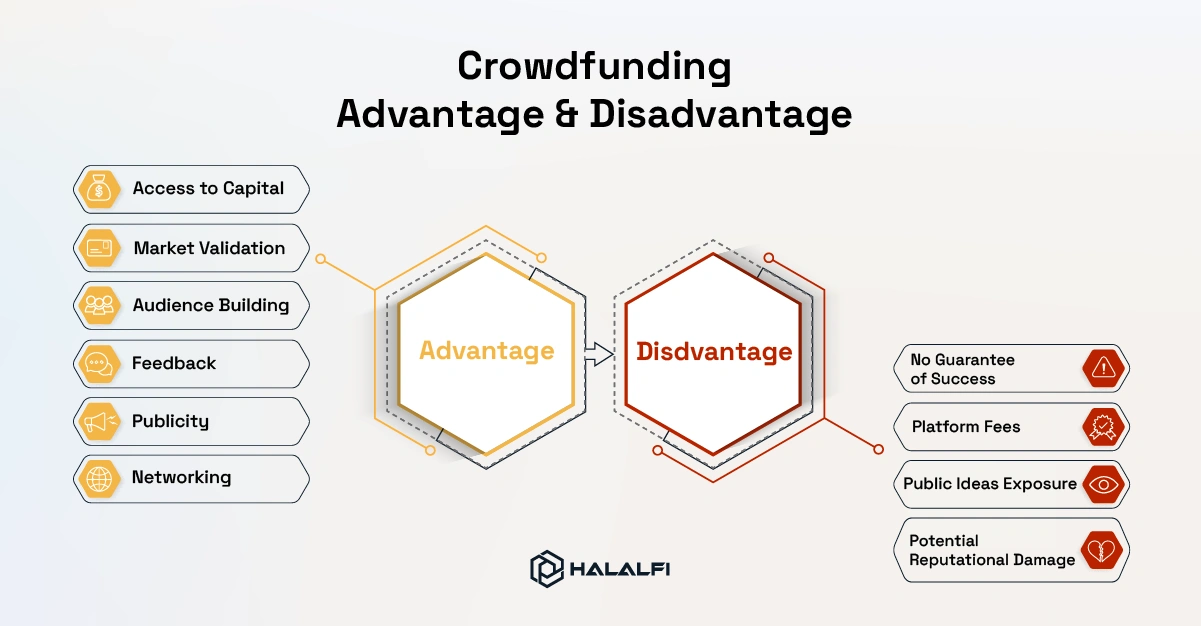
Crowdfunding opens doors for entrepreneurs who lack traditional financing. It builds early customer interest, validates ideas before launch, and creates a community around a project. Campaigns can also double as marketing, spreading awareness quickly.
However, success isn’t guaranteed. Many campaigns fail to reach their goals, and public exposure can invite copycats. Managing backers, fulfilling rewards, and maintaining trust can also become stressful and time-consuming.
Advantages of Crowdfunding
Let’s talk about the advantages of crowdfunding:
Access to Capital: Startups often struggle to secure traditional loans. Crowdfunding provides access when banks say no.
Market Validation: If people are willing to pay upfront, that’s proof of demand.
Audience Building: Backers often become loyal customers.
Feedback: You receive real-world insights before full launch.
Publicity: Successful campaigns attract media attention.
Networking: Industry leaders may notice and connect.
Disadvantages of Crowdfunding
Every opportunity has trade-offs. Here are the disadvantages of crowdfunding:
No guarantee of success
Platform fees
Public idea exposure
Potential reputational damage
Understanding these crowdfunding pros and cons is essential before launching. Here’s a balanced comparison of the advantages and disadvantages of crowdfunding:
Advantages | Disadvantages |
Broad access to investors | No guarantee of success |
Marketing exposure | Platform fees |
Market validation | Public idea exposure |
No debt (in reward/donation models) | Potential reputational damage |
Types of Crowdfunding
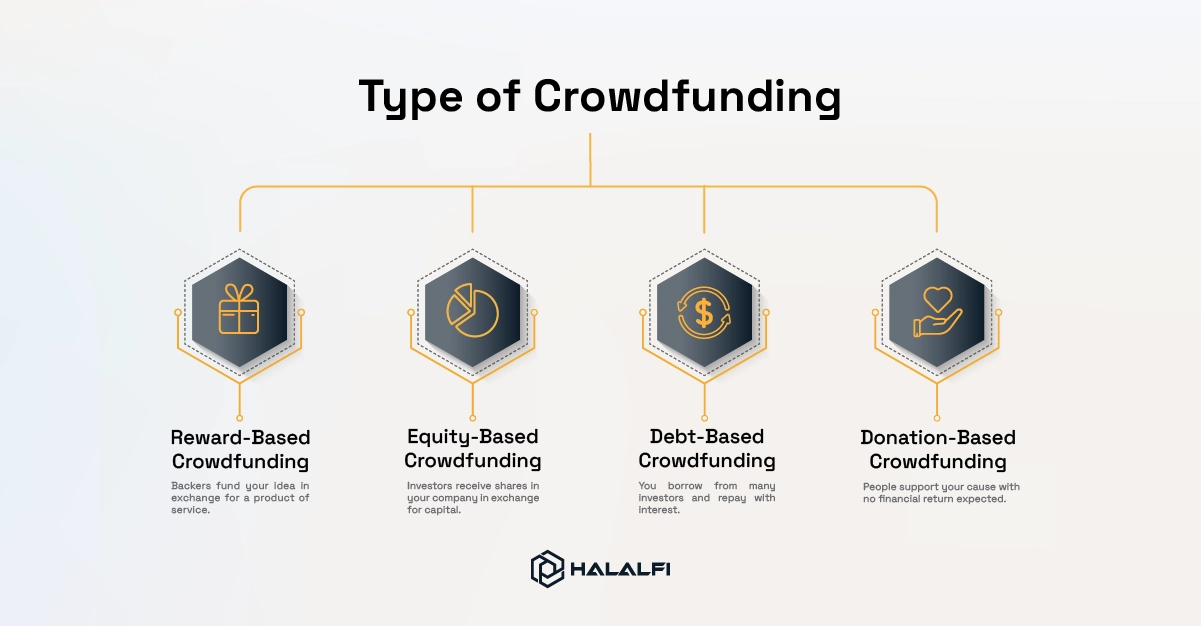
There are four primary types of crowdfunding, each suited to different goals.
Type | What Backers Receive | Best For |
Reward-based | Product or service | New product launches |
Equity-based | Shares in the company | High-growth startups |
Debt-based | Repayment with agreed interest | Businesses needing loans or cash flow |
Donation-based | No financial return | Social causes |
In recent years, Islamic (halal) crowdfunding has developed as a distinct financing model aligned with Shariah principles.
Unlike conventional systems built around fixed interest, halal crowdfunding avoids predetermined interest-based returns. The difference lies in changing the foundation for generating returns.
In many halal project financing models, including structures like those used in Halal-focused platforms, this is not traditional equity in the sense of owning company shares.
Instead, investors participate in a structured financing arrangement that entitles them to a share of the project's actual profits, according to pre-agreed terms.
That distinction matters. Rather than earning fixed interest regardless of outcome, returns are tied to real economic performance.
If the project performs well, investors share in the profit. If performance is weaker, returns adjust accordingly. This shifts the relationship from guaranteed interest to risk-sharing participation.
In donation or reward-based halal campaigns, the ethical layer is equally important. Projects must comply with Shariah guidelines, meaning they avoid industries considered impermissible, such as gambling, alcohol, or other prohibited sectors.
So, halal crowdfunding is a financing structure that replaces fixed-interest mechanisms with performance-based participation, ensuring that the underlying activity aligns with Islamic ethical standards.
This model appeals not only to Muslim entrepreneurs and investors but also to those seeking ethical, impact-driven finance alternatives. It emphasises risk-sharing, transparency, and asset-backed transactions.
While the regulatory landscape varies by country, Islamic crowdfunding continues to grow, particularly in Southeast Asia and the Middle East, reflecting increasing demand for faith-aligned financial solutions.
Reward-Based Crowdfunding
Backers receive a product or service instead of equity. Platforms like Kickstarter and Indiegogo dominate this space mainly.
Pros
No equity sacrificed
Market validation
Pre-sales + marketing
Community building
Cons
All-or-nothing funding risk
Reward fulfilment costs
Public exposure
Platform fees
This model is especially popular for creative products and tech gadgets.
Equity-Based Crowdfunding
Investors receive shares in your company. Platforms like SeedInvest and CircleUp focus on this model.
Pros
Larger capital amounts
Long-term investor relationships
Access to investor networks
Cons
Loss of ownership
Regulatory complexity
Reporting requirements
Pressure for returns
This is true crowdfunding investment, and for some founders, it’s a game-changer.
Debt-Based Crowdfunding (P2P Lending)
Also called peer-to-peer lending. You borrow from many investors and repay with interest. These interests are mainly fixed, but in Sharia-compliant tools, they are performance-based.
Pros
Retain ownership
Fixed repayment schedule
Faster process than banks
Cons
Must repay regardless of performance
Interest costs
Credit risk
Possible collateral requirements
It’s essentially crowd-powered lending.
Donation-Based Crowdfunding
Commonly used for social causes or emergencies. GoFundMe is the largest platform, having raised over $30 billion since 2010. No repayment required, No equity exchange, But success often depends on emotional appeal and reach.
How to Choose Which Type of Crowdfunding to Use
Choosing between reward, equity, debt, and donation crowdfunding is a “future-you” decision. The wrong choice can box you into obligations you didn’t plan for.
Here’s an easy way to think about it:
If you want customers first: Reward-based
Reward campaigns are basically pre-sales + marketing. You keep full ownership, but you must deliver rewards.
If you’re launching a product and want market proof, this is often the cleanest route.
If you want capital to scale: Equity-based
Equity-based crowdfunding can unlock larger amounts and long-term investor relationships, but you give up ownership and take on reporting requirements.
If you hate the idea of sharing control, think carefully.
If you want ownership retained: Debt-based (P2P lending)
Debt-based crowdfunding works like a loan. It can be faster than bank loans with a fixed repayment schedule, but you still carry the burden of repayment (and interest) regardless of performance.
If your mission is social: Donation-based
Donation campaigns work when supporters value the cause more than a financial return. It’s powerful, but not always predictable.
If you want one sentence to remember, pick the model that matches your obligations, not just your funding goal.
Does Crowdfunding Really Work?
Yes, but not automatically. Consider these examples of crowdfunding:
A Medium report shows that long before it became one of the largest blockchain platforms in the world, Ethereum raised about $18 million through an ICO, one of the earliest major blockchain crowdfunding events.
According to another Medium article, Brave Browser (BAT Token) raised $35 million in less than a minute.
A report in turbocrowd shows Ezos raised ~$230 million in its ICO
Also, according to GoFundMe, in 2025, more than 95,000 people came to the platform with the dream of launching their own businesses, and the momentum behind business fundraisers continued to build throughout the year.
But for every success story, many campaigns fall short; preparation matters.
Is Crowdfunding Legit?
Short answer: yes.
Long answer: It depends on the platform and compatibility.
In the U.S., equity crowdfunding is regulated by the SEC. This means crowdfunding and crypto crowdfunding laws and regulations are designed to protect investors. Other countries, including Australia and Nigeria, have also established legal frameworks.
However, like any public funding model, risks remain. Not all businesses succeed. And investors can lose money.
Is Crowdfunding Safe?
It can be safe, but it’s not risk-free. Equity and debt models carry financial risk. Reward-based models carry fulfilment risk. Donation models fulfil the trust risk. Safety often depends on:
Transparency
Regulatory compliance
Platform reputation
Realistic funding goals
Is Crowdfunding a Good Investment?
It can be, but it depends on your risk tolerance. When evaluating crowdfunding as an investment, consider:
Startup failure rates
Liquidity limitations
Regulatory oversight
Long-term horizon
Some people see crowdfunding as a source of finance. Others compare crowdfunding to investing in debates, or discuss the differences between the two.
Angel investors typically invest larger amounts and often seek control or influence. Crowdfunding investors contribute smaller amounts and usually have limited control.
It’s also different from peer-to-peer fundraising, which differs from crowdfunding in structure and scale.
How to Start Crowdfunding
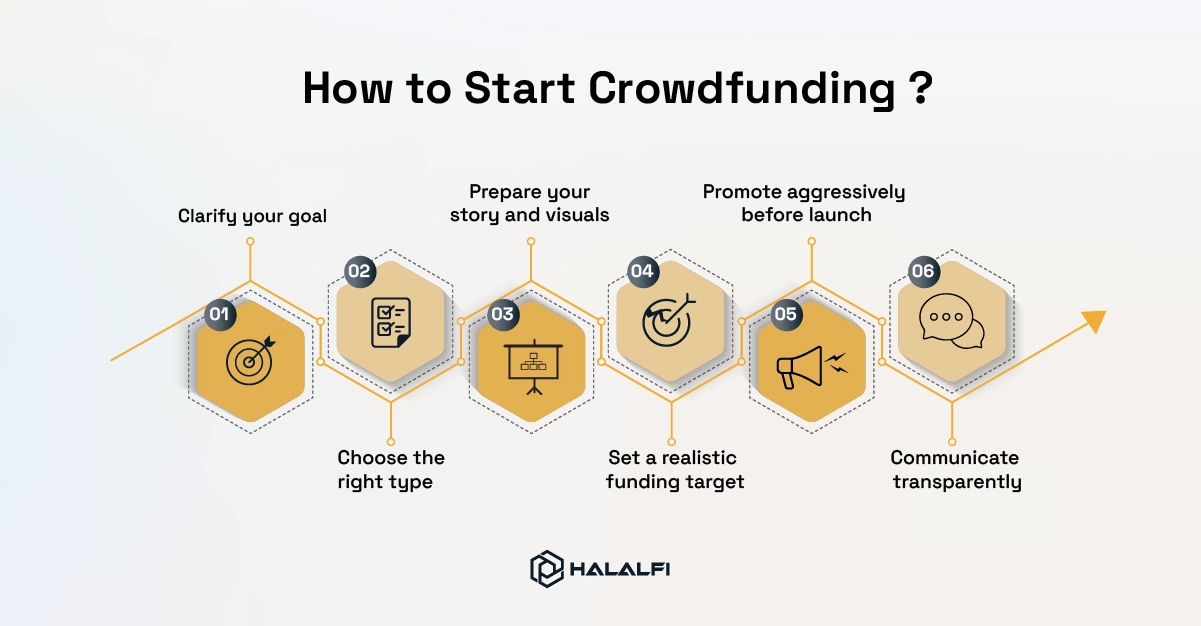
If you’re considering launching a campaign, here’s a roadmap:
Clarify your goal.
Choose the right type.
Prepare your story and visuals.
Set a realistic funding target.
Promote aggressively before launch.
Communicate transparently.
Related Article: How to Start Crowdfunding?
These are practical crowdfunding tips that experienced founders repeat. Preparation is key:
Strong narrative
Clear value proposition
Realistic budget
Engaged community
Success often depends more on pre-launch marketing than on the platform itself.
How to Raise Money Through Crowdfunding
The secret is Momentum. Most successful campaigns secure a large portion of their funding in the first few days. That signals credibility and encourages others to join.
Is Crowdfunding a Good Way to Raise Money?
For many startups, yes. Especially if:
You need validation and KYC/KYB
You want early customers.
You prefer community-driven growth.
But it’s rarely the only funding source.
What Are the Alternatives to Crowdfunding?
Startups often combine funding methods:
1. Debt Financing
Bank loans
Lines of credit
Microloans
2. Equity Financing
Angel investors
Venture capitalists
Private equity
3. Other Methods
Grants
Self-financing
Friends and family
Accelerators
Strategic partnerships
Crowdfunding is powerful, but diversification is wise.
Why Most Crowdfunding Campaigns Fail?
Crowdfunding looks exciting on the surface. Big numbers. Viral campaigns. Millions raised in days. But here’s the uncomfortable reality: Most campaigns fail, and not because the idea is terrible.
The number of campaigns launched far exceeds the number successfully funded. This tells us something important:
Crowdfunding growth does not equal individual campaign success. The industry can grow 16% annually, while individual founders still struggle. That’s the paradox. Crowdfunding Is About Momentum
Here’s where most campaigns collapse; They assume funding is financial. But crowdfunding is psychological. Three behavioural realities shape campaign outcomes:
1. Social Proof Bias
People don’t fund empty campaigns. They fund campaigns that already look funded. Momentum creates momentum.
If your campaign reaches 40% in the first few days, it signals viability. If it stays at 5% for two weeks, it signals doubt. Early traction isn’t luck; it’s a pre-launch strategy.
2. Emotional Activation
Even in equity crowdfunding, logic comes second. Backers fund:
Vision
Story
Belief
Identification
Data supports confidence.
But story triggers action.
3. Risk Perception
If uncertainty feels too high, hesitation wins. This is especially relevant when we consider Muslim investors.

Is Crowdfunding Regulated?
Yes, and it matters a lot, especially for equity. The JOBS Act (enacted April 5, 2012) established a framework for equity crowdfunding in the U.S. The SEC oversees these regulations, and transactions occur through registered intermediaries.
The goal is investor protection and transparency, particularly because many new businesses fail and investors can lose principal.
Australia introduced a legislative framework for crowd-sourced funding in 2017. Nigeria has eligibility rules (e.g., operating track record requirements) for SMEs raising funds through portals. So that regulations exist, but they vary by country and by crowdfunding type.
What Are Crowdfunding Opportunities, and what should you be cautious about?
Crowdfunding opportunities are real. The stats alone show scale and momentum:
According to Skyquestt, the Global market is about $2 billion+ (2024) and is projected to grow to around $7.8 billion by 2033, with steady annual gains.
Also, the growth forecast will be roughly 16.7% annually from 2026 to 2033.
But opportunity comes with constraints:
Platform fees
Public exposure
Campaign risk
Crowdfunding is a powerful but not magical tool. And here’s where something interesting happens.
As crowdfunding becomes more accessible, a new question naturally arises, especially for value-driven investors.
Not just: “Is this a good opportunity?” But: “Is this aligned with what I believe?”
That question doesn’t belong to one religion or one region. Many investors today care about ethics, transparency, and structure. But for Muslims, that concern carries a specific framework.
Shariah-Compliant Financing Starts with Halal Crowdfunding
For Muslim entrepreneurs and investors, halal crowdfunding offers an alternative aligned with Islamic finance principles.
Instead of interest-based lending (riba), halal models typically rely on profit-sharing structures or asset-backed transactions.
For example, rather than paying fixed interest, a business might share profits with investors according to pre-agreed ratios.
This shifts the model toward risk-sharing rather than guaranteed returns. Halal Projects also avoid non-permissible industries such as gambling, alcohol, or other prohibited activities.
In many Muslim-majority markets, particularly across Southeast Asia and parts of the Middle East, halal crowdfunding has grown steadily in recent years as demand for ethical, Shariah-compliant finance increases.
For founders who prioritise faith-based financial structures, this option allows them to raise capital without compromising religious principles.
Why Sharia-Compliant Finance Requires Structural Integrity?
Because if you’re Muslim, you don’t just ask “Can I profit?” You ask: “Can I profit without crossing a line?”
That line, often, comes down to three anxieties people don’t always say out loud:
“Is there a hidden interest in the structure?”
“Is this deal too unclear or too risky in a way that feels wrong?”
“Is this basically gambling dressed up as investing?”
This is where the idea of Sharia compliant finance becomes more than a phrase. It becomes a design requirement.
Related Article: Shariah Compliant Investments
Halal by Design, not halal by marketing
Some platforms treat ethics like branding: a label, a tone of voice, a colour palette.
But in reality, especially in crypto, we’ve seen how easily “halal” can be used as a marketing angle. A few Arabic words on a website. A vague advisory claim. A promise of compliance.
Meanwhile, the business model, product structure, and financial mechanisms underneath may still rely on structures that don’t genuinely align with Sharia principles.
That’s the real issue because compliance isn’t about what you call something, it’ss about how the product is built.
HalalFi frames this differently. It positions halal finance as a structural requirement, not a promotional claim:
Halal by Design: Ethical finance principles embedded directly into business models, contract structures, and financial flows, not added later as decoration.
Accessible Participation: Allowing smaller investors to participate in structured opportunities, rather than limiting access to elite circles.
Inclusive Framework: Opening capital participation beyond insider networks.
Supervised Procedures: Implementing real oversight mechanisms to reduce fraud, mismanagement, and structural ambiguity. And this last point, supervision, matters far more than many realise.
In the Middle East and across Muslim communities, many people don’t avoid investing because they lack ambition. They avoid it because they lack trust.
They don’t want to accidentally step into something that resembles fixed interest, excessive speculation, or an agreement so unclear they couldn’t confidently explain it.
And when they don’t avoid it, they often go all in aggressively, especially during crypto cycles. That swing between hesitation and overexposure usually reflects uncertainty, not strategy.
One of the biggest barriers for everyday participants is verification. Most people are not auditors. They’re not Sharia scholars.
They’re not legal teams or financial analysts. They cannot realistically dissect every whitepaper, smart contract, and funding mechanism on their own.
That’s why structure matters. HalalFi emphasises Dual Audit, financial and Sharia supervision, so compliance isn’t assumed, it’s examined.
The goal isn’t to ask users to “trust the vibe.” It’s to reduce ambiguity at the structural level.
And now, where speculation, hype cycles, and screen-based trading dominate, that clarity becomes even more valuable.
Because when compliance is designed into the mechanism itself, participation no longer feels like a gamble between profit and principle. It becomes aligned.
Moral Risk Perception in Muslim Investment Behaviour
Most crowdfunding articles stop at economics. But there’s a cultural-ethical layer rarely discussed. For Muslim investors, hesitation isn’t just financial. It’s moral risk perception.
They’re not only asking:
“Will I lose money?”
They’re asking:
“Will I regret this decision spiritually?”
That second question changes behaviour dramatically. Because the major risk is misalignment of values, Sharia-compliant design becomes more than compliance. It becomes a psychological risk reduction.
When supervision exists, ambiguity decreases. When structure is clear, hesitation softens. When speculation is minimised, participation increases.
This is behavioural finance through a faith lens.
Social Angle: Crowdfunding as Community Signaling
Crowdfunding isn’t just transactional. It’s social. When someone backs your campaign, they’re not only contributing money, they’re signalling belief.
In many cases, they’re saying publicly, “I stand behind this.” That creates identity attachment. People don’t just fund projects; they associate themselves with them.
Now, place that dynamic in regions like the Middle East. Here, community endorsement carries real weight, Decisions are rarely isolated, Family opinions matter, Reputation matters, Trust networks run deep, sometimes deeper than formal contracts.
If someone supports a project, especially publicly, it’s not a neutral act. It reflects judgment, credibility, and even values.
That’s where structure becomes essential. In tight-knit societies, backing the wrong project isn’t just a financial risk; it can feel like a reputational one.
If a venture fails irresponsibly or violates ethical norms, the social costs can extend beyond monetary losses. People hesitate not because they lack capital, but because they protect trust.
Here, the concept of Ummah subtly reshapes crowdfunding. In Islamic thought, the Ummah represents a collective community bound not only by geography but by shared faith, ethics, and responsibility.
There’s also the concept of brotherhood, mutual care, accountability, and protection. Supporting someone’s venture within this framework isn’t purely investment; it can feel like solidarity.
But solidarity in Islam is not blind. It’s principled. That’s why supervision, compliance screening, and structured governance matter more in these contexts.
When a platform embeds verification, Shariah compliance, and transparent contracts, it reduces social hesitation. It says:
“You’re not just backing a person. You’re backing a process.”
That changes everything. Because within the Ummah framework, trust is sacred. Wealth is considered an amanah, a trust from God, not merely personal capital.
So participating in halal, structured crowdfunding can feel aligned with both financial logic and spiritual responsibility.
So crowdfunding in the Middle East isn’t just about capital formation. It can become:
Form of collective economic empowerment
Reinforcement of ethical brotherhood
Modern tool built on an ancient social principle
When it is done responsibly, it transforms from “funding a startup” into something deeper, strengthening economic ties within a value-based community.
Maybe that’s the real social signal, not just “I believe in this project, but I believe in building together.”
Crowdfunding as Moral Infrastructure
Here’s the angle that separates this article from most others:
Crowdfunding isn’t just a funding mechanism. It’s infrastructure. And infrastructure shapes behaviour.
If the infrastructure rewards hype, hype dominates.
If it rewards speculation, speculation dominates.
If it rewards structure and supervision, trust scales.
That’s why HalalFi’s positioning around supervision, inclusivity, and halal-by-design structure becomes analytically relevant, not just culturally relevant.
It attempts to engineer trust into the system. Whether someone is Muslim or simply risk-aware, structured oversight reduces ambiguity.
And ambiguity is the silent killer of participation. The future of crowdfunding won’t be decided by who shouts loudest.
It will be shaped by:
Trust
Structure
Supervision
Transparency
Audience psychology
The market is growing fast. But growth increases noise. And in noisy markets, clarity wins.
If you approach crowdfunding as:
A behavioural system
A social signalling environment
A moral participation question
A structured risk model
You’ll think differently than 90% of campaign creators.
Where HalalFi fits into crowdfunding
Interestingly, new models are emerging that combine crowdfunding with ethical frameworks.
For example, HalalFi positions itself as a supervised, inclusive model built on halal investment and accessible finance.
Its emphasis on structured oversight, audit, and transparency reflects how crowdfunding can adapt to values-based communities. This reflects a broader trend: crowdfunding isn’t one-size-fits-all. It evolves.
Crowdfunding is already about connecting entrepreneurs with the crowd. HalalFi’s angle is to connect them through a faith-aware lens, so the process is inclusive, accessible, and supervised.
If you’re a Muslim investor who wants real participation in projects (not just chart-watching), the appeal is emotional and practical:
You want to support real economic activity
You want accessible participation.
You want a supervised procedure, so you’re not alone in evaluating legitimacy.
Imagine someone who’s been “watching from the sidelines.” They see opportunities. They want a diversified portfolio. They’d like to participate early in a high-potential project.
But they pause, because they don’t want the spiritual stress of “maybe this isn’t clean.”
That person isn’t behind. They’re careful. A supervised, halal-by-design approach speaks to that careful investor.
For more information about what we do and our vision, please see our document here.
A quick comparison table for Muslims deciding where to participate:
What Muslims often worry about | What typical platforms emphasise | What HalalFi emphasises |
Trust & alignment | Growth and hype | Supervised procedure |
Participation & meaning | Trading activity | Real participation via crowdfunding |
Accessibility | High barriers or complexity | Inclusive attitude |
Clean profit path | “Returns” messaging | Halal by design + accessible finance/profit |
If you’ve ever wanted the community power of crowdfunding but wished it were structured for Muslim concerns, HalalFi is one example of how that gap is being approached, through supervision, inclusivity, and halal-by-design principles.

Final Thoughts
Crowdfunding has reshaped modern entrepreneurship in ways that would’ve sounded unrealistic twenty years ago.
Today, a founder with a solid idea and a strong internet connection can raise capital from people across continents. That’s not a small shift; that’s a structural one.
It democratizes funding. It validates markets before products fully launch. And maybe most importantly, it builds communities around ideas, not just balance sheets, in a world where access to capital often defines opportunity, which matters more than we admit.
But let’s be honest. Crowdfunding isn’t magic. It doesn’t fix a weak business model. It doesn’t replace planning.
What it does do, when executed well, is unlock doors that traditional finance tends to keep closed, especially for early-stage founders without collateral, connections, or perfect credit histories.
If you’re exploring funding options for your startup, slow down enough to understand the mechanics, risks, and real obligations of each model. Raising money is exciting. Managing expectations afterwards is the real work.
And if you're building something meaningful, whether it’s ech-driven, socially impactful, or ethically structured, like HalalFi, crowdfunding may be more than just funding. It may be your launchpad.
As our current focus is on debt and credit financing, we believe that for Muslim entrepreneurs and investors seeking Shariah-compliant opportunities, exploring platforms aligned with Islamic finance principles can make a significant difference.
If that’s the direction you’re considering, you can learn more about how our halal crowdfunding works and review available opportunities here at HalalFi.
Take your time, explore the model, and see whether it aligns with your vision and values.
Because in the end, funding is never just about money. It’s about alignment. Now the real question becomes: What will you build or who will choose to stand behind and finance in HalalFi?
Frequently Asked Questions
1. What types of crowdfunding exist?
Reward-based, equity-based, debt-based, and donation-based, each with different return structures and expectations.
2. How is crowdfunding different from peer-to-peer fundraising?
Crowdfunding runs on structured platforms with defined financial terms. Peer-to-peer fundraising relies on personal networks, often for causes rather than businesses.
3. What are the main advantages of crowdfunding?
Access to capital, early market validation, community building, and brand exposure, all at once.
4. Do all crowdfunding investors receive equity?
No. Only equity-based models offer ownership. Others may offer rewards, repayment, or no financial return.
5. What should founders prepare before launching?
A clear funding goal, a realistic timeline, a transparent use of funds, and an early audience to build momentum.
6. Why choose crowdfunding over traditional financing?
Less reliance on banks or VCs, more community engagement, and faster early-stage validation.
7. What is Halal crowdfunding?
A Shariah-compliant funding model that avoids interest, excessive uncertainty, and prohibited industries.
8. How does HalalFi approach crowdfunding differently?
By combining DAO verification, compliance screening, and smart contracts, we can increase transparency and trust.