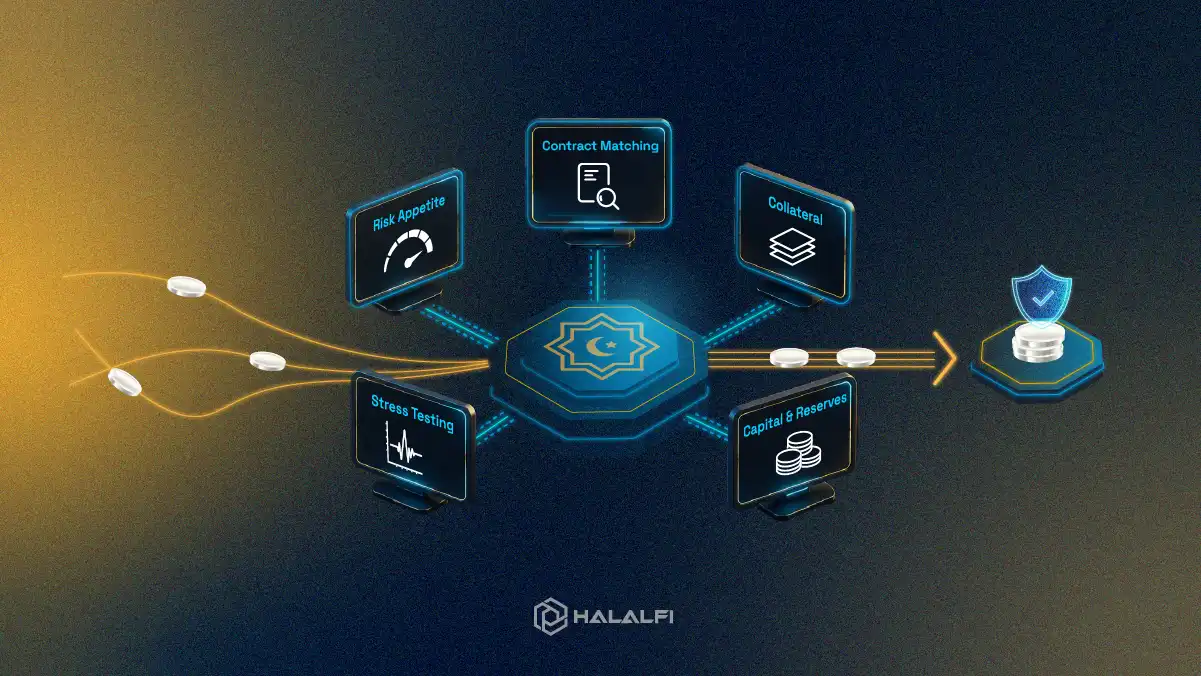
When a halal contract encounters a weak borrower, a frozen market, or a faulty smart contract, effective risk controls are essential to prevent losses from spreading, highlighting the importance of proactive mitigation measures in Islamic finance risk management.
Sharia compliance does not remove risk. Highlighting robust risk controls reassures investors that lawful trade and investment are responsibly managed without interest-based tools or misleading guarantees.
That challenge now extends beyond banks. Sukuk issuers, takaful operators, crowdfunding platforms, stablecoin users, and private investors all need stronger controls.
In this article, we will discuss Islamic Finance Risk Management and how to protect capital without risk.
What Is Risk Management in Islamic Finance?
Risk management in Islamic finance involves identifying, measuring, monitoring, and controlling risks while adhering to Sharia principles.
The process covers familiar financial dangers, such as customer default, market movements, fraud, and cash shortages.
It also addresses risks that conventional institutions may not face in the same way, including Sharia non-compliance, profit-sharing losses, and pressure to match conventional deposit returns.
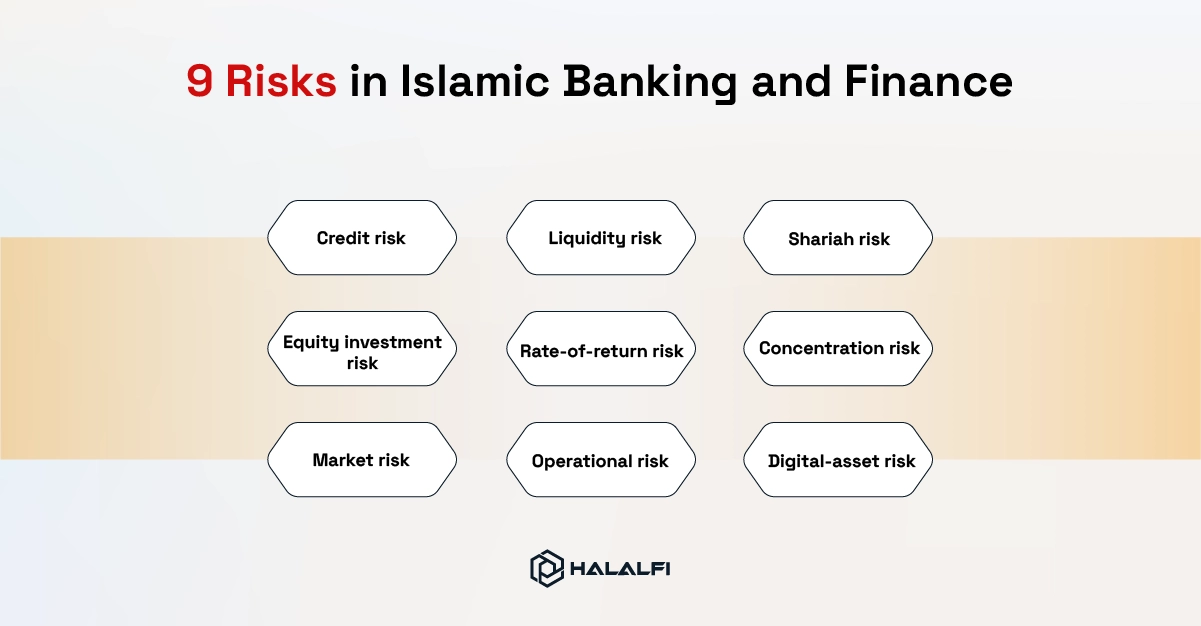
9 Risks in Islamic Banking and Finance
The Islamic Financial Services Board identifies six core categories for Islamic financial institutions:
Credit
Equity investment
Market
Liquidity
Rate-of-return
Operational risk
Sharia risk
Concentration risk
Digital-asset risk
Modern institutions must also track Sharia, concentration, legal, cyber, climate, and technology risks.
Let's see the risks, how each one appears, and why they are important:
Risk | How it appears | What makes it important in Islamic finance |
Credit risk | A customer or business cannot meet an obligation | Exposure changes across sales, leases, and partnerships |
Equity investment risk | A mudarabah or musharakah business loses money | Investors share actual commercial results |
Market risk | Asset, commodity, currency, or property values move | Institutions may own assets before selling or leasing them |
Liquidity risk | Cash arrives later than payments fall due | Islamic banks have fewer suitable short-term liquidity tools |
Rate-of-return risk | Market returns rise above an institution’s investment results | Depositors may move money to competitors |
Operational risk | People, systems, contracts, or processes fail | Contract sequencing affects both finance and Sharia compliance |
Sharia risk | A product or action breaches its approved structure | The breach may damage revenue, contracts, and public trust |
Concentration risk | Too much exposure sits with one sector or customer | Real estate and large trade portfolios can dominate the balance sheet |
Digital-asset risk | Wallet, stablecoin, oracle, or smart contract fails | On-chain records add visibility but introduce technical dependencies |
Risks in Islamic Banking and Finance explained
Let's explain briefly about each risk:
Credit Risk: Credit risk appears when another party fails to pay an amount that has become due.
Equity Investment Risk: Mudarabah and musharakah can align finance with actual business performance. Here, shariah-compliant investment differs from a product that merely changes its terminology. The investor should see both the source of profit and the path of loss.
Liquidity Risk: A bank may own valuable assets and still lack enough cash for withdrawals or payments today.
Rate-of-Return Risk and the Pressure to Copy Conventional Banks: Islamic banks often compete with institutions that advertise predictable deposit rates.
Operational and Cyber Risk: Digital banking has made payments faster. It has also created new points of failure. Technology creates evidence. It does not create honesty by itself.
Sharia Risk: Sharia risk appears when a product, contract, or transaction does not follow its approved Islamic structure. A breach can affect income, legal validity, investor trust, and the institution’s reputation.
Concentration Risk: Concentration risk arises when too much capital depends on one customer, sector, country, asset, or project type. A single downturn can then damage a large part of the portfolio.
Digital-Asset Risk: Digital-asset risk includes stablecoin depegging, wallet loss, smart-contract errors, custody failures, network disruption, and regulatory changes. Blockchain can improve visibility, but it cannot remove technical or counterparty risk.
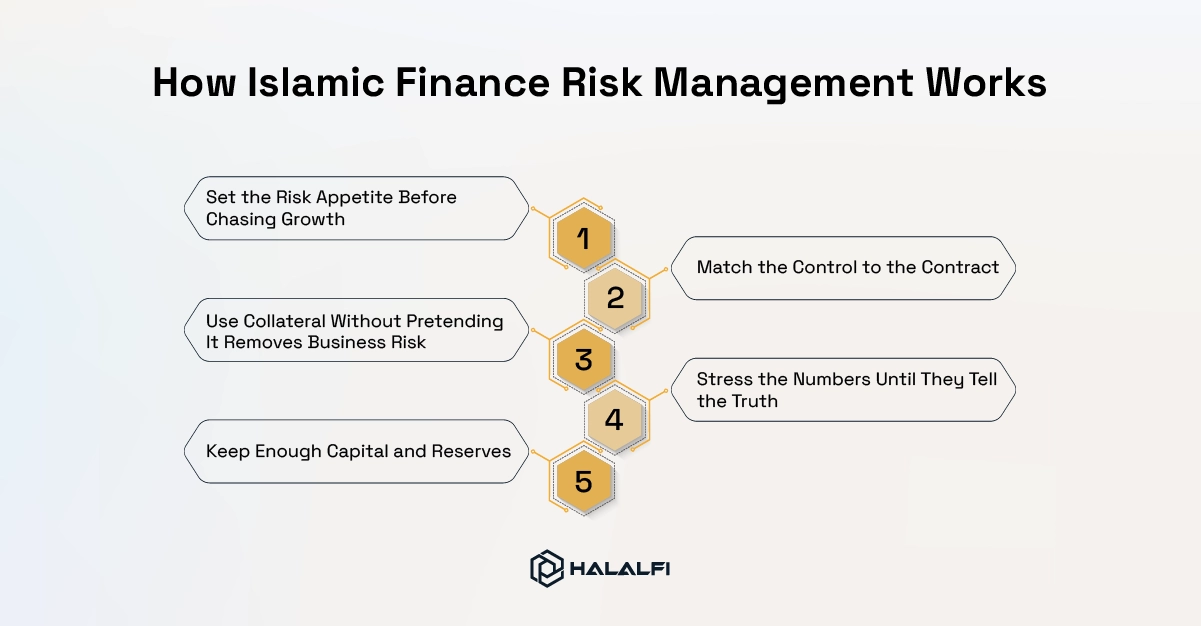
How Islamic Finance Risk Management Works
A strong framework follows a continuous loop. It does not begin and end with an annual report.
1. Establishing the risk appetite before pursuing growth is crucial
The board should decide how much exposure the institution can accept.
Limits may cover one customer, business group, property type, country, currency, digital asset, or financing contract. These limits keep a promising sector from quietly dominating the portfolio.
A risk appetite should also define non-financial boundaries. The institution may reject activities that create excessive Sharia, legal, environmental, or reputational exposure even when projected returns look attractive.
Warren Buffett states in Berkshire Hathaway’s 1992 shareholder letter how difficult conditions expose risks that remain hidden during good times:
“It’s only when the tide goes out that you learn who’s been swimming naked.”
2. Match the Control to the Contract
Different contracts create different risks. A murabaha transaction needs proof of ownership, asset documentation, customer assessment, and receivable monitoring.
Ijarah needs maintenance rules, asset insurance or takaful, and residual-value analysis.
Mudarabah needs business oversight and reliable profit reporting. Salam needs delivery controls, commodity-quality terms, and a plan for receiving or selling the goods.
Copying a single credit checklist across all products will miss important exposures.
3. Use Collateral Without Pretending It Removes Business Risk
Collateral can reduce loss after default. It cannot improve a weak business.
Risk teams should verify ownership, valuation, liquidity, legal enforceability, and priority over the asset. They should also reduce the collateral value through a conservative haircut.
A warehouse valued at $200,000 may not produce $200,000 during a rushed sale. Recovery costs, disputes, taxes, and market conditions can reduce the final amount.
4. Stress the Numbers Until They Tell the Truth
Stress testing asks what happens under adverse conditions. An institution may model a 20% property-price fall, a sharp increase in withdrawals, customer defaults, a cyber outage, a currency shock, or disruption at a major commodity broker.
A reverse test starts with failure and works backward:
Which combination of events could cause it?
Results should influence capital, liquidity, budgets, risk limits, and recovery planning.
5. Keep Enough Capital and Reserves
Capital absorbs unexpected losses. Provisions and reserves address expected or emerging losses.
An institution that reports strong profits but maintains thin capital may fail after a single concentrated shock.
Management should connect capital planning with the risk profile rather than treating regulatory minimums as an operating target.
However, stress in one market showed how delayed loss recognition can hide a weak position until the damage becomes severe.
How HalalFi Manages Project Risk?
HalalFi applies risk controls at the level of individual business projects. It reviews each opportunity from both business and Sharia perspectives.
When an investee misses payment, the project enters a review and dispute process. If the review confirms that the investee caused the default, the guarantor vault may support Principal Protection Investment.
If genuine project conditions caused the loss, the platform may apply another resolution based on the approved structure and arbitration outcome.
The protection does not guarantee expected profit. Vault liquidity, collateral enforcement, legal disputes, stablecoin problems, and smart-contract faults can still affect the outcome.
HalalFi also uses USDT to fund and settle projects. USDT does not generate the investment return. The funded business must create the profit. That keeps the economic logic closer to trade and performance-based profit sharing.
Still, every stablecoin investment needs issuer, reserve, redemption, custody, wallet, and network analysis.
Tether publishes reserve information and quarterly reports, but reserve attestations and technical infrastructure cannot eliminate every operational or market risk. HalalFi manages part of the risk chain. It does not remove the chain.
A Risk Checklist for Investors
Before entering any halal investment, ask:
What activity creates the return?
Which party owns the asset?
What could cause the project to fail?
Does the forecast rely on verified sales or optimistic assumptions?
Who controls the funds?
What events trigger Principal Protection?
Who decides whether a default occurred?
How much liquidity supports the guarantee?
Can collateral produce enough cash after enforcement costs?
Does the investor understand the exit date and possible delays?
Which Sharia reviewer approved the structure?
Could one investment create too much portfolio concentration?
Conclusion
Islamic finance does not promise a world without loss. It asks financial institutions to link rewards to responsibility and manage uncertainty without exploiting either party.
That requires strong underwriting, liquidity planning, independent risk oversight, Sharia governance, stress testing, capital, transparent contracts, and honest reporting. New technologies can strengthen those controls. They can also create fresh vulnerabilities.
HalalFi shows how project screening, exposure limits, blockchain records, collateral, and a USDT guarantor vault may work together. None of those controls makes every project suitable for every investor.
So visit HalalFi’s Projects, open a project, and test it against the checklist above. Study the business before the forecast. Read the default terms before the profit estimate. Good risk management starts before money moves.
Frequently Asked Questions
Can an Islamic investment guarantee the original principal?
A borrower must repay a valid debt, but a business partner normally cannot guarantee investment capital against genuine commercial loss.
Does deposit insurance remove risk-sharing from an Islamic account?
Deposit insurance protects customers when a financial institution fails. It does not necessarily guarantee the performance of each underlying investment.
Can Islamic banks use financial derivatives for hedging?
Islamic institutions cannot assume that every conventional derivative qualifies. They may use Sharia-compatible hedging structures for genuine exposures, subject to contract rules and scholarly approval.
How often should an institution review its Sharia risks?
Institutions should monitor compliance throughout the product lifecycle, not only at launch.
Can blockchain replace a financial or Sharia audit?
No. Blockchain can verify wallet activity and smart contract events. It cannot independently verify inventory, customer orders, legal ownership, revenue, or the honesty of off-chain reports.