
Investing puts your money to work. The goal is to grow what you have, create future income, and move closer to goals like buying a home or retiring with more financial freedom. The real challenge is deciding where your money should go.
Money can buy part of a company. It can finance property, own gold, back a startup, follow an index, or fund a real business project. Each choice earns differently and carries a different kind of risk.
This guide maps those choices and shows you which ones actually fit your money.
What Is Investing?
Investing is putting money into an asset with the expectation that its value, income, or both may grow over time.
Buy a stock, and you own part of a company; buying property and renting it may generate income. Back a private business and its future profits may increase the value of your stake.
No asset owes an investor a profit merely because money was invested in it.
How Does Investing Work?
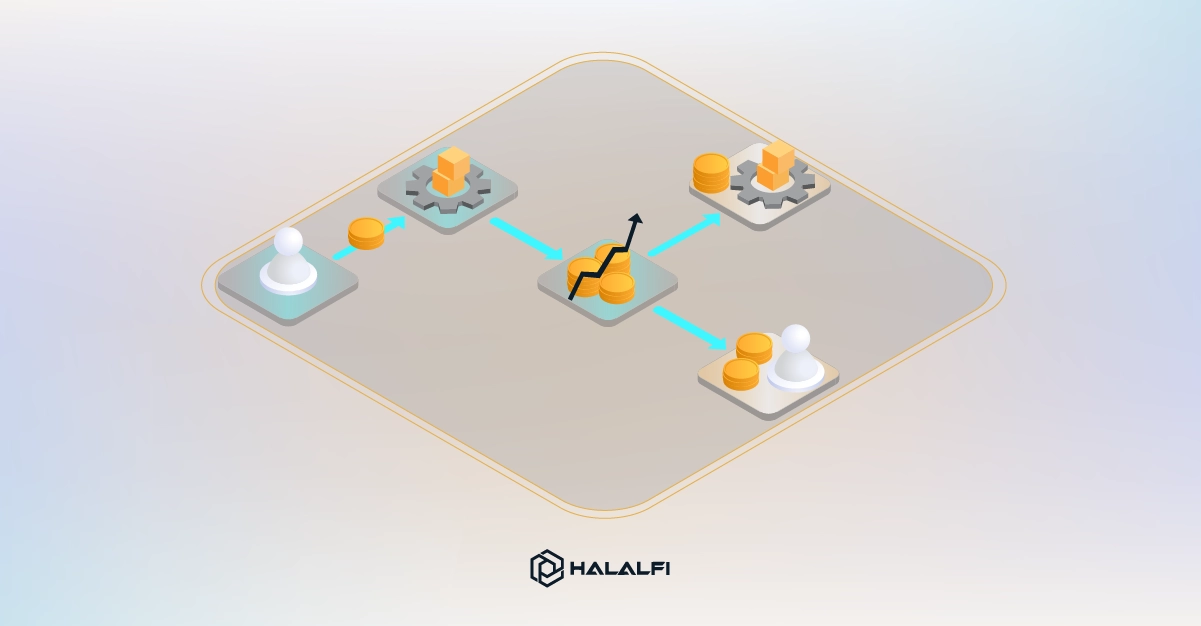
So, how does investing work once money leaves the bank account?
The investor exchanges cash for an asset or contractual right. If the asset becomes more valuable, generates income, or does both, the investment produces a positive return. If the economy deteriorates, the investor can lose money.
For example, a $1,000 stock position that rises to $1,100 produces a 10% capital gain before costs and taxes.
Then compounding starts doing some of the work for you. Returns that stay invested can start generating returns on their own.
Investor.gov estimates that $100 invested monthly for 40 years can grow substantially under a hypothetical 7% annual return. That assumption illustrates compounding; it does not promise a 7% return.
Investing Types: The Full Map
The list of investing types keeps changing as new funds, derivatives, and tokenised products appear.
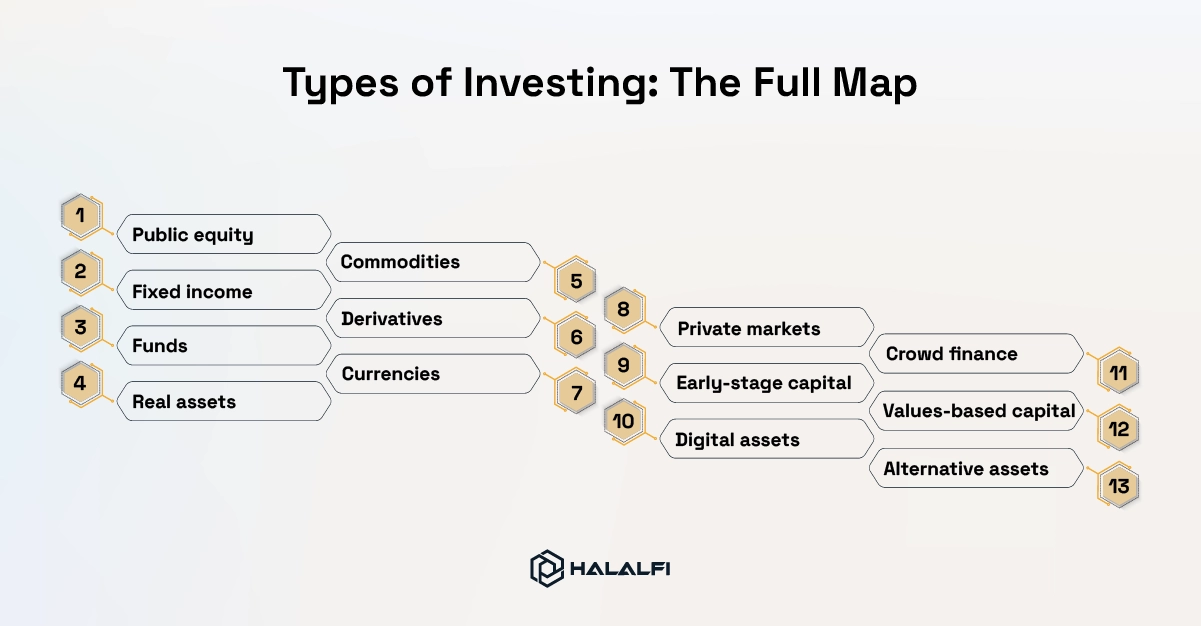
But most investments still fall into a few broad categories, which makes the market easier to understand:
Public equity: individual stocks, stock funds and equity ETFs
Fixed income: government, municipal and corporate bonds
Funds: mutual funds, ETFs, index funds, closed-end funds and investment trusts
Real assets: property, REITs, farmland, timber and infrastructure
Commodities: gold, silver, energy and agricultural commodities
Derivatives: futures, options and other contracts
Currencies: forex and currency funds
Private markets: private equity, private credit and private real estate
Early-stage capital: angel and venture investing
Digital assets: crypto, stablecoins, tokenised assets and DeFi
Crowd finance: equity, debt, reward and project crowdfunding
Values-based capital: ethical, sustainable, impact and halal investment.
Alternative assets: collectibles, art and specialist funds
There are also stocks, bonds, funds, real estate, precious metals, private equity and other alternatives as different investment categories.
Investing Options Are Not the Same as Investing Strategies
An investment option answers the question of what you own. A strategy answers how you choose and manage it. Let's see some investing options:
Investing option | What you own | Return source | Major risk |
Stocks | Company equity | Growth + dividends | Business and market risk |
Bonds | Debt claim | Interest + price movement | Credit and rate risk |
ETFs | Portfolio units | Depends on holdings | Market + fund risk |
Real estate | Property | Rent + appreciation | Property + liquidity risk |
Gold | Metal | Price movement | Price volatility |
Private equity | Private company interests | Business growth + exits | Illiquidity + business failure |
Crypto | Digital assets | Price/utility/project economics | Extreme volatility + custody |
Crowdfunding | Deal-specific interest or rights | Equity, business profit or repayment | Project + liquidity risk |
Halal projects | Shariah-structured business exposure | Trade or business profit | Project + execution risk |
How to Start Investing Without Turning It Into a Second Job
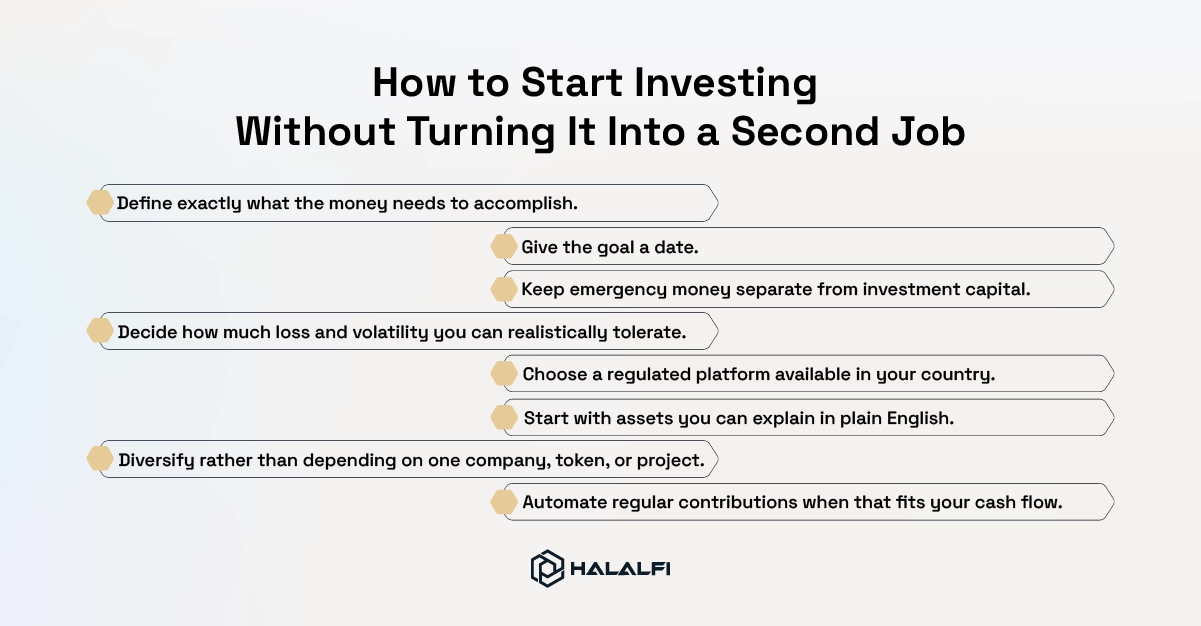
Here is the most important question: how to start investing? This is the structure:
Define exactly what the money needs to accomplish.
Give the goal a date.
Keep emergency money separate from investment capital.
Decide how much loss and volatility you can realistically tolerate.
Choose a regulated platform available in your country.
Start with assets you can explain in plain English.
Diversify rather than depend on a single company, token, or project.
Automate regular contributions when that fits your cash flow.
FINRA recommends defining the goal and time horizon before selecting investments. Risk tolerance comes next.
Investing for Beginners With Little Money
Consider a 25-year-old who wanted to begin investing in ETFs with just $250. Another beginner had $100 available per week. Beginners often think investing requires thousands of dollars.
Fractional shares and low-minimum funds have changed access. For example, ETFs often trade in relatively small dollar amounts, while diversified funds can spread risk across many holdings.
For a beginner, the first $50 or $100 has another purpose too. It teaches how orders, price changes, fees, and emotions feel without placing a large amount of capital at risk. Little money buys useful experience.
Short Term Investment: Protect the Date Before Chasing Return
A short-term investment usually serves money needed within the next few years. That changes the priority.
“Short term” does not mean “find something that pays quickly.” A five-month speculative token can carry far more risk than a ten-year diversified fund. The date controls the acceptable risk.
Long-Term Investment Gives Compounding Room to Work
A long-term investment may remain invested for ten, twenty, or forty years. That longer runway can support more exposure to assets whose prices move sharply in the short run.
Long-term investing does not mean buying something and refusing to look at it for the rest of time.
The goal, allocation, fees, and diversification still need to be reviewed occasionally. The useful part of patience comes from giving sound assets time to work, not from staying loyal to a bad investment because selling feels like admitting a mistake.
Investing vs Saving: Your Money Needs Both
Saving keeps money available for emergencies and near-term needs. Investing puts money at risk in exchange for the chance to grow it over time.
Most people need both. The table below shows where each one is better:
Saving | Investing |
Prioritises access and capital stability | Accepts risk for potential growth |
Fits emergencies and near-term spending | Fits medium- and long-term goals |
Usually has lower expected return | Can offer higher return potential |
Limited market volatility | Value can fall materially |
Protects spending flexibility | Builds future purchasing power |
Investing vs Trading: Ownership and Price Movement Are Different Games
Investing vs. trading differ in objectives and time horizons. An investor buys a company because its profits may grow over ten years.
A trader buys the same stock because a price pattern suggests movement over the next two hours.
Trading also increases the importance of timing, transaction costs, liquidity, and execution. The difference lies in what drives the decision.
Investing vs Gambling: Risk Alone Does Not Make Them Equal
The line between investing and gambling blurs when people remove analysis and add leverage. Gambling stakes money on an uncertain event without owning the productive activity behind it.
Investment behaviour can still become gambling-like. Borrowing heavily to chase a meme stock, buying an unknown token because a creator says it will “100x,” or risking rent money on futures does not make it thoughtful investing just because an app calls the screen a portfolio.
There’s More Than One Way to Invest Your Money
Stocks, bonds, and ETFs might be the first things that come to mind. But there’s also real estate, gold, silver, futures, forex, crypto, and stablecoins like USDT.
Some investors prefer direct investing, angel investing, venture capital, private equity, or crowdfunding, including crypto crowdfunding.
Others follow passive, global, value, momentum, quantitative, ethical, sustainable, or impact investing strategies. Profit sharing is another option, where returns depend on how well a business performs.
Let’s have a look at investing options.
How to Invest in Stocks
People searching how to invest in stocks usually need a process, not another stock ticker. This is the route:
Open an account with a regulated broker available in your jurisdiction.
Decide whether individual stocks fit your knowledge and risk tolerance.
Understand the company’s business before studying its share-price chart.
Read financial statements, debt levels, cash flow, and competitive position.
Compare price with reasonable expectations for future earnings or cash flow.
Avoid making a single company the centre of the entire portfolio.
Decide what would make the original investment thesis wrong before buying.
ETF Investing Turned One Purchase Into Hundreds of Holdings
ETF investing lets investors buy shares in a pooled portfolio through an exchange.
ETFs attract beginners because many offer diversification, liquidity, and low entry amounts. So, read the holdings; two ETFs with different names can own many of the same companies. The ticker tells you what to buy and the portfolio tells you what you actually own.
Investing in Bonds
Investing in bonds creates a debt relationship rather than ownership in the company.
Governments, municipalities and companies issue bonds to borrow capital. Investors expect scheduled payments and principal repayment, subject to the bond’s terms and the issuer’s ability to pay. Global regulated bond funds held about $16.95 trillion at the end of Q1 2026.
For Shariah-conscious investors, conventional interest-bearing bonds create a separate compliance issue.
Sukuk use different underlying structures and may provide an Islamic alternative, depending on the specific instrument and Shariah review. “Fixed income” does not mean “no risk.”
Real Estate Investing
Real estate investing ranges from owning one rental apartment to holding shares in a global property fund.
Direct ownership gives the investor control but brings tenants, repairs, financing, taxes, and illiquidity.
REITs and property funds trade control for easier diversification and smaller investment amounts. Private property funds and real estate crowdfunding add additional structures.
Investing in Gold
Investing in gold involves physical bars and coins, gold-backed funds, mining shares, or derivatives. These routes do not carry identical risks.
Gold had an extraordinary 2025. Total demand exceeded 5,000 tonnes for the first time, while investment demand reached 2,175 tonnes.
Gold ETFs added 801 tonnes during the year. Momentum continued into 2026, although Q2 ETF flows softened as prices cooled.
Gold produces no corporate earnings or rent. Investors depend largely on price changes. That makes it useful for some diversification strategies, but “haven” should never translate into “price cannot fall.”
Silver Investing
Silver works as both an investment metal and an industrial input. Investors can buy bullion, silver-backed products, mining companies, or futures. Each behaves differently.
The Silver Institute reported that silver ETP inflows reached their second-highest level on record in 2025, while coin and net bar demand increased 14%. It expects the market to record a sixth consecutive supply deficit in 2026.
Industrial demand also matters, including electronics and solar manufacturing. That combination can make silver more volatile than investors expect of a precious metal.
Futures Investing
Futures investing means taking exposure through contracts tied to an asset’s future price. What people call investing in futures often behaves much more like specialised trading or hedging than ordinary buy-and-hold investing.
Futures cover commodities, stock indexes, currencies, rates and other markets. The problem for beginners comes from leverage.
A relatively small margin deposit can control a much larger position, magnifying gains and losses.
Forex Investing
Forex investing means taking positions in currencies, although retail activity often resembles short-term trading.
Currency prices respond to rates, inflation, economic growth, capital flows, and political events. Retail platforms may also offer substantial leverage.
Long-term investors usually encounter currency risk through global assets rather than treating currencies as their main wealth-building asset.
Crypto Investing
Crypto investing covers Bitcoin, Ether, other native tokens, tokenised assets, DeFi positions, and crypto-linked securities.
Unlike a stock, many crypto assets do not represent ownership in a company. Their value may depend on network adoption, scarcity, utility, protocol economics, or speculation.
Regulation continues to change too. In August 2026, the U.S. SEC proposed Regulation Crypto Assets, a new framework for certain investment-contract offerings involving crypto assets. It remains a proposal, not a final rule.
Stablecoin Investment
A stablecoin investment starts with an asset designed to track another asset, usually a currency such as the U.S. dollar. That price target reduces one form of volatility, but it does not remove risk.
The return comes from what happens after the stablecoin reaches a platform: lending, liquidity provision, staking-like arrangements, or business investment.
A token staying near $1 does not mean every opportunity paying returns on that token carries cash-like risk.
USDT Investing
USDT investing deserves its own category because holding USDT and investing USDT describe two different actions.
Holding the token creates stablecoin, issuer and custody exposure. Deploying USDT into a business project, DeFi pool, or lending arrangement adds another layer of risk and another source of potential return.
If a platform offers 15% because a real trading project expects a commercial margin, analyse that business. If a protocol pays yield from borrowing demand, analyse the borrower and smart-contract structure.
Angel Investing
An angel usually invests personal money directly into an early-stage company. The upside can be large if a startup grows. The failure rate and liquidity risk can also be severe.
An angel may wait for years for an acquisition, a secondary sale, or an IPO. The shares do not trade like Apple or Microsoft.
Angel investing, therefore, works better as a single risky piece of a broader portfolio than as a substitute for emergency savings or retirement diversification.
Venture Investing
Venture investing also funds young companies, but venture-capital funds pool money and build portfolios across multiple startups.
VC investors expect many investments to disappoint. A smaller number of large winners can drive fund returns. Venture investing brings long holding periods, uncertain valuations and limited liquidity.
Retail investors increasingly see private-market opportunities through funds, secondary markets and crowdfunding, but easier access does not make early-stage companies safer.
Private Equity Investing
Private equity investing involves buying stakes in private companies, improving or expanding them, and eventually seeking an exit. Investing Strategies here include buyouts, growth equity, secondaries, and specialist funds.
Private equity trades daily liquidity for access to companies not listed on stock exchanges. The SEC warns that private placements may offer less disclosure and may remain difficult or impossible to resell for extended periods.
Direct Investing
Direct investing means owning the underlying opportunity rather than accessing it through a pooled fund.
Buying an individual stock is direct. Buying an apartment is direct. Taking equity in a private company or financing a specific business project can also qualify.
Direct investing makes the connection between capital and business activity clearer. It also makes a single bad decision more visible in the portfolio.
Global Investing
Global investing spreads capital across multiple national markets. An investor might combine U.S., European, Asian, and emerging-market stocks or use a global ETF that already does the job.
The attraction comes from access to different industries, economic cycles, and valuations. The risks include currency risk, foreign regulation, taxation, and political events.
Global diversification matters because the biggest market does not win every year. A global portfolio should reduce dependence on any one country, not become a series of bets on which country will win next quarter.
Passive Investing
Passive investing tracks a market index rather than relying on a manager to pick winners.
John C. Bogle’s famous line captures the idea:
“Don’t look for the needle in the haystack. Just buy the haystack!”
Passive does not mean risk-free. If the market falls, the index fund falls with it.
Value Investing
Value investing means buying an asset when analysis suggests its market price sits below a reasonable estimate of its underlying value.
A value investor studies earnings, assets, cash flow, debt, competitive position, and valuation rather than buying solely because a price chart is trending upward.
Cheap does not mean undervalued. Value investing therefore requires two judgments: what the business may be worth and why the market currently disagrees.
Momentum and Quantitative Investing
Momentum investing favours assets whose prices or fundamentals show persistent strength. It assumes trends can continue long enough to exploit.
CFA Institute divides active equity management into fundamental and quantitative approaches. Quantitative strategies may use factors such as value, growth, momentum, volatility and quality.
Ethical, Sustainable and Impact Investing
Ethical investing excludes activities that conflict with the investor’s values. Sustainable investing often incorporates environmental and social factors into financial analysis.
Impact investing goes further by intentionally targeting measurable social or environmental outcomes alongside financial returns.
Crowdfunding Turns a Large Capital Need Into Smaller Contributions
Crowdfunding lets many people contribute money to one campaign, company, or project.
The contributor might donate, preorder a product, lend money, buy securities, or participate in another investment structure. Those models carry completely different rights.
Crowdfunding becomes interesting for direct investors because it can open businesses that never appear on a stock exchange.
A crowdfunding platform is somewhere between the business raising capital and the crowd providing it.
Good platform design makes due diligence easier by showing funding targets, financial information, project duration, ownership rights, risks and previous outcomes.
Crypto Crowdfunding Moves the Crowd Onto Blockchain
Crypto crowdfunding uses blockchain assets or infrastructure to raise and distribute capital.
A project might accept stablecoins, issue tokens, use smart contracts for settlement, or record investor participation on-chain.
It reduces geographic and payment friction and also adds wallet, smart contract, token, and regulatory risks.
The useful version of crypto crowdfunding connects blockchain settlement with something investors can analyse: a business, asset, product, or contractual right.
The weak version relies mainly on a token's price rising because more people arrive later.
Profit Sharing Changes Where the Investor’s Return Comes From
Profit sharing links the investor’s return to economic performance rather than promising a payment because time passed.
Imagine a trading business raises $50,000 to buy and resell goods. Investors receive an agreed portion of realised profit after the commercial cycle concludes. The important word is realised.
A forecast can estimate profit, but the business must still execute. Profit-sharing structures therefore require visibility into revenue, costs, contracts, and settlement.
They can align investors more closely with business performance, but they also expose investors to execution risk.
It is important in Islamic finance, where the source and structure of a return can determine whether an investment aligns with Shariah principles.
Investing Online Made Access Easy
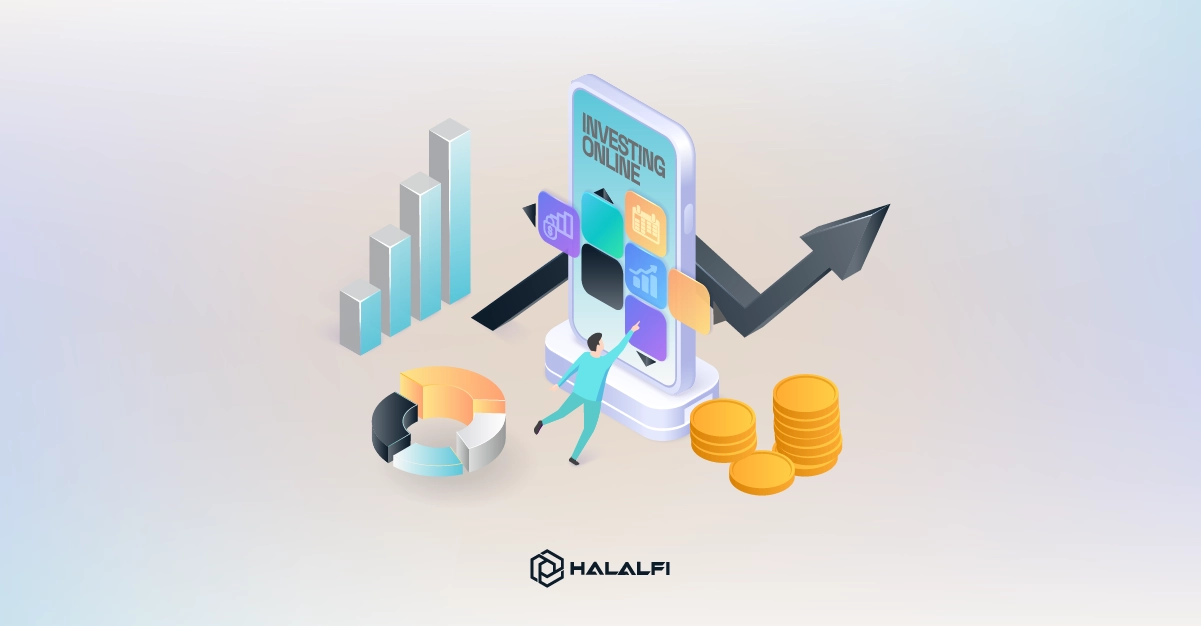
Investing online now covers brokerage apps, robo-advisers, crypto platforms, crowdfunding sites, and private-market portals. So what is the best investing platform?
There is no global winner. Regulations, tax rules, and available products vary by country. Compare licensing, custody, fees, withdrawal rules, asset access, security, and customer support.
How Much Should I Be Investing Each Month?
Start with the goal and work backward. If the goal requires $500,000 in 30 years, calculate the monthly amount using a reasonable range of return assumptions.
Then test whether that contribution fits the household budget without sacrificing emergency cash or creating expensive debt.
The best monthly number is one that moves the goal forward and survives ordinary life.
Investing Tips for Beginners
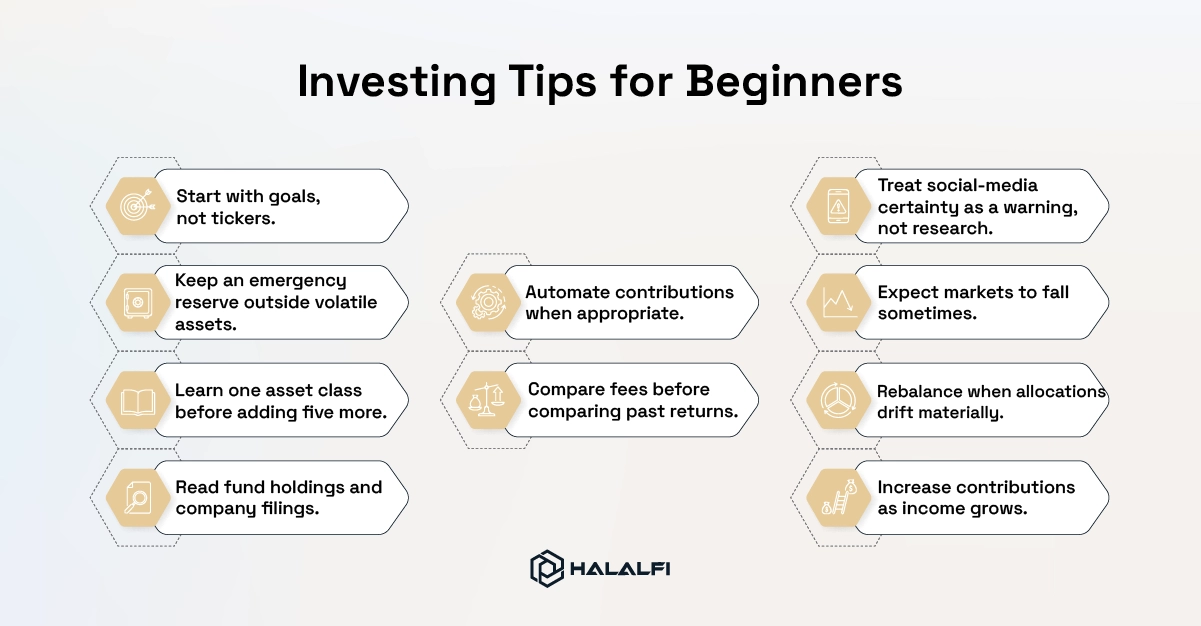
Useful investing tips protect investors from themselves rather than predict tomorrow’s winner. Let's see the tips:
Start with goals, not tickers.
Keep an emergency reserve outside volatile assets.
Learn one asset class before adding five more.
Read fund holdings and company filings.
Automate contributions when appropriate.
Compare fees before comparing past returns.
Treat social-media certainty as a warning, not research.
Expect markets to fall sometimes.
Rebalance when allocations drift materially.
Increase contributions as income grows.
HalalFi Connects Investing Models in One Project
Stocks offer liquidity but usually give investors little connection to how one specific dollar supports a business. Private equity offers direct business exposure but often requires large capital and long lockups.
Crypto moves capital globally but can disconnect returns from productive activity. Traditional crowdfunding reaches real businesses but may rely on conventional payment and settlement systems.
HalalFi Projects combines elements of direct investing, crowdfunding, crypto crowdfunding, USDT investing, and Halal investing.
In HalalFi, each listed business passes Shariah and business reviews. Investors fund individual commercial projects with USDT, while project pages show the funding target, duration, forecast return, business details, and available protection mechanisms. Smart contracts record parts of funding and settlement.
Conclusion
Investing gives your money a job. Instead of letting cash sit still while prices rise, you put it in assets that may grow in value, generate income, or help you reach a future goal faster.
It means building a retirement fund, saving for a home, or creating another source of income.
For best investing, start with the goal, give it a date, decide what loss the plan can survive and then choose the asset.
Stocks build long-term ownership, ETFs spread risk, property generates rent, Gold and silver diversify, Private markets provide access unavailable on exchanges, crypto introduces new financial structures, and crowdfunding connects investors directly with businesses.
HalalFi adds something valuable: Shariah-reviewed, project-based business investing funded through USDT.
No portfolio needs every option in this guide; it needs the right ones. And when the next HalalFi project opens, the same rule should apply there: read the business, inspect the numbers, understand the risk, then put capital to work only when the story and the economics agree.
Frequently Asked Questions
Where should I start investing if I only have $100?
Start by deciding when you will need the money. If it belongs to a long-term goal and emergency savings already exist, low-minimum diversified funds can provide broad exposure without requiring thousands of dollars.
Should a beginner invest a lump sum or invest monthly?
The answer depends on where the money comes from and how comfortable the investor is with market-timing risk. Someone investing new salary each month naturally invests gradually. Someone holding a large amount of cash faces a different decision.
Can someone start investing at 40 or 50?
Yes. Starting later changes the maths, not the possibility.
How often should an investing portfolio be checked?
Checking prices every hour adds information without necessarily improving decisions. A portfolio needs review when goals, income, time horizon, or risk tolerance change, and periodically to check allocation and rebalance where necessary.
Should beginners invest when the stock market is near a record high?
A record high does not reveal what markets will do next. For long-term investors, the better question remains whether the portfolio, contribution.
What is the biggest investing mistake beginners make?
There is no single mistake, but investing in something that the buyer cannot explain combines several problems at once.