
Can a long-term investment still work when markets swing, crypto dominates the headlines, and every other app promises a faster route to wealth?
Yes, but only when the investment matches a real goal. Long-term wealth often grows from a steady, diversified system: regular contributions, controlled fees, patience, and fewer emotional decisions, which can help build confidence over time.
In this guide, we explain what long-term investment means, which options may fit different goals, and how stocks, mutual funds, ETFs, gold, silver, crypto, and crowdfunding compare.
What Is Long-Term Investment?
Long-term investment means investing money in assets you plan to hold for several years, often 1 year or longer.
The aim usually involves retirement, financial independence, education, property, or wealth that can support the next generation.
A good long-term investment needs a credible source of value, which understanding different assets can provide, empowering investors to make better decisions.
According to Investopedia, Warren Buffett captured the long-term mindset in Berkshire Hathaway’s 1988 shareholder letter:
“Our favorite holding period is forever.”

How Long Is Considered a Long-Term Investment?
Most investors treat periods of less than three years as short-term, three to five years as intermediate, and five years or more as long-term. These ranges offer guidance rather than rigid rules.
Time available | Main priority | Common approach |
1–3 years | Lower volatility | Short-duration assets |
3–5 years | Balance | A cautious mixed approach |
5–10 years | Growth with flexibility | Diversified funds and selected assets |
10+ years | Compounding and wealth building | Broad growth assets with periodic rebalancing |
Why Can Long-Term Investment Work?
Long-term investing gives money more time to grow, reduces the pressure to predict every market move, and limits the damage caused by frequent trading and high fees.
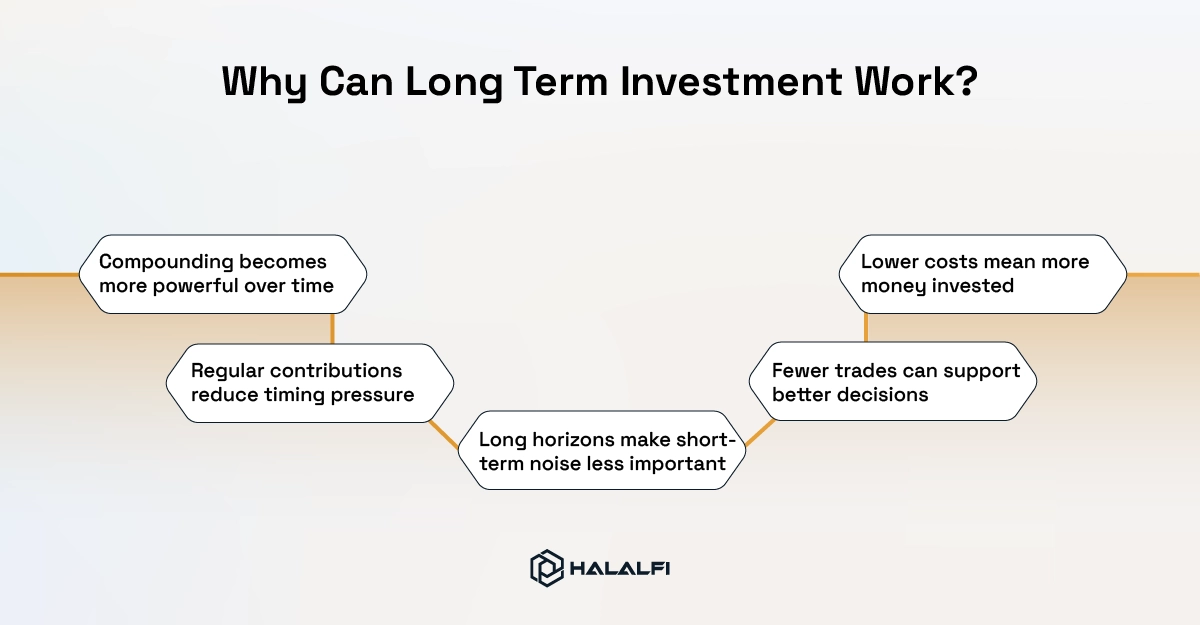
Compounding becomes more powerful over time: Past gains generate new gains, although the effect often looks modest in the early years.
Regular contributions reduce timing pressure: A consistent investment schedule allows investors to keep buying through rising, falling, and quiet markets.
Long horizons make short-term noise less important: Investors do not need to react to every headline, market dip, election, or interest-rate prediction.
Fewer trades can support better decisions: Long-term investors may be less exposed to emotional buying, panic selling, and excessive speculation.
Lower costs mean more money invested: Even a small difference in annual fees can remove thousands of dollars from a portfolio over several decades.
Compare Long-Term Investment Options
What is the best long-term investment? Actually, there is no single answer for everyone. The right option depends on the goal, country, values, knowledge, liquidity needs, and ability to tolerate losses.
Long-term investment type | Main return source | Strength | Main risk | Role |
Individual stocks | Business earnings and growth | High upside potential | Company-specific loss | Focused growth |
Mutual funds | Portfolio performance | Professional management | Fees and weak fund choices | Simple diversification |
ETFs | Index or strategy performance | Often transparent and tradable | Market and concentration risk | Portfolio core |
Real estate | Rent and appreciation | Tangible asset and income | Illiquidity and financing | Income and diversification |
Gold | Price appreciation | Portfolio hedge | No business cash flow | Defensive allocation |
Silver | Price and industrial demand | Industrial upside | Greater volatility | Small diversifier |
Sukuk | Asset, lease, or project cash flow | Sharia-oriented income exposure | Credit and structural risk | Income allocation |
Private business | Profit and enterprise growth | Direct economic exposure | Failure and illiquidity | Higher-risk satellite |
Crypto | Adoption, utility, and demand | Large possible upside | Extreme loss and custody risk | Speculative allocation |
Crowdfunding | Project, revenue, or equity outcome | Access to specific businesses | Default and limited exits | Alternative allocation |
How Each Long-Term Investment Fits Into Your Portfolio?
Every investment serves a different purpose. Some focus on long-term growth, others generate income or reduce overall risk.
Understanding how each asset fits within a diversified portfolio can help you build a strategy that aligns with your financial goals and risk tolerance:
Individual Stocks: Individual stocks offer direct ownership in a business and the potential for strong long-term growth.
Mutual Fund: A good fund should fit the investor’s market,
ETFs: ETFs can serve as strong long-term building blocks because a single purchase can provide exposure to hundreds or thousands of securities.
Real Estate: Real estate can generate returns through rental income and long-term appreciation.
Gold: Gold can diversify a portfolio and preserve value during some periods of currency stress or market fear.
Silver: Silver serves both an investment and an industrial role. Demand can grow with electronics, solar power, manufacturing, and other technologies.
Sukuk: Sukuk provide Shariah-compliant exposure to asset- or lease-backed cash flows and help balance a portfolio by offering a more defensive source of returns than equities.
Private Business: Investing in private businesses creates attractive profit-sharing opportunities and a closer connection to the real economy.
Crypto: A crypto long-term investment can produce large gains, large losses, or complete failure. A stablecoin investment raises a separate question. Stablecoins aim to track another asset, often the US dollar.
Crowdfunding: Crowdfunding allows investors to support specific businesses or projects directly for the long term.
The Growth of Values-Based Long-Term Investing
Long-term investing increasingly includes ethical, environmental, and faith-based filters. This development does not change the need for diversification, fees, liquidity, and risk analysis. It adds another question: what activities does the money support?
Halal investment no longer sits in a tiny corner of finance. Investors now explore screened equities, funds, sukuk, real estate, partnerships, and technology-based project funding.
Long-Term Investment Strategies That Survive Real Life
Successful long-term investing is built on consistent habits, not perfect market timing. The strategies below can help investors stay disciplined, manage risk, and keep their portfolios aligned with long-term financial goals through changing market conditions.
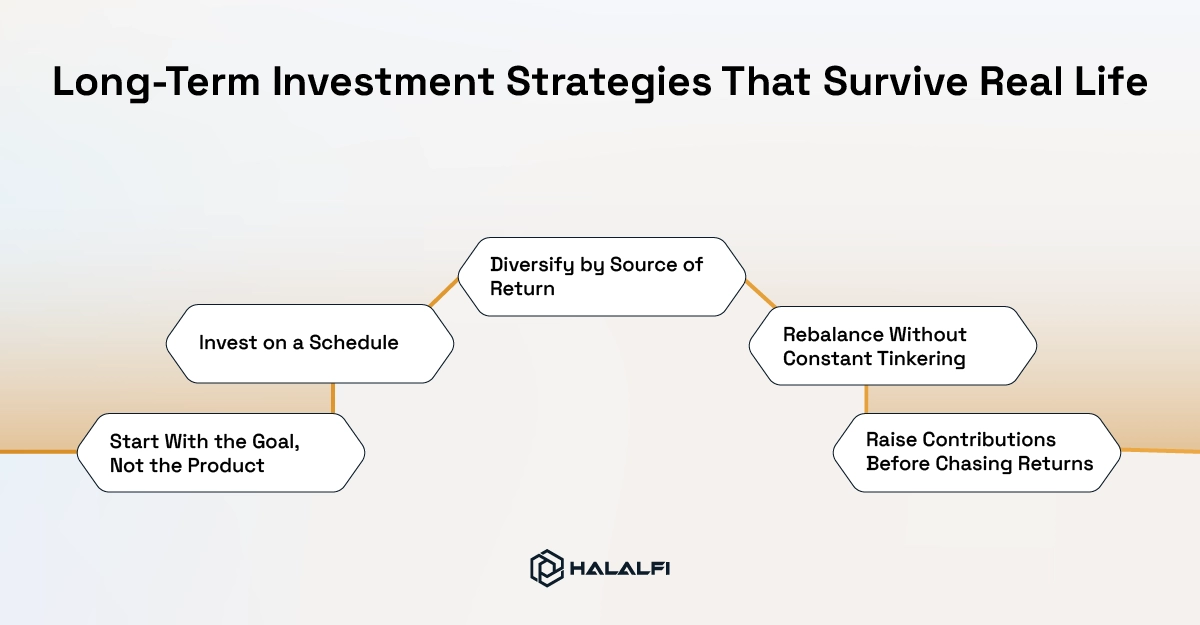
Start With the Goal, Not the Product: “Retirement in 25 years” creates a plan. “Buy something that goes up” creates a temptation.
Invest on a Schedule: Dollar-cost averaging reduces the temptation to put every dollar into the market after a rally or to withdraw completely after a decline.
Diversify by Source of Return: Strong portfolios spread risk across businesses, regions, assets, and return sources.
Rebalance Without Constant Tinkering: One asset may grow faster and quietly change the portfolio’s risk.
Raise Contributions Before Chasing Returns: Investors cannot control market returns. They can control saving rates, costs, debt, diversification, and behavior.
Long-Term Investment vs Short-Term Investment
A long-term plan builds wealth across years. A short-term investment protects or deploys money with a shorter time horizon. Neither approach automatically beats the other because they solve different problems.
Question | Short-term investment | Long-term investment |
When will the money matter? | Usually within five years | Usually after five years |
Main goal | Liquidity or near-term use | Growth and compounding |
Tolerance for a major decline | Low | Often higher |
Typical assets | Cash-like tools and short projects | Stocks, funds, property, businesses |
Main danger | Chasing yield with needed money | Panic-selling or paying high fees |
Review focus | Maturity, access, default | Allocation, costs, progress |
Consider two examples. A couple saving for a wedding next year should not rely on a volatile stock recovering on schedule.
A 28-year-old investing for retirement can tolerate more volatility because the goal is decades away.
The difference between short-term and long-term investment comes down to the deadline, not the investor’s mood.
Should Crowdfunding Be Short Term or Long Term?
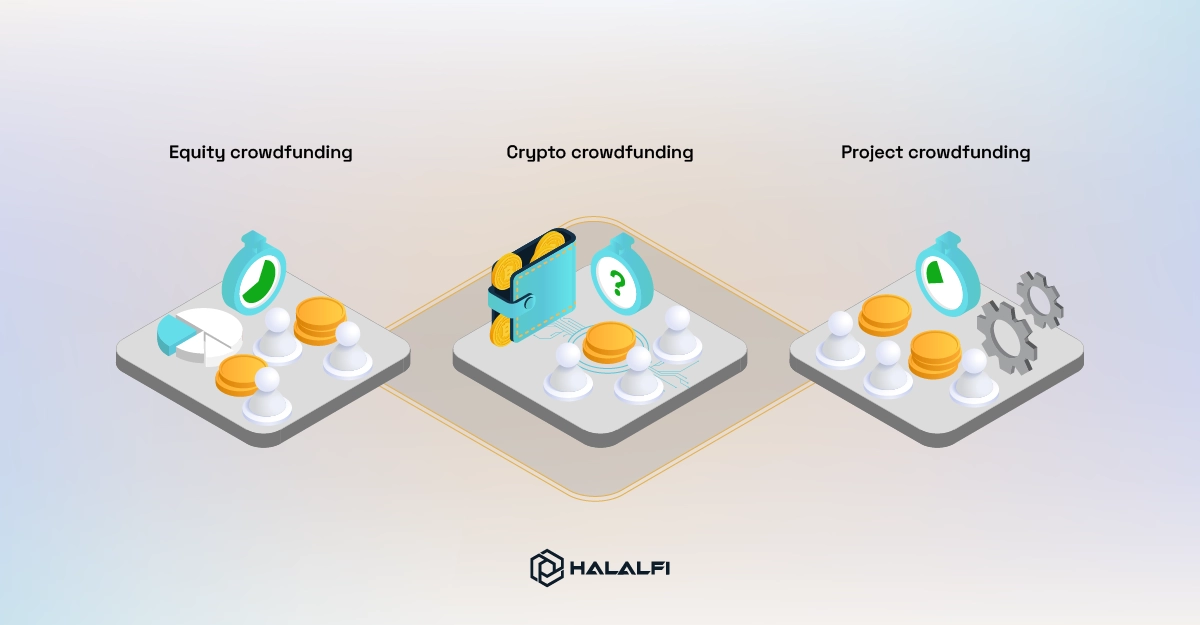
It depends on the type of crowdfunding. Equity crowdfunding often creates a long-term, illiquid position.
Investors may wait years for a sale, dividend, acquisition, or public listing. Many businesses never reach a successful exit.
Project crowdfunding follows a shorter commercial cycle. A retailer might raise money to buy inventory, sell it over four months, and distribute the resulting profit according to the agreement. A property-development campaign could take several years.
Crypto crowdfunding has some different rules. Investors must separate the funded business from token prices, wallet custody, smart-contract security, and regulatory exposure. Blockchain records improve visibility, but they do not remove commercial risk.
Short-Cycle Opportunities With HalalFi
Long-term investment focuses on building wealth over years through assets such as stocks, funds, real estate, or businesses.
HalalFi follows a different timeline. Its project-based crowdfunding platform focuses on shorter commercial cycles, where businesses seek working capital and investors participate in specific opportunities.
This makes HalalFi less of a core long-term portfolio and more of a potential alternative allocation within a broader investment plan.
For example, an investor may use diversified funds for long-term growth while exploring selected HalalFi projects for shorter-term business exposure and profit-sharing opportunities.
As with any investment, investors should review project details, risks, guarantees, and terms before participating.
Conclusion: Give Every Dollar a Job
Long-term investment works when time supports a sound asset, a clear goal, and repeatable behavior.
It does not require constant excitement. In fact, excitement often causes the most expensive mistakes.
Start by separating emergency cash, short-term goals, and long-term wealth. Compare funds, stocks, property, metals, crypto, and private projects by what creates the return not by the size of the advertised number.
HalalFi offers an interesting next step for investors who want to study shorter, real-business funding alongside a long-term portfolio.
Explore HalalFi projects, read the contract and guarantee terms, verify the stablecoin and smart contract, and decide whether one carefully sized opportunity fits your broader plan.
The goal is not to buy because a page creates urgency. The goal is to understand the deal so clearly that hype becomes unnecessary.
Frequently Asked Questions
Is one ETF enough for a long-term portfolio?
One broad ETF may provide substantial diversification, but it may not cover every market, asset type, currency, or risk.
How often should a long-term portfolio be reviewed?
A review once or twice a year may suit a simple portfolio.
Can an investor change a long-term plan?
Yes. A plan should change when the goal, timeline, income, family situation, or risk capacity changes.
How much emergency cash should come before long-term investing?
The right amount depends on job stability, dependants, insurance, expenses, and access to credit. Emergency cash should remain separate.