
Money has never been neutral. Every dollar you invest moves somewhere, helping a business grow, funding an idea, or supporting an entire industry. That’s why understanding how crowdfunding actually works matters more than ever.
Crowdfunding is a process in which many individuals contribute small amounts of capital to fund a project or business, typically through online platforms. But beneath the surface, it’s a structured system:
campaigns are created, funding goals are set, timelines are defined, and contributions are collected and distributed according ton predefined conditions.
Instead of relying on a single bank or investor, crowdfunding spreads both opportunity and risk across a wider group. In many cases, returns are linked to performance, delivery, or participation in the project itself.
This article focuses on exactly that, not just what crowdfunding is, but how it works in practice, how money flows, where risks emerge, and what investors and founders need to understand before getting involved.
What Is Crowdfunding?
Crowdfunding is the process of raising money from a large pool of people, usually through online platforms and social media.
Instead of seeking a single large investment, the campaign creator asks many individuals to contribute smaller amounts.
It sounds almost too simple. Put up a project page, share your story, and wait for the funds to come in. In reality, though, effective crowdfunding is much more strategic. It blends finance, storytelling, promotion, trust-building, and audience engagement.
Crowdfunding turns fundraising into a public campaign. Your idea is no longer shared privately with a handful of lenders or investors. It is presented to the crowd, and theydecides whether it deserves support.
The Main Crowdfunding Types
Not all crowdfunding works the same way. In fact, the differences are significant. One of the biggest mistakes people make is treating all crowdfunding campaigns as if they follow the same rules.
Here is a comparison of crowdfunding types:
Crowdfunding Type | How It Works | What Backers Receive | Who It Suits Best | Main Risk |
Donation-based crowdfunding | People contribute money to support a cause or need | Usually, nothing financial in return | Personal causes, emergencies, nonprofits | No financial return for backers |
Reward-based crowdfunding | People fund a project in exchange for perks or products | Merchandise, early access, gifts, experiences | Creators, startups, product launches | Fulfilment pressure if the campaigns succeed |
Equity-based crowdfunding | People invest in exchange for ownership or future equity rights | Shares or equity-related returns | Startups seeking growth capital | Investors may lose their principal |
Debt-based crowdfunding | People lend money that is repaid with interest | Loan repayment plus interest | Businesses seeking alternatives to bank loans | Borrower must repay; investor default risk |
Why Crowdfunding Matters More Than Ever
Funding has always been a bottleneck for smaller businesses. Big corporations often have easier access to investors, credit, and institutional support. Smaller founders usually do not. That imbalance is exactly why crowdfunding matters. It widens access.
A local founder with a good product idea is no longer limited to nearby lenders or a narrow investor network. Through a crowdfunding platform, they can potentially reach thousands of people online.
Social media amplifies that reach even further, helping founders connect with supporters they may never have met otherwise. It also gives entrepreneurs something beyond capital: feedback.
One of the most famous examples is the Kickstarter campaign for a potato salad. Kickstarter shows that it started with a modest $10 goal and ended up raising more than $55,000 from 6,911 backers. Funny? Definitely.
But it also captures a serious point. Crowdfunding is driven by attention, emotion, and shareability as much as financial logic.

A Brief History of Crowdfunding
Crowdfunding may feel like a modern digital trend, but the idea has older roots.
According to Investopedia, one of the earliest crowdfunding examples occurred in 1997, when a UK band raised money from fans to fund a tour.
Then, in 2000, ArtistShare launched as the first crowdfunding site and became an important funding source for companies.
Over time, the model evolved. At first, crowdfunding platforms operated with relatively light regulation. As the market grew, governments started introducing restrictions and compliance rules, especially for investment-based models.
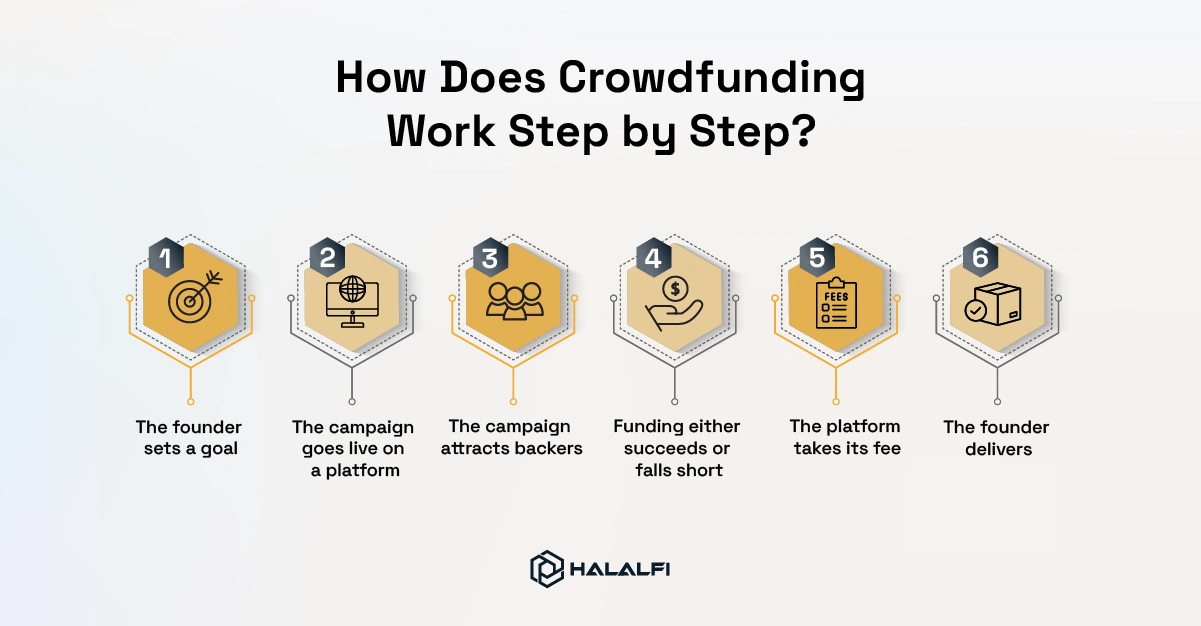
How Does Crowdfunding Work Step by Step?
If you have never launched or backed a campaign before, the process can seem a little abstract. But it usually follows a fairly clear path.
1. The founder sets a goal
Every campaign begins with a purpose. That might be launching a product, funding a creative project, covering medical expenses, or growing a startup.
The first major decision is the raise goal. This is the amount the campaign aims to collect. Set it too low, and you may not cover real costs. Set it too high, and you may scare off potential backers or miss the target.
A strong raise goal should reflect how the money will actually be used. Founders should be able to explain that clearly. People want to know where their money is going.
2. The campaign goes live on a platform
The founder then chooses a crowdfunding platform that fits the project type. Different platforms serve different needs. Some are better for creative products. Some are better for emergencies. Some support flexible funding. Others are more rigid.
Usually, the project page includes:
The project story
The funding goal
A timeline
What the funds will be used for
Rewards or investment terms, depending on the model
This is where presentation matters. A vague pitch rarely works. People need clarity, confidence, and a reason to care.
3. The campaign attracts backers
Once the campaign is live, supporters can contribute money. In many cases, they can invest small amounts. This low barrier matters. It makes crowdfunding more accessible. Backers do not always need deep pockets to participate.
This is also where considerations of minimum and maximum investment come into play. Depending on the platform and model, there may be rules on how much or how little a person can contribute.
For founders, these limits shape the structure of the raise. For investors, they affect access and risk.
4. Funding either succeeds or falls short
Some platforms use an all-or-nothing model. If the campaign reaches its goal, the funds are released. If it falls short, the pledged money may be returned to backers.
Other platforms offer flexible funding, allowing the campaign to receive money as it comes in, even if it does not hit the full target.
This is where the concept of a soft cap becomes useful. A soft cap is the minimum amount a project needs to move forward realistically.
Even if the ideal target is higher, founders should understand the minimum viable amount required to deliver what they promised. That helps avoid overpromising and underdelivering.
5. The platform takes its fee
Crowdfunding platforms are businesses too. They usually charge fees from the amount raised. For example, Kickstarter charges a 5% fee.
This is not a small detail. Fees affect how much capital the founder actually keeps. Before choosing a platform, creators should understand all charges, including any punitive or payment-related fees.
6. The founder delivers
This is where the campaign stops being a pitch and becomes an obligation.
If the model involves rewards, the founder must fulfil them. If it involves equity, investors expect transparency. If it is donation-based, supporters still expect honesty and updates.
Crowdfunding does not end when the money arrives. In many ways, that is where the real work begins.
Top Crowdfunding Platforms to Know
Some platforms have become household names. But they do not all do the same thing.
GoFundMe
GoFundMe is the largest crowdfunding platform. Since its founding in 2010, it has raised over $30 billion, with 150 million people either sending or receiving money through the platform.
It is especially popular for:
Medical expenses
House fires
Natural disasters
Emergency costs
Personal fundraising
Kickstarter
According to Investopedia, Kickstarter was founded in 2009 and has funded more than 250,000 projects, with more than $8 billion pledged across all campaigns.
Kickstarter is strongly associated with:
Creative projects
Product launches
Public-facing startup ideas
Shareable campaigns
HalalFi
If GoFundMe is known for emergency support and Kickstarter is known for creative campaigns, HalalFi is positioned differently. It is built as a Sharia-compliant crowdfunding platform for people who want their money to grow in ways that align with faith, ethics, and real economic value.
HalalFi connects conscious investors with real, cash-flowing businesses, using blockchain transparency, audits, and performance-based profit-sharing instead of fixed interest.
In other words, it is not built around hype, speculation, or guaranteed interest-style returns. It is built around funding real businesses in a more accountable way.
HalalFi is designed for:
Muslims who want to grow wealth without compromising faith
Impact-driven non-Muslims who want ethical, real-world exposure
Businesses seeking growth capital without entering interest-based structures
What makes HalalFi different is that it combines crowdfunding with Islamic finance principles. The platform is built around features such as:
Sharia-compliant investment structures
Performance-based profit-sharing instead of fixed interest
Dual audits, including Sharia review and business review
Smart contracts and blockchain records for transparency
Collateral, guarantor, and risk-mitigation tools
A framework aimed at reducing concerns around riba, gharar, and mysir
HalalFi is also described as a platform for halal investment and crypto crowdfunding, but with an emphasis on real businesses, real revenues, and real use cases rather than speculation-heavy models.
Crowdfunding Rewards and Incentives: Why People Back Campaigns?
A lot of crowdfunding is driven by emotion, but emotion alone is not always enough. Backers often want a sense of connection. That is where rewards come in.
Crowdfunding rewards can include:
Gifts
Experiences
Behind-the-scenes access
Private classes
Early copies of products
Why Startups and Small Businesses Use Crowdfunding
For many founders, especially those exploring crowdfunding for small businesses, the appeal is obvious: access.
Traditional funding can be slow, selective, and difficult to secure. Crowdfunding offers another route. But the real value often goes beyond the money.
Advantages and Disadvantages of Crowdfunding
No funding method is perfect. Crowdfunding creates opportunities, but it also carries real risks. Let's see the advantages and disadvantages of crowdfunding.
Advantages of crowdfunding include Access to a larger and more diverse audience, Stronger interaction with potential customers, Public opinion and demand testing and Brand awareness.
disadvantages, including failure to hit the target, Platform fees, Reputational risk, and High risk for investors.
Related Article: Advantages and Disadvantages of Crowdfunding
Regulation, Transparency, and Investor Protection in Crowdfunding
As crowdfunding grew, regulation became unavoidable.
The U.S. crowdfunding industry is regulated under the JOBS Act, enacted on April 5, 2012. It established equity crowdfunding in the United States.
Initially, access was limited to accredited investors, but later provisions such as Title IV and Title III expanded participation to non-accredited investors and early-stage startups.
The SEC oversees these rules and requires transactions to occur through registered intermediaries.
Minimum & Maximum Investment, Soft Cap, and Distribution in crowdfunding
These details may sound technical, but they shape how a crowdfunding campaign works:
Minimum investment
A low minimum investment makes it easier for more people to participate. This is one reason crowdfunding can reach such a broad base of supporters.
Maximum investment
In some regulated settings, maximum contribution levels help reduce risk, especially for less experienced investors. They are designed to prevent people from putting too much of their savings into highly speculative ventures.
Soft cap
A soft cap is the minimum amount required for a campaign to proceed sensibly. If a founder needs a certain baseline amount to build, produce, or deliver, that threshold should be clear from the start.
It protects both the creator and the backers from campaigns that collect too little to succeed but try to move forward anyway.
Real Examples of Crowdfunding Success
One of the standout crowdfunding success stories is Oculus VR. Founder Palmer Luckey launched a Kickstarter campaign in 2012 with an original target of $250,000.
Instead, the campaign raised $2.4 million. Later, in March 2014, Meta acquired Oculus VR for $2.3 billion in cash and stock.
That is the kind of story people remember when they talk about crowdfunding’s potential. It shows how a campaign can validate an idea, attract attention, and become part of a much larger growth journey.
Another strong example is M3D, founded by two friends who created small 3D printers. In 2014, they raised $3.4 million on Kickstarter for the Micro 3D printer.
Related Article: Crowdfunding Examples
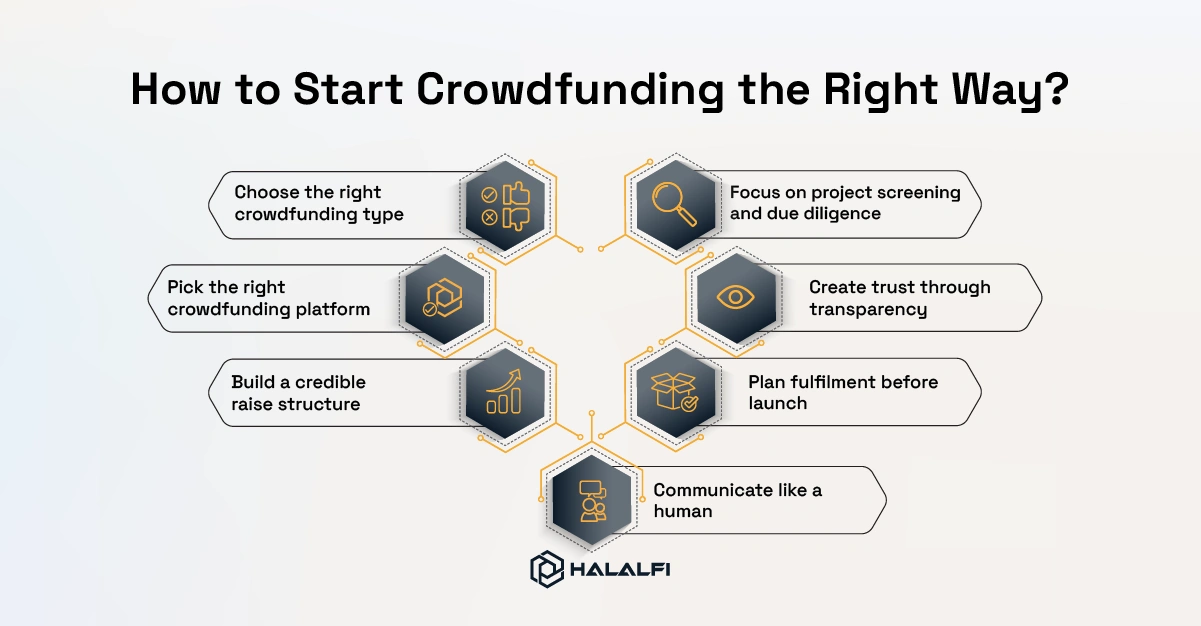
How to Start Crowdfunding the Right Way
If someone asked me what founders get wrong most often, I would say this: they focus only on launch day.
But successful crowdfunding usually starts well before the campaign goes live.
Choose the right crowdfunding type
Start by deciding what you are actually offering:
Donations
Rewards
Equity
Debt
This shapes everything else, from regulation to audience expectations.
Pick the right crowdfunding platform
Do not choose a platform just because it is famous. Choose it because it fits the campaign. Kickstarter is different from GoFundMe.
HalalFi offers different funding mechanics. The wrong platform can make a good idea harder to fund.
Build a credible raise structure
Your campaign should clearly define:
Raise goal
Soft cap
Use of funds
Timeline
Min and max investment terms, where relevant
Risks and expectations
Focus on project screening and due diligence
This is not only for investors. Founders need due diligence, too. They should pressure-test their own idea. Is the goal realistic? Can the rewards actually be delivered? Is the business model credible? Are the promises too ambitious?
Create trust through transparency
People back projects they understand. Be specific. Show what the money will do. Explain what happens if the raise falls short. Outline what backers should realistically expect.
Plan fulfilment before launch
A campaign is easy to imagine in the abstract. Delivery is where things get real. Do not promise rewards, timelines, or outcomes that you cannot support operationally.
Communicate like a human
This part sounds simple, but it matters. Crowdfunding is social by nature. Supporters want updates. They want honesty. They want to feel included, not managed.
Related Article: How to Start Crowdfunding?
Is Crowdfunding Right for Your Business?
Crowdfunding is not for everyone. It can work well if:
You have a clear and marketable idea
Your product or story is easy to explain
You are willing to promote the campaign actively
You can manage backer expectations
You want to build community while raising money
It may be less suitable if:
Your offer is hard to communicate publicly
You are not ready for scrutiny
You cannot deliver rewards or updates consistently
Your funding needs require a different capital structure
Some founders treat crowdfunding like easy money. It is not. It is public fundraising with public accountability. Done well, it can be transformative. Done poorly, it can leave a campaign underfunded and damage its reputation.
What Crowdfunding Teaches Founders
Even beyond the money, crowdfunding teaches important lessons:
How to tell a story
How to communicate value
What people respond to
What happens when interest is real
A founder can spend months assuming people will love an idea. A crowdfunding campaign tests that assumption fast.
Sometimes the result is encouraging. Sometimes it is humbling. Both outcomes are useful.
Crowdfunding and the Human Side of Finance
There is something very different about crowdfunding compared with traditional fundraising.
A bank looks at financial strength, collateral, history, and repayment ability. A crowdfunding campaign certainly involves logic, too, but it also runs on story, trust, hope, and public belief.
That can be powerful. Someone supports a campaign because they want to see a film exist. Or they believe a startup could solve a real problem. Or they want to help a family recover after a disaster. Or they simply like the founder’s honesty and energy.
That does not make crowdfunding less serious. If anything, it makes responsibility even more important. When people back a campaign, they are not always just making a transaction. Sometimes they are placing trust in a person they have never met.
That is why credibility, transparency, due diligence, and proper distribution systems matter so much.
How Does Crowdfunding Work in Halal Investment?
Crowdfunding is already built around the idea of collective participation. People come together, contribute funds, and help bring a project or business idea to life.
Interestingly, this concept aligns very closely with the principles of Islamic finance. When structured correctly, crowdfunding can become a powerful halal investment model that promotes fairness, ethical finance, and shared prosperity.
At its core, crowdfunding is a social collaboration model. People voluntarily support a project, business, or cause that they believe in. This collective participation aligns well with Islamic teachings on community support and fair economic activity.
QFC report shows that this model is gaining traction as digital Islamic finance expands. The global Islamic fintech sector reached approximately $198 billion in transaction volume and $341 billion in assets under management in 2024–2025, and analysts expect it to grow to roughly $341 billion by 2029, reflecting steady demand for ethical and Sharia-compliant financial technology solutions.
Conclusion
Crowdfunding has changed the way ideas get funded. It gives entrepreneurs, creators, and individuals a way to raise money from a broad audience rather than depending entirely on traditional lenders or a small circle of investors.
It can validate demand, grow brand awareness, connect founders with supporters, and unlock capital that may otherwise be hard to access.
But it is not just a matter of putting a page online and hoping for the best. Good crowdfunding requires the right platform, a realistic raise goal, a clear soft cap, proper project screening and due diligence, sensible minimum and maximum investment structures where applicable, and reliable systems for proportionally automated distribution without messy manual accounting. Just as important, it requires trust.
The strongest campaigns usually combine clarity with credibility. They know what they are raising, why they are raising it, and how they will deliver once the funds come in.
If you are considering Crowdfunding or planning how to start crowdfunding for your next venture, this is the moment to think strategically, not just hopefully.
And if your business is looking for a values-driven funding approach with trust, structure, and long-term credibility in mind, Halalfi is worth exploring as part of that journey.
Frequently Asked Questions
Do all crowdfunding campaigns need to reach their full target to receive funds?
No. Some platforms use an all-or-nothing model, while others offer flexible funding that allows campaigners to receive money as it comes in.
Can crowdfunding be used for personal emergencies as well as businesses?
Yes. Crowdfunding is used both for startup and product funding and for personal needs such as medical bills, disasters, and emergency expenses.
Why do some supporters back a campaign if they get no equity?
Because not every crowdfunding model is investment-based, in donation and reward models, people may contribute to support a cause, receive a perk, or simply help an idea succeed.
What is one major mistake new campaign creators make?
A common mistake is focusing too much on raising money and not enough on fulfilment, communication, and what happens after the campaign succeeds.
Is crowdfunding low-risk for investors?
No. Especially in startup and equity-based campaigns, investors can lose their principal. That is why regulation, transparency, and due diligence matter.