Do you think that some financial deals feel “off,” even when they look profitable on paper? That uneasy feeling often comes down to uncertainty, and in Islamic finance, gharar aims to eliminate it.
Gharar in Islamic finance refers to excessive uncertainty or ambiguity in transactions. But it’s more than just a technical rule; it’s about fairness, trust, and protecting people from being misled.
Whether you’re exploring halal investment, diving into Islamic fintech, or just trying to understand how ethical finance works, grasping gharar is essential.
In this guide, we’ll talk about what gharar means, why it’s prohibited, how it shows up in modern finance, and, most importantly, how you can avoid it while building a solid, Sharia-compliant finance strategy.
And if you're serious about aligning your finances with your values, stick around, we’ll show you how platforms like HalalFi can help you take that next step.
What Is Gharar in Islamic Finance?
At its core, gharar means uncertainty, deception, or excessive risk in a contract. The word itself comes from the Arabic root “gharar”, meaning to deceive. That already gives you a hint; it’s not just about risk, it’s about unfairness.
Gharar doesn’t refer to just any kind of risk. In Islamic jurisprudence, it refers to a specific type of uncertainty in a contract, particularly when essential elements such as the subject matter, price, quantity, or delivery are not clearly defined or known to both parties at the time of the agreement.
So gharar happens when:
Ownership is unclear or questionable
The product doesn’t exist yet (like unharvested crops)
The quality or quantity isn’t defined
One party has more information than the other
A classic example often cited is selling “fish in the water” or “birds in the sky.” Sounds poetic, right? But the message is simple: don’t sell what you don’t truly have or can’t deliver.
This forms one of the pillars of Islamic finance, alongside the avoidance of riba (interest) and maysir (gambling).
Surah Al-Baqarah 2:282 Says:
يَا أَيُّهَا الَّذِينَ آمَنُوا إِذَا تَدَايَنتُم بِدَيْنٍ إِلَىٰ أَجَلٍ مُّسَمًّى فَاكْتُبُوهُ
“O you who believe! When you contract a debt for a fixed term, write it down…”
Why Is Gharar Prohibited? The Ethical Foundation
Modern finance often thrives on risk. But Islamic finance draws a line between acceptable risk and exploitative uncertainty.
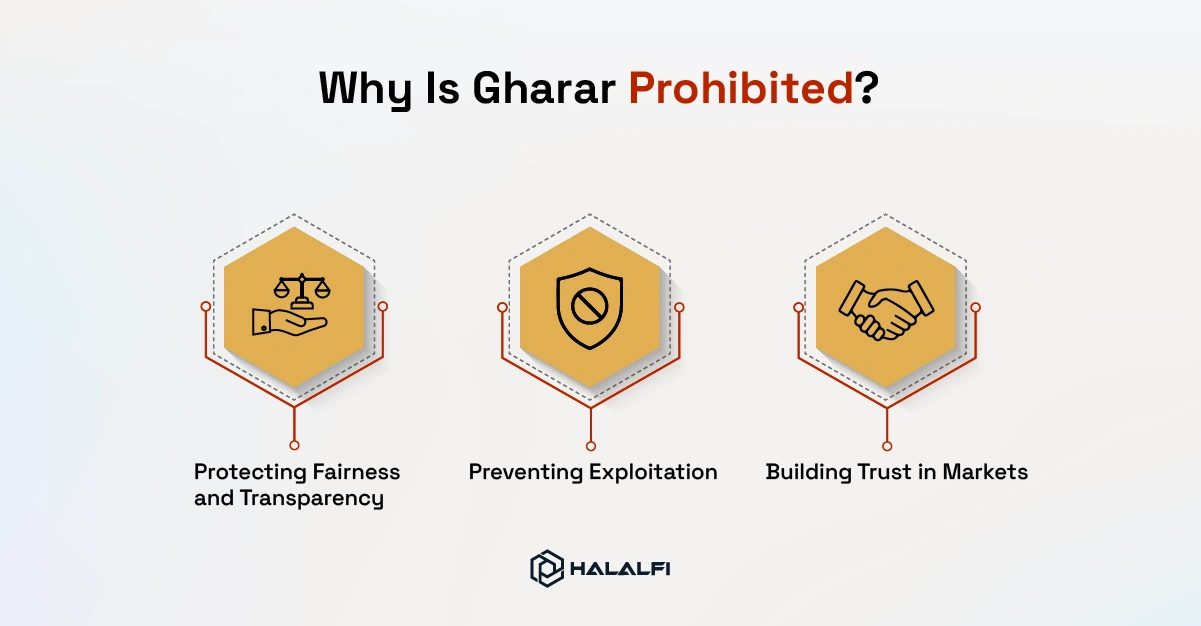
1. Protecting Fairness and Transparency
The prohibition of gharar ensures that both parties:
Fully understand the contract
Share risks fairly
Enter agreements with genuine consent
Without clarity, one side almost always loses.
2. Preventing Exploitation
Imagine buying something without knowing what you’ll actually receive. Sounds like a bad online purchase, right? Now scale that up to financial markets, that’s where gharar becomes dangerous.
The Quran warns against unjustly acquiring wealth, and scholars interpret this as a direct prohibition on deceptive transactions.
3. Building Trust in Markets
In countries like Malaysia and the UAE, where Islamic finance is growing rapidly, trust is everything. According to recent data:
According to Islamicfinancenews, Malaysia’s Islamic finance assets exceed $600 billion.
Types of Gharar: Minor vs. Major
Not all uncertainty is treated equally.
Major Gharar (Prohibited)
This includes:
Selling something that doesn’t exist
Contracts with unclear terms
High-risk speculative trading
These are outright forbidden.
Minor Gharar (Sometimes Acceptable)
Here’s where things get interesting. Some level of uncertainty is unavoidable in real life. For example:
Short-selling commodities like wheat (if delivery is credible)
Commercial practices where outcomes aren’t 100% predictable
When talking about uncertainty (gharar), it’s important not to generalise. Classical jurists across the four Sunni schools, the Hanafi school, the Maliki school, the Shafi'i school, and the Hanbali school, generally agree that excessive uncertainty (gharar fahish) invalidates a contract.
But they also recognise that not all uncertainty can be removed from real-world transactions.
1. Selling Commodities Without Immediate Delivery
Something like short-selling wheat might sound comparable to forward sales. But classical fiqh draws a clear distinction.
The majority of scholars prohibit selling what you do not own or cannot deliver at the time of the contract.
However, exceptions exist in structured contracts, such as Salam (forward sale), which is accepted across all four major schools. For a Salam contract to be valid:
Full payment must be made up front
Quantity, quality, and delivery date must be clearly defined
The commodity must be standardizable (like wheat, not unique items)
Even within this allowance, the intent is not speculative resale but facilitating real trade (e.g., farmers securing capital before harvest).
This is quite different from modern short-selling, where assets are often sold without ownership and repurchased later, a practice most contemporary scholars restrict due to unresolved ownership and delivery risks.
2. Commercial Uncertainty vs. Prohibited Gharar
Not all unpredictability is forbidden. Classical jurists differentiate between:
Minor uncertainty (gharar yasir), which is tolerated
Excessive uncertainty (gharar fahish), which invalidates contracts
For example:
Profit in a partnership (mudarabah or musharakah) is inherently uncertain, yet widely accepted
Every day trade involves some ambiguity (market price changes, demand shifts), which is unavoidable
The condition is that:
Core elements of the contract (price, object, delivery) must be clearly defined
Uncertainty must not lead to dispute or exploitation
The Maliki school tends to be slightly more flexible in recognising customary business practices (‘urf), while the Hanafi school places stronger emphasis on definability and contractual precision.
Still, the overall principle remains consistent: ambiguity is tolerated only when it is minor and unavoidable.
Scholars generally allow minor gharar when:
It’s unavoidable
It doesn’t lead to injustice
Both parties accept the risk knowingly
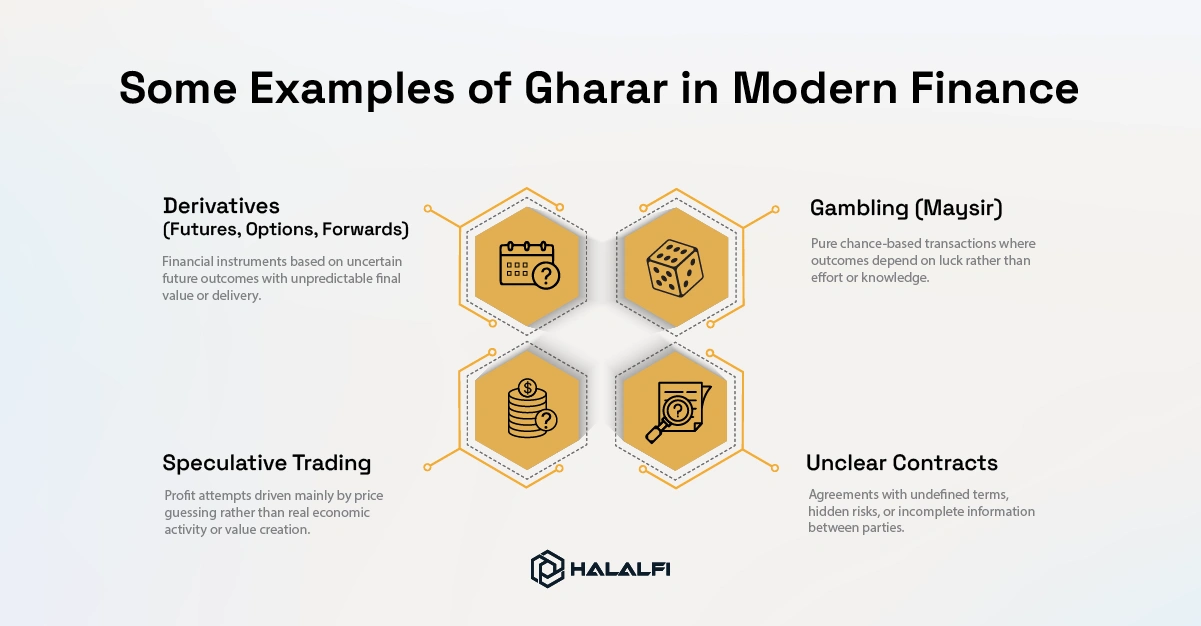
Some Examples of Gharar in Modern Finance
Let’s bring this into today’s world.
1. Derivatives (Futures, Options, Forwards)
These are the biggest offenders, because they involve:
Speculation on future prices
Uncertain delivery
High risk with unclear outcomes
That’s why most derivatives are considered invalid in Sharia law in finance.
2. Speculative Trading
Short-term trading driven purely by market guessing falls under gharar, especially when it resembles maysir in Islamic finance.
3. Gambling (Maysir)
This is actually a separate concept, but closely related. When risk becomes pure chance, it crosses into gambling territory.
4. Unclear Contracts
Even something as simple as a vague agreement between two parties can fall under gharar if:
Terms aren’t defined
Expectations differ
Information is hidden
Gharar vs Riba vs Maysir
Together, these three, Gharar, Riba in Islam and Maysir, form the backbone of ethical restrictions in Sharia-compliant finance:
Concept | Meaning | Key Issue | Example |
Gharar | Uncertainty or ambiguity | Lack of clarity | Selling unknown goods |
Riba | Interest or usury | Unfair gain | Charging interest on loans |
Maysir | Gambling | Pure speculation | Betting on outcomes |
How Gharar Creates Problems in Financial Systems
Let’s not sugarcoat it, gharar isn’t just a theoretical issue.
1. Market Instability
High uncertainty leads to volatility. We saw echoes of this during the global financial crisis, where unclear financial products led to massive losses.
2. One-Sided Risk
Gharar often means:
One party wins big
The other loses everything
That imbalance is exactly what Islamic finance tries to eliminate.
3. Loss of Trust
Once trust is broken, markets collapse. This is why Shariah audit processes are so strict; they ensure compliance and protect investors.
How Businesses Handle Gharar?
Consider a fintech founder in Kuala Lumpur who was building a crypto crowdfunding platform. His biggest challenge was not technology, but compliance.
“We had to redesign our entire model,” he said. “Investors needed clarity on exactly what they were funding. No ambiguity, no hidden risks.”
Similarly, a small business owner in Pakistan shared how switching to crowdfunding under Islamic principles helped him:
Attract more investors
Build stronger trust
Avoid disputes
These aren’t isolated stories. Across Saudi Arabia and the UAE, startups are increasingly aligning with ethical investment standards to avoid gharar.
Related Article: Shariah Compliant Investments
Gharar in Islamic Fintech and Modern Innovation
Here’s where things get exciting. The rise of Islamic fintech is reshaping how we approach financial uncertainty.
Smart contracts ensure transparency
Blockchain tracks ownership clearly
Platforms offering principal-protected investment options
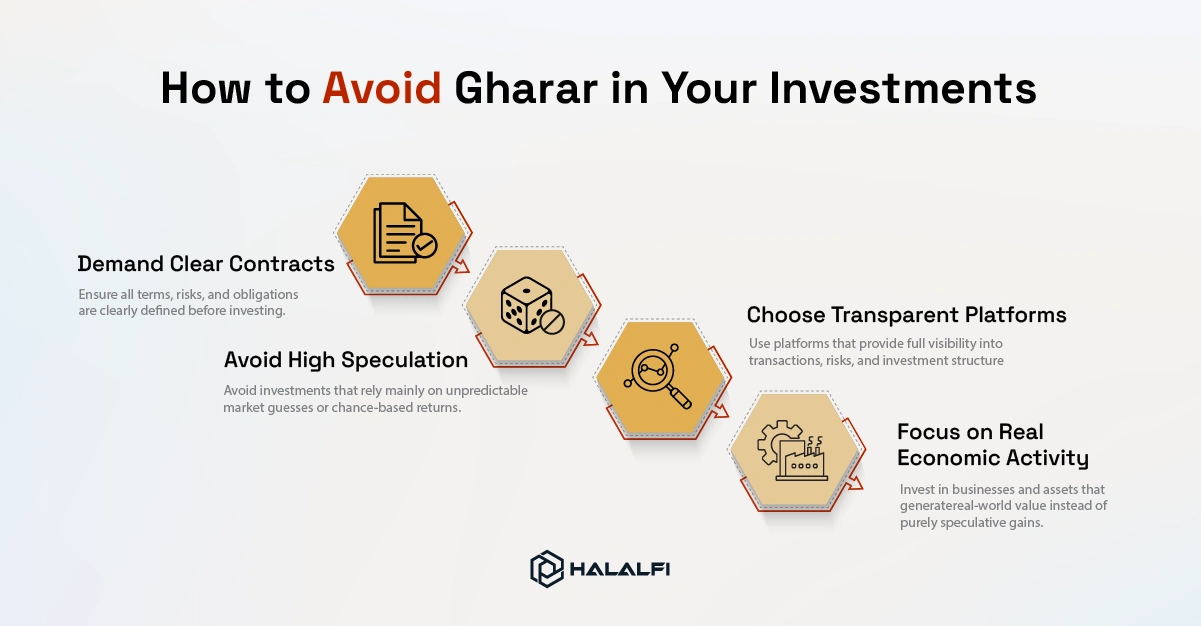
How to Avoid Gharar in Your Investments
If you’re serious about aligning your finances with Islamic principles, here are some steps:
1. Demand Clear Contracts
Always ask:
What exactly am I buying?
When will it be delivered?
What are the risks?
2. Avoid High Speculation
If it feels like gambling, it probably is.
3. Choose Transparent Platforms
Look for services that:
Follow Shariah audit standards
Provide full disclosure
Focus on real assets
4. Focus on Real Economic Activity
Invest in:
Businesses
Tangible assets
Community-driven projects
Gharar is not just a religious concept; it’s a financial safeguard against systemic injustice.
Imam al-Nawawi described the prohibition of gharar as:
“أصل عظيم من أصول البيوع”
“A fundamental principle in the law of transactions.”
How HalalFi Helps You Avoid Gharar
Avoiding gharar sounds straightforward, but in practice, it’s where many investors get stuck. Contracts aren’t always clear, risks can be buried in details, and some platforms promise returns that don’t fully make sense. That gap between theory and reality is exactly where confusion grows.
Reducing gharar comes down to three things:
Clarity
Fairness
Real economic value
When any of these are missing, uncertainty increases. That’s why many investors today look beyond promises and try to understand how platforms actually structure deals and manage risk.
Shorter, clearer agreements help. Defined timelines, visible business models, and transparent profit-sharing all reduce ambiguity.
Instead of vague expectations, investors can better understand what they’re stepping into and what could realistically come out of it.
Another issue is how returns are framed. Fixed or guaranteed profits can raise concerns from an Islamic finance perspective.
A more aligned approach is performance-based sharing, where outcomes depend on how the business actually performs rather than on pre-set promises.

How Some Islamic Fintech Models Approach It
Some Islamic fintech platforms, such as HalalFi, seek to address these issues through a mix of structure and transparency.
For example, they may combine Sharia review with basic business analysis, looking at both ethical compliance and real financial viability before listing opportunities.
They also tend to simplify contracts by clarifying funding targets, defining terms, and reducing hidden clauses.
In some cases, blockchain is used to record agreements and transactions, making information easier to verify rather than relying on trust at face value.
Another approach is to focus on real businesses rather than speculative assets. By tying returns to actual revenue or performance, these models aim to reduce both gharar and excessive uncertainty, though outcomes still depend on the business's actual performance.
Some platforms also experiment with ideas like guarantor systems or stricter business verification. These don’t eliminate risk, but they can help reduce fraud or misrepresentation.
For anyone considering such options, it’s worth reviewing the platform’s documentation carefully to understand how these mechanisms actually work.
No system removes uncertainty entirely. But different models, like those used in parts of the Islamic fintech space, offer ways to manage it more thoughtfully. And for many investors, that shift alone makes a meaningful difference.
Conclusion
Are your investments truly aligned with your values? Understanding gharar in Islamic finance isn’t just about avoiding forbidden transactions; it’s about building a system rooted in fairness, trust, and long-term stability. In a world full of uncertainty, choosing clarity is powerful.
If you’re ready to move beyond confusion and start investing the halal way, explore what HalalFi has to offer. It’s not just about compliance, it’s about peace of mind.
Frequently Asked Questions
Is all risk considered gharar in Islamic finance?
No, only excessive or deceptive uncertainty is prohibited. Normal business risk is acceptable.
Can insurance be considered gharar?
Some forms are debated, but many scholars allow them due to the necessity of modern economies.
How does gharar affect small investors?
It protects them from unclear or misleading investment opportunities.
Are cryptocurrencies considered gharar?
It depends on their use; high speculation may fall under gharar, but structured models may be acceptable.
Why is transparency so important in Islamic finance?
Because genuine consent and fairness can only exist when all parties fully understand the transaction.