Are you a Muslim? This may seem like a personal question, but I want to talk about an interesting income-generating system for Muslims who want to make money halal.
What is halalfi? It’s a Sharia-compliant crowdfunding platform that connects conscious investors with real, cash-flowing businesses, using blockchain transparency, audits, and performance-based profit-sharing instead of fixed interest.
Money Has a Direction…
Money isn’t just numbers on a screen. It builds homes, feeds families, funds wars, and, quietly, shapes the world while we’re busy living our lives.
Most people don’t actually want “profit at any cost.” They want profit that feels clean. They want to look at their investments and feel like it’s building something solid, not quietly backing things they disagree with.
That tension between wanting your money to grow and wanting your values to remain intact is exactly where HalalFi steps in.
Investing in Speculation .V. Invest Real Businesses
We’re living through a weirdly intense moment.
In a fast-changing world, the blockchain environment is packed and filled with memecoins , leverage products and pers and speculation.
While these digital onchain markets are growing louder, it seems real-world businesses are losing ethical capital. On the opposite side, we have muslims investors whohavet sharper problems.
While digital markets grow louder, real-world businesses with actual revenue and real employees still struggle to access fair, ethical capital. And for Muslim investors, the problem gets sharper.
How Impactful Investors Are Dealing with FFinTech. There are around 2 billion Muslims worldwide, one of the fastest-growing populations on the planet. But, something is interesting:
A significant portion remains unbanked or underbanked, and many avoid conventional finance because it can clash with Islamic principles, especially riba in Islamic finance, excessive uncertainty (often discussed as gharar in Islamic finance), and exploitative, casino-like structures (often linked to mysir in Islamic finance).
But the problem is that most current FinTech and Crypto applications rely on a simple profit-fixation mechanism.
Most staking and crowdfunding platform are competing in a race to promise higher profits to their investors, even though their promises are based on offering a fixed amount of profit regardless of how the business performs.
So, basically, most investment opportunities are either promising something irrational and providing liquidity for swaps rather than fueling real businesses.
And it’s not only a “Muslim problem.” A new wave of investors, Muslim and non-Muslim, is impact-driven. They care how money is made, not just how much.
What is halalfi?
Do you know about crowdfunding? It’s a way for people to raise money for a project or idea by collecting small contributions from many supporters, usually through online platforms.
HalalFi is positioned as a crowdfunding platform designed for values-aligned capital. HalalFi is a Sharia-compliant crowdfunding platform that connects conscious investors with real, cash-flowing businesses.
It is not “the next hype token” or a meme-driven chart; it is a real business with real revenues and real growth capital. HalalFi positions itself not just as a fintech product, but as infrastructure for conscious capital.
It can also, with a planned presence in KSA/Dubai and regional expansion, speak to audiences active in Middle East trading while maintaining a values-first framework. For more information about what we do and our vision, please see our document here.
HalalFi is built for:
Muslims who want to grow wealth without compromising faith
Non-Muslims who are impact-driven and want transparent, ethical, real-world exposure
Businesses that create genuine value and need growth capital without stepping into interest-based traps.
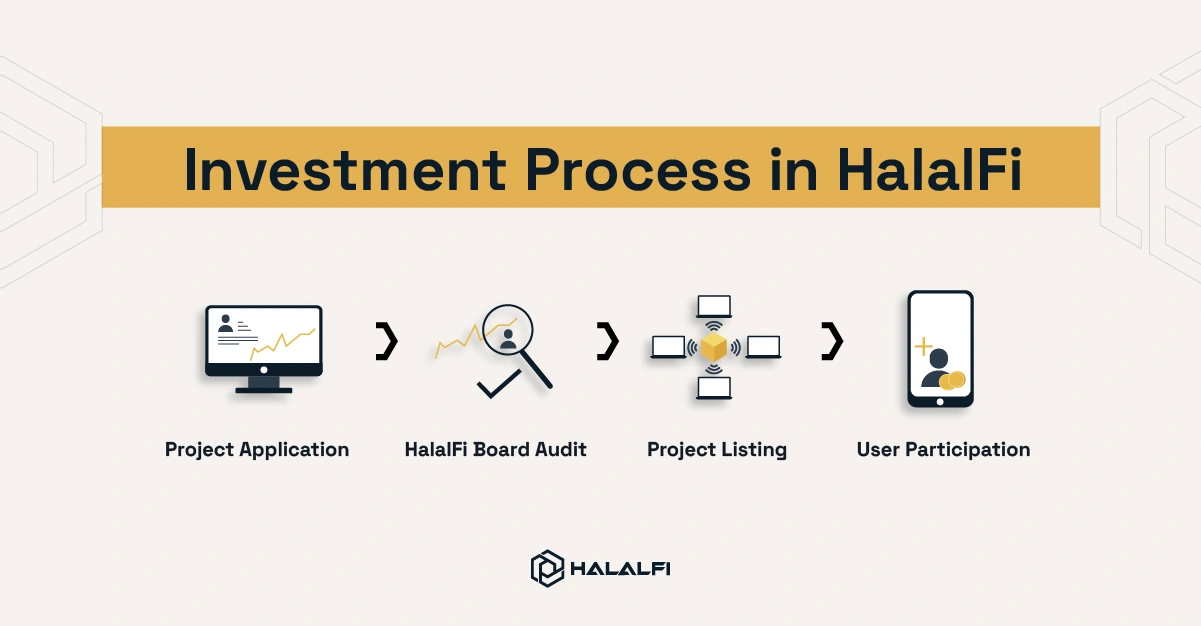
Investment process in Halalfi
Here is the investment process in Halalfi:
1. Project Application
Everything starts with the team behind every project that needs capital. They connect their digital wallet and submit the supporting information in accordance with our guidelines.
This includes details about the team members, business idea, funding structure, and financial goals, along with proof of performance from their most recent operations.
Think of it as pitching to investors, but in a decentralised environment.
2. HalalFi Board Audit
Before any project goes live, it’s reviewed by HalalFi DAO members selected by community members. The focus here is:
Is the project operation halal-compliant?
Is it realistic and financially feasible to offer such a profit?
Are the docs legit, and is the team doxed?
If yes, they probably confirmthe project.
3. Project Listing
Once approved by the board, the projects are officially listed on the platform. Investors can see:
Funding targets
Raising period
Investment terms
Expected returns
Timeline of the project
4. User Participation
Now comes the investment stage. Users browse available projects and choose the ones they want to support. Funds are contributed through smart contracts, which automatically manage the transaction terms.
HalalFi vs “typical finance apps”: what you actually get
Many platforms make investing feel like a game. HalalFi tries to make it feel like… a responsible adult built it.
Here’s a comparison:
Feature | Typical speculative markets | HalalFi approach |
Core focus | Price action, hype cycles | Real businesses with cash flow |
Returns | Often driven by speculation | Performance-based profit-sharing |
Compliance | Not designed for Sharia | Sharia audit + business audit |
Risk focus | Volatility accepted; fraud risk often ignored | “Big Wall” filtering + verification + collateral options |
Transparency | Mixed | Blockchain records + smart contracts |
Investor barrier | Often easy, but confusing | Inclusive for investors with NO KYC, demanding for businesses with YES KYB |
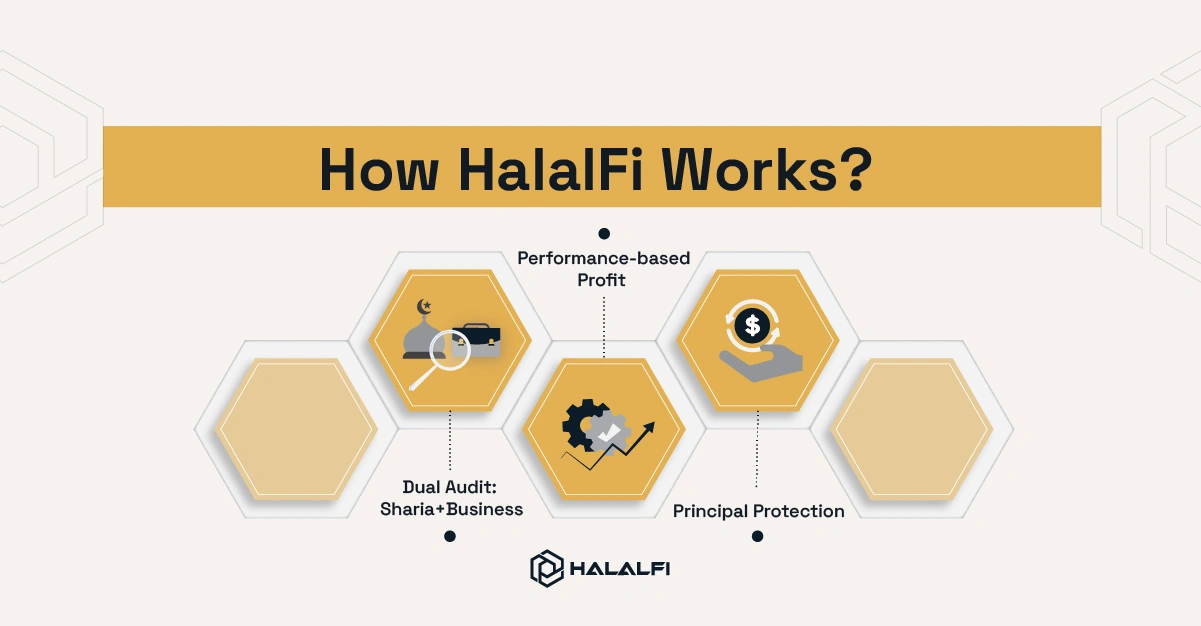
How HalalFi works?
For investors looking for halal investment, the platform’s dual-audit approach is central. HalalFi is strict where it matters and welcoming where it should be.
1) Dual Audit: Sharia + Business
Every business must pass:
A. Sharia audit: The business model and structure are reviewed to ensure alignment with Islamic principles, no riba-based models, no hidden interest, and no clearly prohibited sectors.
B. Business audit: HalalFi evaluates fundamentals: existing cash flow, revenue streams, operations, and sustainability. Here, the focus is on businesses that already generate income and want capital to grow, not just pitch decks.
If a business can’t pass both audits, it doesn’t get access to community capital. Simple.
Let's be honest, this “dual filter” is the kind of thing everyday people wish they had time to do themselves… but don’t.
Most of us already have jobs, families, and about 14 open tabs. A real audit layer changes the whole vibe.
2) Profit is performance-based (not fixed interest)
HalalFi does not operate on a fixed-interest basis; it uses profit sharing linked to both expected and actual revenues.
Investors participate in upside via clearly defined ratios. Businesses receive growth capital without stepping into riba. Incentives align: when the business wins, investors win. Importantly, profit cannot be guaranteed because it’s tied to performance, not a fixed promise.
3) Principal protection: We don’t promise profit; we protect the starting point
HalalFi’s stance is straightforward:
Profit cannot be guaranteed
But the principal should be protected as strongly as possible
So the platform design includes:
The platform itself acts as a legal agent for investors and will initiate legal action against investees who are bad actors.
Think of it like building a defensive wall around your starting capital, while leaving room for upside through profit-sharing.
4) The “Big Wall” against bad actors
HalalFi internally calls itself the Big Wall. Because the most expensive risk isn’t “market volatility.” It’s fraud, opacity, and misaligned incentives.
By filtering businesses tightly and structuring deals clearly, HalalFi aims to let only integrity through the gate.
How HalalFi Addresses Core Islamic Finance Concerns
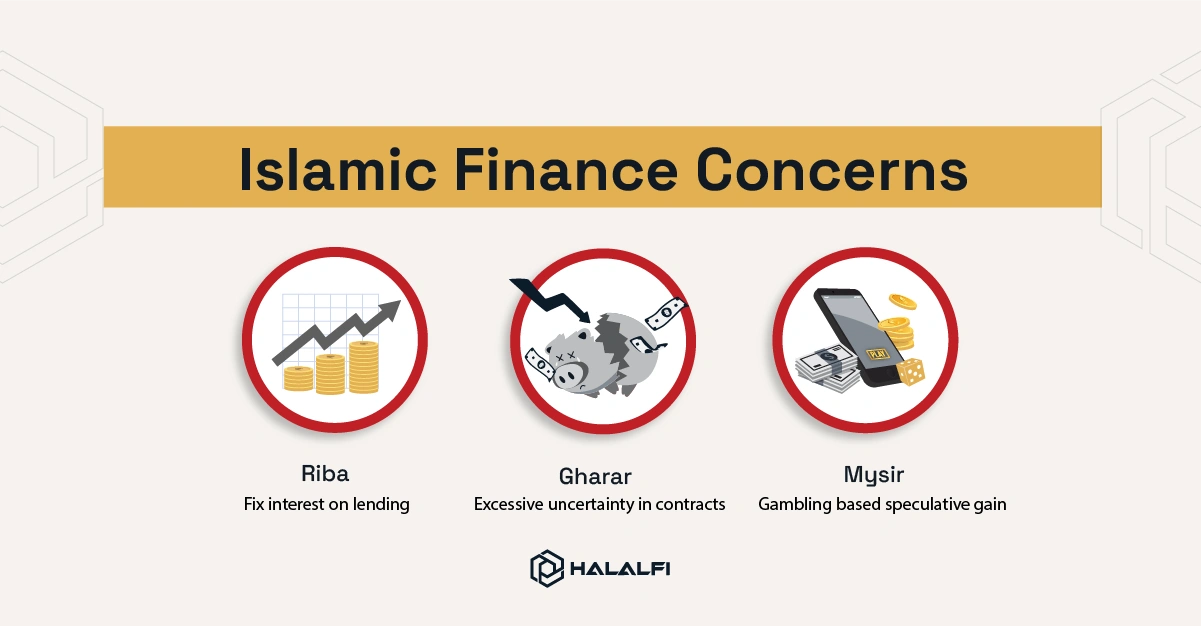
When Muslims hesitate to invest, it’s usually because of three serious concerns in Islamic finance: riba, gharar, and mysir.
HalalFi is designed specifically to address these issues at their structural roots.
Riba in Islamic Finance
Riba in Islam refers to predetermined, guaranteed interest profit earned regardless of actual performance.
HalalFi avoids this by using performance-based profit-sharing instead of fixed returns. Investors participate in real business outcomes. There is no guaranteed interest. Profit depends on actual revenue and results. This shifts the model from “money earning money automatically” to capital participating in real economic activity.
Gharar in Islamic Finance
Gharar in Islamic finance refers to excessive ambiguity or unclear contract terms. HalalFi reduces uncertainty through:
Dual audits (Sharia + business)
Clearly defined funding goals and timelines
Smart contracts that automate agreements
Doxing Investee team members and going through KYB
Transparent blockchain records
Mysir in Islamic Finance
Mysir in Islamic finance refers to gambling-like, zero-sum speculation. Instead of memecoins or leveraged speculation, which are highly discouraged among Islamic scholars, HalalFi focuses on:
Real, cash-flowing businesses
Revenue-based performance
Growth capital tied to tangible activity
Risk mitigation in HalalFi: How HalalFi is offering Risk-Free Investment Opportunities
This is one of HalalFi’s standout ideas: a Guarantors Marketplace built to reduce the trust deficit that plagues decentralised platforms:
guarantors apply and are vetted (credentials, documentation, proof-of-reserves, fee structure)
Approved guarantors build track records and visible profiles
Investees (project creators) invite guarantors during campaign setup for potential vouching
Investors can opt into coverage plans at the time of investment, which means they buy an insurance-like product.
This structure is described as rooted in Islamic principles such as kafala (surety) and wakala (agency).
It is embedded in Mudarabah/Musharakah investment agreements, which are the core of HalalFi Sharia compliance, and is aligned with AAOIFI-style supervision.
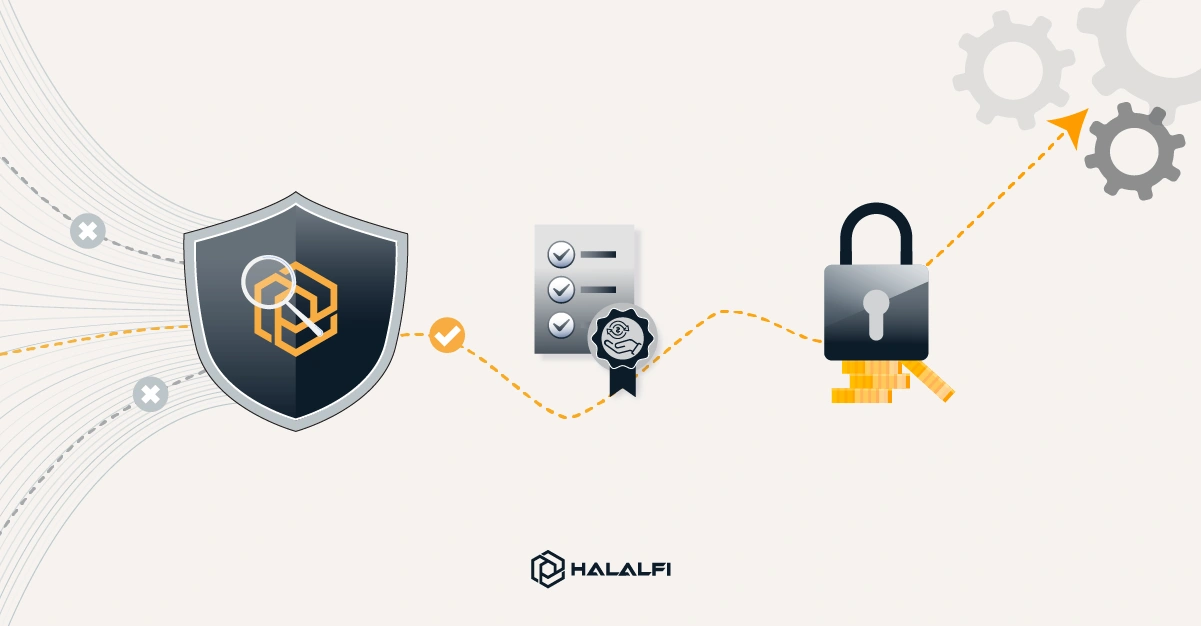
HalalFi is Inclusive for investors, demanding for businesses
HalalFi makes a clear distinction:
Investors: lower barriers, avoid heavy exclusionary processes that lock out everyday Muslims and impact-driven investors worldwide
Businesses: strict KYB (Know Your Business) and due diligence requirements, responsibility sits with the ones raising money
The door opens wide for good capital and narrows hard for anyone trying to misuse trust.
HalalFi’s market context
Halal crowdfunding in Web3 is widely considered largely untapped, so HalalFi isn’t just “another platform.” It’s targeting a gap where demand is high, but infrastructure is still in its early stages.
Tokenomics (2026) *SUBJECT TO CHANGE
HalalFi includes tokenomics for HalalFi Token (HFI):
Token type: ERC-20 (EVM compatible,BNBBase L2)
Total supply: 1,000,000,000 HFI, fixed (no inflation)
Category | % | Tokens |
Pre-Seed | 10% | 100,000,000 |
Seed | 15% | 150,000,000 |
Public Sale | 5% | 50,000,000 |
DAO Treasury | 25% | 250,000,000 |
Rewards | 10% | 100,000,000 |
Team & Advisors | 15% | 150,000,000 |
Impact/ESG Fund | 5% | 50,000,000 |
Liquidity Reserve | 5% | 50,000,000 |
Ecosystem/Growth | 10% | 100,000,000 |
Utility and value creation
Here is the token meant to do what:
staking & governance participation (Shura/DAO decision-making)
fee reductions for stakers/long-term holders
collateralization to boost credit scores and reduce investor risk
exclusive access and allowlists
dynamic rewards tied to platform growth and verified milestones
buyback & burn: up to 10% of platform profits quarterly
optional Zakat automation: 2.5% of rewards to verified charities

HALALFI BUSINESS MODEL: How does the platform plan to stay alive?
HalalFi describes fee-based revenue channels, including:
3% platform fee on funding amounts (deducted from projects)
3% fee on profit withdrawals on the investor's side
1% token sell tax premium services for project creators (priority listing, featured projects)
partnerships and collaborations (referrals/commissions)
Where HalalFi fits in the real world
If you’ve ever felt the tension between wanting your money to work for you and wanting your wealth to stay true to your principles, honestly, you’re not alone.
HalalFi explicitly avoids riba in Islamic finance structures by using performance-based profit-sharing.
HalalFi matters now because:
Finance is speeding up, but meaning is getting lost
Many people want real-world value creation, not endless speculation
Muslims need modern tools aligned with Islamic finance principles
Everyday investors typically can’t run business audits or Sharia audits on their own
Blockchain transparency can strengthen social trust by making performance records visible
HalalFi tries to move away from speculation-heavy behaviour associated with mysir/cheating in Islamic finance by focusing on cash-flowing businesses.
It also aims to reduce excessive uncertainty, often referred to as gharar in Islamic finance, through verification, collateral, and clear terms, while its performance-based profit sharing targets Riba, which is strictly forbidden in Islam.
Conclusion
Halalf is a supervised, Sharia-compliant Web3 crowdfunding platform that connects investors with real businesses through transparent smart contracts, dual audits (Sharia + business), performance-based profit-sharing, and risk-mitigation tools such as guarantors and an insurance marketplace.
HalalFi's mission is to leverage Blockchain technology and decentralised governance to create a halal-compliant crowdfunding platform that targets 2B Muslims and impact-driven investors worldwide.
By using blockchain and smart contracts, HalalFi ensures that the funding process is transparent, secure, and automated.
If you’ve been looking for a way to earn halal profit while staying aligned with faith, and you also want that satisfying feeling that your money is backing something real.
At the same time, it empowers you and increases your RizQ, this is exactly the kind of direction HalalFi is aiming for.
Explore HalalFi’s Projects page, read more about the model, and decide for yourself whether HalalFi deserves a place in your story.
Frequently Asked Questions
1. Is HalalFi only for Muslims?
No. It’s built for Muslims seeking faith-aligned investing and also for non-Muslims who want transparent, impact-driven exposure to real businesses while benefiting from considerable Halal revenue.
2. Does HalalFi guarantee profits?
No. The model is based on performance-based profit-sharing, so profit isn’t guaranteed, though the platform emphasises strong principal protection measures to offer risk-free investment plans.
3. What makes HalalFi different from typical Web3 fundraising?
The combination of dual audits (Sharia + business fundamentals), supervised verification and duediligence,e and optional guarantor/insurancestructures is a key differentiator.
4. Why does HalalFi use a DAO-like entity in verification and governance?
DAO supervision is described as a way to strengthen credibility, community involvement, and multi-signature confirmation for key actions such as project approvals and fund releases. Currently, the HalalFi board is addressing these issues, but inDecember 2026, it will be allocated to the community to choose members.
5. What role does the FI token play beyond speculation?
The token is positioned for governance, staking benefits, fee reductions, collateral support, reputation mining, rewards tied to platform growth, and impact features like optional Zakat automation. So, it is a multi-purpose utility token as well.