
Founders love the speed, investors like the early access, and everyone talks about “community.” Add blockchain to the mix, and suddenly, capital can move across borders faster than a pitch deck gets opened in traditional finance. In theory, it feels like a shortcut to growth. In practice… It’s rarely that clean.
The uncomfortable truth is that most crypto crowdfunding failures don’t start with bad tech. They start with weak trust, poor due diligence, unclear regulation, and systems that are too complicated for real users. Add in AI-powered scams, shaky halal screening, and broken fiat-to-crypto flows, and the risks multiply fast.
That’s exactly why this conversation matters now more than ever. Let's talk about the real problems behind crypto crowdfunding.
Why does crypto crowdfunding still attract founders and investors?
There’s a reason crowdfunding and crypto crowdfunding keep coming up in startup conversations. They promise speed, borderless access, and communities that can fund a project before traditional finance even returns the first email.
Bridging Interest and Real Readiness
Crypto adoption isn’t just a Gulf headline. Markets like Pakistan and the UAE are quietly, but steadily, becoming part of the global story.
Chainalysis shows Pakistan ranked #3 in Chainalysis’ 2025 Global Crypto Adoption Index, while the UAE saw more than $56 billion in crypto value flow through between 2024 and 2025, a 33% jump from the previous period.
Those figures aren’t numbers on a chart. They show that people are already using digital assets in practical ways, such as saving, trading, sending money across borders, and settling payments.
In many emerging markets, including several with predominantly Muslim populations, this shift feels less like speculation and more like a necessity.
Still, this is where founders need to stay careful. Interest doesn’t automatically translate into readiness. Wallet activity doesn’t always mean users are ready to invest at scale. A large, curious audience won’t compensate for a product that isn’t strong enough yet.

Top crypto crowdfunding problems
Crypto crowdfunding is raising funds fast, building a community, and shipping the product. But once real money, real users, and real regulation enter the picture, the process gets messy.
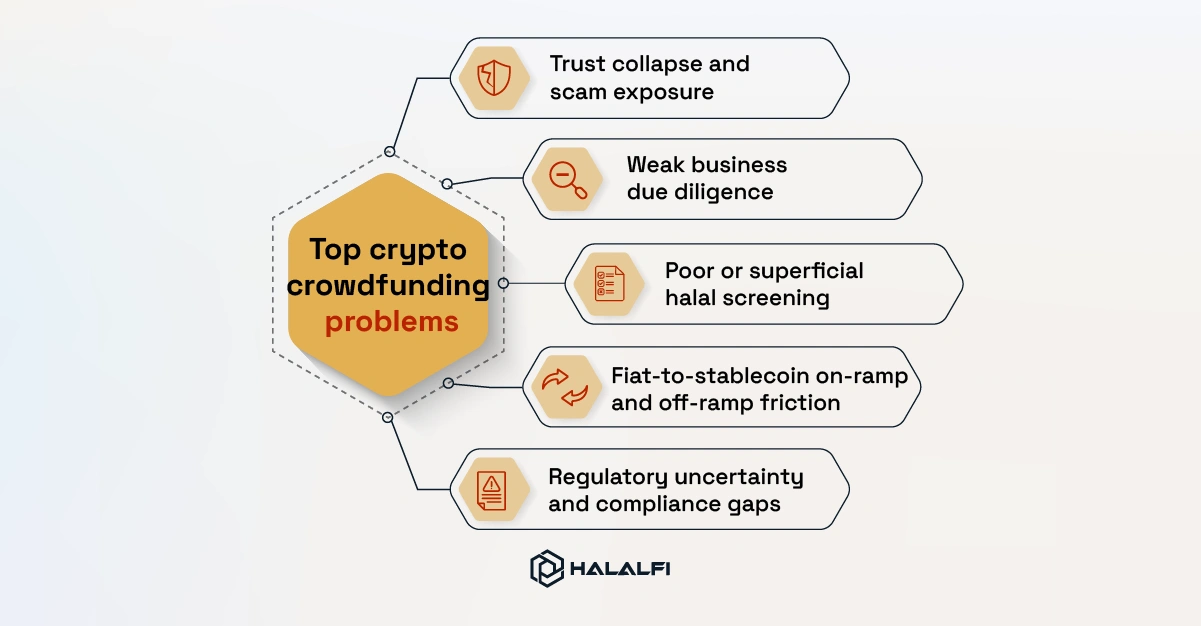
Most failures don’t come from lack of interest; they come from structural weaknesses that show up too late. Here are the top crypto crowdfunding problems:
Rug pulls
Volatility
Trust collapse and scam exposure
Weak business due diligence
Poor or superficial halal screening
Fiat-to-stablecoin on-ramp and off-ramp friction
Regulatory uncertainty and compliance gaps
1. Rug pulls remain one of the fastest ways trust disappears
Few phrases damage confidence in crypto crowdfunding more quickly than “rug pull.”
Because, unlike external hacks, rug pulls usually originate within the project itself.
A rug pull happens when founders, insiders, or liquidity controllers suddenly withdraw funds, dump tokens, or abandon the project after attracting investor capital. In practice, it often appears to be a successful launch right up until the collapse.
Recent research shows the problem has evolved rather than disappeared. In 2025, DappRadar reported that while the number of rug pulls declined year over year, the financial impact of each incident became far larger. The Web3 ecosystem reportedly lost close to $6 billion to rug pulls in 2025 alone.
CoinLaw also notes that rug pulls generally fall into three categories:
liquidity pulls (developers drain liquidity pools)
hard pulls (malicious smart-contract functions)
soft pulls (gradual insider dumping over time)
What makes rug pulls particularly dangerous in crowdfunding environments is that the warning signs can look almost identical to aggressive growth tactics:
fast-moving communities, influencer campaigns, token scarcity messaging, and “early access” incentives.
Rug-pull warning signs include:
unlocked or removable liquidity
anonymous teams with no legal accountability
hidden minting privileges in smart contracts
fake or unverifiable audits
concentrated token ownership
excessive hype with little operational transparency
2. Volatility can destroy confidence even when the project is legitimate
Not every failed crowdfunding outcome is fraud; sometimes, the project is real, the founders are active, and the product works, but volatility still overwhelms the ecosystem around it.
Crypto markets remain structurally volatile compared to traditional fundraising environments. Prices can swing dramatically within days or even hours, especially after token launches or exchange listings.
Reuters reported that during 2025, Bitcoin climbed to roughly $126,000 before falling back into the mid-$80,000 range within weeks, illustrating how quickly sentiment and liquidity conditions can reverse.
For crowdfunding participants, volatility creates some problems:
Treasury reserves may lose value suddenly
Fundraising targets become unstable
Token pricing models break down
Investor behaviour turns speculative rather than long-term
panic selling damages project credibility
This becomes even riskier in early-stage token offerings where liquidity is thin. A project may appear highly valued during launch, only for price discovery to collapse once early investors or insiders begin selling.
A serious crypto crowdfunding platform should explain clearly:
How treasury assets are stored
Whether reserves are hedged or diversified
How volatility affects token economics
What protections exist during liquidity shocks
Whether fundraising assumptions still work in bear-market conditions
Because in crypto crowdfunding, even legitimate projects can fail if volatility outruns governance.
3- The biggest problem: trust collapses faster than code ships
Let’s start with the one issue that sits under almost every failed crowdfunding platform or token raise: trust.
In 2025, crypto scams and fraud reached an estimated $17 billion, according to Chainalysis, with impersonation scams up 1,400% year over year. Chainalysis also found that AI-enabled scams were 4.5 times more profitable than traditional ones.
That matters directly for crypto crowdfunding because scam behaviour often, at first glance, looks exactly like early-stage fundraising. A slick site. A confident founder. A capped allocation. A countdown timer. Influencer noise. A roadmap packed with jargon.
For retail users, especially first-time investors, it can be surprisingly hard to tell the difference between a genuine early-stage raise and a polished extraction machine.
IMF Says:
“Crypto assets have implications for macroeconomic and financial stability…”
What do Ponzi-style crypto crowdfunding schemes usually look like?
The classic “punzy” problem, to use the phrase many retail investors throw around informally, is not always a literal Ponzi. Sometimes it is worse: a project structured to look compliant enough to launch, but vague enough to disappear.
Warning signs include guaranteed returns, referral-heavy rewards, anonymous or unverifiable leadership, unaudited smart contracts, vague token utility, fabricated partnerships, and fundraising language designed to pressure for quick action.
Regulators in Malaysia maintain an Investor Alert List, warning users against unauthorised entities.
At the same time, the country’s Securities Commission continues to tighten its regulatory framework for exchanges to improve investor protection and market integrity.
A serious project should survive five boring questions:
Checkpoint | Healthy answer | Red flag |
Legal entity | Registered, verifiable, jurisdiction disclosed | “Coming soon” or shell-company language |
Use of funds | Clear allocation by milestone | Generic “ecosystem growth” |
Custody | Segregated client assets / known wallet controls | Founder-controlled wallets only |
Audit | Named auditor and published scope | “Audit planned after raise” |
Returns claim | No guarantee; risk explained | Fixed yield or “safe profit” promise |
That table looks plain, maybe almost too plain. But plain is useful. It’s often the plain questions that save money.
4. Business due diligence is usually weaker than the whitepaper
One of the quiet yet critical failures in crypto crowdfunding is this imbalance: projects often look technically sophisticated on paper, yet feel surprisingly fragile when you examine the business beneath the surface.
Founders spend weeks refining tokenomics and smart contract logic, but gloss over market demand, legal exposure, or even how the project will actually make money.
That might pass in early hype cycles. It doesn’t hold up when real capital is involved. In crowdfunding, especially, investors aren’t just evaluating an idea; they’re deciding whether to trust strangers with their money. And trust doesn’t come from diagrams and jargon alone.
At this point, WIRED says:
“ICOs opened funding to a much less experienced group of people… It’s the perfect storm for people to lose money.”
Crypto fundraising risks
At the earliest stage, many projects raise funds based on narrative rather than validation. There’s often no clear proof of demand, no tested product, and no realistic financial projection.
Treasury management is another blind spot: who controls the funds, under what conditions, and with what safeguards? These questions are surprisingly hard to answer in many campaigns.
Token sale risks
Token sales tend to overpromise utility while under-explaining mechanics. Investors may not fully understand supply dynamics, vesting schedules, or how value is created beyond speculation.
Pricing models can also be unclear, especially when influenced by early allocations, insider discounts, or liquidity constraints.
ICO / ITO problems
Initial Coin Offering (ICO) and Initial Token Offering (ITO) still carry reputational baggage and for good reason. Common issues include a lack of regulatory clarity, anonymous teams, and vague use-of-funds statements.
Some projects structure themselves just well enough to launch, but not well enough to sustain scrutiny or long-term operations.
IDO risks (Initial DEX Offerings)
IDOs introduced decentralization into fundraising, but also new vulnerabilities. Liquidity can be thin or manipulated, smart contracts may go unaudited, and price volatility is often extreme right after launch. Retail investors frequently enter at inflated prices without understanding how quickly conditions can shift.
Blockchain crowdfunding challenges
While blockchain is inherently traceable, interpreting that data still requires expertise most users don’t have.
A strong project should be able to answer simple, almost boring questions without hesitation:
How is money managed?
What legal structure exists?
Where does revenue actually come from?
What happens if things go wrong?
A credible raise should examine:
founder identity and prior track record
company registration and jurisdiction
regulatory classification of the token or offering
Treasury controls and wallet permissions
commercial model, not just token demand
audit history, cybersecurity, and incident response
Shariah screening where halal investment is part of the proposition
That last point deserves its own section because too many projects mention “Islamic” or “ethical” standards without building the governance to support those claims.
5. Why ensuring halal audits is now a core issue, not a niche add-on
In Muslim markets, Shariah alignment is not just a branding exercise. It is a trust mechanism.
The 2025/26 Global Islamic Fintech Report makes clear that digital assets are increasingly discussed in terms of supervised infrastructure, tokenisation, and Shariah governance rather than as speculative novelties alone.
The report also says Saudi Arabia, Malaysia, the UAE, and Pakistan are among the most conducive Islamic fintech ecosystems.
At the same time, industry participants still cite consumer education, regulation, and access to capital among the biggest hurdles.
According to Arabnews, the global Islamic fintech market was estimated at $198 billion in 2024/25 and is projected to reach $341 billion by 2029, with Saudi Arabia, Malaysia, and the UAE among the leading ecosystems.
The same report lists 484 Islamic fintech firms globally, indicating this is no longer a fringe experiment.
What experts are really saying:
Economymiddleeast says that when regulators, institutions, startups, and investors move together, Islamic Fintech can deliver on its promise: expanding inclusion, strengthening trust, and building a more resilient financial future.
A halal audit should not stop at asking whether the token itself is “permissible.” It should also review revenue sources, exposure leverage, speculative design, treasury management, yield mechanisms, late-payment penalties, and governance rights.
A project can market itself as ethical while still embedding gharar-like uncertainty, opaque fee extraction, or structures that are impossible for ordinary users to evaluate.
For a business like HalalFi, this is an opportunity. The better message is not “we are Islamic, trust us.” The better message is: we verify, document, audit, and explain.
Why do ordinary investors drop off before they fund?
Because crypto crowdfunding is still too hard. Not always technically impossible. Just exhausting.
A retail user may need to create a wallet, secure a seed phrase, complete KYC, bridge assets, swap into a stablecoin, sign transactions, understand gas fees, and then interpret a token-sale dashboard that looks like a pilot’s control panel.
That is a ridiculous amount of friction for someone who simply wants to back a project.
This is especially important in markets where digital finance is growing, but user education is uneven.
The Global Islamic Fintech Report identified a lack of customer education as one of the biggest hurdles facing Islamic fintech growth.
Where users get stuck most often:
User step | Common problem | Business impact |
Wallet setup | Fear of losing funds or phrases | High abandonment |
KYC onboarding | Rejected or slow verification | Drop in conversion |
Token purchase | Confusing pricing or slippage | Lower completed funding |
Post-investment tracking | No clear dashboard | Trust erosion |
Exit/redemption | Unclear liquidity path | Investor frustration |
If your crowdfunding examples only work for crypto-native users on Telegram at midnight, that is not product-market fit. That is a niche test disguised as a scale test.
6. Fiat and stablecoin on-ramp/off-ramp problems
This one gets underestimated constantly. A project may have a strong story, decent governance, and genuine community interest.
However, users still cannot participate smoothly because converting fiat into accepted digital assets is awkward, expensive, or legally restricted.
Then, at exit, the opposite problem arises: investors can get in but cannot easily cash out.
Stablecoins have become central to real-world crypto use cases. When a market has both major cross-border payment needs and high crypto engagement, stablecoin rails can look attractive.
But if your crowdfunding flow ignores local banking realities, settlement timing, or compliance triggers, users will stall out.
7. Regulation is no longer the thing you “deal with later”
Founders used to treat crowdfunding regulations as a post-launch problem. That window is closing.
Malaysia’s SC published a consultation in 2025 to enhance its digital asset exchange framework. By late 2025, the market had expanded to six registered digital asset exchanges, while the Commission continued to warn investors against unauthorized operators.
Pakistan moved from policy signalling to formal oversight of virtual assets in 2025. The UAE continued layering its framework across the Central Bank, VARA, and the DFSA.
For founders, the lesson is straightforward: regulatory uncertainty is not always a reason to avoid the market. Sometimes it is the reason to design better from day one.
When Crypto Crowdfunding Goes Wrong
These two projects are very different on the surface, but they fail in surprisingly similar ways:
Anubis DAO
Here we want to talk about AnubisDAO. According to Yahoo Finance, it raised nearly $60 million in a token sale, but the funds disappeared almost immediately after launch. To this day, it’s unclear whether it was a hack, insider theft, or a classic rug pull.
What makes it important is how fast everything collapsed. In this project, investors went from excitement to zero within 24 hours. There was no product or accountability. It's just gone.
Here’s what actually went wrong:
Anonymous Team and Zero Accountability: The creators behind AnubisDAO were completely anonymous. So when the funds disappeared, there was no one to hold responsible. Not even a clear suspect.
It was Just Hype without a product: The project launched with no working product. It relied heavily on branding (inspired by OlympusDAO)
Instant Liquidity Drain: Unlike the DAO hack (which involved a technical vulnerability), this was more abrupt. Funds were moved almost immediately after the raise. Around $60M vanished within hours, and no clear technical explanation was publicly confirmed. That’s why many suspect a rug pull or insider action, even if it was never officially proven.
There were no Safeguards for Investors: Basic protections were missing, like an escrow mechanism, staged fund release and investor rights.
Speed Killed Due Diligence: Everything happened fast. Fundraising closed quickly, and Investors had little time to assess risks. Also, FOMO replaced analysis.
The DAO (2016): One of the biggest crypto crowdfunding failures
According to Gemini, the DAO was a decentralized crowdfunding project on Ethereum that raised about $150 million from investors through a token sale.
It was designed as a venture capital fund without managers, where investors vote on projects.
What went wrong?
Smart contract vulnerability (main reason): Hackers exploited a bug in the code (recursive call vulnerability). Around 3.6 million ETH (~$50–60 million) was stolen. This shows a core problem of crypto crowdfunding: Code = law; but buggy code = disaster
Lack of security auditing: Researchers had already warned about “security vulnerabilities” before the attack. The project was still launched and raised huge funds. Typical problem is that projects raise money before being technically safe.
No regulation or investor protection: There was no legal framework protecting investors. After the hack, investors had no clear legal recourse. Unregulated fundraising is a high risk for investors
Governance chaos after the hack: The Ethereum community had to fork the blockchain to recover. Decentralised governance can fail in crises
Loss of trust and project collapse: The DAO effectively shut down after the hack. It damaged confidence in crypto crowdfunding; Investors were afraid to invest after the failure.
The DAO clearly demonstrates the typical problems of crowdfunding platform:
Smart contract vulnerabilities
Lack of regulation
No investor protection
Poor governance design
Overhyped fundraising before product security
Different people experience the same problem differently
One of the biggest mistakes in crypto crowdfunding is assuming everyone sees the same opportunity in the same way. In reality, each participant looks at the same project through a completely different lens, and that disconnect is often where confusion, hesitation, or even failure begins:
A founder sees speed.
An investor sees risk.
A compliance officer sees exposure.
A Shariah adviser sees unanswered questions.
A first-time user sees confusion.
That’s why good crypto crowdfunding content should never rely on one perspective. A startup in Dubai may be focused on licensing pathways.
A Malaysian retail investor may care more about whether a platform appears on the regulator’s approved list.
A Pakistani user may care about low-cost access and easy conversion. A Muslim family office may ask for governance, custody, and halal audit documentation before even discussing allocation. Those are not conflicting views.

Where Crypto Crowdfunding Quietly Breaks
Here is a checklist. If you see more than a couple of these, pause:
Trust feels manufactured, not earned: Polished branding, urgency tactics, vague promises.
Weak due diligence behind strong storytelling: Impressive whitepaper and Fragile business model.
“Halal” claims without real verification: No clear audit and governance. There is just positioning.
Too much friction for real users: Wallets, KYC, swaps… users drop off before investing.
Fiat-to-crypto flow is clunky: Hard to enter, even harder to exit.
Regulation treated as an afterthought: There is no clarity on legal structure or compliance path.
Token mechanics are unclear: Utility sounds good, but value creation is vague.
Why do most crypto projects violate Sharia?
Many crypto projects violate Sharia because their structure often conflicts with core Islamic finance values.
The biggest issue is speculation. A large portion of crypto markets revolve around hype-driven trading, extreme volatility, and “buy now before it moons” behaviour rather than real economic activity.
In Islamic finance, wealth should be linked to genuine value creation, not pure uncertainty or gambling-like risk. That’s where concerns around gharar (excessive uncertainty) and maysir (speculation or gambling) begin to appear.
Another problem is the lack of transparency. Some projects launch with anonymous founders, vague token utility, hidden treasury controls, or unrealistic promises of guaranteed returns.
From a Sharia perspective, unclear contracts and deceptive financial structures undermine trust and fairness between parties.
Then there’s the issue of interest-based mechanics. Certain DeFi protocols generate returns through lending models that resemble riba (interest), while others rely heavily on leverage, perpetual futures, or synthetic yield systems disconnected from real assets.
Even projects that market themselves as “Islamic crypto” sometimes stop at branding. A halal-friendly project requires more than Arabic terminology or ethical slogans.
It needs proper governance, audited financial flows, transparent disclosure of risks, and business activities aligned with permissible economic principles.
So, we shouldn't ask the question “Is blockchain halal?” The real question is: What kind of financial behaviour is the blockchain enabling?
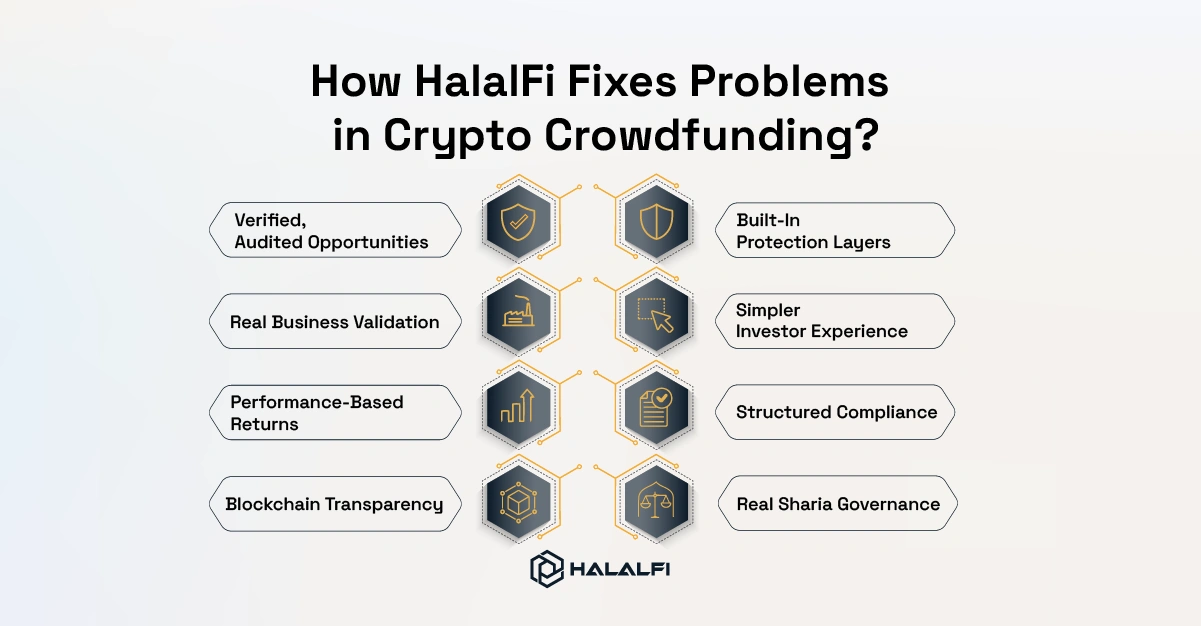
How HalalFi Fixes Problems in Crypto Crowdfunding?
In Muslim-majority markets, there is an attraction: the possibility of pairing digital finance with halal investment principles, especially where younger users want access, transparency, and lower friction. That opportunity is real. But problems still here.
HalalFi doesn’t try to ignore these problems. It’s built specifically to solve them.
1. Verified, Audited Opportunities
In HalalFi, before any project goes live, it passes:
Sharia audit: Ensuring ethical and halal compliance
Business audit: Verifying real revenue, operations, and sustainability
2. Real Business Validation
Most platforms prioritise whitepapers. HalalFi prioritises real businesses. Instead of early-stage ideas with uncertain futures, HalalFi focuses on:
Companies are already generating revenue
Clear financial models
Defined growth paths
3. Performance-Based Returns
Traditional crypto fundraising often revolves around price speculation. HalalFi flips that model:
No guaranteed returns
No fixed interest (Riba)
Returns tied to actual business performance
4. Blockchain Transparency
HalalFi uses blockchain to make this clear:
Smart contracts manage investments
Transactions are recorded on-chain
Terms are visible and verifiable
5. Built-In Protection Layers
Crypto fundraising is highly exposed to scams and bad actors. HalalFi reduces this risk by:
Strict KYB (Know Your Business) checks
Filtering projects before listing
Acting as a legal agent for investors when needed
6. Simpler Investor Experience
HalalFi simplifies the journey:
Clear project listings
Straightforward investment flow
Reduced technical friction
7. Structured Compliance
HalalFi builds with compliance in mind:
Clear governance structures
Transparent processes
Alignment with evolving regulatory expectations
8. Real Sharia Governance
Many platforms claim to be “Islamic” without proper backing. HalalFi is really Islamic:
Reviews revenue sources and financial structures
Avoids excessive uncertainty (Gharar)
Eliminates interest-based mechanisms
Focuses on real economic activity
Conclusion: the projects that win will make trust visible
The typical problems in crypto crowdfunding are no longer mysterious. We know them now: scam projects, Weak due diligence, poor halal screening and Overcomplicated user journeys.
Broken fiat-stablecoin rails and Regulatory shortcuts. The market has matured enough that these are no longer beginner mistakes; they are signals of whether a project deserves capital.
That is exactly why this topic should lead naturally to business action. If your company wants to build or back crypto crowdfunding with stronger governance, credible halal investment standards, clearer crowdfunding regulations, and a smoother investor experience, this is the moment to position HalalFi as more than a platform.
Position it as the place where digital fundraising becomes understandable, auditable, and genuinely investable.
Don’t just launch a raise. Launch trust. And HalalFi is the page people visit when they are ready to fund smarter.
Frequently Asked Questions
1. What are the most typical problems in crypto crowdfunding?
The most common problems are scams, weak business due diligence, poor token governance, unclear regulation, hard-to-use onboarding, and unreliable fiat/stablecoin on-ramp and off-ramp options.
2. Is crypto crowdfunding suitable for halal investment?
It can be, but only if the project structure, revenue model, token design, governance, and treasury practices are reviewed properly. A halal claim without a real audit is not enough.
3. Why do scam crypto crowdfunding projects still attract investors?
Because they often copy the surface features of real startups: urgency, community hype, polished branding, and technical jargon. In 2025, AI-enabled scams became far more profitable, which made fake credibility easier to manufacture.
4. Why are stablecoin on-ramps and off-ramps so important?
Because even a strong project fails commercially if users cannot easily enter or exit, payments, remittances, and settlements increasingly rely on stablecoins; however, local regulation and banking integration still matter.
5. Which Muslim-majority markets are most relevant in 2025–2026?
Saudi Arabia, Malaysia, the UAE, and Pakistan stand out in discussions on Islamic fintech and digital assets. Saudi Arabia, Malaysia, and the UAE rank among the top Islamic fintech ecosystems, while Pakistan entered the global top tier for crypto adoption in 2025.