
Which halal investment options can grow your money without leaving you uneasy about riba, hidden debt, or speculation?
The list now stretches far beyond property and gold. It includes screened stocks, Islamic funds, sukuk, retirement accounts, business partnerships, crowdfunding, and selected digital assets.
Yet more choice has created a new problem: a product may carry an Islamic label while its contract remains hard to understand.
In this guide, we sort the options by how they generate returns, what could make them non-compliant, and where investors can access them.
What do the Halal Investment Options mean?
A halal investment places funds into a lawful asset or business through a contract that adheres to Islamic principles.
The International Islamic Fiqh Academy permits participation in companies engaged in permissible, lawful activities.
It prohibits participation when a company’s main purpose involves riba-based transactions, forbidden products, or other prohibited activities.
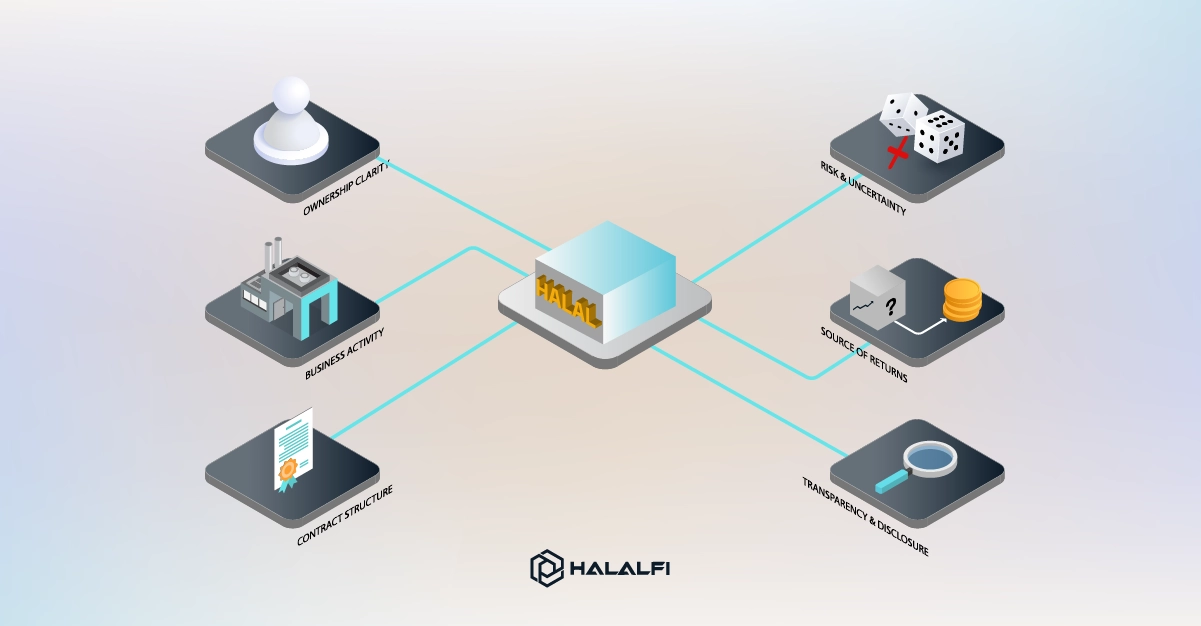
A shariah-compliant investment should pass the following checks:
Main business activity must remain lawful.
Structure must avoid interest.
Investors should understand what they own.
The deal should avoid gambling and excessive uncertainty.
Returns should come from trade, rent, ownership, or real business activity.
The contract should disclose fees, risks, and each party’s duties.
Why Halal Investing Has More Options Than Ever?
Digital Islamic finance has grown quickly. Investors can now find Islamic investment options through stock exchanges, fund managers, pension platforms, fintech apps, and project-based funding services.
More products do not remove the need for research, though. They make good screening more important.
A useful guide to halal investing for beginners should start with a process, not a product recommendation:
Protect the money needed soon.
Match each investment to a financial goal.
Screen the asset and the contract separately.
Check costs, liquidity, and local regulation.
Review compliance again as conditions change.
Which Are the Best Halal Investment Options for Different Goals?
There is no single “best” choice. The best halal investment options depend on when you need the money, how much loss you can accept, and how much research you can handle.
In the table below, we compare the role of each option.
Investment option | Where returns come from | Main Sharia check | Liquidity | Often suits |
Screened stocks | Business growth and dividends | Company activity, debt, interest income | Usually high | Long-term growth |
Islamic ETFs and funds | A diversified asset portfolio | Screening method and holdings | Usually high | Simpler diversification |
Sukuk | Assets, leases, services, or projects | Real investor rights and payment source | Varies | Income and diversification |
Real estate | Rent and property value | Financing, tenants, lease terms | Low to medium | Long-term income |
Gold and silver | Metal price movement | Ownership and possession | Medium to high | Wealth diversification |
Business equity | Company profit and growth | Contract, activity, governance | Usually low | Higher-risk growth |
Islamic crowdfunding | Project trade or business results | Use of funds and funding contract | Usually low | Project-level participation |
Crypto assets | Utility, adoption, or price movement | Asset, custody, trading method | High | Speculative allocation only |
Non-interest cash | No investment return | No interest or hidden lending | Very high | Emergencies and near-term needs |
Halal Investment Options for Different Goals and Risk Levels
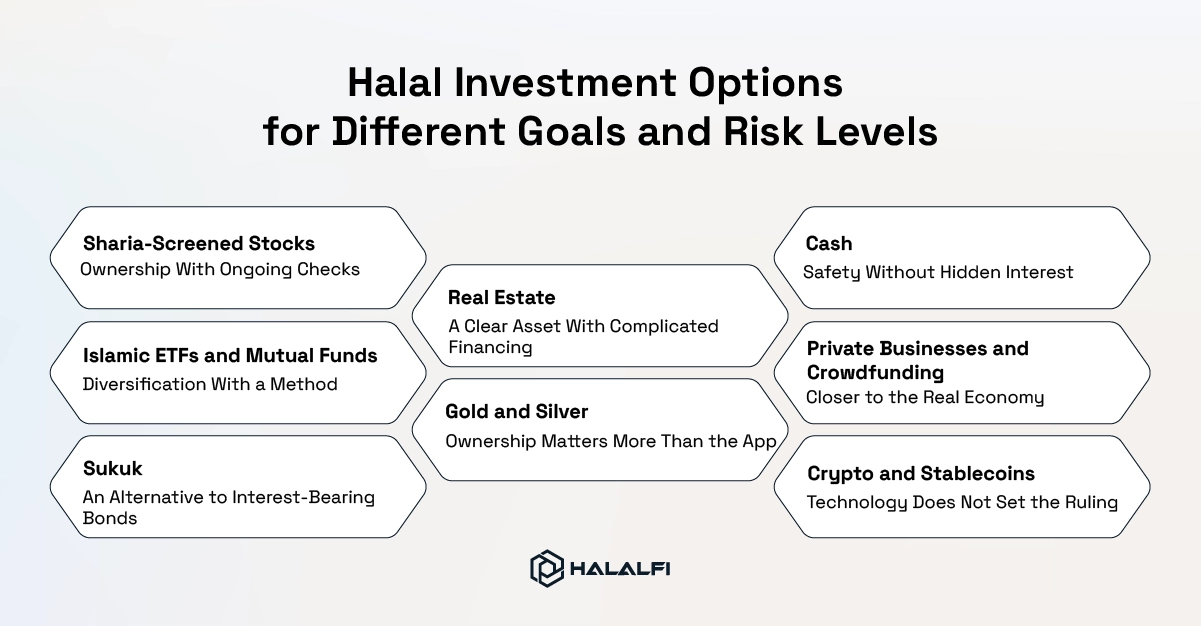
Halal investment options range from screened stocks and sukuk to real estate, gold, private businesses, and carefully reviewed crypto assets.
Each option requires its own Sharia checks, because the asset, contract, income source, and level of risk all matter.
1. Sharia-Screened Stocks: Ownership With Ongoing Checks
A stock represents a share of a company’s assets and business. That ownership provides a clear halal foundation when the company sells lawful products and passes the chosen financial screen.
The International Islamic Fiqh Academy permits shares in companies with lawful purposes.
However, it prohibits companies whose main activity involves riba in Islam or the sale of prohibited goods.
Its resolution also rejects interest-funded share purchases and the sale of shares that the trader does not own.
2. Islamic ETFs and Mutual Funds: Diversification With a Method
An Islamic ETF or mutual fund spreads money across dozens or hundreds of companies. That reduces the damage one failed company can cause, although it cannot remove market risk.
The fund should explain its screening method, Sharia advisers, purification policy, fees, securities-lending rules, and treatment of cash.
Investors should also inspect its actual holdings rather than relying solely on “Islamic”, “ethical”, or “ESG” in the title.
3. Sukuk: An Alternative to Interest-Bearing Bonds
Conventional bonds generally represent loans that require principal repayment plus interest or predetermined gain.
The HalalWallet considers that structure prohibited, even when issuers replace the word “interest” with another label.
Sukuk aim to use a different foundation. They may connect payments to assets, leases, services, or business activity.
4. Real Estate: A Clear Asset With Complicated Financing
Real estate appeals to many investors because the asset feels tangible. A property can provide rent, serve a lawful tenant, and rise or fall in value.
For example, consider two investors who each own part of an apartment building. They share rent after repairs, taxes, and vacant periods. That resembles genuine ownership.
Now change the agreement. One investor receives a guaranteed 12% return every year, while the other bears all losses.
The property remains real, but the contract now raises a different Sharia question.
5. Gold and Silver: Ownership Matters More Than the App
Physical gold and silver can serve as stores of value and portfolio diversifiers. The crucial questions involve ownership, payment, possession, and settlement.
Buying identifiable bullion from a dealer creates a clearer transaction than buying a leveraged gold contract, which does not confer ownership of the metal. Digital products require further checks:
Is the metal allocated?
Who holds it?
Can the investor take delivery?
Does the provider sell more claims than it owns in metal?
6. Cash: Safety Without Hidden Interest
Emergency money serves a different purpose from investment money. It should remain available when the car breaks down, a contract ends, or a medical bill arrives.
A non-interest current account may provide access without generating prohibited income.
Some Islamic institutions also provide compliant cash-management products, although investors still need to inspect the contract and underlying assets.
The IIFA considers interest-paying bank deposits a form of prohibited lending.
7. Private Businesses and Crowdfunding: Closer to the Real Economy
Private business investment can connect capital directly with trade, production, services, and employment. The investor may buy equity, join a partnership, or fund a defined commercial project.
A genuine profit sharing arrangement links payment to business results. A promise of fixed profit on a cash loan raises a riba concern, even if the borrower runs a halal company.
AAOIFI calls for Sharia compliance, stakeholder protection, data controls, transparency, and disclosure throughout each crowdfunding issuance.
Farrukh Raza, Chairman of the AAOIFI Governance and Ethics Board, says:
“It will further enhance public confidence in the Islamic crowdfunding sector and promote entrepreneurship.”
8. Crypto and Stablecoins: Technology Does Not Set the Ruling
Crypto has no single answer that covers every coin, protocol, wallet, and trading method.
The International Islamic Fiqh Academy Resolution No. 237 (8/24) Electronic Currencies has examined electronic currencies but has not issued a blanket approval for all crypto assets.
Its work highlights unresolved questions about classification, ownership, risk, and use.
A crypto review should separate four issues:
The asset itself
The way the user buys it
The activity that produces any return
The custody and platform arrangement
Halal Investment Options Around the World
Halal investment options vary from one country to another because each market has its own regulations, tax advantages, and Islamic finance.
Halal Investment Options in the USA
Muslim investors in the U.S. can hold Sharia-screened investments through brokerage accounts, 401(k)s, Traditional IRAs, and Roth IRAs.
While these accounts offer tax advantages, investors must ensure the underlying assets are Sharia-compliant.
For 2026, the IRS set the employee 401(k) contribution limit at $24,500 and the IRA limit at $7,500.
Halal Investment Options in the UK
The UK offers several ways to invest while following Islamic principles. Investors can use a Stocks and Shares ISA, Sharia-screened pensions, sukuk funds, real estate, gold, and regulated crowdfunding platforms.
The UK government has kept the overall annual ISA limit at £20,000.
Halal Investment Options in Pakistan
Pakistan has one of the most developed Islamic finance markets, with regulated Sharia-compliant stocks, sukuk, Islamic mutual funds, REITs, pension funds, and business partnerships.
During July to March of the 2025–26 fiscal year, Sharia-compliant securities represented 64% of the Pakistan Stock Exchange’s market capitalization.
SECP also issued compliance certificates for 53 corporate sukuk issues worth Rs229.6 billion, while sovereign sukuk issuance reached Rs1.86 trillion.
Halal Investment Options in India
Although India's Islamic finance sector is smaller, investors still have access to Sharia-screened equities, selected funds, gold, property, and private businesses.
The NSE maintains several Sharia indices and regularly reviews their constituents. Since eligible companies can change over time, investors should verify that funds continue to follow recognized Sharia screening standards rather than assuming past compliance remains valid.
The Gap Traditional Investment Options Still Leave
Public funds provide convenience, but they feel distant. An investor buys units in a portfolio and may never see how one business uses the money.
Private investments offer a closer connection, but they often create another problem:
Documents sit offline
Updates arrive irregularly
Investors struggle to verify when funds moved, whether a project reached its target, or how the platform calculated distributions.
This gap has opened space for project-level fintech models. The goal is not merely to place an Islamic label on an investment.
It is to let users inspect the business, contract, timeline, source of profit, and fund movements more directly.
How HalalFi Applies a Project-Level Model?
HalalFi provides one example of this approach. It is a blockchain-based crowdfunding model that connects real-world businesses seeking working capital with on-chain liquidity.
HalalFi reviews projects for business feasibility and Sharia alignment. Users can browse individual projects, choose which to fund, and participate via a smart contract rather than entering a single pooled portfolio.
So in this crowdfunding platform, users can see a project’s duration, expected return, and guarantee status.
Smart contracts record fund movements and distribute money under the project’s stated conditions. HalalFi also maintains project histories, updates, and audit trails.
Conclusion
Halal investing does not require choosing between faith and financial progress. The strongest options make ownership, business activity, risk, and payment sources easy to understand.
The weakest ones hide behind labels, guaranteed language, or complicated return promises.
Start with the option that matches your goal. Screen it, read its documents, and then compare it with alternatives.
For investors who want to examine individual real-business projects rather than buy a pooled fund, the next step is to explore HalalFi’s projects. Review one project against the five-step checklist before making any decision.
Frequently Asked Questions
What are the most common halal investment options for beginners?
Beginners often explore Sharia-screened stocks, Islamic ETFs, sukuk, gold, and carefully reviewed business investments.
Are Islamic ETFs a good halal investment option for long-term growth?
Yes, Sharia-screened ETFs can provide diversification by investing in multiple compliant companies instead of relying on individual stocks.
Is gold considered one of the best halal investment options?
Gold can support portfolio diversification, but it does not generate income like businesses, rental assets, or profit-sharing investments.
Can real estate be a halal investment option?
Yes, real estate can qualify if ownership, financing, tenants, and income sources comply with Sharia requirements.
Are cryptocurrencies included among halal investment options?
Some digital assets may be considered acceptable by certain scholars, but investors must review the asset, its use case, trading methods, and associated risks.
What is the difference between Islamic mutual funds and Sharia-compliant ETFs?
Mutual funds usually rely on active management, while ETFs often track a Sharia-screened index, offering lower costs and greater transparency.
Can halal investment options provide high returns?
Yes, but higher potential returns usually come with higher risk, and Sharia compliance does not remove normal investment uncertainty.
Is crowdfunding a halal investment option?
Crowdfunding can be halal when it funds lawful businesses through transparent contracts and avoids interest-based structures.