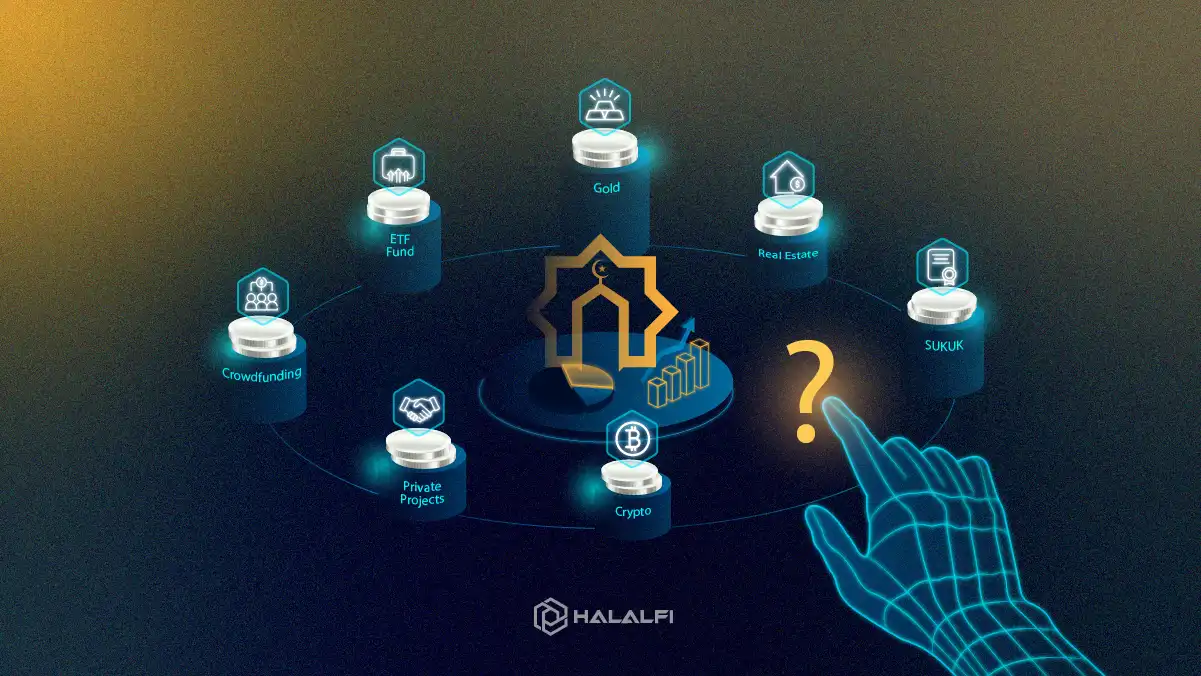
Which of the best Shariah-compliant investments deserves your next dollar and which one only looks impressive after a lucky year?
The answer rarely sits in a “top ten” list. A growth fund may suit a 25-year retirement goal but fail someone saving for a home.
Gold may help stabilize a portfolio without generating income. A private project may offer a clear connection to real trade, yet lock the investor’s money for months.
In the guide, we compare best options based on purpose, return source, Shariah structure, cost, and risk to help investors make informed choices.
What Is a Shariah-Compliant Investment?
A Shariah compliant investment places money into a lawful business or asset through a structure that avoids riba, serious gharar, maysir, prohibited industries, and the sale of assets the seller does not own.
The Best Shariah-Compliant Investments by Financial Goal
The word “best” needs a destination. Without one, investors often choose yesterday’s winner and discover too late that it solves the wrong problem.
In the table below, we examine the best Shariah-Compliant Investments by financial goal:
Financial goal | Why they may fit | Main weakness |
Long-term growth | Diversification and business ownership | Equity-market declines |
Regular income | Asset or lease-linked payments | Credit and liquidity risk |
Wealth diversification | Different return driver | No operating cash flow |
Direct business exposure | Clear link to real economic activity | Illiquidity and business failure |
Short-term stability | Lower volatility and better access | Inflation and limited growth |
Speculative growth | Innovation and adoption potential | Extreme volatility and custody risk |
A suitable halal investment plan may use several rows. It does not need to choose one winner forever.
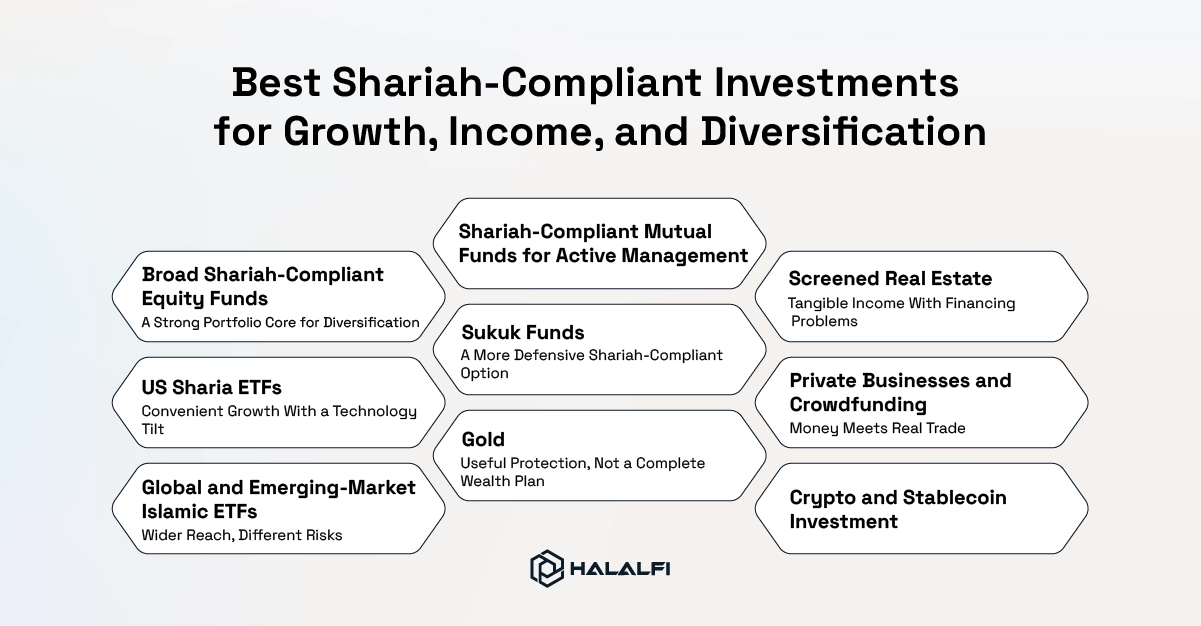
Best Shariah-Compliant Investments for Growth, Income, and Diversification
The best Shariah-compliant investments include screened equity funds, Islamic ETFs, sukuk, gold, real estate, and private business opportunities.
Each option serves a different goal, so investors should compare how it generates returns, how much risk it carries, and how closely its structure aligns with Sharia principles.
1. Broad Shariah-Compliant Equity Funds: A Strong Portfolio Core for Diversification
For many investors, a diversified equity fund offers the clearest starting point. It spreads money across many screened companies rather than depending on a handful of stock predictions.
Sharia index providers usually remove conventional banks, gambling businesses, alcohol producers, and other prohibited activities. They also apply financial-ratio tests to debt and non-compliant income.
According to Dawood, Majid Dawood, founder of Sharia consultancy Yasaar, describes the underlying idea neatly:
“Islamic finance is about financing real growth with real money.”
2. US Sharia ETFs: Convenient Growth With a Technology Tilt
US-focused Sharia ETFs suit investors seeking exposure to large American companies without having to review each balance sheet.
The Wahed FTSE USA Shariah ETF, or HLAL, follows an index of large and mid-sized US companies.
3. Global and Emerging-Market Islamic ETFs: Wider Reach, Different Risks
A global Islamic ETF reduces dependence on one country. Emerging-market funds add countries such as Taiwan, Saudi Arabia, Malaysia, Indonesia, and other developing economies, depending on the index.
They may benefit from younger populations and faster economic growth, but currency fluctuations and political risks can produce volatile returns.
4. The Best Shariah-Compliant Mutual Funds for Active Management
A mutual fund pools investor money while a professional manager chooses the holdings.
Unlike a passive ETF, an active manager avoids an expensive company, holds cash, and changes sectors when conditions shift.
According to Yahoo Finance, Amana Growth Fund provides a useful US example. As of June 30, 2026, its investor shares had returned 29.98% over one year and an annualized 17.60% over ten years, after fees. The investor share class carried a 0.86% expense ratio.
5. Sukuk Funds: A More Defensive Shariah-Compliant Option
Sukuk provide income and diversification without using a conventional interest-bearing bond structure.
Depending on the issuance, holders may receive rights linked to assets, leases, services, partnerships, or projects.
A sukuk fund suits an investor seeking lower equity volatility. However, it still carries issuer, currency, duration, liquidity, and structural risk.
Some funds also concentrate heavily in Gulf governments, banks, or property-related issuers.
6. Gold: Useful Protection, Not a Complete Wealth Plan
Gold remains one of the most familiar Islamic investment options. It carries no corporate debt, needs no business manager, and behaves differently from equities.
Gold protects part of a portfolio. It does not produce rent, profit, or dividends. An investor who places everything into gold depends entirely on future price appreciation.
7. Screened Real Estate: Tangible Income With Financing Problems
Property creates returns through rent and long-term appreciation. That makes it attractive within Islamic finance, which links money to ownership and real economic activity.
Yet the building alone does not settle the Sharia question. Investors must examine the financing, tenants, leases, insurance, cash holdings, and debt inside a property fund or REIT.
Direct property also requires large capital, repairs, taxes, management, and patience. A screened REIT provides easier access, but its share price can move like the stock market.
8. Private Businesses and Crowdfunding: Money Meets Real Trade
Private business investment connects capital directly to a shop, manufacturer, software firm, farm, or trading project. It may use Musharakah, Mudarabah, equity, or another lawful arrangement.
This category delivers genuine profit sharing. Investors earn when the commercial activity performs, rather than by collecting a required increase on a cash loan. That link to real activity creates social and financial value.
9. Crypto and Stablecoin Investment
Crypto and stablecoin investment raise complex Sharia questions. They do not become halal simply because they use blockchain technology. The focus remains on the asset, contract, and source of return.
A crypto or stablecoin investment may align with Sharia principles when:
The asset has real utility: The token should represent a legitimate use case rather than pure speculation or gambling-like trading.
The transaction avoids riba: Returns should not come from interest-based lending, guaranteed yields, or fixed payments on borrowed money.
Ownership is clear: Investors should actually control the asset and understand custody arrangements.
The activity remains halal: The project, business model, and revenue sources should avoid prohibited industries.
Risk stays transparent: Excessive uncertainty, hidden terms, and highly speculative structures can create Sharia concerns.
A Simple Way to Build a Shariah-Compliant Portfolio
An investor with a long horizon might use a structure like this:
Portfolio role | Illustrative allocation | Possible investment |
Long-term growth core | 50%–70% | Broad global Sharia equity fund |
Defensive income | 10%–25% | Diversified sukuk fund |
Wealth diversifier | 5%–15% | Allocated gold |
Emerging growth | 5%–15% | Emerging-market Islamic fund |
Private opportunities | 0%–10% | Screened business or crowdfunding project |
Near-term reserve | Separate from portfolio | Islamic cash-management option |
These percentages only illustrate the structure. Age, income, location, family needs, taxes, and risk capacity can change every number.
The core should carry the plan. Small satellite positions can add opportunity without giving one business, country, metal, or token control over the investor’s future.
Could HalalFi Be One of the Shariah-Compliant Investment Options?
For investors looking beyond traditional funds, HalalFi presents a different type of opportunity:
project-based investing connected to real businesses. It may suit investors who want to evaluate specific commercial activities rather than buy a broad portfolio.
HalalFi focuses on some elements that matter in Shariah-compliant investing:
Real business activity: Returns come from funded projects rather than interest-based payments or token price speculation.
Project-level transparency: Investors can review the business purpose, funding needs, timeline, and project details before participating.
Profit-sharing structure: In profit sharing, returns depend on business performance rather than on a fixed interest rate.
Blockchain records: Smart contracts track funding and distributions on-chain.
USDT settlement: USDT serves as the settlement tool, while the underlying business generates the potential return.
Conclusion
The best Shariah-compliant investments do not win through a halal logo or last year’s return.
They show what the investor owns, how the asset generates income, which risks remain, who oversees compliance, and what happens when the plan goes wrong.
HalalFi adds an interesting project-level option to this landscape. Its model connects performance-based returns with business reviews, blockchain records, collateral, and planned guarantor protection.
Review HalalFi’s documentation and follow its project marketplace. When a live project appears, test the business, contract, USDT process, protection terms, fees, and Sharia review before committing funds. Good opportunities do not fear careful questions.
Frequently Asked Questions
What are the best Shariah-compliant investments for beginners?
Broad Shariah-compliant equity funds, Islamic ETFs, sukuk funds, and allocated gold often provide a starting point.
Which Shariah-compliant investment is best for long-term growth?
Diversified Islamic equity funds and global Shariah ETFs can suit long-term growth objectives by providing exposure to a broad range of screened businesses.
What is the best Islamic investment for regular income?
Sukuk funds, screened rental property, and selected profit-sharing projects may generate regular income.
Are Shariah-compliant ETFs better than Islamic mutual funds?
Neither option is always better. ETFs often offer lower costs, transparency, and easier trading. Islamic mutual funds may offer active management and greater flexibility in company selection.
How can investors identify the best-performing Shariah-compliant funds?
Investors should review more than one-year returns. Compare three-, five-, and ten-year performance, maximum losses, fees, benchmark results, volatility, top holdings, and sector exposure.
Is gold one of the best Shariah-compliant investments?
Gold can help diversify a portfolio and reduce dependence on equities. However, it does not produce income.
Can crowdfunding qualify as a Shariah-compliant investment?
Yes, when the funded business operates lawfully, and the contract avoids interest, excessive uncertainty, and prohibited activities.
What is the safest Shariah-compliant investment?
No investment is completely safe. Islamic cash-management products and high-quality sukuk may carry lower volatility than equities, property, or private projects.