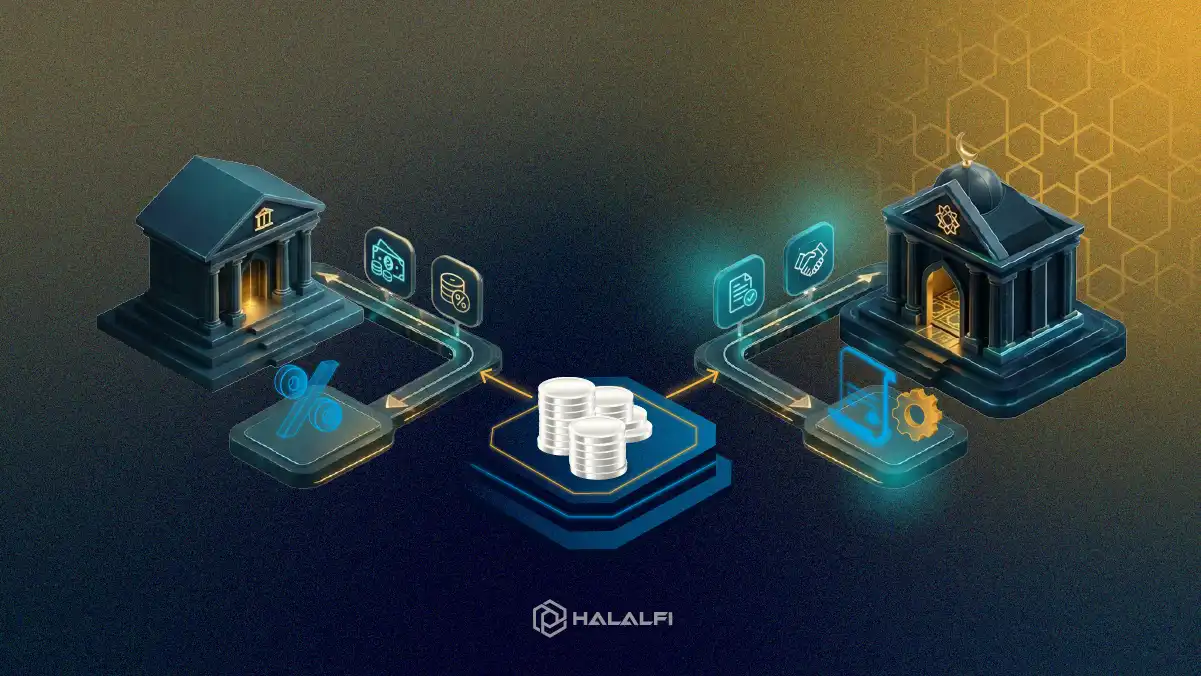
If the monthly payments are similar, what is the difference between Islamic and conventional banking?
A traditional mortgage and an Islamic home-financing plan can produce monthly payments that look close. Both institutions check income, expect payments, and make money.
But follow the transaction one step deeper and the relationship changes. Let’s follow the money.
The Main Difference Between Islamic Banking and Conventional Banking
Conventional banks lend money and charge interest for the use of that money.
Islamic banks cannot build a Sharia-compliant transaction around riba. Instead, they use contracts connected to trade, leasing, ownership, or investment. Examples include Murabaha, Ijarah, Musharakah and Mudarabah.
The IMF also points to another difference. Islamic financial transactions should be linked to real economic activity and allocate risk in accordance with the contract, rather than treating money itself as the product.
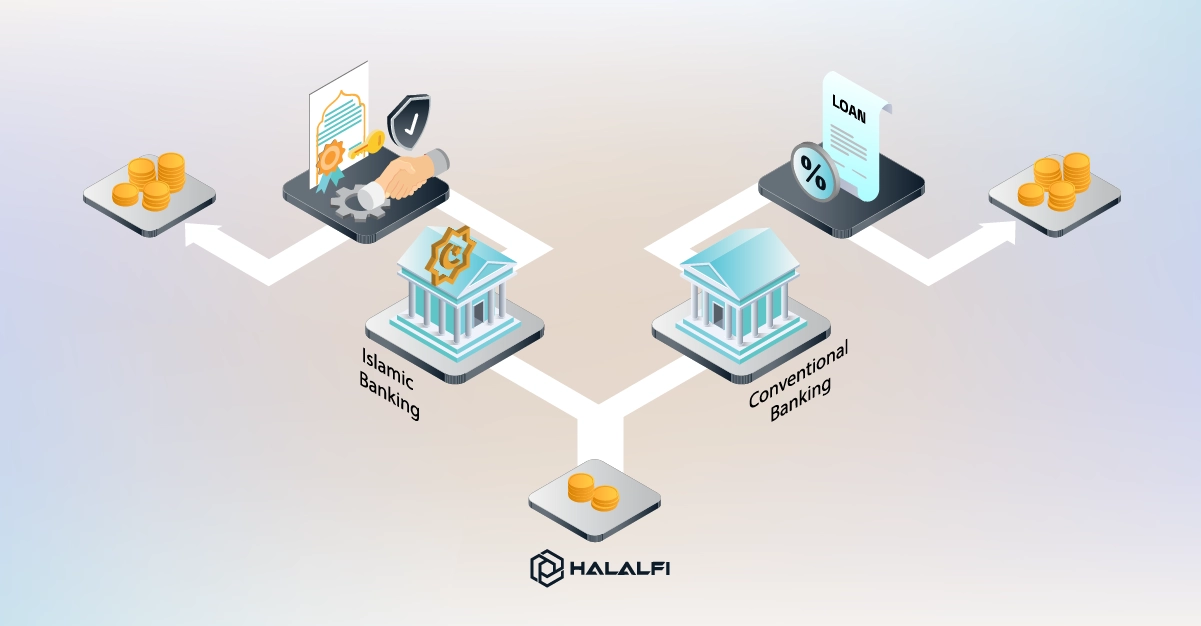
Let's have a quick comparison here:
Area | Islamic Banking | Conventional Banking |
Main source of financing return | Trade profit, rent, fees, or investment profit | Interest and fees |
Interest | Sharia prohibits riba | Banks can charge and pay interest |
Asset connection | Contract usually connects to an asset, service,ce or business | A cash loan can stand on its own |
Business screening | Must meet Sharia criteria | Law and bank policy set restrictions |
Speculation | Sharia limits excessive gharar and maysir | Regulation determines allowed activity |
Risk | Contract determines ownership and risk allocation | Lender-borrower structure usually dominates |
Extra governance | Sharia review | No Sharia review required |
Islamic Finance Is Much Bigger Than Interest-Free Banking
Reducing Islamic finance to “banking without interest” misses half the picture. Sharia sets rules around the transaction itself. Four ideas shape many Islamic financial products:
Riba in Islam prohibits returns arising from interest on a loan.
Gharar in Islamic finance addresses excessive contractual uncertainty.
Maysir in Islamic finance restricts gambling and chance-based gain.
Sharia screening excludes prohibited business activities from compliant financing and investing.
Islamic contracts do not always share profit and loss equally. Murabaha earns through a sale markup, Ijarah through rent, while Musharakah and Mudarabah involve partnership structures.
For example, for a $500,000 home, a conventional bank might lend $400,000 and charge interest.
A Murabaha provider instead buys and resells the property at an agreed-upon price, while diminishing Musharakah allows the buyer to purchase the financier’s ownership share gradually.
Islamic Financing vs Conventional Loan
With a conventional loan, the deal starts with borrowed money. The lender provides cash, and the borrower repays the principal plus interest, even if the financed business or asset loses money.
In Islamic financing, the return comes from selling an asset, leasing it, or participating in a partnership rather than charging interest on a cash loan.
In the table below, we will make it clearer:
Structure | What Happens | Where the Financier Earns |
Conventional loan | Bank lends cash | Interest |
Murabaha | Financier sells an asset at disclosed cost plus profit | Sale markup |
Ijarah | Financier leases an asset | Rent |
Musharakah | Parties contribute capital | Agreed profit sharing |
Mudarabah | One party provides capital, another manages | Agreed share of profit |
Sukuk | Investor gains rights linked to assets or activity | Asset/project cash flow |
Why Can an Islamic Loan Look Like a Conventional Loan?
Because banks live in the same economy. Property prices, inflation, central-bank rates, funding costs, and competition affect both systems.
Islamic banking cannot ignore the market price of capital simply because it uses a different contract.
That means an Islamic financing provider may use a conventional benchmark when calculating a competitive profit rate.
The benchmark alone does not create the contract. In finance, structure warrants much closer scrutiny because tiny contractual details can affect ownership, risk, and Sharia compliance.
Similarities Between Islamic Banking and Conventional Banking
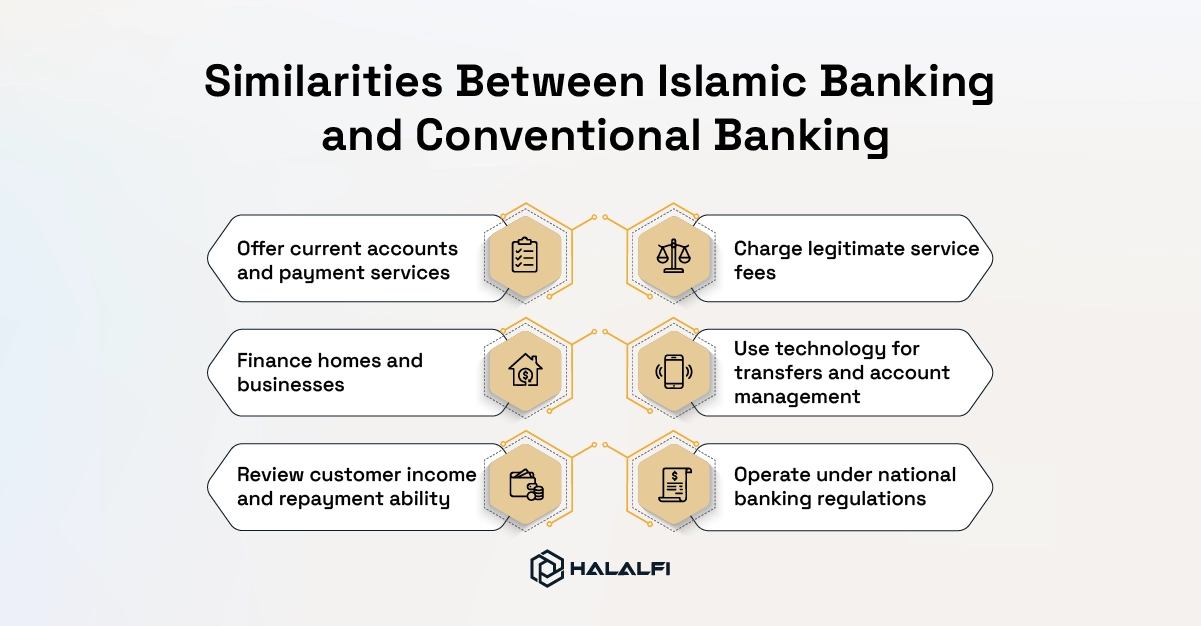
Look past the contracts, and the two banking systems have plenty in common. Both handle deposits and payments, finance customers and businesses, assess borrowers' ability to repay, and manage liquidity.
Behind the scenes, both also rely on cybersecurity, compliance teams, auditors, and sufficient capital to keep everyday banking running. Both can also:
Offer current accounts and payment services
Finance homes and businesses
Review customer income and repayment ability
Charge legitimate service fees
Use technology for transfers and account management
Operate under national banking regulations
Who Takes the Risk in Islamic Finance?
“Risk sharing” sounds as if an Islamic bank splits every loss with the customer. That is not how it works.
In Musharakah, both parties have capital at stake so that business losses can affect them. Murabaha follows a different logic. The financier sells an asset at an agreed price, and the buyer still owes that price after the sale.
Islamic banks also deal with familiar problems such as credit, liquidity, and operational risk. The contract does not make risk disappear. It decides who carries it, when, and why.
Why Islamic Finance Appeals to More Than Faith
Many Muslim investors do not want their money tied to riba. Some investors also like to know what lies behind a financial return. They prefer money connected to a business, asset, or trade rather than interest on debt.
Sharia screening gives investors different rules for deciding where their money goes and how it earns. A Shariah-compliant investment adds screening around both business activity and financial structure. Islamic finance appeals to someone who wants:
A clearer connection between finance and commercial activity
Restrictions on interest-based structures
Sector screening before investment
Contracts with defined ownership and economic purpose
Another layer of Sharia review
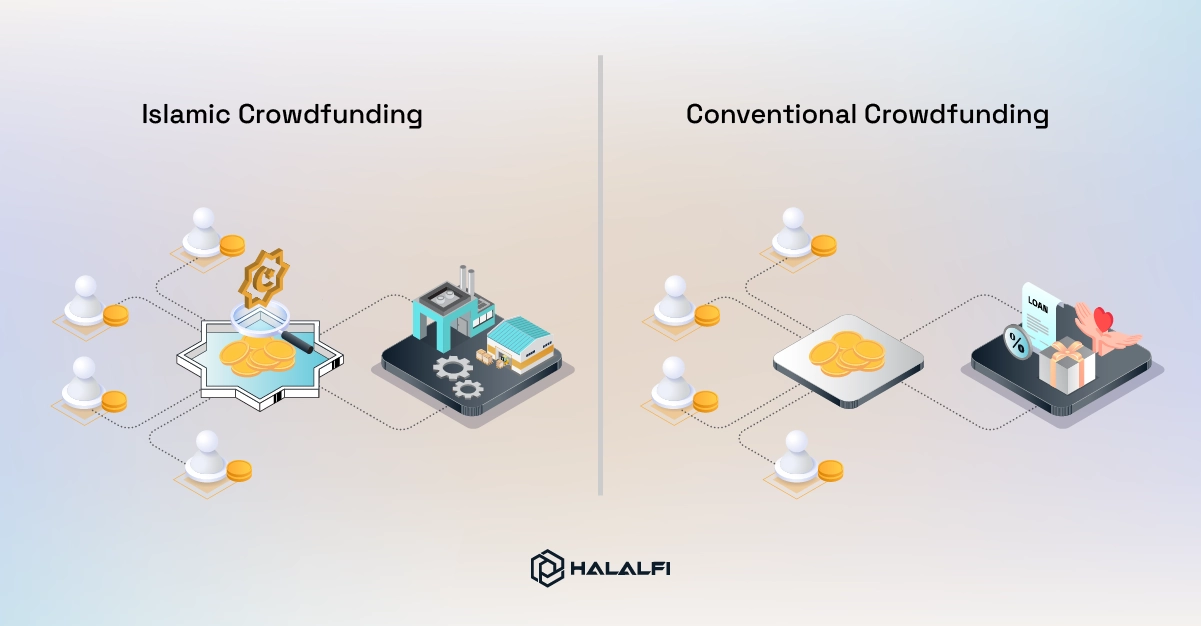
Differences Between Islamic Crowdfunding and Conventional Crowdfunding
Crowdfunding works on a familiar principle: many people contribute money to a project through a single platform.
Islamic crowdfunding uses the same basic model, but it imposes other rules on where the money goes and how investors can earn from it. Before a campaign is allowed, the platform needs to look at:
What does the business actually sell or do?
Does the funding structure involve riba?
Does the deal contain excessive uncertainty or gambling-like speculation?
How will investors and the business share profit, ownership, and risk?
Does the contract itself meet Sharia requirements?
Conventional crowdfunding does not apply these religious screens and can include rewards, equity, donations, or interest-bearing loans.
Malaysia offers a useful real-world example in islamic finance. Through MyCIF, the country has supported Musharakah- and Mudarabah-based campaigns on regulated ECF and P2P platforms, demonstrating how Islamic crowdfunding can operate within a formal financial market.
What If Your Money Funded a Business Instead of Sitting in a Bank?
Imagine having USDT available to invest. You could leave it untouched, move into public markets, or look for something more actual: a business that needs capital to buy inventory, source products, or complete a short commercial cycle.
Now the conversation changes. You are asking, “What will this business do with my money, and where could my profit come from?”
That is the territory of project-based investing. Instead of earning from an interest-bearing loan, capital can participate in real commercial activity. And that is where a platform like HalalFi starts to make sense.
Where HalalFi Fits into the Islamic Finance Comparison?
HalalFi does not operate like a conventional savings account or interest-bearing lender.
Its crowdfunding platform connects eligible investors with Sharia-reviewed business projects using USDT. HalalFi reviews both the Sharia structure and the business before listing a project. Smart contracts record funding and allocations, while the actual company conducts its commercial operations off-chain. The platform focuses on:
Real commercial projects
Performance-based profit structures
Sharia and business review
USDT-based participation
Funding targets and project durations
Project-specific protection mechanisms
Conclusion
A percentage fools you. Two deals show the same return, the same payment schedule, even a similar final cost. Yet one earns from lending money at interest, while the other earns through a sale, lease, or business partnership.
That is where the difference between Islamic banking and conventional banking becomes real, and that is worth remembering when you move from banking to investing.
HalalFi gives investors something useful to inspect: the business behind the return. You can look at what a project does, how long it runs, where its projected profit comes from, and how previous projects performed.
Explore the HalalFi project marketplace, study previous deals, and decide what you want your money to participate in before the next opportunity opens.
Frequently Asked Questions
Can non-Muslims use Islamic banking?
Yes. Islamic financial products generally do not require customers to follow Islam. Provider rules and local law determine access.
Why do Islamic financing rates sometimes follow conventional rates?
Providers may use market rates as pricing benchmarks. The benchmark helps price the deal; the underlying sale, lease or partnership contract determines its structure.
Is Islamic banking always cheaper than conventional banking?
No. Legal work, Sharia governance, taxes, funding costs and competition can affect pricing. Compare total cost rather than labels.
Can Islamic banks charge late-payment fees?
Some structures allow limited charges under specific Sharia and regulatory rules. Treatment varies by product and jurisdiction, so check the contract.
Is Islamic crowdfunding the same as Islamic banking?
No. Banks accept deposits and provide banking services. Crowdfunding platforms connect investors with campaigns or projects under a different regulatory and contractual structure.