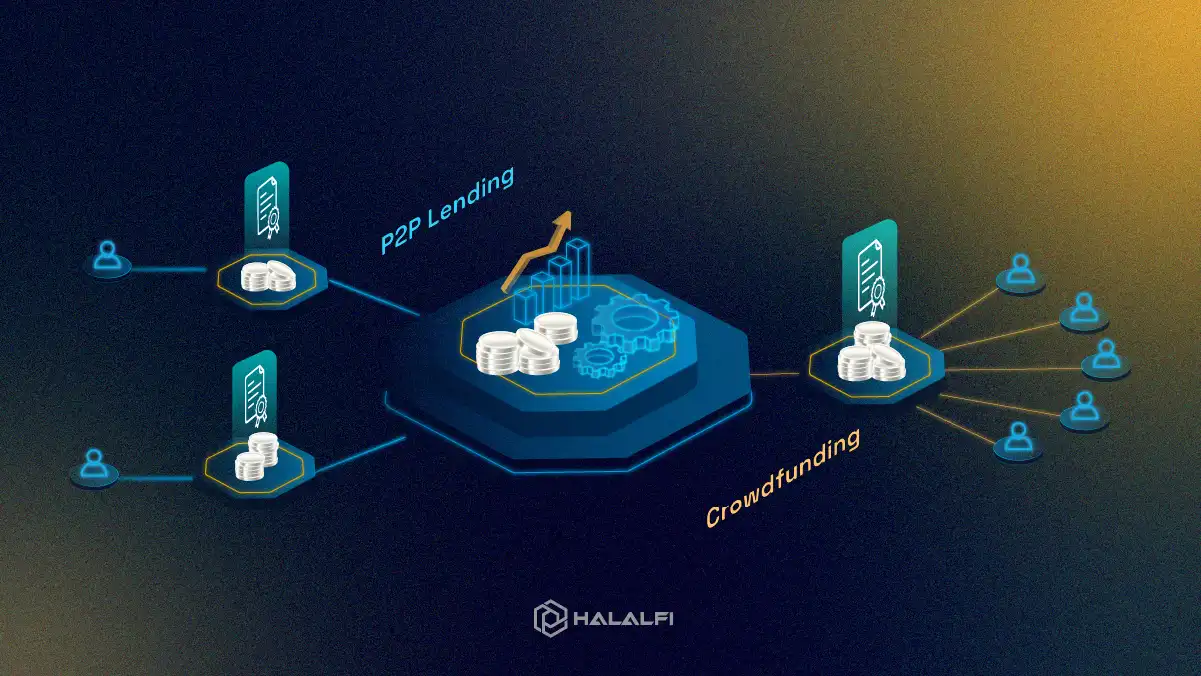
What changes when the same $1,000 is treated as a loan on one platform and as project capital on another?
P2P lending vs crowdfunding look almost exact from the outside. A platform introduces people with money to a person or business that needs it; Click, fund, and wait.
But who bears risk, how businesses handle bad months, what investors can earn, and whether the arrangement aligns with Islamic finance principles. This guide tracks cash on hand on both sides.
P2P Lending vs Crowdfunding in 30 Seconds
P2P lending creates debt. The investor lends money, the borrower agrees to repay it, usually with interest, according to a schedule.
Crowdfunding describes a much wider family of models. Donation campaigns ask for support, reward campaigns promise a product, and equity campaigns exchange capital for ownership. Investment crowdfunding can also use debt or revenue-linked structures.
The UK Financial Conduct Authority classifies P2P as “loan-based crowdfunding.” So P2P lending falls under the broader crowdfunding category, even though people often treat the two as separate products.
For this article, “crowdfunding” refers to reward-based, equity, and project-based investment rather than conventional interest-bearing P2P loans.
Differences Between Crowdfunding and P2P Lending
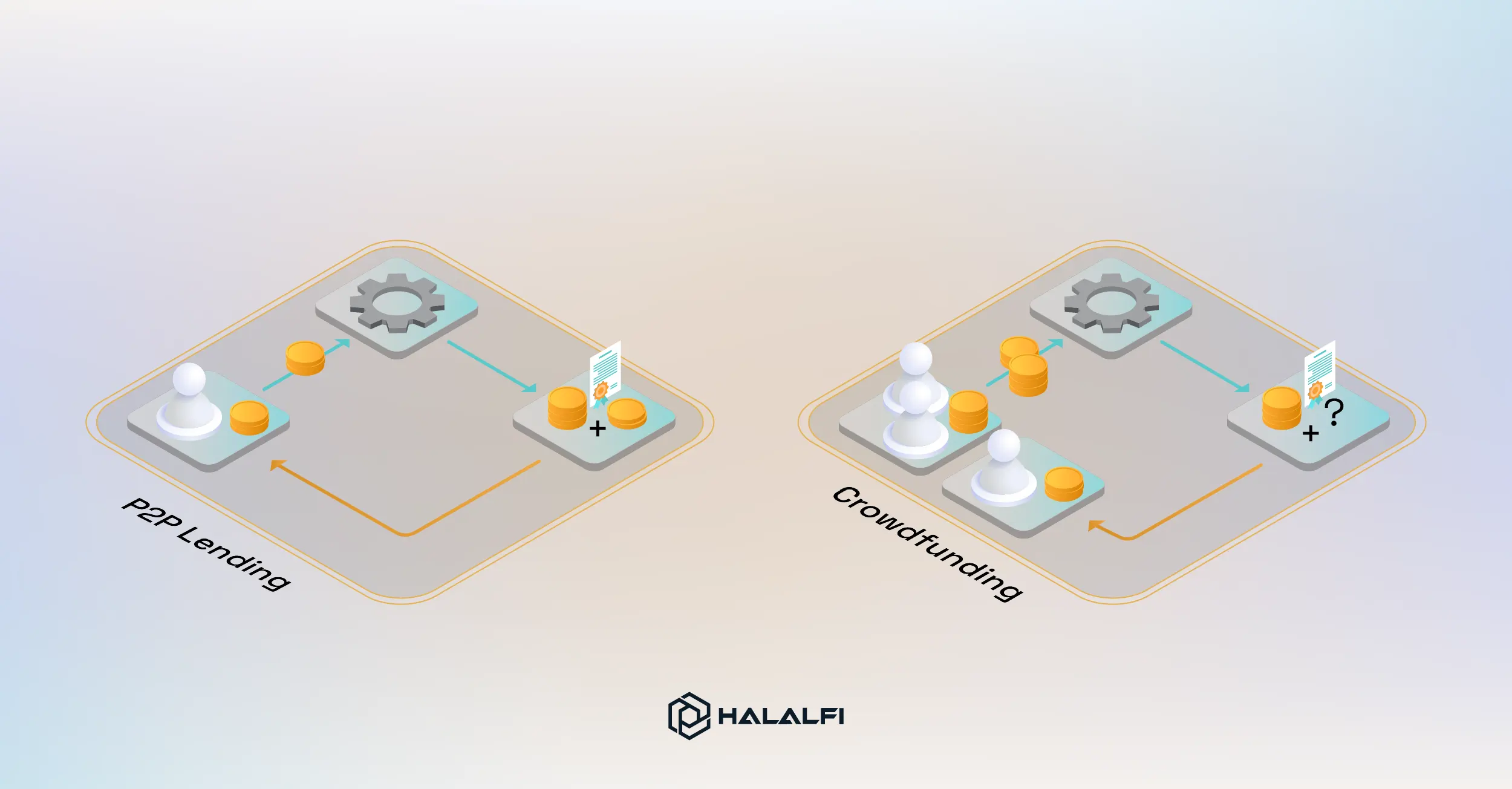
Forget the app interface for a moment and look at the agreement. A P2P investor becomes a creditor. The borrower owes money regardless of whether the funded expansion performs brilliantly or struggles.
A crowdfunding investor can occupy a very different position. For example, equity investors own a stake in a company, reward backers expect a product, and project investors may participate in defined commercial performance.
That contract determines what happens after the money leaves the platform. Let’s compare crowdfunding opportunities with P2P lending:
Question | P2P Lending | Crowdfunding |
What does the funder provide? | Loan capital | Contribution or investment capital |
What comes back? | Principal + usually interest | Reward, equity, profit participation or nothing |
Does the business owe repayment? | Yes | Depends on model |
Investor upside | Usually capped | Can vary with project/company |
Main investor risk | Default | Project, business or execution failure |
Ownership | Usually none | Possible in equity structures |
Payment schedule | Usually defined | Depends on campaign terms |
What Does a P2P Investor Get?
P2P lending tries to make lending more direct. Instead of a bank funding the borrower from its own balance sheet, a digital platform connects capital providers with borrowers.
P2P investors lend to borrowers and receive repayments over time, usually with interest. That structure gives the lender several things to assess:
Borrower credit quality
Interest rate and loan term
Default probability
Collateral or guarantees
Platform servicing quality
Recovery procedures after missed payments
What Does a Crowdfunding Investor Get?
Crowdfunding starts with the campaign, but the campaign does not tell you what you own. Crowdfunding is the practice of raising relatively small amounts of money from many people. Before investing, check:
What legal right does the contribution create?
What generates the potential return?
Does the company owe repayment?
Can the investor sell or exit?
What happens if the project fails?
Which fees reduce the final result?
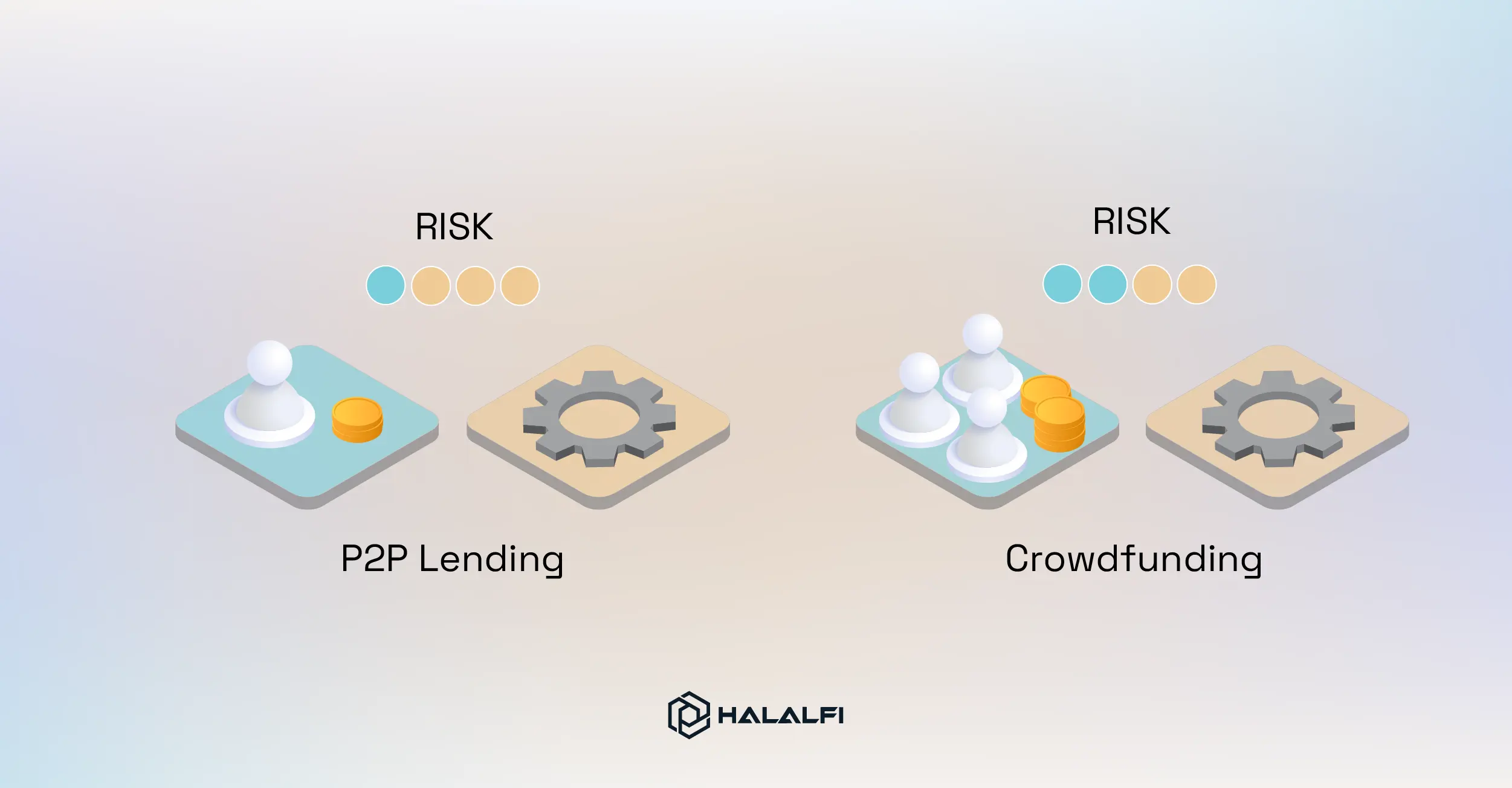
Crowdfunding vs. Peer-to-Peer: Who Carries More Business Risk?
Here the comparison gets interesting. A P2P borrower owes the debt even when the project funded by that debt performs badly.
That shifts more commercial risk toward the borrower, at least contractually. Crowdfunding can move more performance risk toward investors.
An equity investor participates in company success but may lose everything if the business fails. A project investor may receive less profit than forecast when real commercial performance disappoints.
The FCA warns investors:
“Those returns aren’t guaranteed, and your money may be at risk.”
It also classifies loan-based P2P and investment crowdfunding as high-risk investments in the UK and notes that FSCS protection does not cover them.
Which Model Gives Investors More Upside?
Put $10,000 into a P2P loan paying 8%, and your upside is usually written into the contract. If the borrower has its best year ever, you do not suddenly earn 20%. You still get the agreed payment.
Equity crowdfunding removes that ceiling, but also the safety of a fixed claim. A startup might triple in value. It might also fail, leaving your shares worth little or nothing.
In Project-based crowdfunding, your return may depend on a single defined commercial project rather than on the future value of an entire company.
So don’t stop at “How much could I earn?” Check: “What has to happen in the real world for me to earn it?”
Which Is Easier for a Business to Raise?
P2P lending rewards businesses with a track record. Revenue, credit profile, operating history, and repayment capacity can carry more weight than storytelling.
On a crowdfunding platform, the business may need to convince hundreds of people that the opportunity deserves attention.
Product-based businesses suit campaign-driven crowdfunding because founders can visually demonstrate the product and offer rewards.
Lending can work across a broader range of established business models because lenders focus more heavily on financial history.
Speed Makes P2P Look More Attractive
Businesses sometimes need money before they need an audience. For example, a company facing a short inventory window may not want to spend weeks producing campaign videos, building social traction, and waiting for a funding target.
A P2P application can move faster when the borrower already has the required documents and financial history. Crowdfunding carries another advantage. The fundraising can become market validation.
Five hundred people pre-ordering a product tells a founder something a loan approval never will. That marketing value disappears when a platform treats capital purely as debt.
So “faster” and “better” are not the same thing. The correct choice depends on what the business needs besides money.
When the Customer Pays Late but the Loan Does Not Wait
Imagine the electronics distributor expects a major customer to pay on Friday. Friday passes, and no payment is made. The invoice eventually gets settled three weeks later.
The P2P loan does not care. Its repayment date remains on the calendar, and interest continues to accrue under the contract. A late customer can suddenly leave the business scrambling for cash just to meet its debt obligation.
Equity and performance-linked crowdfunding can work differently. Investors participate in the business outcome so that returns can move with actual performance rather than a fixed loan schedule.
Of course, investors take on more uncertainty in return. But for a growing company with uneven cash flow, patient capital can sometimes be more useful than fast money with an unforgiving due date.
Where HalalFi Changes the P2P Lending vs Crowdfunding Comparison
HalalFi approaches business funding without starting from an interest-bearing loan.
Businesses present specific commercial projects. Investors participate with USDT, and every listed project undergoes both a Sharia review and business assessment before funding opens. The model focuses on:
Permissible commercial activity rather than prohibited sectors
Performance-based profit rather than conventional loan interest
Defined funding targets and project duration
Business and project information before capital moves
Smart-contract records for funding and distributions
Project-specific protection mechanisms
This does not make a HalalFi project guaranteed or risk-free. What changes is the source of the potential return.
Instead of earning because a borrower owes interest on money, investors participate in the economics of a reviewed business project.
HalalFi vs P2P Lending: Follow the Return Backward
Imagine two opportunities both display “7%.” They are not automatically comparable. The P2P investor may earn 7% because a borrower is contractually obligated to pay interest.
A HalalFi project might forecast a return because a distributor expects to buy goods, sell them, cover costs, and generate commercial profit.
Regulators now differentiate among equity, loans, rewards, and project structures. Halalfi is a crypto crowdfunding platform that uses stablecoins and smart contracts to move and record capital globally, while off-chain due diligence still checks what businesses actually do.
Technology, therefore, makes the contract underlying each platform easier to scrutinize.
Conclusion
P2P lending vs crowdfunding is a choice about what your money becomes after you invest it. In P2P, it becomes a loan that earns interest.
In equity crowdfunding, it buys ownership. In project investing, it can fund inventory, sourcing, trade, or another defined business activity.
That last model opens a different door for investors who want to avoid riba. HalalFi is built around that idea, connecting USDT to Sharia-reviewed commercial projects.
But invest only after you understand what your money will do, how the project expects to make profit, and what could go wrong. See HalalFi projects and what businesses are being funded on the platform.
Frequently Asked Questions
Can P2P lending count as crowdfunding?
Yes. Some regulators classify P2P lending as loan-based crowdfunding because multiple investors fund borrowers through a platform.
Can investors lose more than they invest in crowdfunding?
Usually, losses are limited to the amount invested. Leverage, guarantees, or certain contracts can create extra exposure.
What happens to P2P loans if the platform shuts down?
It depends on local rules. Some regulated platforms must maintain wind-down plans, but these do not guarantee full recovery.
Do crowdfunding investors receive regular income?
Not always. Income depends on the model. Equity, reward, and project-based crowdfunding can have very different payment schedules.
Does using USDT make crypto crowdfunding safer?
USDT can reduce crypto price volatility, but it still carries issuer, custody, smart-contract, depeg, and project risks.