Can you stake USDT, protect the original capital, and earn a halal return without relying on fixed interest?
HalalFi proposes an unusual answer. Investors do not stake Tether for an advertised APY. Instead, an approved guarantor locks USDT in an on-chain vault.
That USDT protects investors if a funded business fails to repay its principal. In return, the guarantor earns an underwriting fee linked to the project’s expected profit.
For someone searching for competitive USDT returns, HalalFi offers a different path: finance a real business and put risk behind.
Stake USDT? What does that mean?
Do you know how to invest in stablecoin for capital growth? Is that staking a good way?
People often use “USDT staking” as a catch-all phrase. It can describe lending USDT, placing it in a liquidity pool, depositing it with an exchange, or joining a promotional earn program.
Technically, USDT does not work like the native token of a proof-of-stake blockchain. Native staking helps validate transactions and secure a network.
Depositing USDT into Aave, for example, supplies liquidity to borrowers and earns variable interest. It does not validate the Tether network.
HalalFi uses the word differently again. It describes an approved guarantor depositing real USDT into an on-chain vault.
The platform then locks the required guarantee credit against a specific business project. The investor does not perform this lock.
So, how is the stake with Tether on HalalFi? A guarantor locks USDT to back an investment. Investors invest in a vetted business opportunity and receive a performance-based return.
Why Are USDT and Real-World Finance Meeting at the Right Time?
Islamic financial assets grew 13.4% year over year, while outstanding sukuk passed $1 trillion and Islamic fund assets increased 25.6%.
The IFSB’s 2026 stability report shows particularly large concentrations in the Gulf states and East Asia-Pacific markets.
Crypto use has also expanded in several Muslim-majority countries. Chainalysis ranked Pakistan third in its 2025 global adoption index.
It estimated nearly $200 billion in annual crypto activity for Türkiye and about $53 billion for the United Arab Emirates during its measured period.
These figures do not prove demand for any one platform. They do show why a USDT-based business-finance product could attract attention.
Cross-border users already understand stablecoins, while many still want halal investment with clearer links between returns, real trade, and risk sharing.
Current USDT Yield Models Compared
The table below reveals the central problem with comparing USDT staking rates. The percentage alone says little about who owes the money, how the platform creates the return, how long the offer lasts, or what happens after a default.
Model | Who supplies the USDT? | Source of return | Rate snapshot | Main issue |
Aave supply market | Any eligible user | Interest from borrowers | About 2.82% variable APY | Smart-contract, liquidity and depeg risk |
Ledn Growth Account | Account holder | Primarily its BTC-backed lending book | 6.5%–8.5% APY | Custody, counterparty and jurisdiction risk |
Nexo fixed-term product | Eligible account holder | Platform lending and yield activities | Up to 12.5% | Tier conditions; principal can remain at risk |
Binance promotion | Eligible new user | Short promotional subsidy | 30%–35% APR for seven days | Caps, regional rules and temporary rates |
HalalFi guarantor model | Approved guarantor | Project underwriting fee | No universal APY | Business default, collateral and contract risk |
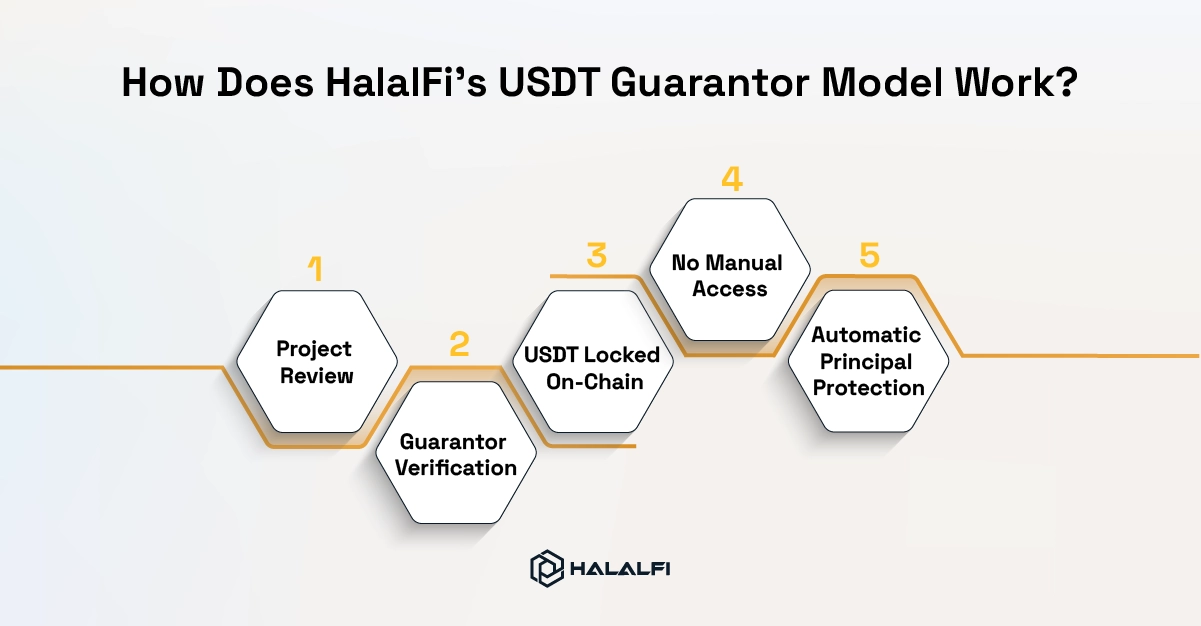
How Does HalalFi’s USDT Guarantor Model Work?
HalalFi combines crowdfunding, crypto crowdfunding, business screening, profit-based investment, and an on-chain guarantee, emphasizing shared risk and mutual benefit to foster fairness and collaboration among investors.
The process follows five steps:
Project Review: HalalFi reviews the business activity, funding amount, project duration, expected profit, supporting documents, and Sharia compliance before listing the opportunity.
Guarantor Verification: An approved guarantor completes identity, financial, and eligibility checks before supporting a project.
USDT Locked On-Chain: The guarantor locks USDT on the blockchain in an amount equal to the project’s principal. This USDT creates direct on-chain protection for investors’ original capital.
No Manual Access: Neither HalalFi nor the guarantor can freely withdraw or use the locked USDT while the project remains active. The smart contract keeps the funds secured under the project rules.
Automatic Principal Protection: If the project completes successfully, the smart contract releases the guarantor’s USDT. If the project fails under a covered default, the blockchain automatically returns the protected principal to eligible investors from the guarantor vault.
The guarantor protection exists on-chain, uses real USDT, remains inaccessible during the project, and executes automatically according to the smart contract.
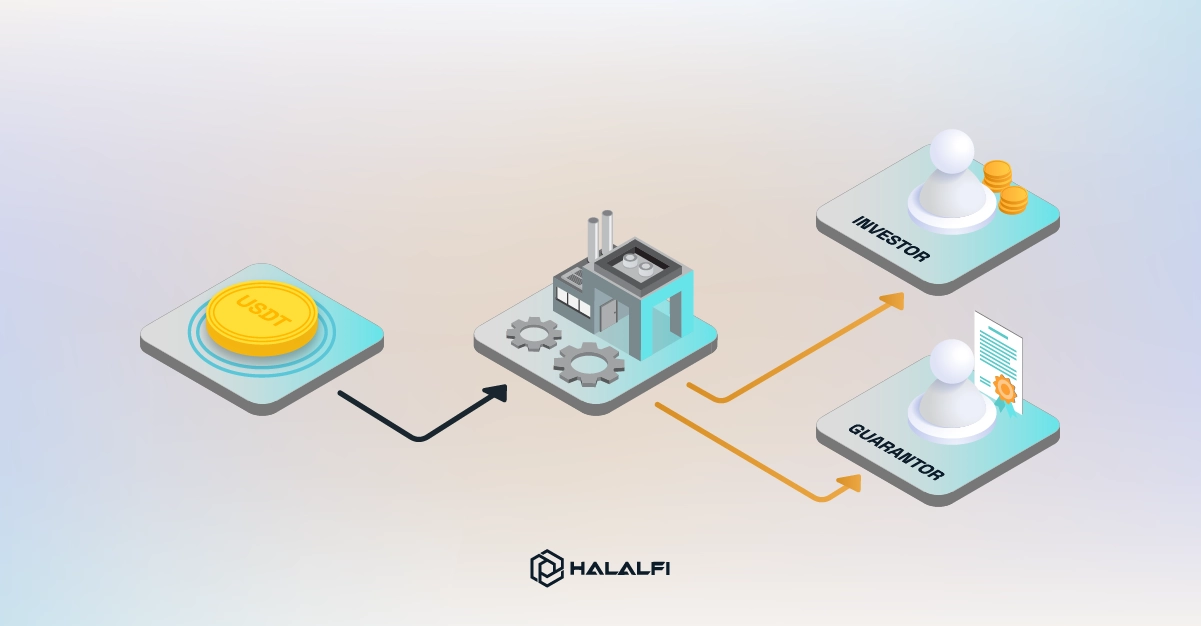
What Happens When a HalalFi Project Misses Payment?
An investor selects a project and contributes USDT. The investor expects a share of the business result.
The guarantor separately locks an amount of USDT equal to the project’s principal, creating on-chain protection for the investors’ original capital.
Once the review confirms that the investee caused a covered default, the smart contract automatically triggers compensation for eligible on-chain guaranteed investors from the guarantor’s USDT vault.
HalalFi does not manually transfer each payment; the blockchain executes the payout according to the project rules.
The guarantee protects the investor’s principal, while expected profit remains tied to the business outcome.
When a covered default occurs, the guarantor structure is designed to return the investor’s original USDT principal under the project terms.
The guarantor provides this protection by locking USDT or approved collateral against the project.
The expected profit remains separate from principal protection. HalalFi protects the invested capital in confirmed default cases, while project profit still depends on the business outcome.
So it is not risk-free; no platform is. According to Aave:
“No protocol can be considered entirely risk-free.”
Where Does the Halal Profit Come From?
HalalFi separates the investor’s profit from the guarantor’s fee. The investor funds a real commercial project.
Returns depend on the project’s forecast and business performance rather than a predetermined interest charge on a cash loan.
The guarantor earns an underwriting fee. HalalFi sets that fee at 40% of each investor’s expected profit, calculated at the beginning of the project and fixed in USDT.
HalalFi’s profit-sharing model focuses on project results. Its principal-protected investment structure adds a separate guarantor. Together, those elements shape its approach to halal investment.
Is HalalFi Better Than Tether Staking?
For someone who wants instant withdrawals and a visible variable rate, a liquid lending market feels simpler.
For a company, fund, or experienced individual willing to examine real businesses, lock collateral, and accept defined default exposure, HalalFi offers a different economic role. The participant acts as an underwriter rather than a passive depositor.
That difference can make the model more meaningful than chasing a temporary USDT staking high-APY promotion.
It can also make the work harder. A guarantor must understand credit, contracts, collateral, and recovery.
HalalFi’s strongest idea does not come from a spectacular percentage. Its profit sharing model rests on assigning responsibility: the business must perform, the guarantor must stand behind the principal, and the investor can see who bears the downside.
Conclusion
The phrase “stake USDT” suggests an easy deposit and an automatic reward. HalalFi replaces that image with something more concrete:
a guarantor locks Tether,
a real business uses investor capital,
and each party earns money under a defined commercial contract.
The approach may appeal to investors who want performance-based returns and to guarantors who understand underwriting.
Yet the documents matter more than the label. Review the project, vault, collateral, default process, smart contract audit, and Sharia opinion before committing funds.
Visit HalalFi Projects to examine its available projects and guarantor model. Start with the contract and the source of profit. The percentage should come later.
Frequently Asked Questions
Is USDT staking the same as staking Bitcoin or Ethereum?
No. USDT does not secure a blockchain through proof-of-stake. Most USDT “staking” products involve lending, liquidity pools, or platform earn programs that generate returns in different ways.
Is earning interest from USDT staking halal?
It depends on the structure. If the return comes from lending USDT with a fixed increase, it may raise concerns about riba. A halal structure should connect returns to real trade, assets, or business performance.
Why do some platforms offer higher USDT staking rates than others?
Higher rates usually stem from increased borrowing demand, promotional incentives, liquidity risk, or greater platform exposure. A high APY does not automatically mean a better or safer investment.
Can USDT be used for a halal investment?
Yes, USDT can serve as a payment or settlement asset. However, the halal status depends on how it is used, what activity generates the return, and whether the contract avoids prohibited elements.
Does HalalFi pay a fixed USDT staking reward?
No. HalalFi does not describe its model as a fixed USDT staking product. USDT supports funding and settlement, while potential returns come from the performance of underlying business projects.
What is the difference between USDT staking and HalalFi’s guarantor model?
Traditional USDT staking products usually generate yield through lending or liquidity activities. HalalFi’s model uses a guarantor who locks USDT as protection while investors participate in business opportunities.
Can a USDT staking platform guarantee my principal?
No investment platform can remove every risk. Smart-contract failures, custody issues, counterparty problems, stablecoin risks, and market events can still affect outcomes.
What should I check before choosing a USDT staking platform?
Review the source of the yield, custody method, withdrawal rules, smart-contract security, stablecoin risks, fees, and whether the return comes from a real economic activity or simply from lending money.