Can an app move money faster without quietly changing what makes the transaction halal?
Islamic fintech combines financial technology with rules that reject interest, excessive uncertainty, and harmful business activity.
The goal is to maintain the speed of digital finance without sacrificing the commercial logic of Islamic finance.
That means more than adding a Shariah badge to a banking app. A credible product must clearly show where profit comes from, who owns the underlying asset, who carries the risk, and what happens when a deal fails, fostering trust with your audience.
What Is Fintech?
Fintech refers to technology that delivers or improves financial services. A mobile wallet counts as fintech.
So does an app that checks a customer’s identity, a platform that matches businesses with investors, or software that sends cross-border payments without several layers of paperwork.
The technology handles speed, records, and access. It does not determine whether the transaction complies with Islamic principles. That decision depends on the product’s contracts, assets, fees, and risk allocation.
Fintech covers different financial technologies, including:
Mobile banking apps for managing accounts and making payments
Digital wallets for storing and transferring money or digital assets
Online payment platforms for processing personal and business payments
Crowdfunding platforms that connect businesses, charities, and investors
Robo-advisors that provide automated investment recommendations
Digital identity verification (eKYC) tools for customer onboarding
Peer-to-peer lending platforms that connect borrowers and lenders
Blockchain and smart contract platforms for transparent digital transactions
Insurtech solutions that digitize insurance services and claims
Regtech software that helps financial firms meet regulatory requirements
Cryptocurrency exchanges for buying, selling, and storing digital assets
Cross-border payment solutions that simplify international money transfers
Islamic Fintech Definition
Islamic fintech uses digital tools to offer financial services that follow Shariah principles.
Islamic finance is a way of managing money and conducting business in accordance with the moral principles of Islam.
A Shariah fintech product might link financing to an asset, such as a trade or business venture, and avoid interest-based debt, gambling, or participation in prohibited industries, thereby demonstrating real-world applications of Islamic principles.
The technology may handle onboarding, payments, investment records, or automated contract execution, but qualified reviewers, including Shariah specialists, must study the commercial arrangement to ensure compliance and confidence.
According to IsDB, Bandar Hajjar, former President of the Islamic Development Bank
“We are committed to supporting the development of Islamic finance in the age of fintech.”
Islamic Fintech Theory and Practice
The theory starts with familiar Islamic finance principles. The practice starts with awkward operational questions:
Who owns the goods during a sale?
When does ownership transfer?
Can an investor lose money?
Does a fee pay for genuine work, or does it imitate interest under another name?
That gap between theory and practice explains why credible Islamic fintech companies need both engineers and Shariah specialists. Let's compare in the table below:
Question | Conventional fintech may ask | Islamic fintech must also ask |
How does the company earn? | Does the model generate revenue? | Does the revenue come from a permissible activity and contract? |
How does the customer receive a return? | What rate or yield applies? | What trade, lease, asset, or profit creates the return? |
How does the platform manage risk? | Can software reduce defaults? | Do the parties share risk fairly under the contract? |
What does the customer buy? | A financial product or account | A clearly defined interest, asset, service or venture |
Who checks compliance? | Legal and financial teams | Legal, financial and Shariah reviewers |
The Global Islamic Fintech Report 2025/26 estimates that the volume of Islamic fintech transactions reached $198 billion in 2024–25.
The report expects that figure to reach $341 billion by 2029, which implies an annual growth rate of 11.5%.
What Do Islamic Fintech Companies Build?
The phrase “Islamic fintechs” creates the wrong picture. These companies do not all build digital banks. Many solve one narrow problem. Here are some examples of what Islamic fintech companies build:
Product category | Typical service | Practical customer benefit |
Digital banking | Accounts, cards and payments | Faster access without an interest-based account structure |
Wealth technology | Share screening and portfolios | Easier filtering for a Shariah-compliant investment |
Alternative finance | SME or asset financing | More funding routes for businesses outside large banks |
Crowdfunding | Project-based fundraising | Direct access between ventures and many smaller investors |
Social finance | Zakat, sadaqah and waqf tools | Clearer collection, reporting and distribution |
Takaful technology | Digital cooperative insurance | Faster claims and simpler participation |
Compliance software | Screening and transaction review | Lower manual workloads for Shariah and risk teams |
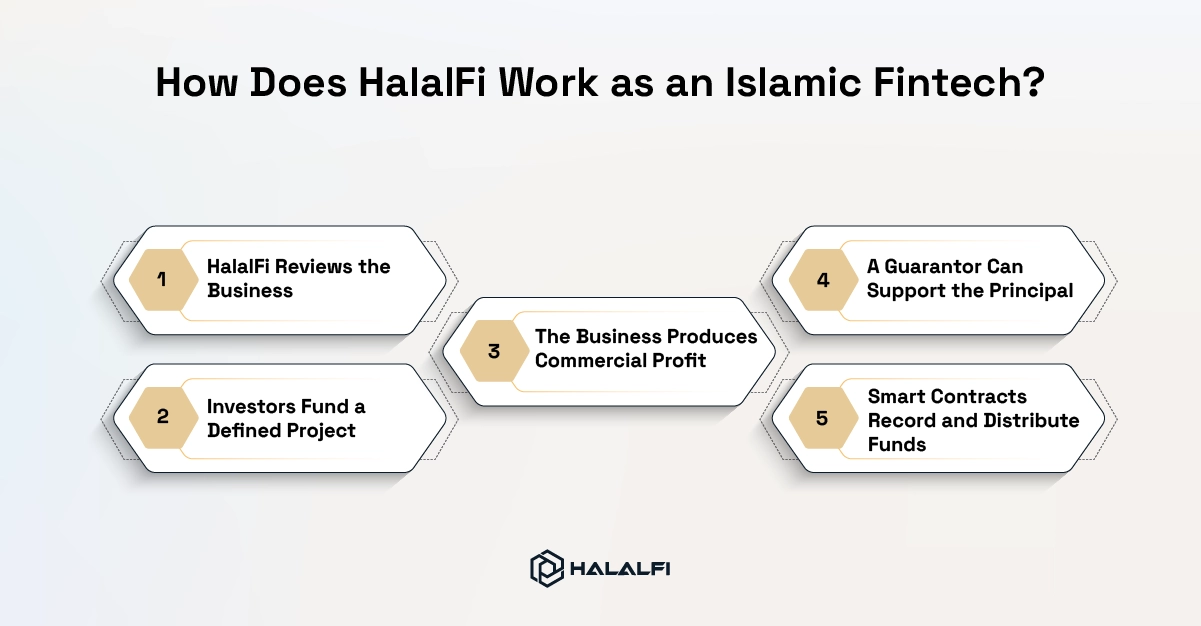
How Does HalalFi Work as an Islamic Fintech?
HalalFi is a blockchain-based, Shariah-compliant crowdfunding platform. Businesses present funding requests, while investors use USDT to participate in selected opportunities.
1. HalalFi Reviews the Business
The platform examines the proposed business activity, funding need, expected return, and supporting documents.
The platform examines the proposed business activity, funding need, expected return, and supporting documents.
This thorough review by both technical and Shariah experts is vital to build confidence that the product is compliant and sound.
2. Investors Fund a Defined Project
Investors contribute USDT to a listed opportunity rather than to an unspecified yield pool. The listing can show the target amount, duration, forecast return, and project description.
This model transforms crypto crowdfunding into a financing route for real commercial activity, with blockchain records enhancing transparency and allowing investors to inspect funding and distribution transactions more easily.
3. The Business Produces Commercial Profit
A successful investee uses the funds for the stated project and reports the results in accordance with the contract. The return should come from trading, services, or another permissible commercial activity.
That approach links profit sharing to business performance. It differs from a fixed payment that the borrower owes merely because time has passed, emphasizing the importance of clear contracts and effective risk management for trustworthiness.
4. A Guarantor Can Support the Principal
A project may rely on off-chain collateral, or an approved guarantor may lock USDT in an on-chain vault for selected opportunities.
The guarantor, not the investor, provides that separate security. If a covered business default occurs, the platform can use the guarantee to compensate eligible investors for principal. The guarantee does not cover the expected profit.
HalalFi verifies guarantors through identity, business, financial, and collateral checks.
5. Smart Contracts Record and Distribute Funds
HalalFi uses blockchain infrastructure to make funding records, distributions, and transaction histories easier to inspect. It currently uses USDT for project participation.
That creates a form of stablecoin investment, but USDT only serves as the payment and accounting asset. The commercial project must still create the return.
5 Signs of a Genuine Islamic Fintech Platform
Before trusting any Islamic fintech platform, check the points below:
The profit comes from real business activity: Returns should come from trade, services, or investment performance, not from lending money at a fixed return.
The contracts are clear and transparent: You should understand who owns the asset, how profit is calculated, who bears risk, and what happens if the project fails.
The platform applies Sharia review: A credible Islamic fintech should explain how it reviews projects and whether qualified Sharia experts assess the structure.
Technology improves transparency, not just marketing: Blockchain, smart contracts, and digital records should help users verify transactions instead of simply adding crypto buzzwords.
Risk stays visible: A trustworthy platform explains business, legal, custody, and technology risks instead of promising guaranteed profits or "risk-free" investing.
Conclusion
Islamic fintech works when technology makes a sound financial contract easier to use and inspect.
It fails when the app becomes a distraction due to unclear fees, hidden risks, or a return with no convincing commercial source.
HalalFi gives the idea a tangible form. It connects investors with screened business projects, uses USDT for funding,g and explores collateral and guarantor structures for principal support.
That makes it worth examining, rather than unquestioningly trusting. Visit HalalFi’s official platform, read a project’s documents, and trace the return back to the underlying business. A good investment decision starts with that trail, not with a logo or a forecast percentage.
Frequently Asked Questions
Can non-Muslims use Islamic fintech services?
Yes. Islamic finance products do not require customers to follow Islam.
Does a Shariah certificate guarantee that an investment will remain compliant?
Not automatically. A company may change its contract, revenue model, assets or operating process after an initial review.
Can artificial intelligence issue a reliable Shariah ruling?
AI can search documents, compare contract clauses and flag possible issues. It cannot replace accountable human scholars who understand jurisprudence, commercial context and conflicting interpretations.
What happens when smart-contract code conflicts with the written legal agreement?
The answer depends on the contract and governing jurisdiction. Investors should check whether the legal document treats the code as final, subordinate,e or supplementary.
Are stablecoins automatically halal because they track the US dollar?
No. Reviewers must consider the stablecoin’s reserve structure, use, custody, redemption terms, and the contract that generates any return.