Grow your money without risking your values? Yes, it is possible. A principal‑protected investment promises to return your initial capital at maturity, even if markets fall.
That security appeals to investors who want upside without heart‑pounding volatility. Yet for many, including Muslim investors seeking halal investment options, traditional products can feel unclear.
In this article, we explain principal‑protected notes, highlight current statistics from global markets, and show how HalalFi, a values‑driven halal investment platform, brings faith, impact, and profit together.
What is a Principal-Protected Investment?
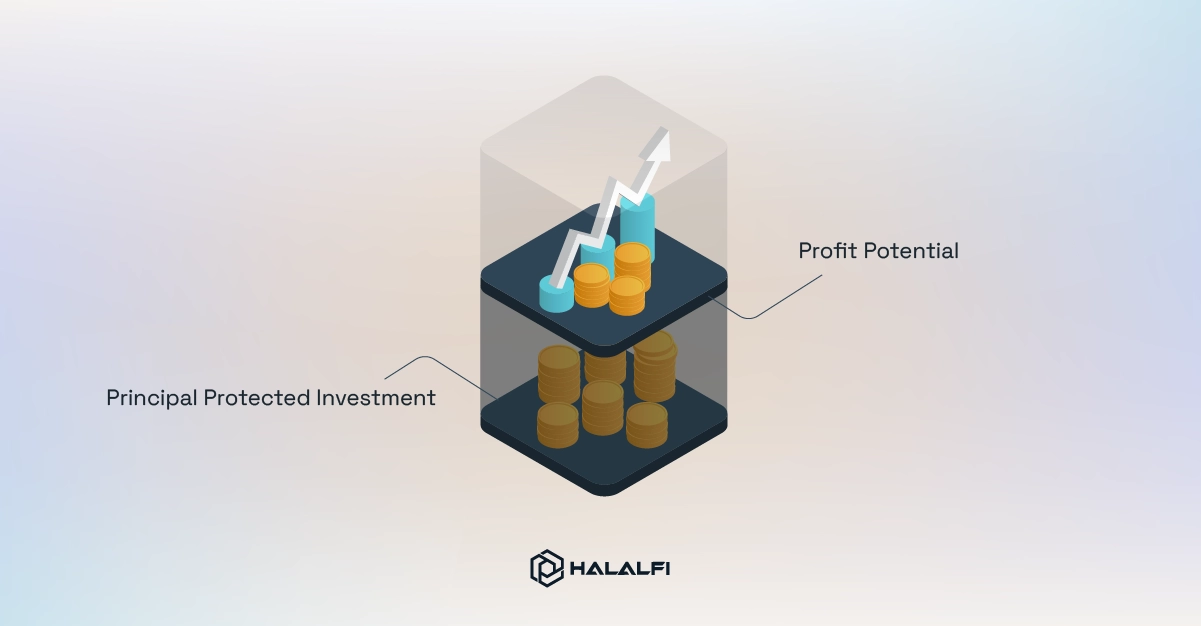
A principal-protected investment is an investment designed to help preserve your original capital while allowing you to earn returns.
Unlike traditional investments that may expose your entire investment to market losses, principal-protected investments use safeguards such as collateral, guarantees, or structured agreements to reduce the risk of losing your initial deposit.
While your principal receives an added layer of protection, returns are usually linked to the performance of the underlying investment and are not guaranteed.
What Are Principal‑Protected Notes?
Principal‑protected notes (PPNs) are structured products that combine a bond with a derivative to provide upside potential while promising to return the original investment at maturity.
The embedded options link your return to the performance of one or more assets, such as equity indices or commodities.
Investors are attracted to PPNs because they can experience market profits without risking their principal. However, these products are not risk‑free.
They may include barriers or buffers that restrict protection and have complex structures that make fees and risks hard to understand.
A 2025 survey by Structured Retail Products noted that rising interest rates rekindled interest in principal‑protected notes. The end of the ultra‑low rate era allowed issuers to price notes with “enticing upside”.
How Protection Works?
Structured notes can provide full or partial protection:
Full or partial protection: Some investments protect 100% of your principal, while others only protect part of it.
Hold until maturity: You typically receive your full principal only if you keep the investment until it matures.
Protection limits: In partial-protection products, your capital may be at risk if losses exceed a predefined buffer or barrier.
Issuer risk: Your protection depends on the issuer's financial strength. If the issuer defaults, you could lose money.
Limited liquidity: Many products have long lock-up periods and limited secondary markets.
Early exit costs: Selling before maturity may result in receiving less than your original investment.
Higher fees: Some principal-protected products charge higher fees, which can reduce your overall returns.
Why Investors Choose Principal-Protected Investments?
The structured‑products market has expanded steadily over the past five years. Higher interest rates have made principal‑protected products more attractive to conservative investors and wealth managers seeking defensive strategies.
According to BIIA, World Bank Group President AjayBanga, emphasizing that digital finance and modernized payment systems are critical, explains:
“Financial inclusion has the potential to improve lives and transform entire economies"
Fees and Risks of PPNs
While PPNs may appear safe, there are some risks:
Hidden fees: PPNs may include guarantee, structuring, distribution, management, and performance-related fees.
Complex pricing: Many costs are built into the product, making them difficult for investors to identify.
Limited liquidity: Most PPNs are designed to be held until maturity and often lack an active secondary market.
Capital lock-up: Your money may remain tied up for several years, limiting access to other investment opportunities.
Zero-return risk: If the underlying asset performs poorly, you may recover your principal but earn no return.
Inflation risk: Even if you get your original investment back, inflation can reduce its real purchasing power over time.
Beyond PPNs: Challenges for Impact‑Driven Investors
Most conventional FinTech and crypto platforms focus on speculation, high leverage, or fixed returns, often at odds with religious and ethical principles.
Riba (guaranteed interest), gharar (excessive uncertainty), and mysir (gambling) are the roots of Islamic finance.
Yet many platforms continue to entice investors with high, fixed yields that may not reflect underlying business performance.
An emergent group of impact‑driven investors, Muslim and non‑Muslim alike, seek transparent, ethical opportunities that support real businesses and social good.
They want alternatives that protect capital, offer upside tied to actual performance, and avoid exploitative structures.
HalalFi: A Values‑Driven Alternative
Many investors want more than potential returns. They want confidence that their capital is treated responsibly and that clear safeguards are in place if a project underperforms or fails.
HalalFi is a Shariah‑compliant investment platform that connects investors with real, cash‑flowing businesses. HalalFi helps investors pursue transparent, values-driven returns. Features include:
Dual Audit
Performance‑Based Profit Sharing.
Principal Protection
Guarantor Marketplace
Inclusivity for Investors
Alongside features such as business screening, Shariah reviews, and profit-sharing structures, the platform explores an on-chain guarantor model designed to strengthen investor confidence.
Approved guarantors may choose to lock collateral on the blockchain that corresponds to the level of coverage they provide for a project.
Because this collateral is recorded on-chain, participants can verify the guarantee's existence rather than relying solely on promises or off-platform documentation.
For every project on HalalFi, the amount of principal protection is predefined, and the corresponding collateral is locked on the blockchain through a smart contract.
The protected amount varies from one project to another and is fully visible before you invest.
If a project fails to generate profits or triggers the predefined protection conditions, the smart contract automatically releases the locked principal and refunds it directly to the investor's wallet.
Because the payout follows transparent on-chain rules encoded in the smart contract, the process executes automatically without manual claims or approvals.
This blockchain-based protection mechanism is designed to minimize investment risk while providing investors with greater confidence and transparency.
For Muslims, this halal investment platform avoids riba, reduces gharar through transparent contracts and smart‑contract automation, and eliminates mysir by focusing on real productive assets. For non‑Muslims, it offers ethical exposure to emerging markets and ESG‑aligned projects.
Case Study: PPN vs HalalFi Investment
Imagine two investors each contributing US$10,000. One buys a five-year PPN linked to the S&P 500 with a 10% downside buffer, which protects against a portion of market losses but does not guarantee a fixed profit.
The other funds a HalalFi‑listed manufacturing project with an audited cash flow:
Scenario | PPN Investor | HalalFi Investor |
Initial Investment | US$10,000 | US$10,000 |
Term | 5 years | 3 years (project duration) |
Return Structure | Linked to S&P 500; returns capped at 60 % participation; 10 % buffer | Profit sharing based on project revenue and profit ratio |
Minimum Outcome | Principal returned if S&P 500 doesn’t breach 10 % buffer; potential zero return if index is flat | Principal protected via legal recourse; profit not guaranteed but tied to actual earnings |
Liquidity | Low; the secondary market may offer discounts | The investor's principal stays locked on the blockchain. If the project fails, the smart contract automatically refunds the protected principal to the investor's wallet. |
Fees | High structuring fees, distribution commissions, and management charges | Platform fee (around 3 %), optional guarantor premium; no hidden interest |
Ethical Alignment | Traditional finance may include instruments prohibited in Islamic finance | Fully Shariah‑compliant; avoids riba, gharar, and mysir |
In this example, both investors protect their principal, but the HalalFi investor shares in a business's real profits while supporting a tangible project.
The entire investment process runs on blockchain technology, in which smart contracts automatically execute agreements, distribute profits, and record every transaction transparently, without manual intervention.
In contrast, the PPN investor gains exposure to market indices but may earn little or no return if the index remains flat. Each option suits different risk profiles.
Country statistics highlight why Shariah‑compliant platforms are gaining momentum. The BIIA report says that financial inclusion gaps remain.
More than 1.3 billion adults globally remain outside the formal financial system, and women constitute 55% of the unbanked. HalalFi’s technology‑driven approach can help bridge this gap by combining blockchain transparency with inclusive investment structures.
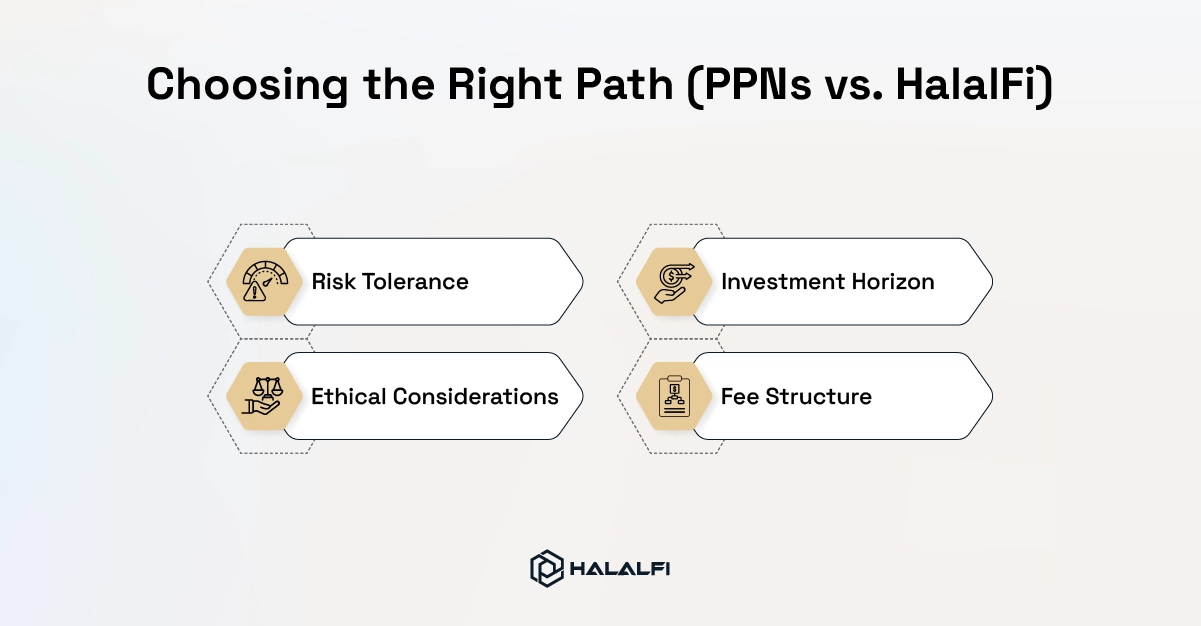
Choosing the Right Path (PPNs vs. HalalFi)
Selecting between a principal‑protected note and the HalalFi Approach for halal investment depends on your goals:
Risk Tolerance: If you seek market exposure with defined protection and are comfortable with complex structures and lower liquidity, PPNs may be appropriate. Ensure you understand barriers, buffers, and issuer credit risk.
Ethical Considerations: For investors wanting compliance with Islamic finance principles or broader ESG alignment, HalalFi’s model avoids guaranteed interest, ensures transparency, and supports real businesses.
Investment Horizon: PPNs often have longer maturities and limited exit options. HalalFi projects can vary by offering greater flexibility through secondary markets or shorter project durations.
Fee Structure: Evaluate all fees. PPNs may include hidden costs, whereas HalalFi discloses its platform fee and optional guarantor charges upfront.
Conclusion
Principal‑protected investments provide a way to participate in the market while safeguarding your initial capital.
As markets grow more volatile and ethically conscious investors seek impact alongside returns, products such as PPNs offer one solution, yet they come with complexities and fees.
HalalFi extends the concept by aligning capital protection with Shariah principles, transparent governance, and social impact.
Whether you’re a halal investment seeker, an ESG‑minded investor, or simply someone tired of speculative hype, exploring HalalFi’s model could be an eye‑opening next step.
Ready to see how your wealth can grow ethically? See HalalFi’s projects and join a community where faith, impact, and profit align. Your money can build more than returns; it can build a better world.
Frequently Asked Questions
What is a principal‑protected investment?
Imagine a hybrid between a bond and a fancy option. A principal‑protected note (PPN) is a structured product that combines a bond with a derivative so that, if you hold it to maturity, you should get back the amount you initially invested.
Are principal‑protected investments truly risk‑free?
That “protected” label can feel reassuring, but it doesn’t make the product bulletproof. Most structured notes don’t offer full principal protection; some have barriers or buffers that kick in only under specific conditions.
How do the returns work on a PPN?
The return formula can be surprisingly complex. Some notes cap your gains or provide only partial participation in the underlying asset’s upside.
What fees and costs should I expect?
Structured products can be expensive. FINRA notes that PPNs often have hidden or imputed costs, things like structuring fees, distribution charges, and option premiums.
Who might benefit from a principal‑protected note?
If you’re a conservative investor looking for a bit of market exposure without the gut‑churning ups and downs, a PPN might appeal to you.
How is HalalFi risk-free?
HalalFi is designed to minimize investment risk, not eliminate it. By locking principal protection on the blockchain and using smart contracts to refund protected funds when predefined conditions are met automatically, the platform reduces reliance on manual intervention and increases transparency.