Can one urgent need become a campaign that strangers trust enough to fund? Nonprofit crowdfunding can make that happen, but a donation button alone won't tell the story.
People want to know who receives the money, what one contribution changes, and whether the organization will report what happened next.
A campaign succeeds when it turns a broad mission into a specific result that donors can trust.
In this guide, we explain how nonprofits can crowdfund, what successful campaigns do differently, and how organizations can receive donations directly.
What Is Nonprofit Crowdfunding?
Crowdfunding lets an organization collect many contributions toward one defined goal. A nonprofit might fund school meals, medical equipment, emergency accommodation, a community garden, or a new service for families.
The campaign usually combines a public page, a target amount, a deadline, a clear story, and regular updates. Supporters contribute directly or create peer-to-peer pages that introduce the cause to their own friends.
Unlike a general annual appeal, crowdfunding gives donors one visible finish line. “Support our work” feels broad. “Help us equip a classroom for 120 children before September” gives the contribution a job.
That clarity can turn a passive reader into an active donor. Using compelling stories and engaging updates can inspire supporters to stay involved and feel emotionally connected to the campaign's progress.
Can Nonprofits Use Crowdfunding?
Yes. Registered charities, community groups, religious organizations, schools, foundations, and other nonprofits can use a crowdfunding platform when local law and the chosen platform allow it.
The organization should control the campaign, approve the message, and receive the money through an account linked to the legal entity.
A well-meaning volunteer should not collect thousands of dollars in a personal account and promise to transfer the balance later.
Tax treatment also depends on where the organization and the donor are located. In the United States, for example, a gift generally needs to reach a qualified organization before the donor can claim a charitable deduction. Gifts to individuals or personal fundraising accounts usually do not qualify.
The rules vary by country, so a nonprofit should confirm registration, receipt, reporting, and fundraising requirements before launching.
This awareness can help the audience feel more secure and confident in their campaign's legality and integrity.
How Does Crowdfunding Work for Nonprofits?
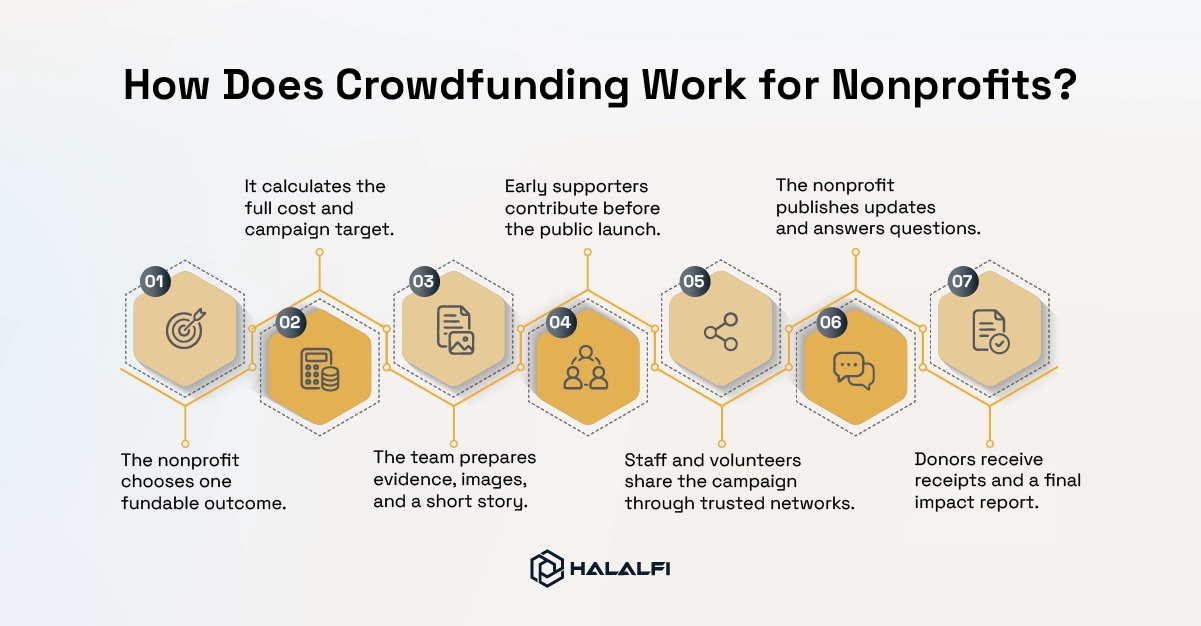
People searching how does crowdfunding work expect the platform to bring a ready-made crowd. Usually, the organization must bring its own first supporters. The process follows a sequence:
The nonprofit chooses one fundable outcome.
It calculates the full cost and campaign target.
The team prepares evidence, images, and a short story.
Early supporters contribute before the public launch.
Staff and volunteers share the campaign through trusted networks.
The nonprofit publishes updates and answers questions.
Donors receive receipts and a final impact report.
Crowdfunding creates a public home for the appeal. It does not replace community relationships, email lists, volunteers, local leaders, or previous donors.
The first wave matters because visible participation reduces the awkwardness of being the first person to give.
Research across online campaigns also suggests that engagement signals, comments, updates, and campaign activity can support fundraising performance.
Does Crowdfunding Work for Nonprofits?
Yes, but success depends less on publishing a page than on what happens around it.
M+R’s 2026 Benchmarks study found that average nonprofit online revenue rose 15% in 2025. One-time revenue increased by 17%, while monthly gifts produced 27% of total online revenue.
Those figures cover digital fundraising broadly, not crowdfunding alone, but they show that donors continue to respond online.
A campaign can attract attention and still lose people through a slow page, a confusing message, or a long donation form.
How to Create a Nonprofit Crowdfunding Campaign People Trust
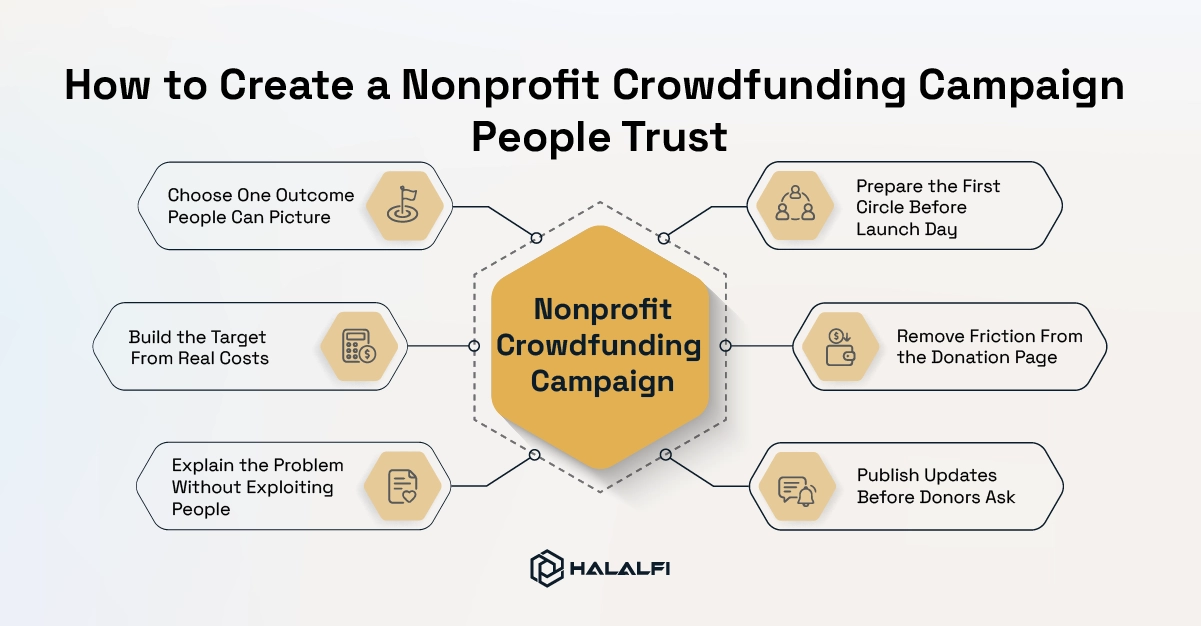
A strong crowdfunding campaign begins with a result, not a description of the organization. This is how we can create a nonprofit crowdfunding campaign:
Choose One Outcome People Can Picture: “Reduce poverty” carries moral weight, but it does not tell donors what this campaign will deliver. Specificity helps the team build the budget. It also helps the donor imagine completion.
Build the Target From Real Costs: Add equipment, delivery, processing fees, staff time, permits, contingency, and reporting costs. Then show the main numbers on the page.
Explain the Problem Without Exploiting People: A compelling story needs a person, place, or moment. It does not need humiliation.
Prepare the First Circle Before Launch Day: The public campaign should not start from scratch. Ask board members, staff, volunteers, longtime donors, community leaders, and partner businesses to support or share the page during the opening days. This approach creates momentum and reduces the risk of a slow start.
Remove Friction From the Donation Page: Most visitors use a phone, yet mobile donors often convert at lower rates and give smaller average gifts than desktop users.
Publish Updates Before Donors Ask: Do not disappear after collecting the money. Share the first purchase, delivery date, delay, milestone, and beneficiary count.
Is Crowdfunding Good for Nonprofits?
Crowdfunding works best for a defined need with a clear deadline, a reachable audience, and visible progress.
It performs less well when an organization has no supporter base, needs indefinite operating money, cannot share evidence, or expects the platform to generate attention automatically.
The advantages and disadvantages of crowdfunding become clearer side by side:
Advantage | Limitation |
Reaches many smaller donors | Requires constant promotion |
Makes one goal easy to understand | Can oversimplify long-term problems |
Creates fast public momentum | Attention may disappear after the deadline |
Allows peer-to-peer sharing | Favors organizations with stronger networks |
Produces useful donor data | Some platforms keep or limit access to that data |
Shows progress publicly | Missed goals and delays also remain visible |
Can attract first-time donors | New donor retention often remains weak |
Crowdfunding is good for nonprofits when it serves a wider fundraising plan. It becomes exhausting when the organization treats every need as another emergency campaign.
Nonprofit Crowdfunding for Islamic Organizations
Islamic nonprofits often work with some kinds of money at once:
Zakat
Sadaqah
Waqf
Grants
Unrestricted donations
Qard Hasan
Those funds should not be lumped into one vague campaign balance.
UNDP defines Islamic social finance as including zakat, waqf, sadaqah, and interest-free loans.
Each instrument carries a different purpose and may require different governance, beneficiary rules, and reporting.
“Digital technology makes it easier to identify, evaluate, and fund causes.”
An Islamic nonprofit should label a campaign clearly:
Is it zakat-eligible?
Can the organization use funds for administration?
Will unspent money remain restricted?
Does a Sharia adviser review the distribution policy?
A donor who intends to give zakat should not later discover that the organization used part of the gift to finance a profit-making venture.
Likewise, an investor should not receive commercial profit from money donated as sadaqah. Digital transparency helps. Clear fund separation matters more.

When Nonprofits Need Investment, Not Donations
HalalFi does not operate as a zakat, sadaqah, or donation. It is a crypto crowdfunding model that focuses on reviewed commercial projects where investors provide USDT and earn returns from real business activity.
That makes HalalFi unsuitable for food relief, medical aid, mosque expenses, scholarships, or emergency grants. Those needs belong on a nonprofit donation page.
It fits a different case: an Islamic nonprofit that owns or supports a revenue-generating social business.
In those cases, the project needs investment capital rather than a charitable gift.
HalalFi reviews the business case, documents, and Sharia structure before listing a project. Smart contracts record contributions and distributions, while the commercial activity must create the profit. A funding split looks like this:
Donations support relief and social programs.
Zakat follows eligible recipients.
Waqf supports long-term charitable assets.
Qard hasan provides interest-free temporary help.
HalalFi supports approved revenue-generating projects. Profit is not guaranteed, and capital may remain locked until the project ends. Business, legal, wallet, and stablecoin risks still apply.
Build the Trust Before Asking for the Gift
Nonprofit crowdfunding does not succeed because the internet is full of millions of generous strangers.
It succeeds when a specific story reaches people who trust the messenger, understand the need, and can see how their contribution will make a difference.
Keep the campaign narrow. Send money directly to the organization. Report progress before supporters chase you.
Then turn first-time donors into long-term participants rather than treating them as a one-time campaign payment source.
An Islamic nonprofit with a separate revenue-generating venture can also examine HalalFi’s projects. Start with the business activity, not the forecast return.
Keep donated funds separate, and ask whether investment capital genuinely fits the project.
A donation should serve the mission, and an investment should help sustainable work pay for itself.
Frequently Asked Questions
Can a volunteer start a crowdfunding page for a nonprofit?
Yes, with written authorization and a clear payment route.
Can a new nonprofit crowdfund before receiving tax-exempt status?
It may raise money where local law allows, but donors may not receive a charitable deduction.
Can crowdfunding money pay nonprofit salaries?
Yes, when staff costs support the stated project and the campaign discloses them.
Who issues the receipt on a third-party crowdfunding page?
The answer depends on who legally receives the gift. The nonprofit, platform, fiscal sponsor, or another intermediary may issue it.
Can a nonprofit accept USDT or other crypto donations?
Potentially, where local law and the organization’s policies allow it. The nonprofit needs rules for wallet security, valuation, conversion, acknowledgments, sanctions screening, and accounting.