
What makes someone donate thousands of dollars to a stranger’s idea online? And why do some crowdfunding campaigns explode overnight while others quietly disappear?
A successful crowdfunding campaign is rarely about luck. It is usually a mix of storytelling, trust, timing, transparency, and a clear mission people genuinely care about.
In recent years, crowdfunding has evolved far beyond creative projects and startup gadgets. It now funds nonprofits, medical causes, climate initiatives, local businesses, and even ethical blockchain ventures.
At the same time, a new challenge has emerged. Many investors want profit, but they also want purpose. They want transparency and want to know where their money goes and whether it supports something meaningful.
That shift is exactly why platforms like HalalFi are attracting attention in both the Islamic finance and ethical fintech spaces.
In this guide, we explain what a crowdfunding campaign is, how crowdfunding works, how to create a crowdfunding campaign step by step, and what separates average campaigns from the most successful crowdfunding campaigns in the world.
We also see how HalalFi is approaching halal crowdfunding differently through blockchain transparency, Sharia-compliant audits, and performance-based profit-sharing.
What Is a Crowdfunding Campaign?
A crowdfunding campaign is a fundraising effort in which many individuals contribute small amounts of money to support a project, business, cause, or organisation.
Crowdfunding campaign creators, rather than relying on a single large investor or a bank loan, collect funding from an online community. Crowdfunding allows ordinary people to support ideas they believe in financially.
There are several crowdfunding types:
Crowdfunding Type | How It Works | Use Cases |
Donation-Based | Supporters donate without expecting returns | Nonprofits, medical causes |
Reward-Based | Backers receive rewards or products | Startups, gadgets, creative projects |
Equity Crowdfunding | Investors receive ownership shares | Businesses, startups |
Debt Crowdfunding | Funds are repaid with returns | SME financing |
Crypto Crowdfunding | Blockchain-based fundraising | Web3 startups |
Halal Crowdfunding | Sharia-compliant profit-sharing | Ethical business funding |
How Does a Crowdfunding Campaign Work?
The question here is: “How does crowdfunding work?” The process is simple:
A creator launches a campaign
The campaign explains the idea, goals, and funding target
Supporters contribute money online
The campaign updates supporters regularly
Funds are used to execute the project
The difficult part is not the technology; it is convincing people to trust the campaign.
Campaigns with videos raise significantly more money than those without them. Transparency also matters. Campaigns with regular updates often outperform silent campaigns by a huge margin.
That makes sense. People invest emotionally before they invest financially.

How to Start a Successful Crowdfunding Campaign
Many campaigns fail before they even launch. It happened not because the idea is bad, but because the planning is weak. Here is what strong crowdfunding campaigns do before going live.
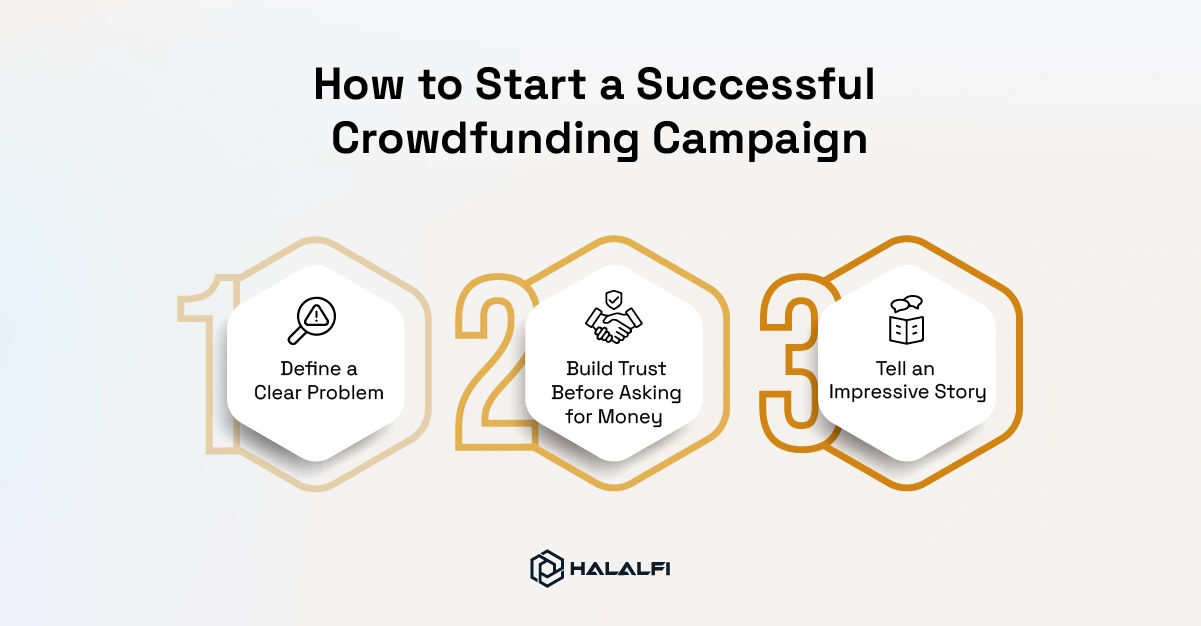
1. Define a Clear Problem
People fund solutions, not vague concepts. A nonprofit campaign might help improve access to clean water, or A startup campaign might solve payment friction.
The clearer the problem, the easier it becomes for people to care.
2. Build Trust Before Asking for Money
One mistake creators make is launching immediately without preparing the audience. The best crowdfunding campaign examples spend weeks or months building:
Email lists
Community groups
Social media audiences
Partnerships
Press mentions
3. Tell an Impressive Story
Facts matter,r and Stories move people.
Consider one nonprofit campaign that raises funding for mobile education vans by sharing stories of rural children studying under streetlights after sunset. Donations will surge because supporters emotionally connect with the mission.
That emotional connection matters more than polished marketing language.
So the campaigns succeeding now combine:
Strong storytelling
Short-form video content
Community engagement
Transparency
Consistent updates
Ethical positioning
People increasingly support missions, not just products. That explains why ethical and halal investment models continue growing globally.
How to Create a Crowdfunding Campaign That People Remember
A campaign page should feel human, not corporate or robotic. The strongest campaigns usually include:
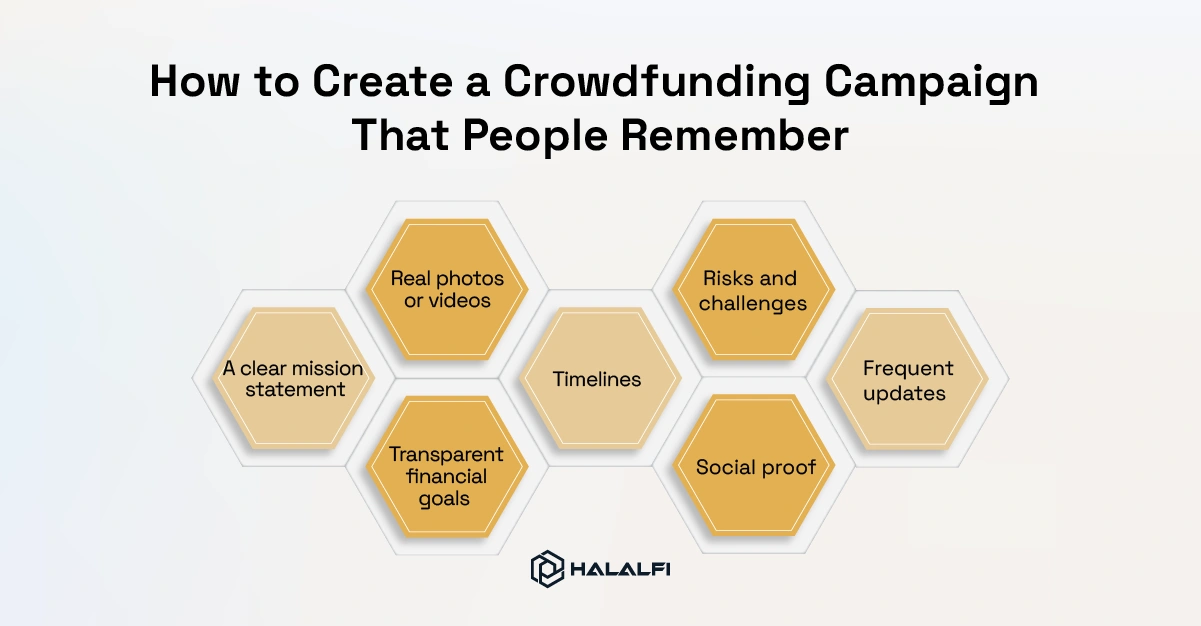
A clear mission statement
Real photos or videos
Transparent financial goals
Timelines
Risks and challenges
Social proof
Frequent updates
Short paragraphs also help. Most users skim before they commit.
A Simple Campaign Structure That Works
This structure appears repeatedly in successful crowdfunding campaign examples because it mirrors how people make decisions:
Section | Purpose |
Opening Hook | Grab emotional attention |
Problem | Explain the issue clearly |
Solution | Present the project |
Why Now | Create urgency |
Funding Goal | Explain where money goes |
Team Story | Build credibility |
Rewards or Returns | Show supporter value |
CTA | Encourage action |
Crowdfunding Campaign Examples That Changed Industries
Here are some crowdfunding campaigns that became cultural moments:
Pebble Watch
According to The Guardian, Pebble raised over $20 million on Kickstarter and became one of the most successful crowdfunding campaign stories ever.
The interesting part is that the campaign focused less on technology specs and more on solving a simple frustration: smartphone notifications on the wrist.
Exploding Kittens
According to Kickstarter, this card game campaign raised nearly $9 million with humour, community engagement, and absurd marketing.
It proved personality can outperform polished corporate branding.
Why Many Crowdfunding Campaigns Fail
Not every campaign succeeds. Actually, many fail quietly. Here are some reasons:
Mistake | Impact |
Weak storytelling | Low emotional connection |
Unrealistic funding goals | Loss of trust |
Poor marketing | Low visibility |
No updates | Supporter disengagement |
Lack of transparency | Credibility damage |
Complicated messaging | Audience confusion |
Sometimes campaigns become too focused on hype instead of value. That problem became visible in crypto crowdfunding during the speculative boom years.
Examples of failed crowdfunding campaigns
Let’s see some examples of crowdfunding campaigns that failed:
1. Coolest Cooler
According to Wikipedia, one of the most famous crowdfunding failures is. The project raised over $13 million on Kickstarter, promising a high-tech cooler with a blender, Bluetooth speaker, and more. On paper, it sounded like the ultimate summer gadget.
In reality, production delays, rising costs, and poor logistics meant most backers waited years, or never received the product at all.
Eventually, the company even asked some supporters to pay extra just to ship their orders. It became a textbook case of how ambitious promises can spiral out of control.
2. Zano Drone
Gizmodo Report shows Zano was a mini drone funded on Kickstarter with nearly $3.5 million raised. It promised intelligent flight features and easy smartphone control. But the final product fell far short.
The drones barely worked, had unstable flight performance, and the company eventually collapsed.
Most backers received either defective units or nothing at all. It highlighted how even polished marketing and strong funding don’t guarantee technical success.
Crowdfunding Campaigns for Nonprofits Are Also Changing
Nonprofits increasingly use crowdfunding because it creates direct emotional engagement. The best campaigns focus on:
One clear mission
Tangible impact
Real human stories
Transparent reporting
Transparency consistently increases trust. That same principle is central to blockchain-based crowdfunding platform.
Advantages and Disadvantages of Crowdfunding Campaign
Like every funding model, crowdfunding campaigns have pros and cons. Here are the advantages and Disadvantages of Crowdfunding:
Advantages of Crowdfunding | Disadvantages of Crowdfunding |
Access to global audiences | High competition |
Faster market validation | Marketing costs |
Community building | Campaign fatigue |
Alternative to banks | Public failure risk |
Transparency opportunities | Regulatory complexity |
Flexible fundraising | Reputation damage if mismanaged |
Warren Buffett once said:
“Risk comes from not knowing what you're doing.”
Transparent campaigns reduce uncertainty and build confidence.
Best Crowdfunding Campaign Lessons From Real Campaigns
After analysing hundreds of crowdfunding campaign examples, several patterns appear repeatedly:
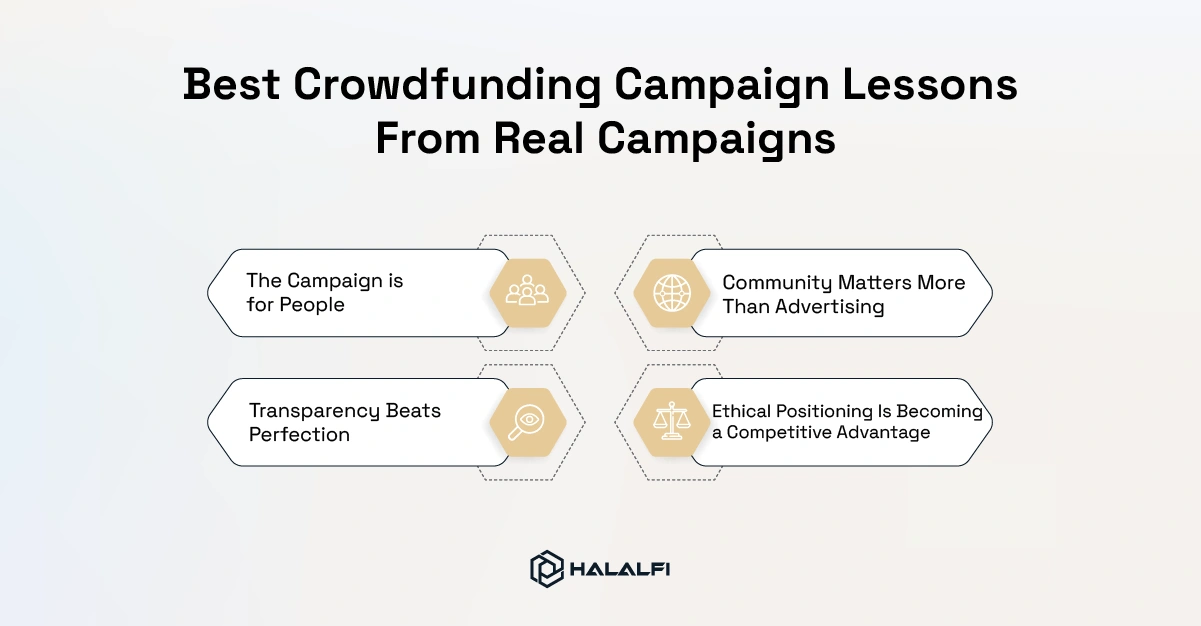
The Campaign is for People
People support people. Even highly technical campaigns succeed more often when they communicate emotionally.
Transparency Beats Perfection
Supporters tolerate challenges. They do not tolerate silence or dishonesty.
Community Matters More Than Advertising
Many campaigns fail because they focus entirely on paid ads rather than on building loyal communities.
Ethical Positioning Is Becoming a Competitive Advantage
Especially among younger investors. More people now ask:
Where does my money go?
What does it support?
Is this sustainable?
The Shift From Speculation to Ethical Crowdfunding
Over the last few years, many investors have started questioning speculative financial systems.
A growing number now care about:
Ethical investing
Real business activity
Transparency
Social impact
Risk reduction
That trend is visible globally.
According to the Islamic Finance Development Report, global Islamic finance assets reached nearly $6 trillion and could approach $9.7 trillion by 2029. Malaysia, Saudi Arabia, the UAE, Pakistan, and Indonesia remain major growth hubs.
Also, BFSI Insider shows that Saudi Arabia, Malaysia, and the UAE are also leading the rise of Islamic fintech infrastructure and Sharia-compliant digital finance.
That broader movement created space for platforms like HalalFi.
How HalalFi Solves Problems Traditional Crowdfunding Often Ignores
Many traditional finance apps focus heavily on speculation. HalalFi takes a very different direction.
In HalalFi's documentation, we see that it positions itself as a halal crowdfunding platform that connects investors with real businesses generating actual revenue. This is the distinction, and it matters.
Here is what makes HalalFi different:
Dual Audits: Sharia compliance review and Business viability review.
Performance-Based Profit Sharing: Traditional finance often guarantees fixed returns regardless of business performance. HalalFi avoids this model.
Blockchain Transparency: One of the biggest frustrations in crowdfunding is the lack of transparency. HalalFi uses blockchain records and smart contracts to improve transparency and automate agreements.
The “Big Wall” Approach: HalalFi emphasises filtering and verification.
Also, the company explores halal crowdfunding options. Instead of chasing speculative funding, they connect with values-driven investors who care about ethical growth and long-term sustainability.
The funding allows them to hire additional workers, expand regional distribution, and improve production efficiency.
HalalFi’s crowdfunding campaign process connects ethical investors with real businesses through a transparent, Sharia-compliant system. Here’s the version of how it works:
Business applies for funding
Dual audit process
Project listing
Investor participation
Risk mitigation and transparency
That is the kind of ecosystem HalalFi is attempting to build at scale.

Conclusion
Crowdfunding campaigns are no longer just fundraising tools. They have become trusted ecosystems.
Crowdfunding is evolving beyond simple fundraising into a model built on trust, transparency, and community participation.
The platforms likely to succeed in the future are those that combine clear structures, accountability, and ethical finance principles with real value creation.
This is one reason platforms like HalalFi are gaining attention. By focusing on transparent business models, dual audits, and performance-based profit-sharing instead of speculation-driven finance, they reflect a broader shift toward more responsible investing.
Frequently Asked Questions
Can crowdfunding campaigns work for small local businesses?
Yes. Many local restaurants, clothing brands, and family-run businesses successfully use crowdfunding to validate ideas and raise early-stage capital.
How long should a crowdfunding campaign run?
Most successful campaigns run between 30 and 60 days. Longer campaigns can lose momentum unless community engagement stays strong.
What makes a crowdfunding campaign successful?
Successful crowdfunding campaigns usually combine a clear story, realistic goals, transparent communication, and strong community engagement. People are more likely to support campaigns they understand and trust.
Why is transparency important in crowdfunding campaigns?
Transparency helps backers feel confident about where their money goes. Campaigns that openly share updates, timelines, risks, and financial details often build stronger long-term trust with supporters.
How do crowdfunding campaigns attract investors or supporters?
Most campaigns grow through storytelling, social proof, online communities, and consistent communication. Supporters tend to back projects that feel authentic and connected to a real purpose.
Can crowdfunding campaigns fail?
Yes. Not every campaign reaches its funding goal or delivers expected results. Market conditions, weak planning, or poor communication can all affect campaign performance.