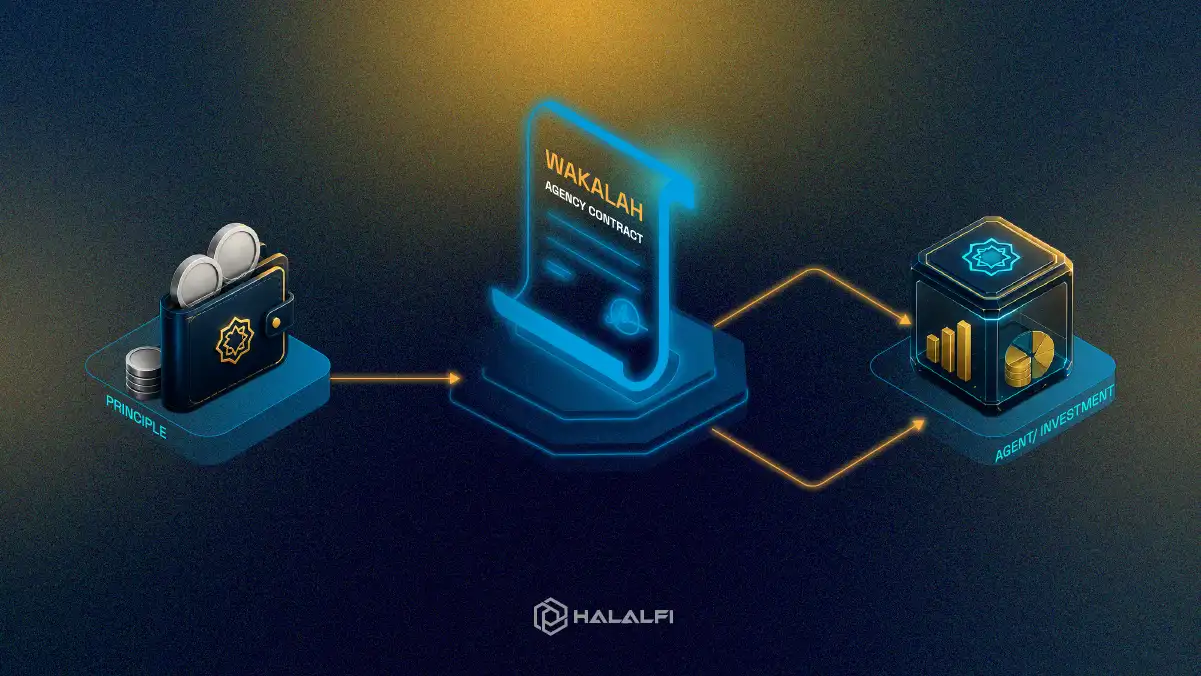
What happens when an investor has capital but lacks the time, access, or expertise to manage it?
Wakalah answers. One party appoints another to complete a defined task. The agent may purchase an asset, manage an investment, collect payments, arrange a trade, or administer a takaful fund.
This guide explains the contract, examines sukuk wakalah, and shows how its agency logic relates to a project-based funding model.
What Is Wakalah in Islamic Finance?
A halal investment may use wakalah when an investor appoints a qualified person or institution to act on their behalf.
Still, it is important to understand the associated risks and limitations. The investor becomes the muwakkil, or principal, while the appointed wakil acts as the agent, with the scope and responsibilities clearly defined to ensure compliance with Sharia principles.
Bank Negara Malaysia offers a definition:
“Wakalah refers to a contract where a party, as principal, authorizes another party as his agent.”
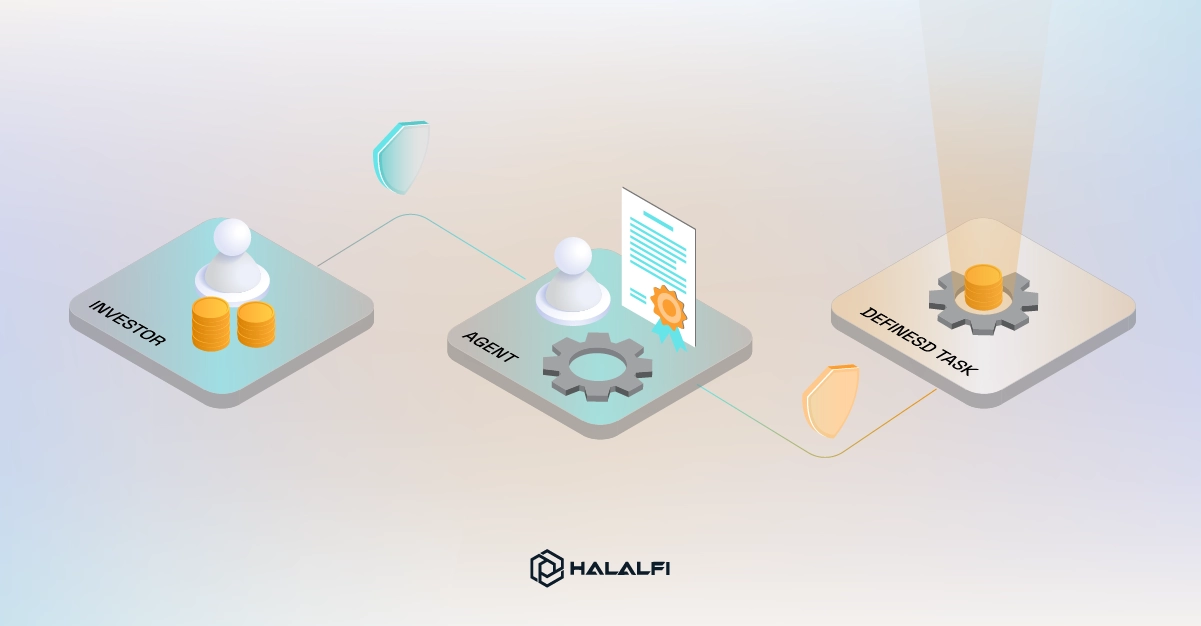
The principal does not transfer complete freedom. The agent receives authority for an agreed task.
That task may involve buying goods, investing within a stated mandate, collecting a debt, signing documents, or managing a financial service.
The contract may carry a fee or operate without one, but proper structuring ensures compliance and reduces risks within lawful boundaries.
Parts of a Wakalah Contract
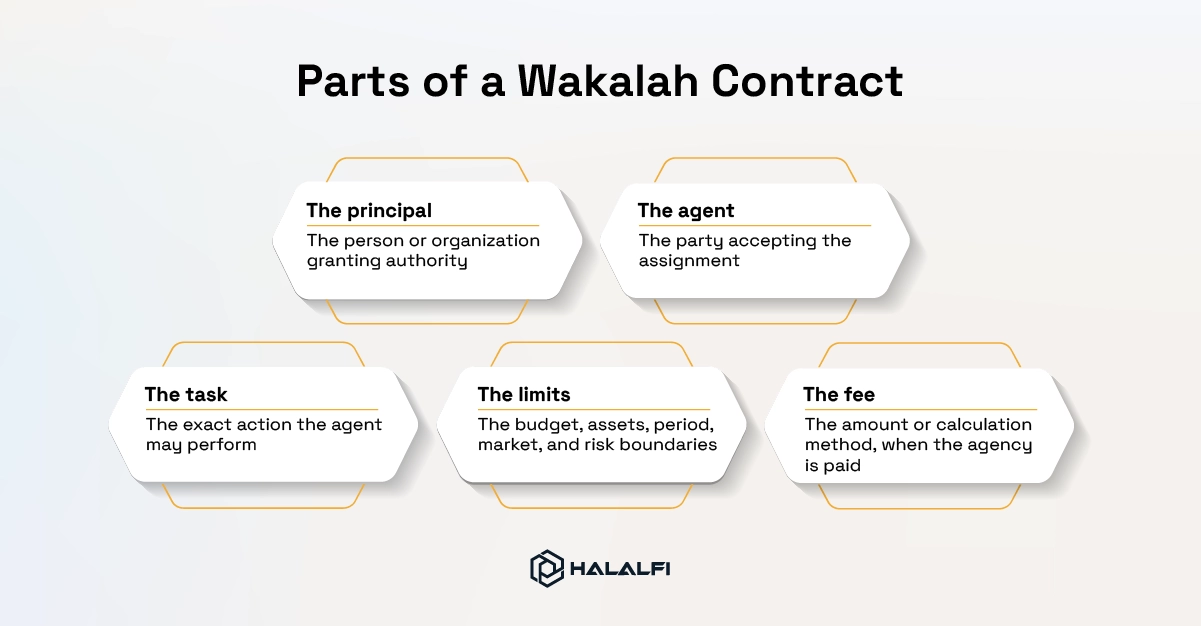
A good agreement should identify:
The principal: The person or organization granting authority
The agent: The party accepting the assignment
The task: The exact action the agent may perform
The limits: The budget, assets, period, market, and risk boundaries
The fee: The amount or calculation method, when the agency is paid
Is Wakalah Halal?
Yes. Wakalah is generally halal when the task, authority, fee, and conduct follow Sharia principles.
The agent must act within the mandate and protect the principal’s interests. The agent must not quietly exceed the agreed budget, enter prohibited investments, or keep an unauthorized benefit.
According to Trowers, Jonathan Grosvenor, Partner, and Lilli Sutherland, Senior Associate at Trowers & Hamlins, say:
“Any profits and losses are to be borne by the muwakkil.”
The contract can become problematic when:
The task remains vague or legally impossible
The agent acts outside the approved mandate
The fee remains hidden or uncertain
A loan charge appears under the name of an agency fee
The agent guarantees an investment return without a valid basis
The structure funds a prohibited activity
One party hides a conflict of interest
The agent normally does not carry ordinary commercial loss simply because an investment underperforms. The principal owns the invested capital and bears the investment risk.
Liability changes when the agent commits misconduct, acts negligently, or breaches the contract.
What Is Wakalah in Islamic Banking?
In Islamic finance, banks use wakalah whenever a customer needs the institution to act as an agent to complete a financial task, making it essential to evaluate the fairness and transparency of associated fees.
That task may involve investing funds, buying an asset, arranging payments, collecting receivables, managing takaful contributions, or executing part of another Sharia contract.
Some banking applications include:
Application | Principal | Agent | Agent’s task |
Investment account | Customer | Islamic bank | Invest under an agreed mandate |
Trade finance | Customer or bank | Other contracting party | Purchase, inspect, or deliver goods |
Murabaha arrangement | Bank | Customer | Buy a specified asset for the bank |
Takaful | Participants | Takaful operator | Manage underwriting and the fund |
Payment service | Customer | Bank | Transfer or collect money |
Sukuk wakalah | Certificate holders | Wakeel | Manage the sukuk asset portfolio |
What Is Wakalah Bi Al-Istithmar?
Wakalah bi al-istithmar means investment agency. An investor gives capital to an agent and defines an investment mandate.
The mandate may specify permitted sectors, asset types, currencies, duration, target risk, geographic limits, and Sharia requirements.
The agent then invests the money within those boundaries.
A bank may state an expected rate of return to help the customer evaluate the opportunity. That rate remains an expectation, not a debt that the agent must pay regardless of performance.
The agent cannot normally guarantee either the capital or the investment return. An independent third party may provide a separate guarantee under applicable conditions, but the agent cannot use such an arrangement to eliminate ordinary investment risk.
The Role of Wakalah Fees in Islamic Finance
A wakalah fee, or ujrah, compensates the agent for completing the authorized task, but it is important to assess whether the fee is justified by the actual services rendered.
The fee should be transparent, agreed upon upfront, and directly related to specific work such as research, execution, or administration, helping readers recognize legitimate charges.
It does not represent interest on the principal’s money. The fee pays for work such as research, execution, administration, asset management, reporting, document handling, or payment collection.
When Does a Wakalah Fee Become Questionable?
A service fee needs a genuine service behind it. Suppose a provider transfers $10,000 as a cash loan and charges an annual “wakalah fee” of 8% for as long as the debt remains unpaid. Renaming the increase does not change its economic purpose.
The fee becomes concerning when it:
Grows only because time passes on a debt
Pays for no identifiable agency service
Remains unknown when the contract begins
Changes without an agreed method
Rewards the agent for breaking the mandate
Duplicates another hidden charge
Inside Sukuk Wakalah: How Investors Earn Through Islamic Structures
Sukuk wakalah uses an agency structure to manage a portfolio of Sharia-compliant assets, services, or investment activities.
Investors purchase sukuk certificates. A trustee or special-purpose vehicle holds the relevant rights on their behalf.
The certificate holders appoint a wakeel to invest the proceeds and manage the portfolio under an agreed plan.
A good structure follows these steps:
Investors subscribe to sukuk certificates.
The issuer or trustee receives the proceeds.
The trustee appoints a wakeel.
The wakeel acquires or manages approved assets.
Portfolio income funds periodic distributions.
The assets follow an agreed sale or liquidation process at maturity.
The portfolio may combine leases, sales, services, or other eligible assets. The offering documents should explain what investors own, how distributions are made, what the wakeel may do, and what happens in the event of underperformance or default.
Wakalah vs. Other Islamic Finance Contracts
Wakalah appoints an agent. Other contracts create different economic relationships. Let’s see a comparison:
Contract | Main relationship | Source of payment | Who usually carries business loss? |
Wakalah | Principal and agent | Agreed service or performance fee | Principal, unless the agent causes loss through breach |
Musharakah | Capital-contributing partners | Share of actual profit | Partners according to capital shares |
Mudarabah | Capital provider and manager | Agreed share of actual profit | Capital provider, absent manager misconduct |
Murabaha | Seller and buyer | Disclosed sale markup | Seller carries ownership risk before sale |
Ijarah | Owner and lessee | Rent for use of an asset | Owner carries ownership-related risks |
Kafalah | Guarantor and beneficiary | Guarantee arrangement | Guarantor assumes the covered obligation |
Qard | Lender and borrower | No contractual profit | Borrower must return an equivalent amount |
What Can Go Wrong in a Wakalah Contract?
The greatest risk often comes from a vague mandate. “Invest the money responsibly” gives the agent little direction.
“Invest only in screened trade projects, with no single exposure above 20% and quarterly reporting” creates measurable boundaries.
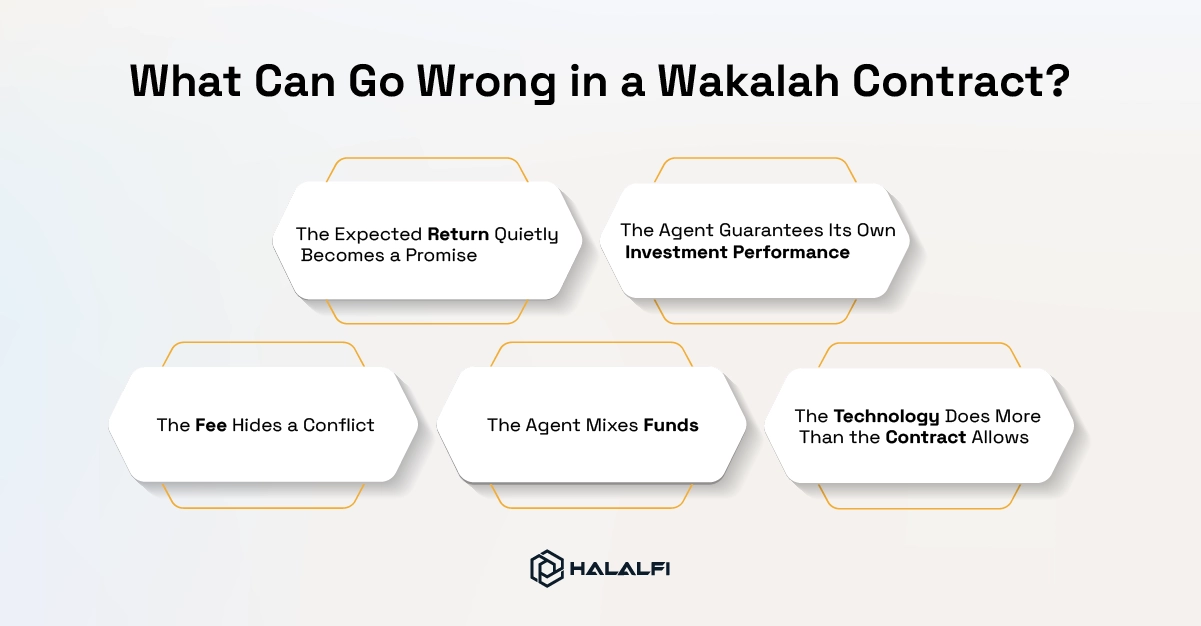
Other problems include:
The Expected Return Quietly Becomes a Promise: Marketing may display a target so consistently that customers treat it as guaranteed. The contract should state what happens when actual profit falls below the forecast.
The Agent Guarantees Its Own Investment Performance: The investment agent must not guarantee capital or return. It may become liable when misconduct, negligence, or a breach of contract causes loss.
The Fee Hides a Conflict: An agent may select an affiliated supplier, broker, or asset manager without explaining the relationship. The principal should know who receives each material payment.
The Agent Mixes Funds: A pooled investment can make it difficult to identify which assets belong to which mandate.
The Technology Does More Than the Contract Allows: A smart contract may execute automatically, but automation does not excuse an unauthorized transaction. Code should reflect the legal and Sharia mandate, not expand it.
How HalalFi Applies Wakalah-Like Agency Logic
In HalalFi, not every listed opportunity uses a pure wakalah contract. Each project can follow its own Sharia-reviewed commercial structure.
Still, the platform performs several agency-like functions. It reviews project information, coordinates funding, records contributions, manages smart-contract processes, and distributes funds in accordance with stated project rules.
Businesses submit projects for trade, sourcing, production, or distribution. HalalFi conducts commercial and Sharia reviews before listing them.
Investors then choose a specific opportunity and contribute USDT through the crowdfunding platform.
The return does not come from a fixed fee for lending USDT. The funded business must produce commercial profit.
Give the Agent a Mandate, Not a Blank Check
Wakalah allows people and institutions to act through specialists without surrendering accountability.
The principal chooses the task and carries legitimate investment risk. The agent follows the mandate, earns an agreed fee, and answers for negligence or breach.
Sukuk wakalah extends this logic to large portfolios, while Islamic banks apply it across investment, trade, payments, and takaful.
HalalFi brings parts of this agency discipline into project-based digital funding. It gives investors a defined business to review, records USDT activity on-chain, and separates project profit from third-party Principal Protection.
Visit the HalalFi Platform and open one project. Read the commercial purpose, fees, smart-contract process, guarantee status, and source of profit before considering the forecast.
A trustworthy agent should make the transaction easier to understand, not harder.
Frequently Asked Questions
Can a wakalah agent appoint another agent?
Yes, when the principal authorizes a sub-agency or the contract permits it.
Can the principal cancel a wakalah contract at any time?
It depends on the agreement. A paid agency may become binding, particularly after work starts or when cancellation would harm a party or affect third-party rights.
Does the agent own assets purchased under wakalah?
Normally, the agent purchases or holds them for the principal.
Can a wakalah fee change after the work begins?
Only under an agreed method or a new mutual agreement. An agent should not impose an unexpected fee after accepting the task.
Is the expected profit rate in wakalah the same as interest?
No. An expected rate forecasts what a Sharia-compliant investment may produce.
Who pays zakat on a wakalah investment account?
The answer depends on ownership, the underlying assets, local rules, and the account terms. The principal often remains responsible because the agent manages the assets on the principal’s behalf.