
What happens when you search halal investment Canada and discover that a TFSA can hold a Shariah-screened ETF, while the GIC sitting beside it may fail the same religious test?
That odd contrast sums up halal investing in Canada rather well. The country gives investors excellent tax accounts and deep access to global markets.
Yet anyone avoiding riba still has to look more carefully at what sits inside those accounts, how it earns money and who checks its Shariah compliance.
This guide compares halal investment options in Canada, from Canadian ETFs and real estate finance to sukuk and project-based investments.
What makes an investment halal in Canada?
Canada counted 1.78 million Muslims in 2021, or 4.9% of the population. With a median age of 30, demand for retirement, homeownership, and long-term investing is growing.
For halal investment, Canadian investors consider both the company's business and its finances. Shariah screens exclude prohibited sectors and assess debt and non-permissible income.
Wealthsimple’s WSHR also removes companies that earn more than 5% from restricted activities or have excessive leverage.
Ratings Intelligence Partners reviews the fund's Shariah compliance. That leads to a useful rule for halal investing for beginners: separate the account from the investment.
A TFSA holds halal shares or a conventional interest-bearing product. The tax wrapper does not decide Shariah compliance; what the money owns inside that wrapper does.

What is the best halal investment in Canada in 2026?
There is no winner. For a long-term investor who wants convenience, a diversified Shariah-screened ETF can make a strong core holding.
Someone seeking income may consider sukuk or halal real estate finance. An experienced investor may add individual stocks or private business projects.
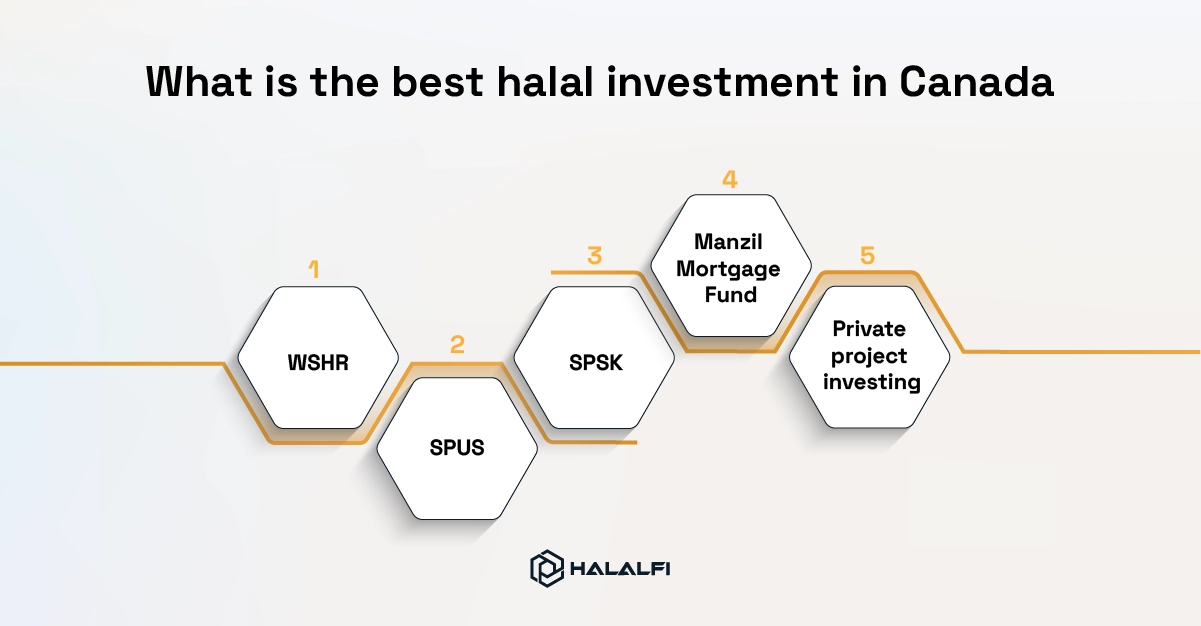
The goal should decide the product, not the other way around. Let's see the best halal investment options in Canada in 2026 below:
Option | What drives the return | Current detail | Best suited to |
WSHR | Global Shariah-screened equities | 0.50% management fee; trades in CAD | Investors wanting one Canadian-listed equity fund |
SPUS | Shariah-screened U.S. equities | 0.45% expense ratio | Investors seeking heavier U.S. exposure and accepting USD currency exposure |
SPSK | Global sukuk | 0.50% expense ratio; 4.59% 30-day SEC yield at July 31, 2026 | Investors seeking a non-conventional-bond income component |
Manzil Mortgage Fund | Canadian residential financing | Website reports 5.49% annualized return for its latest 12-month period | Investors seeking real-estate-linked income |
Private project investing | Profit from a specific commercial activity | Terms, duration and risk vary by project | Experienced investors comfortable with less liquidity |
But here is something important: Best for what? Money needed for a home in 2 years should not be subject to the same risk as money intended for retirement in 30 years.
Halal Investment Funds that Make Sense for Canadian Investors
Canadian investors can now choose from several halal funds instead of building portfolios stock by stock.
Wealthsimple’s WSHR offers diversified exposure to developed markets, with most holdings outside Canada, and publishes dividend-purification information.
The Global Iman Fund offers another Canadian option, though its 2026 Series F MER of 1.71% is higher than that of many ETFs. Investors can also access U.S.-listed funds such as SPUS and HLAL.
HLAL tracks the FTSE Shariah USA Index and charges a 0.50% expense ratio. The main comparison points are fees, geographic exposure, Shariah screening methods, and account accessibility.
A TFSA helps a halal portfolio do more.
Canada's registered accounts give Islamic finance and investment in Canada an advantage that investors should not ignore. Shariah compliance does not remove ordinary tax planning.
The 2026 TFSA dollar limit is C$7,000. Unused room can be carried forward, and withdrawals normally return to the contribution room in the following calendar year.
Investors should always check their personal room rather than assuming the annual limit equals what they can contribute.
An FHSA starts with C$8,000 of contribution room in the first year it's opened and carries a C$40,000 lifetime contribution limit. First-home withdrawals can receive favorable tax treatment.
The 2026 RRSP dollar ceiling reaches C$33,810, although each person's actual room depends on income, unused room and pension adjustments.
Account | 2026 headline limit | Where it can fit |
TFSA | C$7,000 new annual room | Long-term halal ETFs, qualifying securities |
RRSP | Up to C$33,810, subject to personal room | Retirement-focused Shariah investments |
FHSA | C$8,000 annual participation room | First-home savings invested in qualifying halal assets |
For official limits, you can check the Canada Revenue Agency's TFSA.
Why halal income investing gets harder than buying stocks
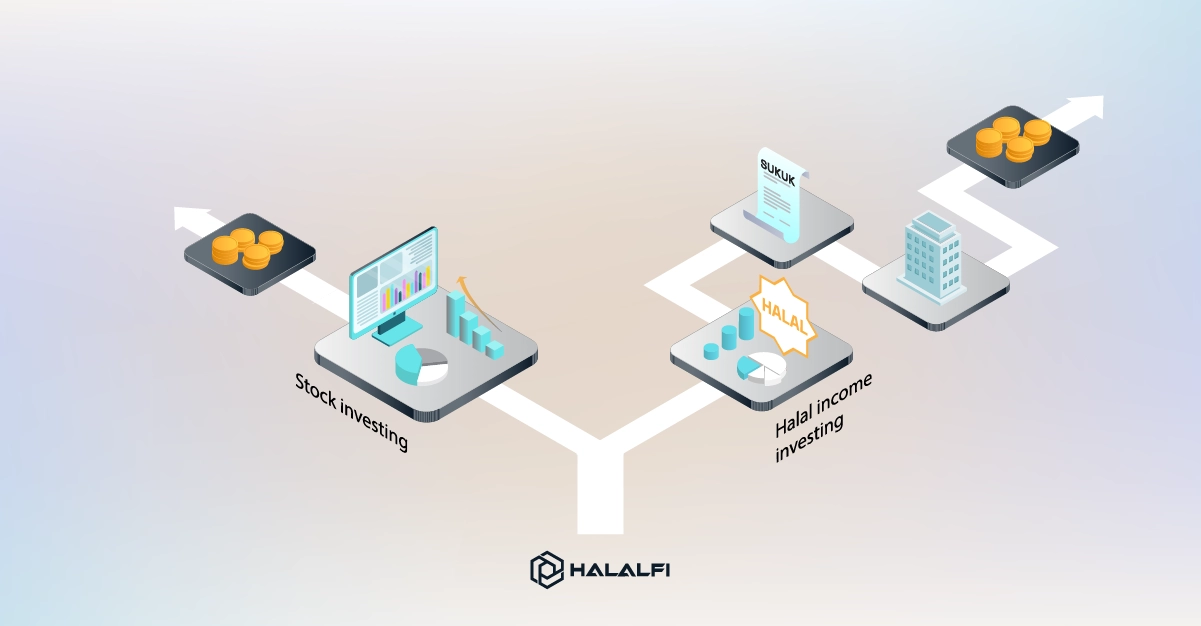
Income-focused halal investing can be harder in Canada because conventional bonds and GICs rely on interest.
Sukuk offer an alternative by linking returns to assets or permitted commercial arrangements rather than traditional interest-bearing debt.
Canadian investors can access this market through products such as the U.S.-listed SPSK ETF, although currency and fund risks still apply.
Real estate provides another route. The Manzil Mortgage Fund finances Canadian residential property through Musharakah and Murabaha structures.
It shows about C$101.8 million in residential assets and C$55.4 million in its mortgage portfolio, but investors should verify these provider-reported numbers in the fund's current documents.
Can a fixed profit still be halal in Canada?
Sometimes, depending on the contract, it is not just for Canada. Around the world, a fixed profit in a genuine Murabaha sale does not automatically constitute interest.
AAOIFI's Murabaha standard states that the sale price and the institution's profit must be fixed and known at the time the parties sign the contract. The profit comes from a sale transaction rather than lending cash for interest.
That logic does not mean an investment manager can simply rename guaranteed interest as “profit.” Partnership structures such as Mudarabah work differently because actual business performance drives returns.
Halal investing moves from stock tickers to real businesses with HalalFi
Canadian investors can already access Shariah-screened ETFs, funds, sukuk, and Islamic real estate products. HalalFi uses direct funding of specific halal business projects.
Through HalalFi projects, investors can use USDT to fund reviewed commercial projects rather than buying shares in a broad fund.
Each opportunity goes through Shariah and business checks, while smart contracts record funding and settlement on-chain.
One current IT storage project has reached its 104,000 USDT target and forecasts a 7.2% profit over four months, although that return is not guaranteed. Some projects may also include collateral or guarantor arrangements.
If you are exploring halal investment in Canada, HalalFi can therefore provide access to project-based opportunities alongside more traditional funds, sukuk and property investments.
Conclusion
Halal investment in Canada does not mean choosing between idle cash and a handful of individual stocks.
Investors now compare Canadian-listed Shariah ETFs, managed funds, sukuk exposure, real estate financing, and project-based opportunities.
The better portfolio usually does not chase one answer to “what pays the most?” It gives different jobs to different investments and keeps the source of every return understandable.
HalalFi offers an interesting option for investors who want to shift from public-market screens to funding identifiable commercial projects.
If that fits the risk budget, explore its current opportunities, review the smart contract and guarantee terms, and follow the documentation. That is a healthier reason to click Invest than excitement alone.
Frequently Asked Questions
What are the best halal investment options in Canada?
Canadian investors can choose from Shariah-screened ETFs, halal mutual funds, sukuk funds, real estate investments, and selected private business opportunities.
Can halal investments be held inside a TFSA in Canada?
Yes. A TFSA can hold eligible Shariah-compliant investments such as certain ETFs, stocks, and funds. The TFSA itself does not determine whether an investment is halal.
Are there halal investment funds available in Canada?
Yes. Canadian investors can access funds such as the Wealthsimple Shariah World Equity Index ETF and the Global Iman Fund. They can also buy eligible U.S.-listed Shariah ETFs through Canadian brokerages, although currency conversion, fees and tax treatment deserve attention.
How can beginners get started with halal investing in Canada?
A beginner can start by choosing a registered account, such as a TFSA or RRSP, and then selecting a diversified Shariah-screened fund that matches their investment horizon.
Are halal investments in Canada completely free from interest?
Not always in the strictest sense. Many Shariah-screened funds allow companies that meet defined financial-ratio limits rather than requiring zero debt or zero interest income.
Is halal real-estate investment available in Canada?
Yes. Canadian investors can access Shariah-structured real-estate and mortgage investments through providers that use contracts such as Murabaha or Musharaka.
Can Canadians invest in international halal investment platforms?
Potentially, yes, but Canadian residents should first check provincial securities rules, tax treatment, currency or crypto exposure, and whether the platform accepts Canadian investors.