
Crowdfunding is a method of raising capital by gathering small contributions from a large number of people, typically through online platforms, to fund a project, business, or idea collectively.
Crowdfunding isn’t a monolithic activity; there are many models, each with its own triumphs and disasters. Let's see donation, reward, equity, lending, crypto, and Islamic (halal) crowdfunding examples, including success stories and cautionary tales in each category.
Donation‑based crowdfunding examples
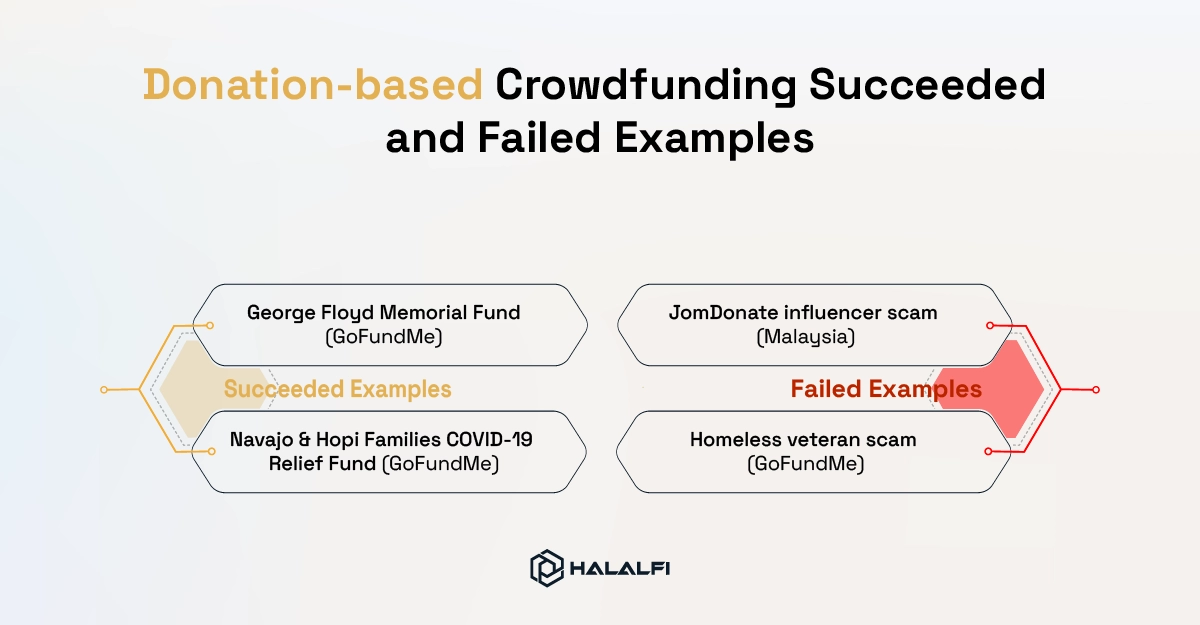
Here are Success stories about Donation‑based crowdfunding based on a Newsweek report:
George Floyd Memorial Fund (GoFundMe): In 2020, a fundraiser created by George Floyd’s family after his death set a GoFundMe record. It collected about US$14.7 million from more than 500,000 donors in 140 countries. The campaign far exceeded its initial goal and became a rallying point for protests against police brutality.
Navajo & Hopi Families COVID‑19 Relief Fund (GoFundMe): During the pandemic, volunteer organizers launched a fund to supply food, water, and PPE to Native American communities. The campaign raised US$7.5 million, delivering essentials to Navajo and Hopi families and highlighting the power of donations to support marginalized groups.
Here are Failure stories about Donation‑based crowdfunding:
JomDonate influencer scam (Malaysia): An Islamic donation platform, JomDonate, was misused by an influencer couple who diverted RM740 000 (~US$170 k) from a charity fund. Academics note that the scandal eroded trust in donation crowdfunding because the organizers misled donors about where the money would go.
Homeless veteran scam (GoFundMe): A feel‑good story about a homeless veteran giving a stranded woman his last $20 went viral. Prosecutors alleged that the veteran and the couple who launched the campaign conspired to deceive donors and spent the US$400,000 they raised on luxury items and casino trips. GoFundMe refunded donors and emphasized that misused campaigns account for less than 0.1% of all fundraisers. The case demonstrated how easily fraudsters can exploit emotional stories to gain donors' trust and raise money.
Reward‑based crowdfunding examples
Here are success stories about Reward-based crowdfunding:
Pebble Time smartwatch: When Pebble launched its color e‑ink smartwatch on Kickstarter in 2015, it became a phenomenon. Over 778,741backers pledged US$20.3 million, forcing the small company to organize mass production and proving that crowdfunded gadgets could compete with big brands.
Exploding Kittens card game: A whimsical card game from Matthew Inman and former Xbox designers went viral. According to The Guardian, this campaign asked for US$ 10k but ended with US$8.8 million from 219,382 backers, making it the third-biggest campaign on the platform and the one with the most backers at the time.
Here are failure stories about Reward-based crowdfunding:
Zano drone: European start‑up Torquing Group promised a tiny autonomous drone and raised about £2.3 million on Kickstarter. An independent review commissioned by Kickstarter found that the company over‑promised, lacked the engineering expertise to deliver, and squandered money on marketing. Most backers never received a drone.
Coolest Cooler: This “ultimate cooler” raised more than €13 million on Kickstarter but ran into manufacturing delays and mismanagement. Five years later, the company still had not delivered coolers to many backers, even while it sold the product on Amazon for €99. This failure led critics to label the campaign one of crowdfunding's biggest disasters.
Equity‑based crowdfunding examples
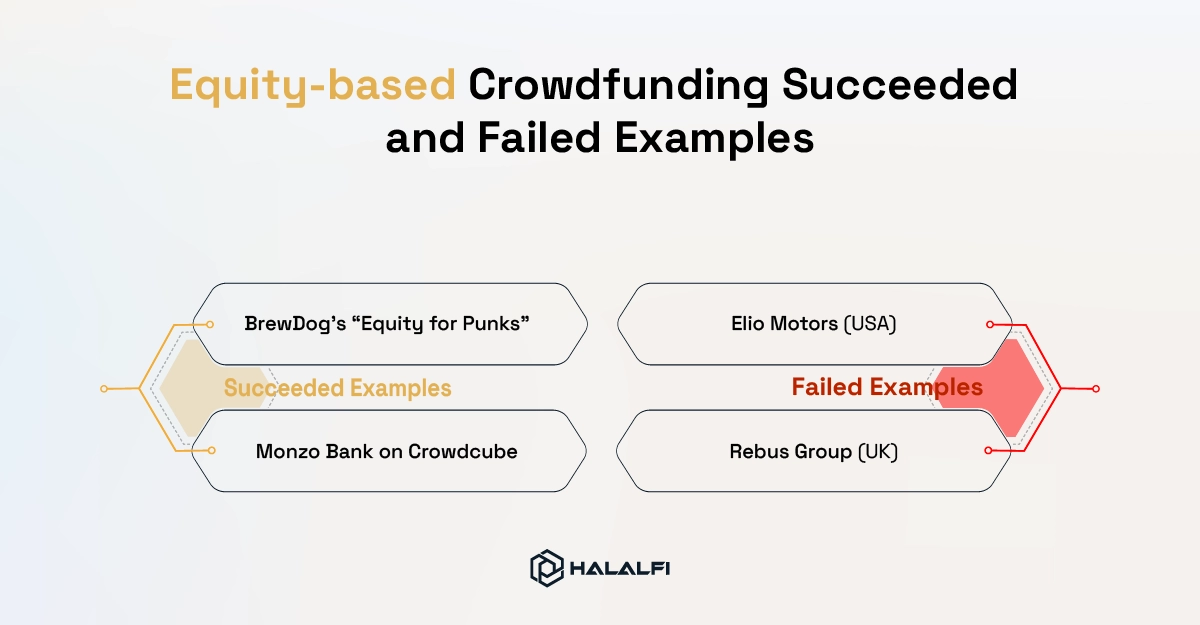
Here are success stories about Equity‑based crowdfunding:
BrewDog’s “Equity for Punks”: Scottish craft brewer BrewDog pioneered equity crowdfunding. Its first round in 2009 raised £1.26 million from 1,300 investors, and later rounds in 2011, 2013, and 2015 pulled in £2.2 million, £4.25 million,n and £19 million, respectively. The 2017 “Equity for Punks V” campaign capped off the series by raising £26.2 million from 94,000 investors. These campaigns not only funded expansion but also built a loyal community of shareholders.
Monzo Bank on Crowdcube: Crowdfundinglawyers shows that in 2016, the British app‑based bank Monzo opened a small equity round on Crowdcube, allowing customers to own a stake in the company. Within 96 seconds, it raised £1 million from 1,861 investors, selling 3.33% of the company. The lightning‑fast round illustrated how eager everyday investors were to support fintech innovations.
Here are failure stories about Equity‑based crowdfunding:
Elio Motors (USA): Automotive start‑up Elio Motors used Regulation A crowdfunding to raise roughly US$16 million from more than 66,600investors. Despite collecting deposits from 65,000 customers, the company never delivered a functioning three-wheel car, accumulated heavy debt, and repeatedly delayed production, leaving investors with nearly worthless shares.
Rebus Group (UK): Claims‑management firm Rebus raised over £ 800,000 from 109 investors through Crowdcube. Within a year,r it went into administration. Investigations revealed that the company had already engaged restructuring advisers before the fundraising, but did not disclose this to investors. The collapse wiped out investors’ funds and prompted calls for greater due diligence.
Lending‑based crowdfunding (peer‑to‑peer lending)
Here are success stories about Lending‑based crowdfunding:
Funding Circle (UK): Since its launch in 2010, Funding Circle has facilitated more than £15 billion in loans to small businesses. It is listed on the London Stock Exchange, demonstrating how well-regulated P2P lending can complement traditional banking.
LendingClub (USA): For several years, LendingClub was a poster child for P2P lending, matching individual lenders with borrowers. While a later scandal erupted (see below), early success saw the platform originate billions of dollars in personal loans and become the first P2P lender to go public in the United States.
Here are failure stories about Lending‑based crowdfunding:
China’s P2P crash: Roughly two-thirds of China’s 3,500 P2P lending platforms either collapsed or defrauded investors. Many operators ran Ponzi schemes that wiped out billions of yuan in investor funds. The carnage led regulators to effectively shut down the industry.
LendingClub scandal: In 2016, an internal probe found that LendingClub had sold US$22 million in loans to an investor who did not want them. Founder Renaud Laplanche resigned, and shares plunged 35 %, shaking confidence in the entire P2P sector. The scandal underscored governance risks in lending platforms.
Crypto crowdfunding examples (initial coin offerings and token sales)
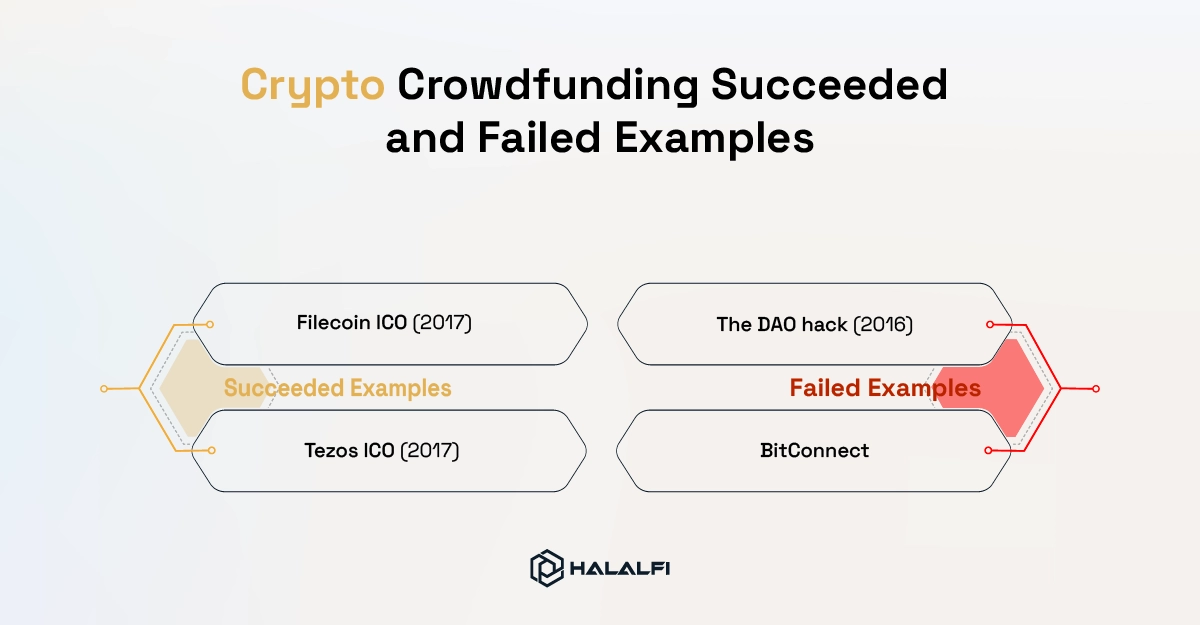
Here are success stories about crypto crowdfunding:
Filecoin ICO (2017): The decentralized storage network ran a record‑breaking token sale. The public ICO raised about US$205.8 million and, combined with a presale, the total reached more than US$257 million, surpassing all previous token sales. The project later launched a functioning network, demonstrating that some ICOs can fund real infrastructure.
Tezos ICO (2017): According to Coindesk, Tezos offered a self‑amending blockchain, and its ICO collected 65,6277 BTC and 361,122 ETH, worth roughly US$232 million at the time, making it another record‑setting fundraiser. Though governance disputes slowed progress, the network ultimately went live.
Here are failure stories about crypto crowdfunding:
The DAO hack (2016): One of the earliest and most hyped decentralized organizations, The DAO, raised about US$150 million in ether but was vulnerable. Attackers siphoned tens of millions of dollars’ worth of ether, causing the price of Ethereum to plunge and forcing developers to hard‑fork the blockchain. The incident exposed security risks inherent in a smart‑contract crowdfunding platform.
BitConnect: Marketed as a crypto‑lending investment, BitConnect amassed about US$2.4 billion from investors worldwide. The U.S. Department of Justice later identified BitConnect as a Ponzi scheme that used money from new investors to pay earlier participants before collapsing within a year. Its collapse highlighted the risks of unregulated crypto investments.
Islamic (halal) crowdfunding examples
Islamic crowdfunding follows Sharia principles: no interest (riba), no funding of prohibited industries, and transactions based on real assets. The sector mirrors the broader market’s successes and setbacks.
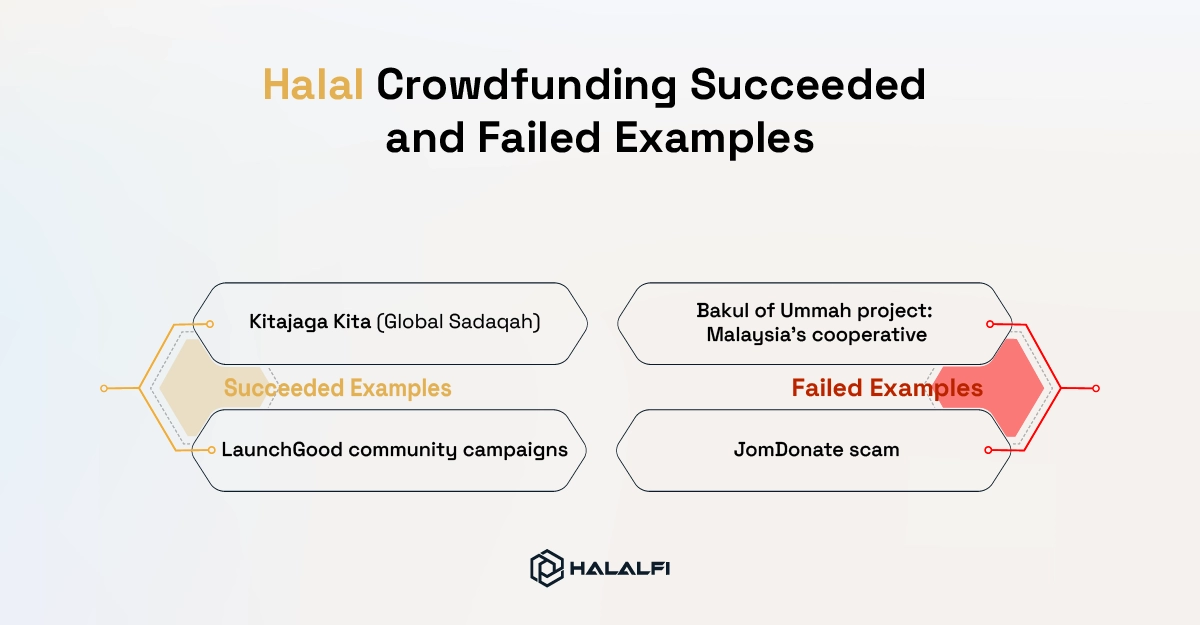
Here are success stories about halal crowdfunding:
Kitajaga Kita (Global Sadaqah): During Malaysia’s COVID‑19 crisis, the charity platform Global Sadaqah launched the “Kitajaga Kita” campaign to provide food and essential items to affected families. The drive raised almost RM100 000 in two weeks, showing how Islamic donation campaigns can mobilize quickly for humanitarian relief.
LaunchGood community campaigns: LaunchGood, a Muslim‑focused crowdfunding campaign, has hosted numerous record‑breaking campaigns. For example, it raised more than US$100 000 to rebuild burned African‑American churches and over US$200 000 to support the victims of the Pittsburgh synagogue shooting. These campaigns demonstrate cross‑community solidarity and the platform’s global reach.
Here are failure stories about halal crowdfunding:
Bakul of Ummah project: According to RSIS International, Malaysia’s cooperative KOJUSA launched the “Bakul of Ummah” initiative to fund food packages for needy families. The campaign aimed for RM20 000 but attracted only about RM6 000. Lack of promotion and trust were cited as reasons for the poor response, highlighting the need for marketing even within charitable communities.
JomDonate scam: The misuse of RM740 000 on the JomDonate platform by influencers shocked the Malaysian Muslim community and tarnished the reputation of Islamic crowdfunding types.
Success & Failure Factors in Crowdfunding
What makes crowdfunding succeed or fail?
Clear and realistic planning builds trust and credibility
Strong storytelling attracts emotional and financial support
Transparent use of funds reduces the risk of backlash
Poor execution or delays lead to project failure
Overpromising without delivery destroys investor confidence
Lack of communication kills community trust fast
Final thoughts
These stories show a pattern: heartfelt narratives and clear value propositions inspire people to give or invest, but the absence of transparency, oversight, or expertise can quickly lead to disaster.
Donation platforms thrive on trust; reward‑based campaigns succeed when creators understand the manufacturing process; equity crowdfunding rewards both companies and investors only when business fundamentals are sound; P2P lenders need robust regulation; and crypto tokens require mature security and governance.
Islamic crowdfunding adds an extra layer of ethical screening, but still faces the same human pitfalls of misuse and poor execution.
HalalFi is a platform that upholds Islamic principles while drawing lessons from across the crowdfunding types. HalalFi tries to ensure that the mistakes of the past do not taint the next generation of crowdfunding success stories.
Frequently Asked Questions
Which crowdfunding example raised the most money?
The George Floyd Memorial Fund on GoFundMe raised around $14.7 million, making it one of the largest donation-based crowdfunding campaigns ever.
Why is the Pebble Time campaign considered a crowdfunding success?
Pebble Time didn't just raise over $20 million on Kickstarter; it also proved that a small startup could compete with major tech brands by building a loyal community before launching a product.
What went wrong with the Coolest Cooler campaign?
Although it raised more than $13 million, the company struggled with production and fulfillment costs. Many backers waited years for rewards, and some never received them at all.
Why is the Zano drone often cited as a crowdfunding failure?
The creators promised advanced features they couldn't realistically deliver. After raising millions, the project collapsed, leaving many backers without the product they funded.
Did any crypto crowdfunding projects actually succeed?
Yes. Filecoin and Tezos are two notable examples. Both raised hundreds of millions of dollars through token sales and eventually launched functioning blockchain networks.
What is the most famous crypto crowdfunding failure?
Many experts point to The DAO. It raised around $150 million but was hacked due to a smart-contract vulnerability, leading to one of the biggest crises in blockchain history.
What can investors learn from the Rebus Group collapse?
The case shows the importance of due diligence. Rebus raised money from the crowd despite serious financial problems and entered administration shortly afterward.