
A simple idea turns into a fully funded business without a bank loan. But how? Crowdfunding helps you.
In the now-digital economy, crowdfunding isn’t just for raising money; it’s for building trust, testing ideas, and creating a loyal audience from day one. So, crowdfunding types are more than a trend.
If you want to know how crowdfunding works or decide which model suits your business, this guide has everything you need. And if you’re looking for ethical, Shariah-compliant options, we’ll also touch on halal crowdfunding and how platforms like HalalFi are shaping the future of this space.
What Is Crowdfunding?
Crowdfunding is simple. It’s raising money from a large group of people, often online, rather than relying on a few investors or banks.
In this system, instead of pitching to a single venture capitalist, you present your idea to hundreds or even thousands of individuals. Each contributes a small amount, and together, they fund your vision.
Crowdfunding doesn't just find your product; it proves people actually want it. It’s validation.

Types of Crowdfunding; Practical Examples
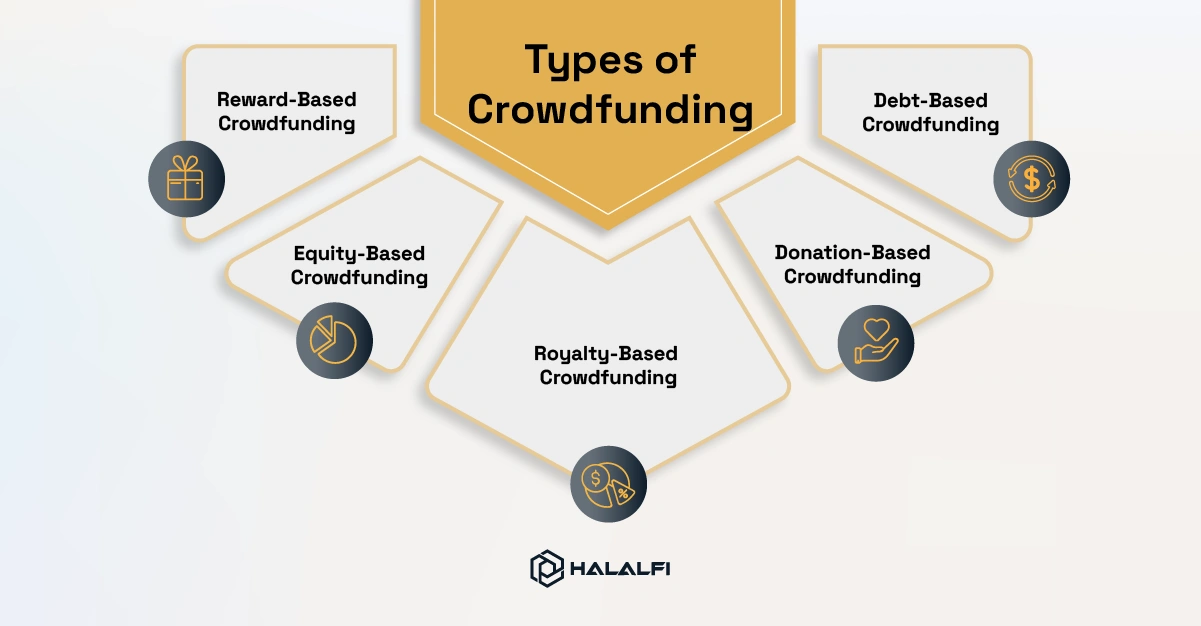
We explained the advantages and disadvantages of crowdfunding completely before. But crowdfunding has different types, and each has its own pros and cons. So let’s look at the four main crowdfunding types and how they actually work.
1. Reward-Based Crowdfunding
This is the most recognisable form of crowdfunding. In the model, you offer a product or service in return for funding. Here, backers pledge money and receive a reward, often the product itself.
Think of a startup launching a smart gadget. Early supporters get the product at a discounted price.
Pros
No ownership loss
Acts as pre-sales
Builds community
Validates demand
Cons
All-or-nothing funding risk
Delivery challenges
Idea exposure
Platform fees
You can see campaigns fail not because the idea is bad, but because logistics were underestimated.
According to Kickstarter, this company aimed to raise US$100,000 but ended up collecting more than US$10 million from nearly 69,000 backers. It became one of the campaigns that helped popularise modern crowdfunding globally.
Kickstarter reported that its Games category alone attracted US$270 million in pledges during 2024, with the platform’s community surpassing 23 million backers overall.
2. Equity-Based Crowdfunding
Here, investors get shares in your company, and Backers invest money and receive equity.
Pros
Larger funding potential
Long-term investor relationships
Access to expertise
Cons
Loss of ownership
Legal complexity
Reporting requirements
Pressure for returns
Equity crowdfunding feels like getting 50 advisors overnight, but also 50 people expecting results.
One notable example is Revolut, which used equity crowdfunding during its earlier growth stages. Thousands of retail investors joined before the fintech giant reached its multi-billion-dollar valuation.
The market itself has grown rapidly. According to CommunityCapital, European equity crowdfunding campaigns raised around €280 million in 2025 across 354 public campaigns involving more than 68,500 investors. The average campaign size reached €789,000.
3. Debt-Based Crowdfunding
It is also known as peer-to-peer lending. But the question is: how does crowdfunding work in this model? This is simple; here, you borrow money and repay it with interest.
Pros
Full ownership retention
Faster than banks
Fixed repayment plan
Cons
Requirement to repay
Interest costs
Credit risk
Possible collateral
This model works well for businesses with predictable revenue.
IMARC Group estimated the global peer-to-peer lending market reached roughly US$279.4 billion in 2025 and projected annual growth above 20% through 2034.
Also, Grand View Research estimated the peer-to-peer lending segment generated around US$1.2 billion in revenue in 2024 and could nearly quadruple by 2030.
4. Donation-Based Crowdfunding
This one is driven by purpose, not profit. Here, people donate without expecting financial returns.
Pros
No repayment
Ideal for social causes
Strong emotional connection
Cons
Limited scalability
No guaranteed funding
Platform fees
According to Wikipedia, the largest example globally is GoFundMe, which has become synonymous with medical fundraisers, disaster relief, and emergency support campaigns.
5. Royalty-Based Crowdfunding
Royalty-based crowdfunding is a lesser-known but increasingly interesting model. Instead of receiving shares or fixed interest payments, investors earn a percentage of the project's future revenue or profits.
Here, supporters fund a business, product, film, music album, or intellectual property project and later receive ongoing royalties tied to sales performance.
Industry analysts describe royalty crowdfunding as a hybrid between reward-based and equity crowdfunding because investors participate in business success without becoming shareholders.
The model is common in:
Music and film projects
Intellectual property and patents
Mobile apps and digital products: Creative industries with recurring revenue
According to Happenplace, one example would be an independent musician raising US$50,000 for an album while promising investors 15% of streaming and sales revenue for the next five years. As the album earns money, investors receive periodic royalty payments.
Pros
No ownership dilution
Flexible repayments tied to revenue
Attractive for creative industries
Investors benefit directly from commercial success
Cons
Revenue sharing reduces future margins
Earnings for investors are unpredictable
Complex contractual structures
Works best for businesses with stable sales potential
Many founders like this model because it keeps them in control of the company. But there’s a point; if revenue suddenly takes off, royalty payouts will become expensive over time.
A startup may avoid losing equity today, only to realise later that sharing long-term revenue was not as cheap as it first looked.
Comparison of Crowdfunding Types
In the table below, we will compare Crowdfunding Types:
Type | Return to Backers | Risk Level | Best For | Ideal Funding Size | Risk for Founders | Investor Expectation |
Reward-Based | Product or service rewards | Medium | Product launches, creative projects, gadgets | Low to Medium (US$5K–US$500K) | Production delays, fulfilment costs, and public failure risk | Early access to products and project success |
Equity-Based | Company shares | High | High-growth startups and scalable businesses | Medium to High (US$100K–Millions) | Ownership dilution, legal obligations, and investor pressure | Long-term business growth and capital gains |
Debt-Based | Interest repayments | Medium | Stable businesses with predictable cash flow | Medium to High (US$10K–US$1M+) | Loan repayment pressure and possible default risk | Fixed returns through interest payments |
Donation-Based | No financial return | Low | Charities, medical campaigns, nonprofits, social causes | Low to Medium (US$1K–US$250K) | Unpredictable funding and campaign visibility challenges | Emotional satisfaction and social impact |
Royalty-Based | Percentage of future revenue or profits | Medium to High | Creative industries, media, music, IP-based businesses | Medium to High (US$20K–US$2M) | Long-term revenue sharing can reduce profitability | Ongoing royalty income tied to project performance |
How to Choose the Right Crowdfunding Type
Choosing between these crowdfunding types isn’t always obvious. It depends on your goals.
Ask Yourself:
What’s the nature of your business?
How much funding do you need?
Do you want to keep full ownership?
Can you deliver rewards or repay loans?
For example:
If you have a tech gadget, Reward-based is a good option.
If you're scaling SaaS, Equity-based is a better one.
If you have a stable retail business, choose Debt-based.
If you found a charity, you can choose Donation-based.
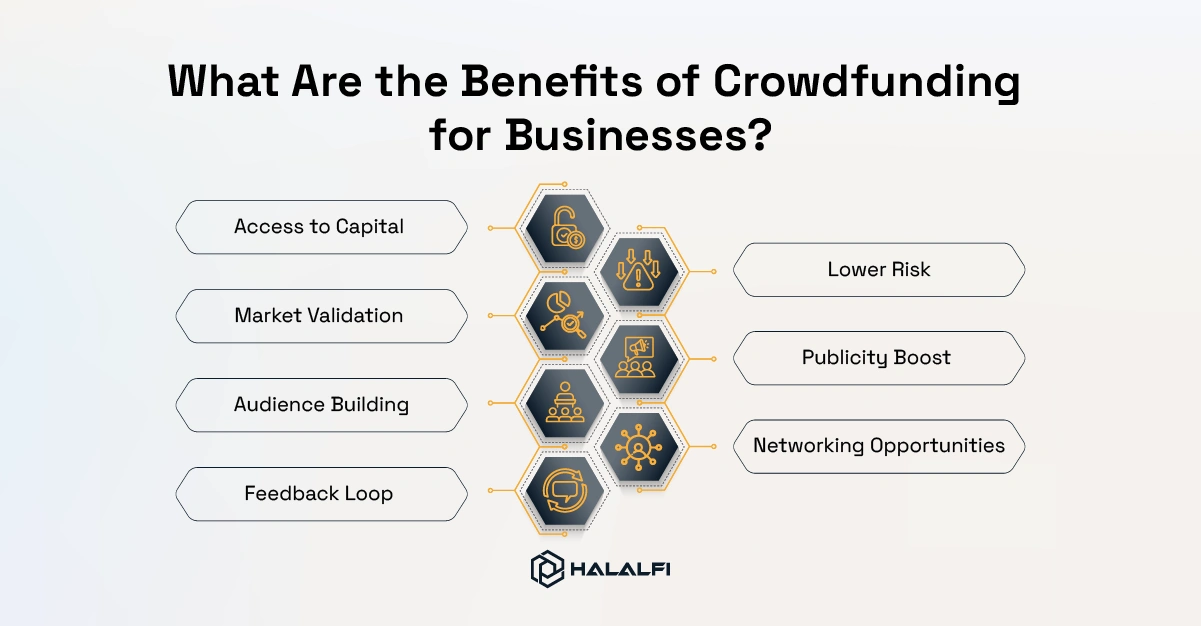
What Are the Benefits of Crowdfunding for Businesses?
Now you know crowdfunding types, so let’s talk about why so many founders choose this path.
Access to Capital: Startups often struggle with traditional funding. Crowdfunding opens doors that banks might close.
Market Validation: If people invest, your idea has demand. Simple as that.
Audience Building: Backers become early adopters, and often your loudest promoters.
Feedback Loop: You get real-time insights before launching.
Lower Risk: No equity loss (in some models) and no debt obligations (in others).
Publicity Boost: A successful campaign can generate serious buzz.
Networking Opportunities: Investors, partners, and even media attention can follow.
According to a report by the World Bank:
“Crowdfunding has the potential to democratize finance globally.”
Crypto Crowdfunding: A New Frontier
Let’s not ignore the elephant in the room: crypto crowdfunding.
This model uses blockchain technology to raise funds. It’s fast, borderless, and increasingly popular among startups seeking alternative financing options.
In many cases, projects can attract global investors within hours, rather than spending months pitching traditional VCs.
But crypto markets are volatile, and regulations still vary wildly from one country to another. A campaign that looks promising today can face legal or financial uncertainty tomorrow.
There are also concerns around scams, weak compliance standards, and investor protection. Some projects disappear overnight, while others struggle to meet evolving regulatory requirements. That’s why transparency and proper due diligence matter more than ever.
Even so, many startups are now experimenting with hybrid models that combine crypto fundraising with traditional crowdfunding strategies, seeking the speed of blockchain without completely sacrificing stability or trust.

Crowdfunding in Muslim Markets & Halal Finance
Here’s something interesting. Crowdfunding is growing fast in Muslim-majority countries.
Malaysia has become a leader in Islamic fintech
UAE and Saudi Arabia are investing heavily in startups
Pakistan is seeing rising digital funding platforms
This is where halal crowdfunding comes in on platforms like HalalFi. It follows Islamic finance principles: no interest, ethical investments, and transparency.
Which Crowdfunding Type Is HalalFi?
If you’re looking for halal investment options, HalalFi offers a modern platform aligned with Shariah values that bridges innovation and ethics.
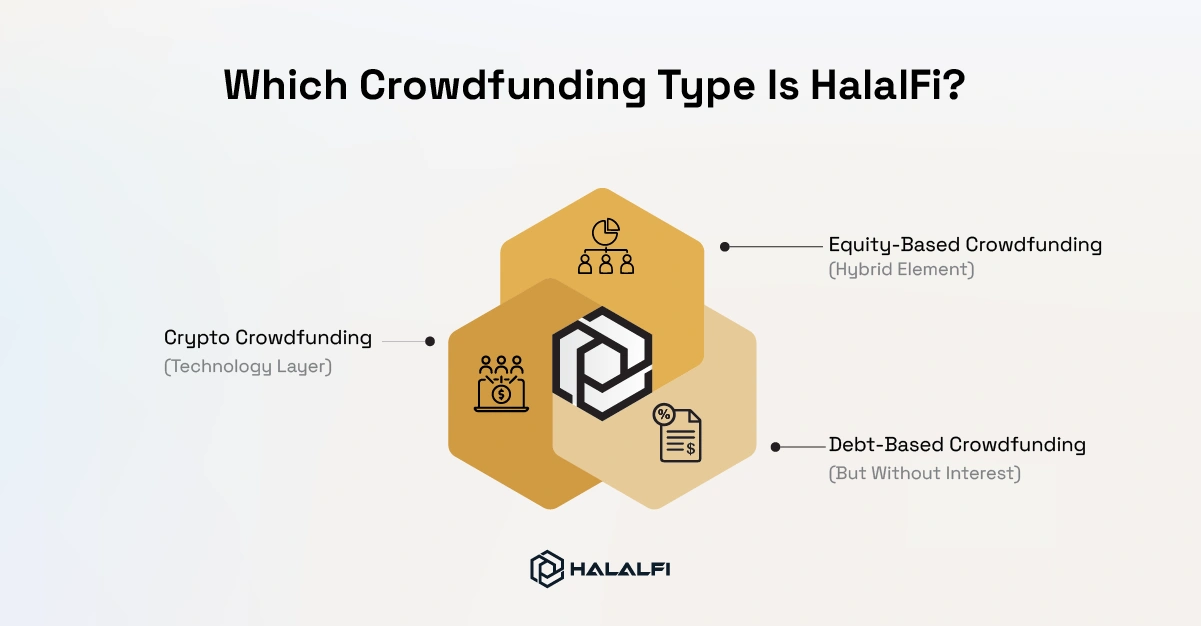
But HalalFi doesn’t fit neatly into any single traditional crowdfunding type. It actually combines elements from multiple models:
1. Equity-Based Crowdfunding (Hybrid Element)
Like equity crowdfunding, HalalFi allows investors to participate in a business’s success.
But instead of shares, it uses profit-sharing agreements rooted in Islamic finance (similar to Mudarabah or Musharakah structures).
The similarity is participation in business performance, and the difference is the absence of ownership dilution in the traditional sense.
2. Debt-Based Crowdfunding (But Without Interest)
HalalFi replaces interest-based lending with profit-based returns.
The traditional model works based on fixed interest payments, but the HalalFi model works based on Variable, performance-driven returns.
So while it resembles debt crowdfunding structurally, it avoids riba in Islamic finance, making it compliant with Islamic finance.
3. Crypto Crowdfunding (Technology Layer)
HalalFi uses blockchain and smart contracts. So it has Transparent transactions, Automated agreements and DAO-based governance.
This places it within the crypto crowdfunding category, but with a strong ethical filter.
If we want to summarise, HalalFi is best described as:
A hybrid halal crowdfunding model combining equity-style profit-sharing and blockchain-based transparency.
Conclusion
Crowdfunding isn’t just a funding tool; it’s a launchpad. It helps you test ideas, build a community, and grow with real support behind you.
In this article, we explained the types of crowdfunding. Whether you choose reward-based, equity, debt, or donation models, understanding these crowdfunding types is the first step toward making smarter financial decisions.
Besides, if you’re looking for a more ethical, transparent way to raise funds, especially aligned with Islamic values, platforms like HalalFi offer a powerful alternative.
Ready to fund your idea the right way? See our document and start building something people truly believe in.
Frequently Asked Questions
Which crowdfunding type is best for a startup with no revenue yet?
For early-stage startups, reward-based crowdfunding is often the most practical choice. It allows founders to validate demand and generate pre-sales without giving up equity or taking on debt. If your idea resonates, backers essentially become your first customers, which is incredibly valuable.
How do I decide between equity and debt crowdfunding?
It comes down to control and risk. Equity crowdfunding is better if you’re comfortable sharing ownership and want long-term investors. Debt crowdfunding works if you prefer to retain full ownership and are confident you can repay the loan with interest.
Which crowdfunding type is best for keeping full ownership of a business?
If maintaining complete ownership matters to you, reward-based or donation-based crowdfunding is usually the best option. Debt-based crowdfunding can also work, since you repay the funds rather than giving away shares. Equity crowdfunding, on the other hand, requires giving investors a stake in your company.
Which crowdfunding type raises the largest amount of capital?
Equity-based crowdfunding generally offers the highest fundraising potential because investors are buying into the company's future success. Startups with strong growth potential often prefer this model when they need substantial capital for expansion.
Which crowdfunding type is the safest for new entrepreneurs?
Reward-based crowdfunding is often considered the safest starting point for beginners. Founders can test demand, build an audience, and raise funds without taking on debt or giving up ownership. However, success still depends on strong marketing, realistic funding goals, and timely delivery of rewards.
Are hybrid models like halal or crypto crowdfunding worth considering?
Yes, especially if values or transparency matter to you. These newer models combine technology and ethical frameworks, offering alternatives to traditional approaches while still supporting real business growth.