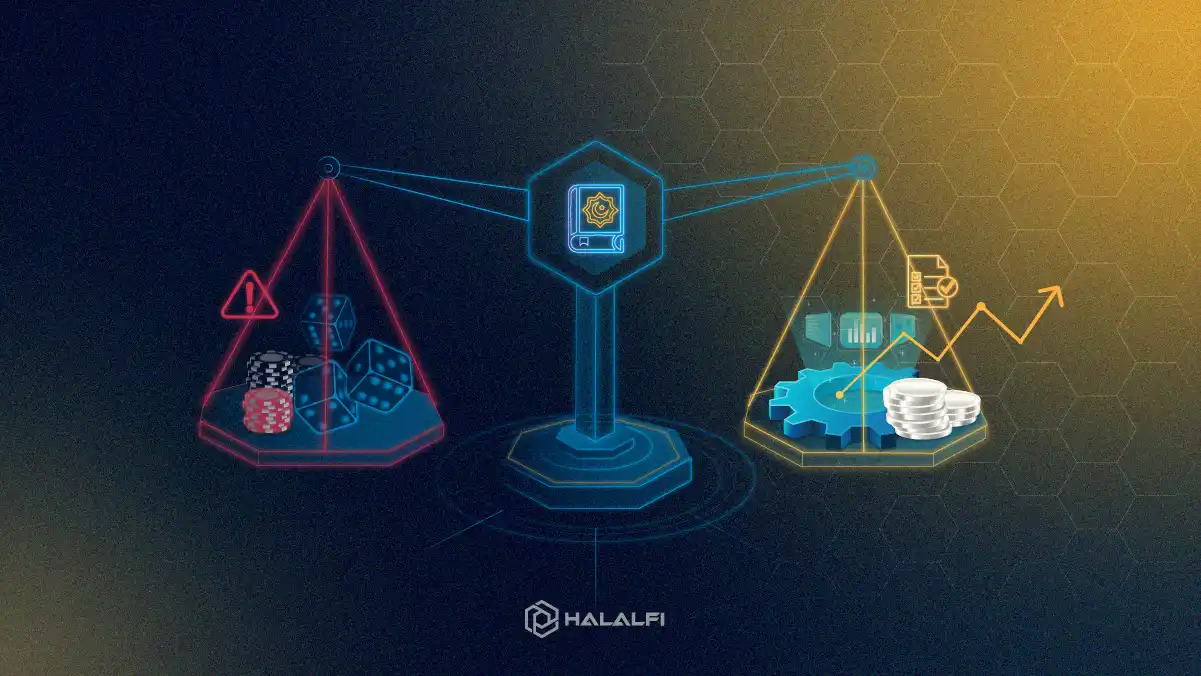
Do you think that some investments feel more like a casino game than a real wealth-building opportunity? That is about understanding maysir in Islamic finance.
People can buy speculative crypto tokens in seconds, join prize-based finance apps, or trade leveraged assets from their phones.
Some of these activities look modern and harmless. But under Islamic law, many fall into the category of maysir, earning money by chance rather than through productive effort.
Many people understand that gambling in casinos is prohibited. Still, fewer recognise how gambling-like structures appear inside modern investing, trading apps, insurance products, and digital finance platforms.
In this guide, we explain the meaning of maysir, why it is prohibited, how it appears in modern finance, and how investors can protect themselves through Sharia-compliant finance practices. If you want to build halal wealth, this article will help you.
What Is Maysir in Islam?
The Arabic term maysir (مَيْسِر) refers to acquiring wealth through chance without fair effort, productive contribution, or legitimate exchange.
Actually, one person gains because another loses, and the outcome depends mainly on luck.
For example, if People would contribute money to a pooled game involving arrows. One winner would receive everything, while the others lost their contributions. No productive work happened, and no real economic value was created. Wealth shifted hands randomly.
That is the meaning of maysir in Islamic finance.
Under sharia law in finance, transactions must be fair, transparent, and involve shared responsibility. Islam allows business risk, investment, and trade. But it prohibits systems in which money changes hands solely due to unpredictable outcomes.

Why Is Maysir Forbidden in Islamic Finance?
The prohibition of maysir is deeply rooted in the Qur’an and Prophetic teachings.
In Surah Al-Baqarah (2:219), Allah acknowledges that gambling may contain some temporary benefit, but its harms outweigh its benefits. It says:
«...قُلْ فِيهِمَا إِثْمٌ كَبِيرٌ وَمَنَافِعُ لِلنَّاسِ وَإِثْمُهُمَا أَكْبَرُ مِنْ نَفْعِهِمَا...»
Later, Surah Al-Ma’idah (5:90–91) places gambling alongside intoxicants and idolatry, describing them as destructive influences that create hatred, division, and distraction from worship. It says:
«يَا أَيُّهَا الَّذِينَ آمَنُوا إِنَّمَا الْخَمْرُ وَالْمَيْسِرُ وَالْأَنْصَابُ وَالْأَزْلَامُ رِجْسٌ مِنْ عَمَلِ الشَّيْطَانِ فَاجْتَنِبُوهُ لَعَلَّكُمْ تُفْلِحُونَ * إِنَّمَا يُرِيدُ الشَّيْطَانُ أَنْ يُوقِعَ بَيْنَكُمُ الْعَدَاوَةَ وَالْبَغْضَاءَ فِي الْخَمْرِ وَالْمَيْسِرِ وَيَصُدَّكُمْ عَنْ ذِكْرِ اللَّهِ وَعَنِ الصَّلَاةِ فَهَلْ أَنْتُمْ مُنْتَهُونَ»
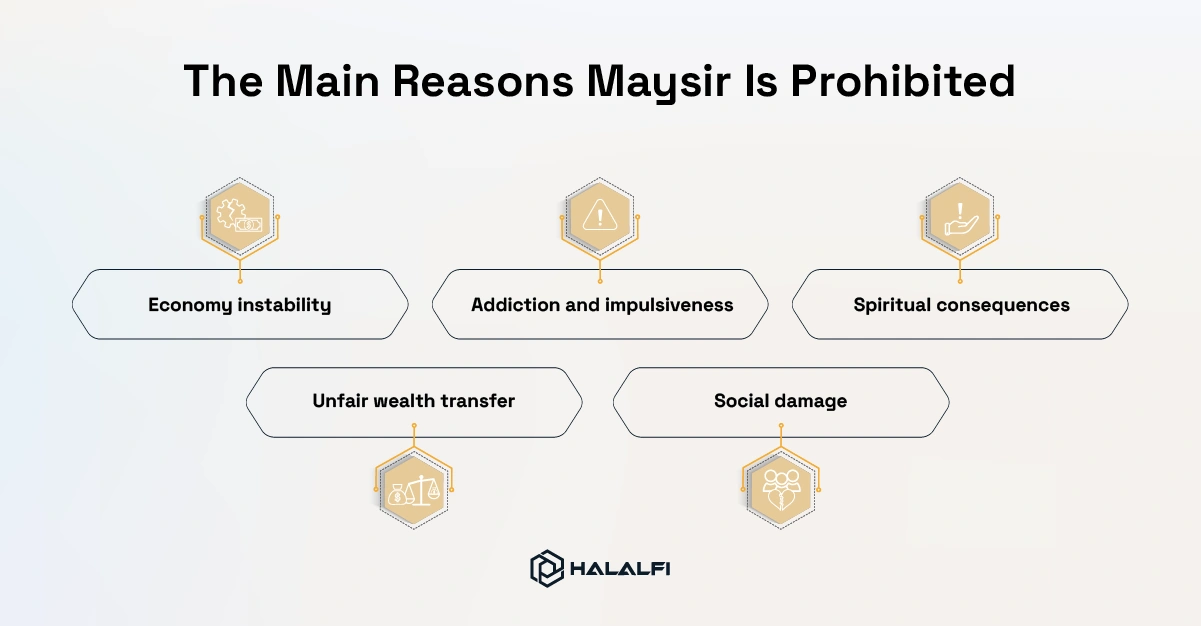
The Main Reasons Maysir Is Prohibited
Here are the reasons that show why Maysir Is Prohibited in Islam and against halal investment:
Economic instability: Chance-based systems destroy wealth. Families lose savings. Debt increases. Financial planning collapses.
Unfair wealth transfer: Maysir creates zero-sum outcomes. One side profits only at the expense of the other.
Addiction and impulsiveness: Gambling structures encourage emotional decision-making rather than disciplined investing.
Social damage: Communities suffer when financial systems encourage greed, manipulation, and exploitation.
Spiritual consequences: Islamic teachings emphasise discipline, patience, and honest work. Gambling shifts focus toward shortcuts and unhealthy attachment to uncertainty.
Signs of Maysir in Modern Finance
If you see the signs, take a moment:
Warning Sign | Why It Is Problematic |
|---|---|
Profit is based purely on luck | No real economic value created |
Extreme speculation | Outcomes depend on unpredictable price swings |
One-sided risk exposure | One party benefits unfairly |
Gamified trading systems | Encourages addictive behavior |
Lack of transparency | Users cannot properly evaluate risks |
In many cases, these structures overlap with the concept of gharar in Islamic finance. That overlap explains why Islamic scholars carefully review financial products before approving them.
This process is often conducted through a shariah audit, in which scholars evaluate contracts, operational structures, and risk exposure to ensure compliance with Islamic finance principles.
The Difference Between Maysir and Gharar
People often confuse maysir and gharar in Islamic finance, but they are not identical.
Here is a comparison:
Maysir | Gharar |
Based on chance | Based on uncertainty |
Gambling-like outcomes | Ambiguous contract terms |
One side wins unfairly | Information is unclear |
Deliberate speculation | Lack of clarity or transparency |
Zero-sum structure | Potential contractual injustice |
For example:
Buying a lottery ticket is maysir.
Selling a product without clear delivery details may involve gharar.
Both are prohibited because Islamic finance prioritises fairness, transparency, and ethical exchange.
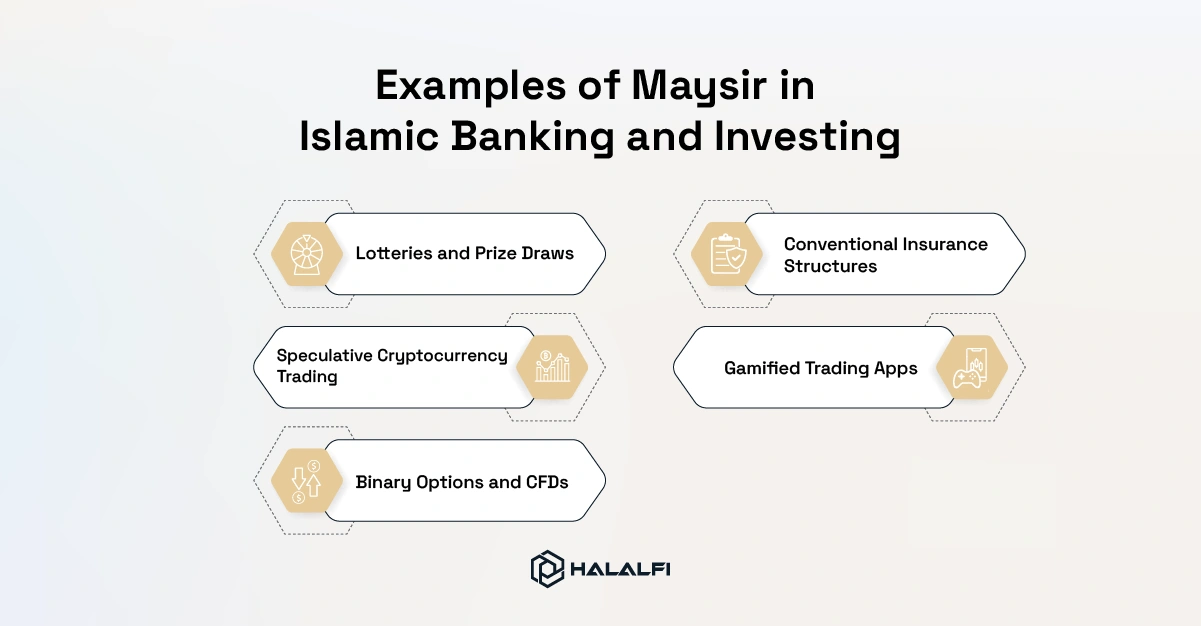
Examples of Maysir in Islamic Banking and Investing
Let's see some examples of Maysir in Islamic Banking and Investing:
1. Lotteries and Prize Draws
This is the clearest example. Participants pay money for a chance to win a larger prize. Most lose, a few win. The outcome depends entirely on luck.
Even modern digital prize systems can become problematic if entry fees indirectly fund rewards.
The Powerball lottery in the United States generates jackpots worth hundreds of millions of dollars, while the overwhelming majority of participants lose their ticket money. The structure is chance-based and is one of the clearest examples of Maysir.
Regulators worldwide warn that lottery-style products can create addictive gambling behaviour and financial harm, especially among lower-income consumers.
The New York Times reported that during the January 2016 Powerball jackpot, ticket sales exploded to over US$1.5 billion as speculative participation surged globally despite infinitesimal odds of winning. Economists later noted that consumers often treated the lottery as a “fantasy investment” rather than entertainment.
Mufti Taqi Usmani classifies lotteries as prohibited Maysir because wealth transfers occur without productive economic activity or fair exchange. He argues that one party’s gain depends on the losses of many others.
2. Speculative Cryptocurrency Trading
Not all cryptocurrency activity is automatically prohibited. But highly speculative token trading often resembles gambling. This is true when people buy hype-driven assets with no underlying utility or economic value.
Many traders openly admit they are “guessing price movement.” That language itself reveals the problem.
According to Binance, the collapse of TerraUSD and LUNA in 2022 wiped out roughly US$40 billion in market value within days. Many retail traders admitted they entered purely because of hype, momentum, and fear of missing out rather than fundamental utility.
The Financial Conduct Authority repeatedly warned consumers that cryptoassets are “high risk and speculative". It cautions that investors should prepare to lose all their money. Similar warnings came from the SEC and ESMA.
Also, the 2021 memecoin boom surrounding Dogecoin showed classic speculative behaviour. Prices surged primarily due to celebrity tweets and online hype rather than intrinsic value or productive use cases.
Sheikh Haitham Al Haddad has argued that highly speculative crypto trading may fall under Maysir when investors are effectively betting on short-term price movements without ownership utility, productive contribution, or genuine economic purpose.
3. Binary Options and CFDs
Contracts for Difference (CFDs) and binary options frequently raise Sharia concerns because traders often speculate on price movement without owning real assets. The transaction becomes closer to wagering than investing.
Binary options platforms became notorious during the 2010s for encouraging retail traders to gamble on minute-by-minute market movements. Many users lost substantial savings through high-leverage speculative bets.
Data reviewed by ESMA showed that the European Securities and Markets Authority prohibited the sale of binary options to retail investors in 2018 and imposed strict restrictions on CFDs due to widespread consumer losses.
Between 74% and 89% of retail CFD accounts lost money. Excessive leverage and speculative short-term trading were identified as major causes.
Mufti Muhammad Abu-Bakar has argued that many CFD and binary-option structures resemble gambling because traders often neither own underlying assets nor engage in genuine investment activity. Instead, the transaction revolves solely around predicting price direction.
4. Conventional Insurance Structures
Certain insurance models may involve uncertainty and disproportionate risk transfer.
This is why Islamic finance developed takaful, a cooperative model based on shared responsibility rather than profit-driven uncertainty.
In takaful, participants collectively support one another rather than entering a zero-sum arrangement.
According to IAIS, Traditional insurance contracts sometimes involve significant uncertainty regarding payout timing, amount, and outcome. Critics in Islamic finance argue that this uncertainty can create elements of Gharar and Maysir.
After the 2008 financial crisis, regulators scrutinised major insurers such as AIG because complex derivatives and risk-transfer structures amplified systemic instability.
The collapse of AIG’s credit default swap exposure demonstrated how excessive risk-transfer mechanisms inside conventional financial structures could destabilise global markets and create disproportionate speculative exposure.
Muhammad Taqi Usmani and the AAOIFI have long argued that cooperative takaful models are preferable because participants share risk among themselves rather than transferring it to a profit-seeking insurer under uncertain conditions.
Trading apps such as Robinhood popularised confetti animations, achievement-style notifications, instant rewards, and push alerts designed to encourage frequent trading activity.
During the 2021 meme-stock frenzy involving GameStop Corp. (GME), millions of retail investors traded aggressively through gamified mobile apps. Behavioural finance researchers later connected frequent app notifications and social reinforcement mechanisms to impulsive decision-making and herd behaviour.
Modern Islamic finance scholars warn that gamified trading transforms investing into entertainment rather than productive capital allocation. Scholars associated with the Islamic Fiqh Academy argue that when trading becomes thrill-seeking speculation driven by psychological stimulation rather than economic analysis, it approaches the definition of Maysir.
Research published in the Journal of Behavioural and Experimental Finance also concluded that gamified trading nudges significantly amplify risk-taking behaviour among inexperienced investors.
5. Gamified Trading Apps
This trend is growing rapidly.
Apps use flashing graphics, reward systems, notifications, and “achievement” mechanics to encourage impulsive trading. A financial tool slowly becomes entertainment.
That shift may sound harmless, but behavioural finance research consistently shows that gamification can increase reckless trading by encouraging more frequent and riskier decisions through features such as leaderboards, badges, push notifications, and reward systems.
Studies by the UK Financial Conduct Authority (FCA) and the Journal of Behavioural and Experimental Finance found that these “digital engagement practices” significantly increase trading frequency and risk-taking, particularly among inexperienced investors.
Real Statistics Showing the Growth of Islamic Finance
The global Islamic finance industry is expanding rapidly across Muslim-majority countries and beyond.
According to KuCoin, the meme-coin market offers another modern example of speculation-driven behaviour associated with Maysir-like concerns.
In 2025 alone, the meme-coin sector lost around 65% of its market value as retail speculation collapsed after the previous hype cycle.
Trading volume also plunged by approximately 72%, showing how quickly emotionally driven markets can evaporate once momentum disappears.
Cornell University reported in 2025, in an academic study analysing nearly 35,000 meme coins across multiple blockchains, that 82.8% of high-return meme tokens showed evidence of artificial growth manipulation, such as wash trading or liquidity-based price inflation.
Researchers identified more than 17,000 victim addresses linked to realised losses exceeding US$9.3 million.
Another large-scale forensic study on Solana meme coins found that fewer than 2% of tokens successfully survived long enough to reach major exchanges, despite massive retail participation.
The speculative nature of these markets becomes even clearer during market crashes.
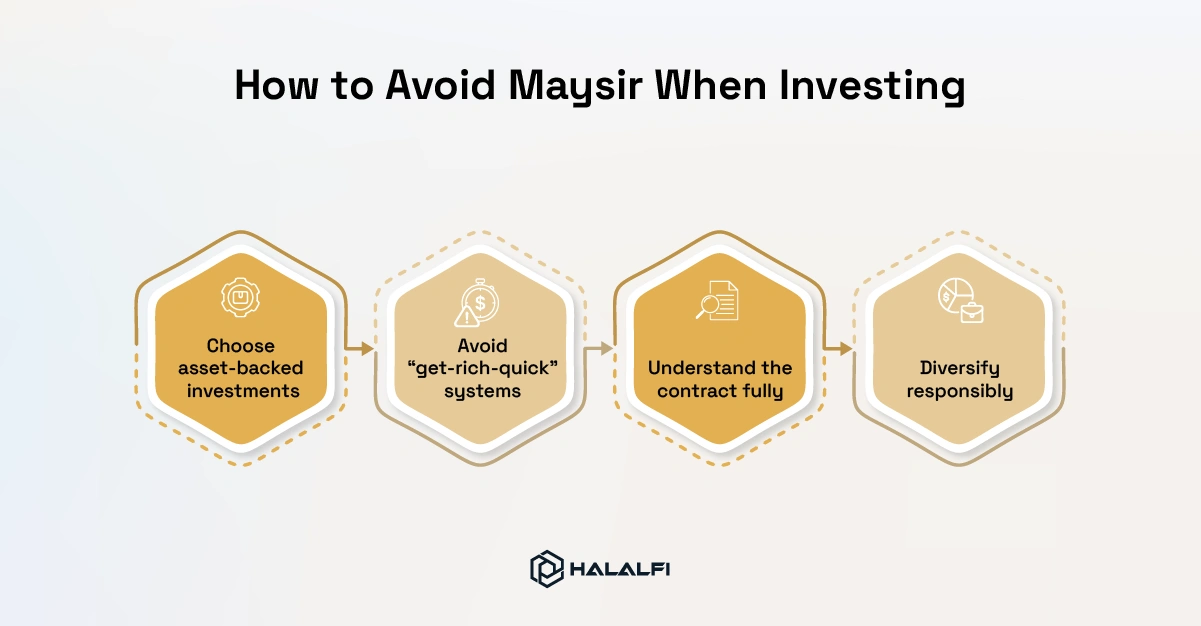
How to Avoid Maysir When Investing
Avoiding maysir involves understanding the structure, intent, and fairness. You should do it like this:
Choose asset-backed investments: Invest in businesses or assets connected to real economic activity.
Avoid “get-rich-quick” systems: If returns depend mainly on unpredictable price swings, be cautious.
Understand the contract fully: Transparency matters in every financial agreement. Use regulated halal investment options. Also, work with providers specialising in Sharia-compliant finance and ethical investment models.
Diversify responsibly: Diversification helps manage risk, though it never removes risk entirely.
Maysir and the Rise of Islamic Fintech
The growth of Islamic fintech is reshaping how Muslims interact with money.
Technology can simplify Halal Investment, but it can also disguise speculative behaviour behind attractive interfaces.
Many modern finance platforms are designed to maximise engagement, not necessarily financial well-being.
That is why ethical screening matters more than ever.
In platforms like HalalFi, the focus is not just on avoiding obvious gambling. The bigger goal is to help users understand the structure of financial products so they can make informed decisions aligned with Islamic finance principles.
How HalalFi Avoids Maysir in Islamic Finance
Maysir is the idea of earning money through pure chance or gambling-like speculation. In Islamic finance, that’s not just discouraged, it’s avoided because wealth should come from real effort, real value, and real economic activity. HalalFi works against that kind of profit driven by uncertainty.
HalalFi avoids maysir by:
Removing the “betting” layer that dominates many modern financial platforms.
You’re investing in actual businesses with real products, real customers, and measurable cash flow.
It doesn’t rely on zero-sum trading environments where one person’s gain is another’s loss.
There’s a heavy focus on audits and transparency in HalalFi. Projects go through Sharia review and business verification before receiving funding.
It uses blockchain and smart contracts, making it harder for hidden, speculative manipulation to sneak in.

Conclusion
Maysir in Islamic finance is a necessity for anyone navigating modern investing, digital assets, online trading, or fintech platforms.
Ethical investment alternatives continue to grow worldwide. Countries like Malaysia, Saudi Arabia, Pakistan, and the UAE are investing heavily in Islamic finance ecosystems designed for accountability and long-term sustainability.
If you want to build wealth while staying aligned with Sharia-compliant finance, now is the right time to learn, ask questions, and choose platforms that prioritise transparency over hype.
So check the HalalFi documentation; it helps investors make smarter, more ethical financial decisions without compromising their values.
Frequently Asked Questions
Can reward points from shopping apps become maysir?
If rewards are guaranteed and not based on random selection or loss to others, they are generally permissible. Problems arise when rewards depend mainly on chance.
Is fantasy sports considered maysir in Islam?
Many scholars consider paid fantasy sports problematic because participants risk money on uncertain outcomes resembling gambling structures.
Are all high-risk investments considered maysir?
No. Islam allows legitimate business risk when tied to real assets, effort, and economic value. Maysir specifically involves chance-based wealth transfer.
Why do Islamic scholars review fintech apps carefully?
Modern apps may hide speculative behaviour behind entertainment features, making gambling-like structures less obvious.
Can non-Muslims benefit from Islamic finance principles?
Yes. Many non-Muslims are attracted to Islamic finance because of its focus on transparency, ethical investment, and responsible risk management.