
What happens when your investment goes down 18% two weeks after you buy it? That moment tells you more about your investing strategies than a year of reading market predictions.
A strategy does not tell you what to buy. It tells you why you bought it, how long you plan to hold it, how much risk you are willing to accept, and what you will do when markets stop cooperating.
This guide compares the main strategies, shows where each one fits, and explains how investors can combine them without turning a portfolio into a collection of random ideas.
What Is an Investing Strategy?
If "what is investing" explains how capital can grow, an investment strategy explains the rules you use to make that happen.
The strategy connects four things:
Your goal
Time horizon
Tolerance for loss
Investment selection.
Think of the strategy as the operating system behind the portfolio. Buying an ETF is an action. Buying it every month for 20 years because you want broad, low-cost exposure is a strategy.

What Are the 4 Main Investment Strategies?
No regulator or investment firm recognizes one universal list of four. Still, four approaches explain much of the way people build equity portfolios. Let’s see investing types in the table below:
Strategy | Basic idea | Typical investor | Weakness |
Passive | Follow a market index | Long-term, lower-maintenance investor | Will not deliberately avoid expensive parts of an index |
Active | Select investments to outperform | Research-heavy investor | Fees and manager mistakes |
Value | Buy assets that appear underpriced | Patient investor | Cheap assets can stay cheap |
Growth | Buy businesses expected to expand quickly | Higher-risk investor | High expectations create sharp downside |
1. Passive Investing
Passive investors track market indexes through funds or ETFs. This strategy requires less effort but tends to follow market declines.
2. Active Investing
Active investors select stocks or funds to outperform the market. It requires regular research and carries higher costs and decision-making risks.
3. Value Investing
Value investors look for stocks trading below their estimated worth. The challenge is identifying genuine bargains rather than struggling businesses.
4. Growth Investing
Growth investors focus on companies with strong expansion potential. Returns can be attractive, but high valuations increase the risk of losses.
How to Choose a Strategy Before Choosing an Investment
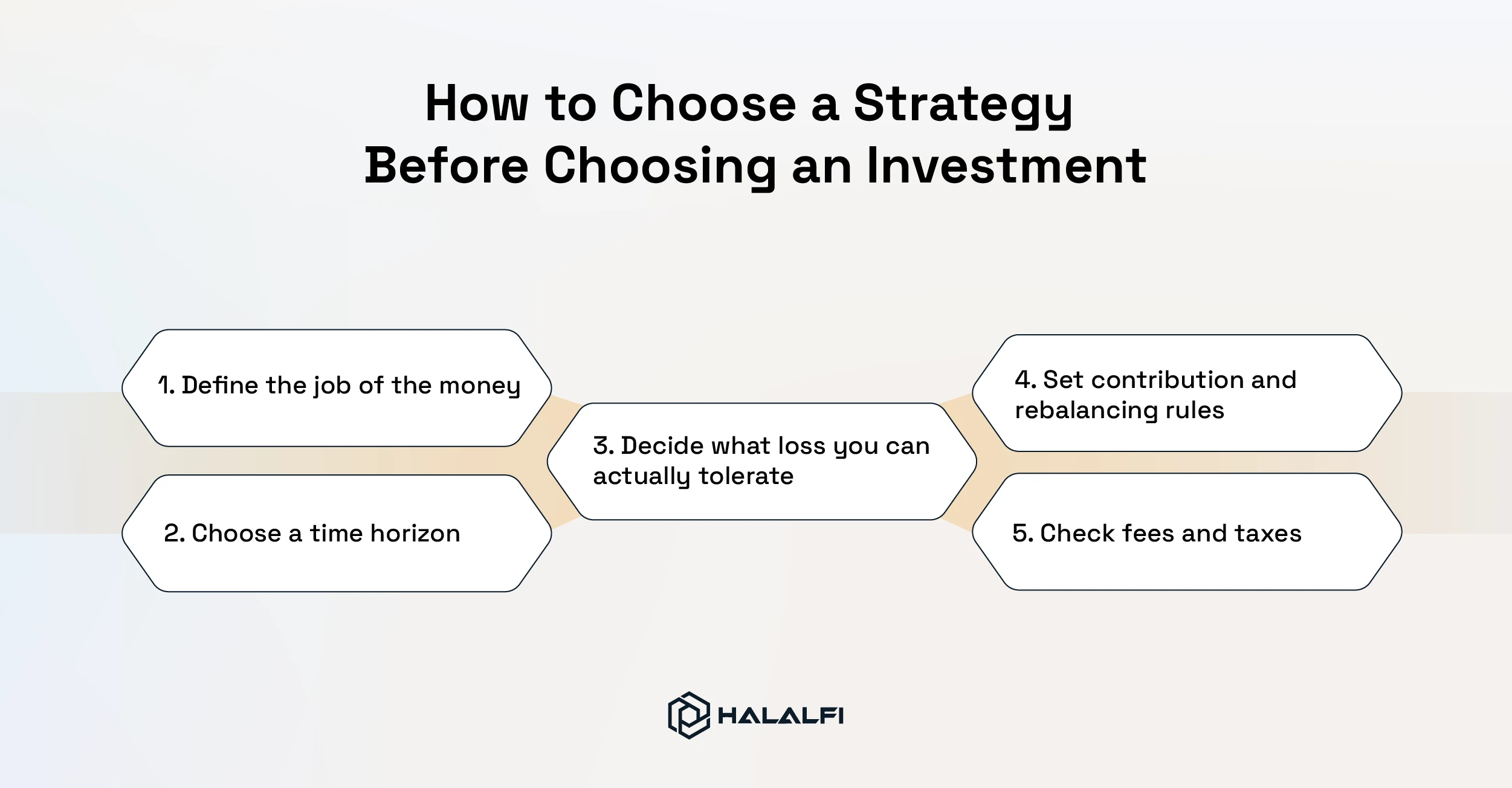
This is how to choose a strategy before investing:
Define the job of the money: Retiring in 2055 requires a different approach from purchasing a house in 2028.
Choose a time horizon: Time can help investors recover from volatility, but it cannot remove risk.
Decide what loss you can actually tolerate: A 30% theoretical decline feels different when real money disappears from the screen.
Set contribution and rebalancing rules: Decide these before headlines test your discipline.
Check fees and taxes: A good idea can become mediocre once costs are factored in.
Investment Strategies for Different Goals and Risk Levels
The right investment strategy depends on your financial goals, timeline, and risk tolerance. Whether you prefer stocks, bonds, crypto, or halal investments, these strategies help you make more informed decisions.
Long-Term Investing Strategies Win by Reducing Decisions
A good long-term investment strategy does not require constant action. Regular contributions, diversification, sensible costs, and periodic rebalancing can do much of the work.
Fidelity notes that investors who maintain a disciplined long-term plan often fare better than people who repeatedly jump in and out of markets.
Imagine someone invests on payday for 15 years. His colleague waits for “better entry points,” moving between cash and stocks whenever the news becomes uncomfortable.
He still suffers market declines. He avoids turning every decline into another prediction contest. Consistency becomes part of the strategy.
A good long-term strategy is to invest a fixed amount monthly in diversified, low-cost funds. Reinvest earnings and rebalance your portfolio annually to stay on track.
Short-Term Investing Strategies
A short-term investment strategy should not chase the returns expected from a 20-year portfolio.
If you need the money in 12 or 24 months, avoiding a major loss may matter more than maximizing upside. Cash equivalents, short-duration bonds or other lower-volatility instruments may fit that job better than concentrated stocks.
Here, investing vs. saving becomes important. Saving protects near-term spending power and liquidity. Investing accepts uncertainty to pursue future growth.
Using volatile investments for a known short-term bill creates a mismatch between the asset and the goal. No clever forecast can repair that basic structural mistake.
You can focus on preserving capital. Choose high-yield savings accounts, money market funds, or short-term bonds that match your investment timeline.
Beginner Investing Strategies
Best investing strategies for beginners reduce complexity rather than promise higher returns. If you are a beginner, do it:
Build emergency savings before risking money you may need next month.
Start with one clear financial goal.
Use broad diversification instead of trying to identify the next superstar stock.
Automate contributions where practical.
Review the portfolio on a schedule instead of reacting every morning.
Build an emergency fund first. Start with small, regular investments in diversified ETFs and avoid putting all your money into one asset.
Passive Investing Strategies
Passive investing tries to track a market or index rather than continually pick winners.
The approach now holds enormous weight. Morningstar reported that passive funds represented more than 55% of U.S. fund assets at the end of 2025.
By mid-2026, only 25% of active U.S. funds had survived and beaten comparable passive strategies over the previous decade.
According to SEC. gov, John Bogle captured the logic with a famous line:
“Don’t look for the needle in the haystack. Just buy the haystack!”
Buy low-cost index funds or ETFs that track major market indexes. Automate contributions and avoid frequent trading.
Active Investing Strategies
Passive investing has strong numbers to back it up, but active investing strategies have not disappeared.
An active manager can change sector exposure, credit quality, duration, geography, or individual holdings when conditions change. An active strategy needs a reason stronger than “someone manages the fund.”
Check what the manager actually does differently, what it costs, and whether the record supports the approach over a meaningful period.
So Research individual assets, set clear buying and selling rules, and compare your results against a market benchmark after fees.
Value Investing Strategies
Value investing strategies seek out companies trading below what investors believe their underlying businesses deserve.
That means examining earnings, cash flow, debt, competitive strength, and valuation ratios instead of buying solely because a share price recently rose.
Warren Buffett summarized the principle through Benjamin Graham’s famous line:
“Price is what you pay, value is what you get.”
Look for financially healthy companies trading below their estimated intrinsic value. Check earnings, debt, and cash flow before buying.
Growth Investing Strategies
Growth investors search for companies whose revenue or earnings may rise faster than the wider market.
The strategy works spectacularly when a company meets or beats those expectations. It hurts just as quickly when growth slows.
A downside of growth investing strategies is that a good company can still become a bad investment at an excessive price.
Target companies with strong revenue growth and expansion potential. Monitor earnings and avoid paying excessive prices for future growth.
Investing Strategies in the Stock Market
Useful investing strategies for stocks start at the portfolio level. An investor might diversify across sectors and countries, mix growth and value exposure, rebalance annually, or create a core-and-satellite portfolio in which broad funds form the core and selected stocks hold smaller positions.
The second-half 2026 market gives this idea extra relevance. Fidelity reported that value stocks had gained momentum and were on course to outperform growth for the first time since 2022 as of late June.
Strong equity investing strategies survive those changes without forcing the investor to predict every rotation.
Diversify across industries and countries. Combine broad-market ETFs with a smaller allocation to carefully researched individual stocks.
Bond Investing Strategies
Bonds provide income, diversification and a different risk profile from shares.
But bond investing strategies also require choices around maturity, credit risk and duration. Duration measures how strongly a bond’s price reacts to changes in interest rates.
A bond strategy begins with the income goal, maturity date and risks associated with the issuer.
Build a bond ladder with different maturity dates. Prioritize credit quality and match bond maturities to your financial goals.
Mutual Fund Investment Strategies
Two mutual funds sit side by side on a platform while following completely different rules. One may track an index.
Another may use active stock selection. Others focus on value, growth, income, bonds, specific countries or retirement dates.
That makes mutual fund investment strategies more important than the word “fund.” Read the objective, benchmark, expense ratio, holdings and turnover before investing.
Target-date funds go a step further. They automatically adjust their asset mix as the target year approaches.
Two funds with the same retirement year can still hold very different portfolios and charge different fees.
Choose funds based on your goals, compare expense ratios, and review their holdings. Consider target-date funds for automatic portfolio adjustments.
Investing Strategies by Age
Age is so important because it changes how soon an investor needs the money.
Vanguard’s target-date framework, for example, uses a high stock allocation for younger investors and gradually reduces stock exposure as retirement approaches.
Fidelity’s framework also suggests savings milestones of roughly 1× salary by 30, 3× by 40, 6× by 50 and 10× by 67. These represent planning guidelines, not guarantees.
Favor long-term growth when retirement is decades away. Gradually adjust your portfolio toward lower volatility as your withdrawal date approaches.
Investing Strategies for Retirement
Retirement creates a problem that younger investors rarely face: withdrawals.
A market crash early in retirement hurts more when an investor sells assets to fund living expenses.
Someone 25 years from retirement may prioritize growth. Someone retiring next year may care more about liquidity, income, and reducing the chance of selling volatile assets during a downturn.
This is why investing strategies for retirement need to evolve. When investing options are considered in these ways, the goal stops being only “build the biggest number.” Eventually, the portfolio also needs to fund a life.
Build a diversified portfolio that balances growth and income. Maintain accessible savings for near-term expenses to avoid selling investments during market declines.
Low-Risk Investing Strategies
“Low risk” never means “no risk.” Cash faces inflation; bonds face interest-rate and credit risk. Dividend stocks fall, and Funds lose value.
Useful low-risk investing strategies reduce specific risks by matching investments to goals, diversifying across issuers and maturities, keeping costs under control, and avoiding unnecessary concentration.
The appropriate level of risk also changes with time. It explains why investing should start with the purpose of the money rather than with a product recommendation.
A person saving for retirement in 2060 accepts risks that someone planning a home purchase next summer probably should not.
Prioritize capital preservation through insured savings, high-quality bonds, and short-term investments. Diversify to reduce exposure to individual issuers.
Impact Investing Strategies
Some investors want their capital to pursue a social or environmental result alongside financial returns.
Good impact investing strategies need two scorecards; One measures financial performance, the other checks whether the investment produced the intended outcome.
That second measure separates serious impact investing from vague marketing claims. GIIN’s 2026 work stresses measurement, transparency, and the link between investor capital and real-world outcomes.
Choose investments with measurable social or environmental goals. Review both financial returns and impact reports before committing capital.
Crowdfunding Investment Strategies
Crowdfunding lets investors fund businesses, startups, or commercial projects with smaller amounts of capital.
Effective crowdfunding investment strategies include diversifying across projects, choosing shorter funding periods, and reviewing business performance before investing.
Investors can also explore equity crowdfunding, debt-based funding, or profit-sharing models. Each offers different returns and risks.
Start with a manageable amount, check the project's track record, and review repayment terms, fees, and potential capital losses before committing funds.
Crypto Investing Strategies
Crypto investing changes quickly, but one useful rule survives every cycle: decide how much you can lose before deciding what you hope to earn.
Best crypto investing strategies include long-term holding, recurring purchases, staking, DeFi, stablecoin lending, and project-based financing. The risk sources differ.
Investing in USDT depends on where the return comes from. Stable value does not automatically mean stable investment. The economic activity behind the yield is important.
Limit crypto to an affordable portion of your portfolio. Use dollar-cost averaging for spot assets and research staking, DeFi, or project-based profit-sharing risks.
Halal Investment Strategies
Islamic finance has moved far beyond a small specialist market. ICD-LSEG measured global Islamic-finance assets at $5.98 trillion in 2024, up 21% year over year. Iran, Saudi Arabia and Malaysia accounted for 72% of those assets.
For Halal investment, the strategy is to choose Sharia-compliant assets and businesses. Review contracts, avoid interest-based returns, and consider asset-backed investments or transparent profit-sharing arrangements.
For people researching halal investment, what is the importance of strategy in generating returns?
HalalFi: Real-Business Project Investing to the Strategy Mix
Let's answer the question. Here we have a name: HalalFi. HalalFi allows eligible investors to use USDT to participate in vetted business projects.
On this platform, projects undergo business and Sharia reviews before listing. Its Sharia process examines commercial activity, contracts, revenue sources, fund flows, stablecoin use, and smart-contract logic.
Returns come from commercial activity and profit sharing, not a fixed interest payment. It gives investors another set of investing options alongside funds, stocks, bonds, and crypto assets. It also creates a different due-diligence job: analyze the project rather than predict a token chart.
Smart Investing Rules
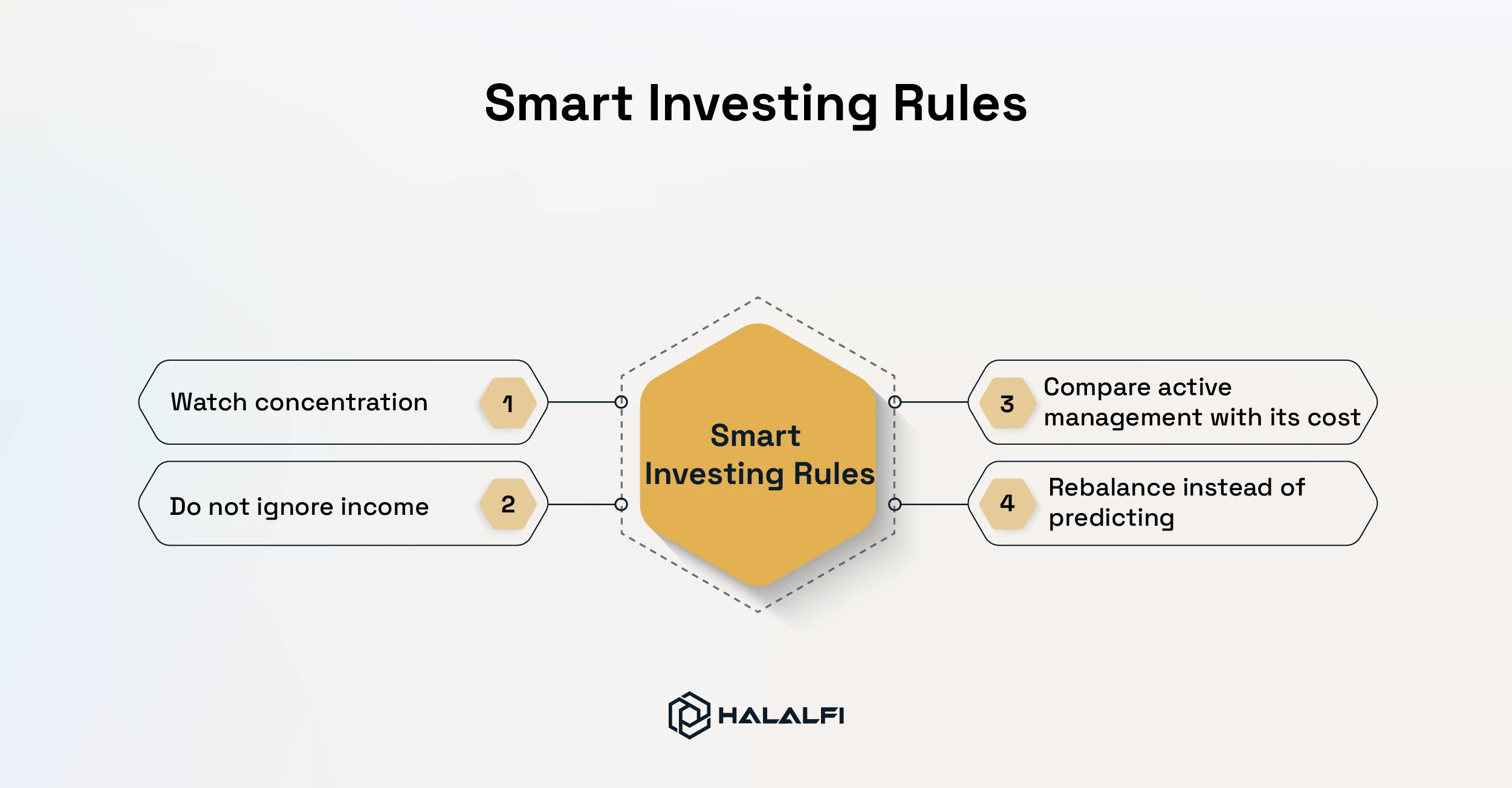
Markets give investors reasons to leave a plan. That makes discipline more useful. These are some investing rules in 2026:
Watch concentration: BlackRock’s 2026 outlook still sees opportunity in AI but also stresses diversification away from concentrated AI exposure.
Do not ignore income: Higher yields have made bonds and credit relevant again.
Compare active management with its cost: Only 25% of active U.S. funds beat passive peers over the decade through June 2026.
Rebalance instead of predicting: Market leadership changes faster than long-term goals.
A Strategy Should Tell You What Not to Do
A good investing plan creates boundaries. It:
Tells a long-term investor not to panic because markets fall for a month
Tells a short-term saver not to chase a volatile asset with next year’s tuition money.
Tells an active investor when a thesis has failed.
Clarifies investing vs trading. Investing follows an economic thesis over time. Trading focuses more heavily on price movement and timing.
And investing vs gambling comes back to process.
Conclusion
Best investment strategy? There is no best one. The common thread is consistency.
Choose the goal first, match risk to time, understand where the return comes from, and set allocation rules before excitement arrives.
For investors seeking Sharia-reviewed exposure to real-world business projects, HalalFi offers another avenue worth exploring.
Explore the HalalFi projects, read the terms, compare the forecast with the risks, and decide whether the opportunity fits your strategy rather than changing your strategy to fit the opportunity.
Frequently Asked Questions
Can someone use more than one investment strategy?
Yes. Many portfolios combine approaches. An investor might use passive funds for a core portfolio, with smaller allocations to value, bond, crypto, or impact funds for specific goals.
How often should an investment strategy change?
Change it when your goal, time horizon, finances, or risk capacity changes. A bad market week alone usually does not provide a strong reason to rewrite a long-term plan.
Is dollar-cost averaging an investment strategy?
It works more as a purchasing method. Investors invest equal amounts on a set schedule rather than trying to choose a single perfect entry point.
How often should a portfolio get rebalanced?
There is no universal schedule. Some investors check annually, while others rebalance when allocations move beyond preset ranges. Taxes and transaction costs can affect the decision.
Can an investment strategy guarantee profit?
No. A strategy can organize decisions and manage risk, but it cannot guarantee returns. Even conservative assets can lose purchasing power or market value.
Should beginners copy portfolios they find online?
Not unthinkingly. Two investors can own identical assets yet have completely different income needs, goals, taxes, and time horizons. Copying holdings without copying the underlying circumstances creates hidden risk.