
If an Islamic bank earns 5% and a conventional bank charges 5%, did anything change? Here, interest in Islamic banking gets confusing.
The percentages may look alike. The monthly payments may even differ by only a few dollars. Yet Islamic finance does not judge a transaction by the numbers. It asks what created that number.
So follow the return backward; that usually tells you more than the percentage ever will.
What Is Interest in Islamic Banking
Strictly speaking, an Islamic banking contract should not contain interest as the source of return.
You will usually see different terms instead:
Profit rate
Financing rate
Rental payment
Markup
Expected return
Those words alone prove nothing. A bank could rename interest “profit” and change very little. Sharia compliance depends on the underlying contract and transaction.
Imagine two people each need $20,000 to acquire equipment. Bank A lends $20,000 and requires $21,000 back. Its $1,000 return comes from the lending contract.
Bank B buys equipment for $20,000 and sells it to the customer for $21,000 on deferred payment under a valid Murabaha structure. Its $1,000 comes from a sale.
Both produce a 5% difference. But one begins with money exchanged for more money later. The other begins with an asset and a sale.

Is Bank Interest Haram in Islam?
Under mainstream contemporary Islamic jurisprudence and standard Islamic-finance practice, predetermined interest attached to a loan counts as riba.
The IIFA states it:
“Interest on all types of loans is a prohibited Riba.”
The Academy also treats interest-bearing bank deposits as loans that produce prohibited riba.
Some modern scholars have proposed narrower interpretations of riba, but mainstream Islamic finance institutions follow the prohibition on conventional loan interest.
Why Is Bank Interest Haram?
The problem starts with the loan contract. If someone lends $10,000 and requires $11,000 back, the extra $1,000 does not depend on a successful sale, productive asset, or profitable business. The borrower owes it because the lender supplied money for a period of time.
That creates features Islamic finance seeks to avoid:
The lender receives a predetermined increase on a loan.
The borrower owes that increase even if the financed activity loses money.
Time itself produces the lender's contractual gain.
The loan does not require ownership of a productive asset.
The lender can earn without taking on the commercial risk associated with that asset.
That is the core issue behind riba in Islamic finance.
Difference Between Interest and Profit in Islamic Banking
The most immediate comparison comes from asking what produced the extra money:
Test | Interest | Islamic Commercial Profit |
Starting transaction | Loan or debt | Sale, lease, partnership or business activity |
Return source | Increase on money lent | Trade, rent or commercial performance |
Asset required | Not necessarily | Usually relevant to the contract |
Business outcome | Interest remains due despite losses | Depends on contract |
Can amount be known early? | Yes | Sometimes |
Main Sharia issue | Riba | Must satisfy contract rules |
Risk link | Primarily borrower credit risk | Ownership, asset, or commercial risk may apply |
Fixed Profit Does Not Mean Riba
Yes, you heard right: fixed profit does not mean Riba.
A Murabaha seller can disclose a purchase cost and agree on a known markup before completing the sale. Murabaha contracts can set the markup at the time of contract, and the agreed markup does not continue to increase after the sale.
Compare that with lending. A lender who gives $10,000 and contractually demands $10,500 simply because repayment occurs later creates a different transaction.
The word fixed does not settle the Sharia question; the contract does.
What Islamic Banks Use Instead of Interest
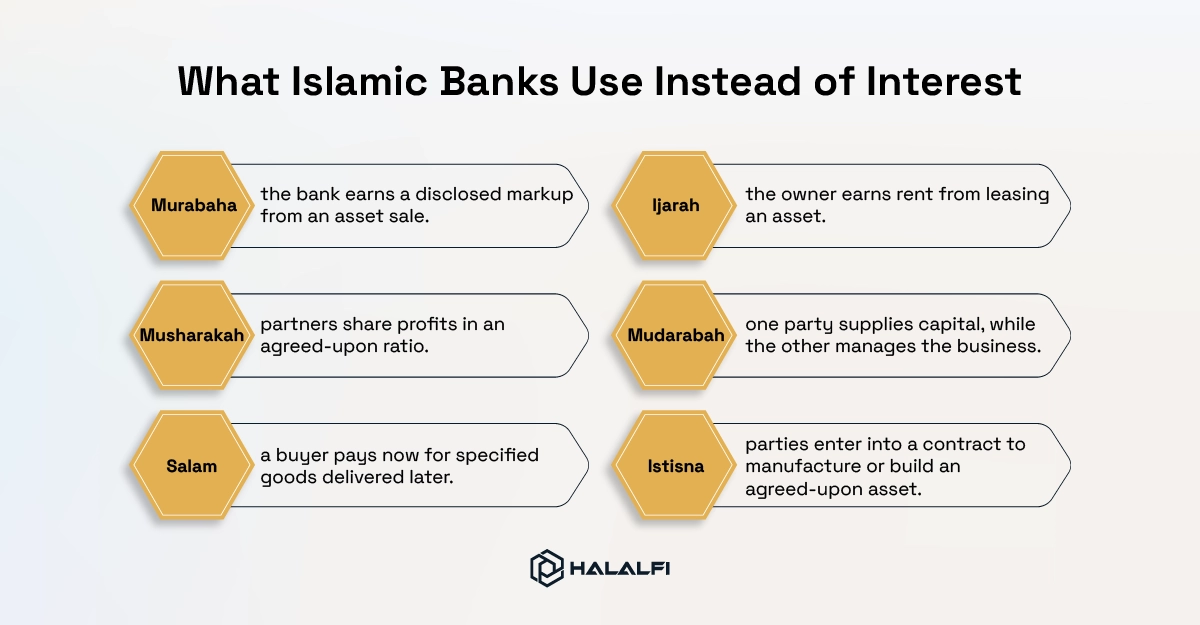
Islamic banking needs revenue. Staff, technology, compliance, and capital all cost money. They use contracts that create income through another route:
Murabaha: the bank earns a disclosed markup from an asset sale.
Ijarah: the owner earns rent from leasing an asset.
Musharakah: partners share profits in an agreed-upon ratio.
Mudarabah: one party supplies capital, while the other manages the business.
Salam: a buyer pays now for specified goods delivered later.
Istisna: parties enter into a contract to manufacture or build an agreed-upon asset.
Why Islamic Profit Rates Follow Interest Rates
An Islamic home-financing rate can approach conventional mortgage rates. Critics often see that and conclude the bank merely changed the vocabulary. Pricing and contract structure are separate issues.
Islamic banks operate in economies shaped by central bank rates, inflation, funding costs, and competitors' pricing. They may use conventional benchmarks when deciding what profit rate makes commercial sense.
Bank Negara Malaysia's Shariah Advisory Council has even addressed time value. It permits its use in exchange contracts involving deferred payment, while rejecting it for qard (loan) transactions.
Interest-Free Does Not Mean Profit-Free
Islamic finance does not ask investors or businesses to operate for free. The industry has grown far beyond experimental scale.
LSEG reported $5.98 trillion in global Islamic finance assets in 2024, up 21% year over year. Its dataset covers more than 2,000 Islamic financial institutions.
That growth would make little sense if Islamic finance were to prohibit profit itself. It determines how participants make claims on money and how financial returns are generated. Profit needs an economic reason.
Interest Becomes More Interesting When You Leave the Bank
Banking solves payments, deposits, mortgages, and business financing. Investing creates another choice.
Someone with spare capital does not necessarily need to lend it at interest to seek a return. Capital can participate in a business, an asset, a trade cycle, or another permitted commercial activity.
So halal investment is more than Islamic banking, and today Islamic crowdfunding deserves attention.

How HalalFi Avoids Riba in Its Project Model
HalalFi connects investors with real commercial projects rather than interest-bearing loans. Its platform describes activities such as sourcing, trading, and exporting goods as the source of project returns. Before listing a project, HalalFi uses:
Sharia review to examine the business and funding structure.
Business review before a project reaches investors.
Performance-based profit rather than loan interest.
Real commercial activity behind each opportunity.
USDT funding for eligible participants.
Smart contracts to record on-chain funding and distributions.
In HalalFi-approved projects, participants must avoid interest, gambling, and prohibited industries. It changes where the return should come from.
Why Consider HalalFi Instead of Chasing Interest
HalalFi becomes relevant for investors who want capital to do something more concrete than sit behind an interest-bearing debt claim.
HalalFi uses USDT, but USDT does not turn a transaction into Islamic finance. The more useful features are the project structure, Sharia screening, business review, defined commercial activity and visibility into funding terms. Smart contracts can also make on-chain transfers easier to inspect.
Investors face project, counterparty, stablecoin, smart-contract and operational risks. So the reason to investigate HalalFi is not “guaranteed profit.” It is an opportunity to examine the drivers of profit before committing capital.
Conclusion
Understanding interest in Islamic banking becomes much easier once you stop comparing percentages. Islamic finance does not prohibit earning.
It asks that profit come through a permissible economic relationship rather than from an increase attached to a loan merely because time has passed.
HalalFi gives you a place to do that. Its marketplace shows operating and completed projects, forecast returns, project durations, and reported outcomes.
Study the HalalFi projects now. Understand where each return comes from. Then watch for the next funding window with the contract already clear in your head.
Frequently Asked Questions
Is every bank interest rate considered riba?
Mainstream institutional Islamic finance treats predetermined interest on loans and interest-bearing deposits as riba. Specific products can involve additional details, so contract-level review still matters.
Can an Islamic bank guarantee a profit on an investment account?
A genuine Mudarabah-style investment should not turn the investor's profit into a guaranteed fixed amount. Deposit and investment structures differ, so check the exact contract.
What should someone do with bank interest already received?
Scholars differ on some practical details, but a common view advises against treating prohibited interest as personal income and directs it toward public or charitable benefit without seeking spiritual reward.
Are Islamic credit-card late fees interest?
Not automatically. Sharia treatment depends on why the fee exists, how the bank calculates it, and whether the institution profits from it. Review the product's Sharia documentation.
Why do Islamic banks mention “profit rates” as percentages?
Percentages make pricing easy to compare. A percentage itself does not create riba. The underlying sale, lease, or investment contract determines the nature of the return.