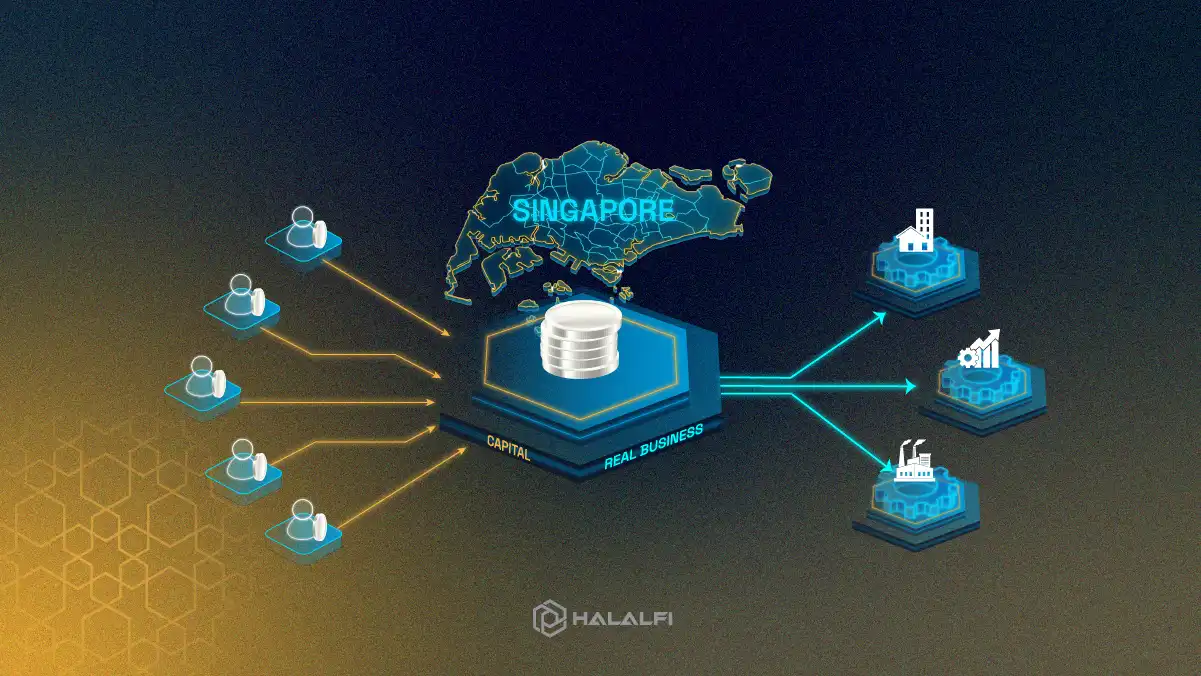
Crowdfunding in Singapore puts your money into a young company, an SME loan, a product launch, or a charitable appeal.
Those pages may look remarkably similar on a phone. Financially, they can lead to completely different places.
Singapore regulates securities-based crowdfunding, while donation and reward campaigns are subject to different rules.
Investors also have to consider defaults, liquidity, fees, platform failures, and what they legally own. Let's see everything about Crowdfunding in Singapore.
Crowdfunding in Singapore Is More Than a Funding Trend
In Singapore, crowdfunding starts with a problem: a business needs capital now, but bank financing may take longer, require more paperwork, or simply not be a fit for the deal.
Here, a crowdfunding platform steps in. In this way, instead of relying on a single lender, a company can raise capital from multiple investors online, often for inventory, expansion, working capital, or a specific project.
Crowdfunding opens access to private-market opportunities that once felt reserved for banks, funds, or wealthy networks.
But the interesting part starts after the money leaves your account. You should find answers to these questions:
Who receives it?
What creates your return?
What happens if the business struggles?

Which Crowdfunding Platforms Can Investors Find in Singapore?
Funding Societies, FundedHere, and GXS Capital all connect capital with businesses, but they package the opportunity differently. Let's compare the best crowdfunding opportunities you can invest in Singapore:
Platform | What gets funded | How investors can earn | Current distinguishing feature | Regulatory position |
Funding Societies | SME financing and debt notes | Interest paid on business financing | Investments can start from S$20 per note | MAS Capital Markets Services licensee |
FundedHere | Mainly e-commerce/private-credit opportunities | Defined private-credit returns | Markets 30–60 day notes and 10–14% p.a. average returns for accredited investors | MAS Capital Markets Services licensee |
GXS Capital | SME financing, including invoice and purchase-order structures | Interest and other payments under transaction documents | Formerly Validus; now owned by GXS Bank | MAS Capital Markets Services licensee |
HalalFi | Defined commercial projects funded with USDT | Performance-linked project profit | Sharia review, business review and on-chain funding records | Global platform; Singapore users must check current local eligibility and legal requirements |
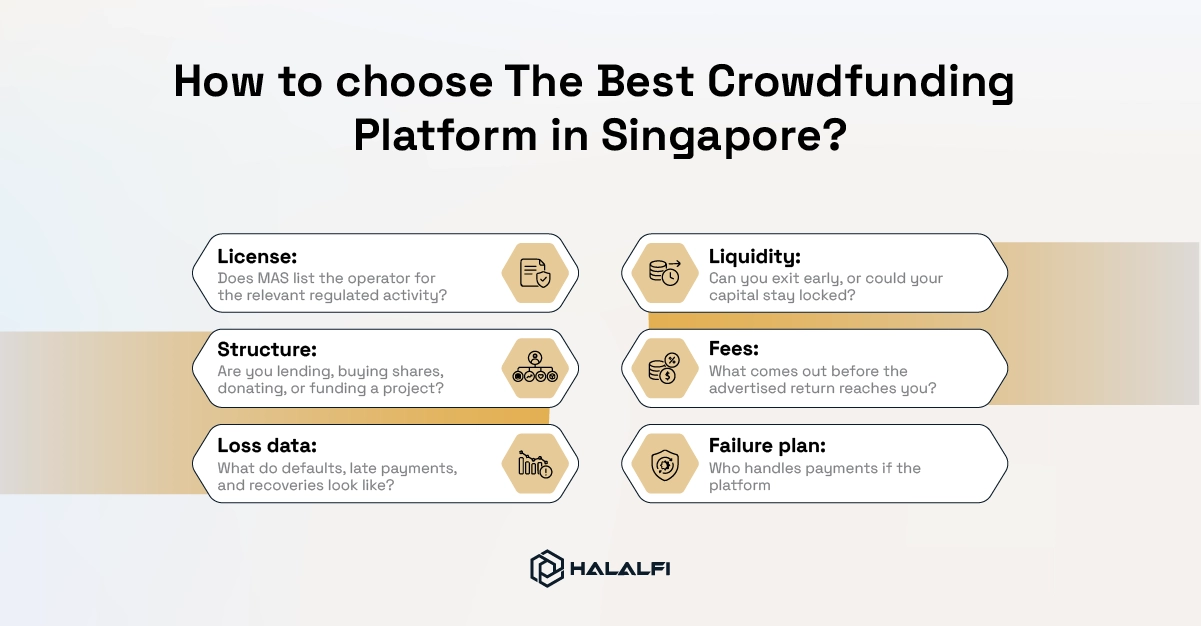
How to choose The Best Crowdfunding Platform in Singapore?
To choose the crowdfunding campaign, the answer changes with the job you want the platform to perform. Before opening an account, check:
License: Does MAS list the operator for the relevant regulated activity?
Structure: Are you lending, buying shares, donating, or funding a project?
Loss data: What do defaults, late payments, and recoveries look like?
Liquidity: Can you exit early, or could your capital stay locked?
Fees: What comes out before the advertised return reaches you?
Failure plan: Who handles payments if the platform closes?
Why Crowdfunding Makes Sense in Singapore?
Singapore had about 356,100 enterprises in 2024. SMEs represented 99% of them, employed about 70% of the workforce, and generated 47% of nominal value added, according to Singapore's Department of Statistics.
That creates a large group of companies that sometimes need 300,000 for expansion rather than a giant corporate bond.
Picture a small electronics distributor. A retailer places a large order, but the distributor must pay its supplier before the retailer pays its invoice.
A bank may finance that gap. So can alternative financing. That practical cash-flow problem sits behind much of crowdfunding for small businesses.
Singapore Crowdfunding Regulation
Singapore does not regulate every crowdfunding page in the same way.
MoneySense says securities-based crowdfunding, or SCF, covers lending- and equity-based structures that involve offers of securities.
SCF operators operating in Singapore must hold the relevant MAS license. Donation and reward structures that do not offer securities are not subject to MAS securities regulation. For SCF operators, requirements include:
Segregating investor money properly
Keeping transaction records
Dealing fairly with investors
Disclosing key investment risks
Meeting MAS licensing and financial requirements
MAS lists securities-based crowdfunding operators among businesses that may require a Capital Markets Services license.
The S$5 Million Rule in Singapore
Singapore's Securities and Futures Act contains a small-offer exemption that applies when securities offers raise no more than S$5 million within 12 months, subject to certain conditions.
A separate private-placement exemption applies to offers made to no more than 50 people within 12 months. Those exemptions remove the need for a registered prospectus in qualifying situations.
Sometimes investors see “prospectus exempt” and read it as “government approved,” but that is not what it means.
It describes how the offer relies on a legal exemption, and Investors need to inspect the issuer, platform, and investment terms.
A MAS License Does Not Remove Investment Risk
A MAS license tells you something useful about the operator. It does not guarantee the business behind every campaign will repay investors.
MoneySense lists capital loss, fraud, foreign-issuer risk, illiquidity and platform failure among the risks of crowdfunding. It also warns that some issuers may provide unaudited financial statements.
It is important to “Don't focus just on the SCF operator's interest rates of return.” MoneySense said.
For example, a 12% return with weak cash flow may deserve less attention than an 8% opportunity with clearer economics and stronger repayment capacity.
Not Every Crowdfunding Page Is Asking You to Invest
A fundraising page for a child’s surgery and a platform raising money for a private company may both use the word “crowdfunding.” Financially, they are worlds apart.
Singapore treats charitable fundraising differently from investment activity. Someone raising S$80,000 for medical treatment is asking for support, not offering shares, debt, or a financial return.
That is why platforms such as Give.asia, Giving.sg, Ray of Hope, and DeeDa sit in a different part of the market.
Singapore’s Charity Portal identifies them among platforms that follow its Code of Practice for Online Charitable Fund-Raising Appeals.
For the donor, the decision is: Is the campaign genuine? Who receives the money? Will it be used for the stated purpose? For an investor, those questions change.
Now you need to know what you own, how you get paid, and what happens if the business fails. That shift from giving money to putting money to work is where crowdfunding becomes much more interesting.
What has to happen in the real world for this return to appear?
That question becomes important once crowdfunding moves from loans and shares into individual business projects.
That is the kind of evidence people remember because it turns an investment from a claim into something you can inspect.
And once you start thinking that way, HalalFi becomes much easier to understand. You are looking at a business journey from funding to execution to outcome.
HalalFi Breaks From the Usual Crowdfunding Model
Once Funding Societies, FundedHere, and GXS Capital sit side by side, HalalFi's position becomes easier to understand.
Singapore's established investment platforms show how efficiently technology can connect investors with SMEs. HalalFi changes one part of that formula.
HalalFi, as a crypto crowdfunding platform, instead of building investor returns around interest-bearing SME debt, says potential profit should come from a Sharia-permissible commercial project.
It adds business review, Sharia screening, USDT funding and smart-contract records around that model.
That does not make a HalalFi project better or safer. But it gives investors who want to avoid riba a different contract to examine. And that is far more significant than another “halal” badge.
Conclusion
The crowd gets the attention, but it is the contract that decides what happens to your money. Singapore already gives investors several routes: SME debt, equity campaigns, reward projects and charitable crowdfunding. Regulation changes depending on what the campaign actually offers, which is why checking MAS status and legal structure should come before chasing returns.
For investors who also want to avoid riba, project-based Islamic finance adds another route. HalalFi makes that route visible through business projects, Sharia review, USDT funding, and recorded project outcomes.
So explore HalalFi's project marketplace, open the past projects, follow the money from investor to business to profit, and decide whether the next project deserves your capital before the funding button reappears.
Frequently Asked Questions
Is crowdfunding legal in Singapore?
Yes, but the rules depend on the structure. Securities-based crowdfunding platforms operating in Singapore generally need appropriate MAS licensing, while donation and reward models are subject to different requirements.
Is interest from lending-based crowdfunding taxable in Singapore?
IRAS says interest received by a fund provider from lending-based crowdfunding is taxable and should generally be reported as interest income.
Can foreigners invest in Singapore crowdfunding platforms?
Sometimes. Eligibility depends on the platform, investor status, residency rules, and the specific investment. Always check the platform’s current requirements before opening an account.
Is crowdfunding in Singapore risky?
Yes. Investors can face borrower defaults, business failure, illiquidity, platform risk, and partial or total capital loss. MAS licensing does not guarantee repayment.
What is the minimum amount needed to start crowdfunding investment in Singapore?
It varies widely. Some platforms allow investments from relatively small amounts, while private-credit or accredited-investor products may require much larger commitments.