What if raising money for a business, startup, or project no longer depended on convincing one investor behind closed doors, but hundreds or thousands of people who genuinely believe in your idea?
Crowdfunding can help entrepreneurs, startups, creators, and small businesses raise capital directly from supporters without relying on traditional investors or bank loans.
However, launching a campaign is not as simple as publishing a project page and waiting for funding.
Successful founders validate their ideas, build trust, grow an audience, and create momentum long before launch day. Without a clear strategy, even promising projects can struggle to attract backers.
In the following steps, we'll talk about how to start crowdfunding, build momentum before launch, and create a campaign that inspires people to contribute.
What is Crowdfunding and Why is it Growing So Fast?
Crowdfunding is a way to raise money from a large number of people, usually through online platforms. So, the short answer is that people want alternatives.
Traditional financing is slow, selective, and intimidating. Banks want collateral, and venture capital firms want traction and ownership. Many founders do not fit those boxes. Crowdfunding changes the rules.
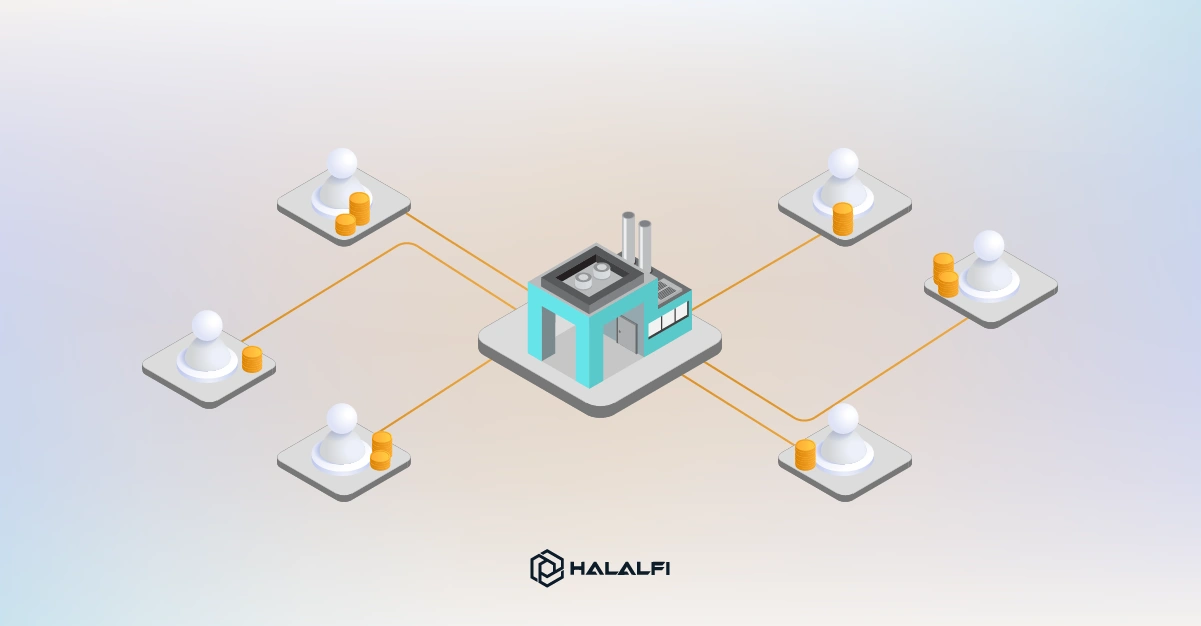
With Crowdfunding, instead of relying on one gatekeeper, founders can raise money from a community.
That community includess:
Customers
Supporters
Early adopters
Investors
Mission-driven backers
Crowdfunding is becoming mainstream.
Understanding the 4 Types of Crowdfunding
Not all crowdfunding works the same way. Choosing the right types of crowdfunding matters. Here is a breakdown.
Type | How It Works | Backer Gets | Main Risk | Best For | Example |
Donation | People contribute freely to support a cause or project. | Satisfaction of supporting a cause. | No financial return and limited accountability. | Causes, charities, community projects. | Disaster relief fundraiser, nonprofit campaign. |
Reward | Backers contribute money in exchange for perks or products. | Early access, products, or exclusive rewards. | Product delays or failure to deliver rewards. | Startups, creators, product launches. | Kickstarter gadget campaign. |
Equity | Investors provide funding in exchange for ownership shares. | Equity stake and potential future returns. | Business failure or loss of investment. | Growth businesses and startups. | A startup raising capital through equity crowdfunding. |
Debt | Supporters lend money that is repaid over time with interest. | Principal repayment plus interest. | Borrower default or delayed repayment. | SME financing and established businesses. | Peer-to-peer business lending campaign. |
Revenue / Profit-Sharing | Investors provide capital to a business and receive a pre-agreed share of revenue or profits generated by the project or company. | A share of business revenue or profits based on agreed terms. | Lower-than-expected business performance may reduce returns; profits don't guarantee. | Ethical businesses, growth-stage companies, and Shariah-compliant fundraising. | A halal crowdfunding campaign where investors share in business profits through a Mudarabah or Musharakah structure. |
Reward-based campaigns remain popular for product launches.
Equity and debt models are increasingly important in crowdfunding for small-business and startup capital.
The debt segment currently represents a major share of crowdfunding activity globally.
Crowdfunding Regulations
Many campaigns operate within legal and regulatory frameworks that founders cannot afford to ignore.
The requirements vary depending on the fundraising model, the country, and the platform you choose.
For donation- and reward-based campaigns, regulations are often less complex, but founders are still responsible for truthful marketing, consumer protection, tax obligations, and the delivery of promised rewards.
Equity and investment-based crowdfunding campaigns typically face stricter requirements, including investor verification, financial disclosures, securities compliance, and ongoing reporting obligations.
Before launching a campaign, research the rules that apply in your target market and on your chosen platform.
You should also verify whether the platform supports fundraising in your country and whether it allows international backers or investors.
Crowdfunding Risks
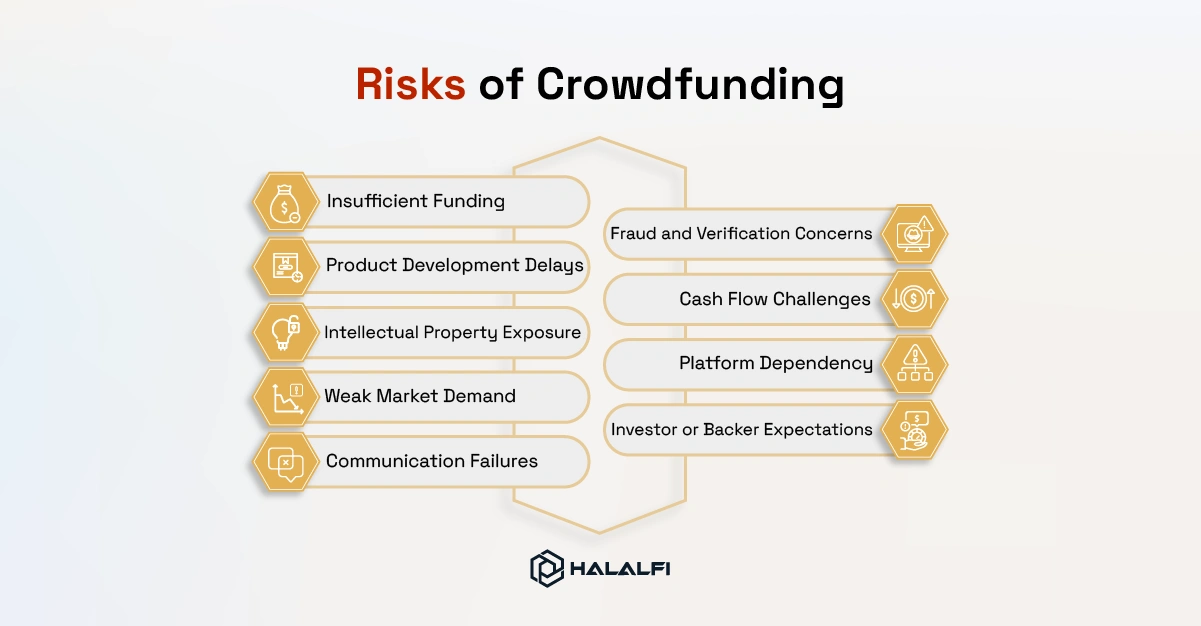
Crowdfunding comes with risks that founders should evaluate before launching a campaign:
Insufficient Funding: The campaign may fail to reach its funding goal.
Product Development Delays: Manufacturing, sourcing, or technical challenges can delay delivery.
Intellectual Property Exposure: Publicly sharing an idea may increase the risk of imitation.
Weak Market Demand: Interest from friends and family does not always translate into public support.
Communication Failures: Inadequate updates can erode backer confidence and foster negative sentiment.
Fraud and Verification Concerns: Both founders and backers face risks when due diligence is limited.
Cash Flow Challenges: Receiving funding does not guarantee sufficient capital to complete the project.
Platform Dependency: Changes in platform policies, fees, or account status can affect campaign performance.
Investor or Backer Expectations: Supporters may expect faster results than the project can realistically deliver.
What Is a Crowdfunding Campaign Plan?
A crowdfunding campaign is not a fundraising page; it is a launch strategy. A crowdfunding campaign plan acts as a roadmap that defines:
Funding goals
Timeline
Audience
Messaging
Promotion
Rewards
Campaign management
Without this structure, many campaigns struggle. Founders often focus on the product and forget that the campaign itself is also a product that must be marketed.
A campaign plan helps avoid that mistake. Think of it this way:
Idea + excitement = not enough.
Strategy + preparation + momentum = far better odds.
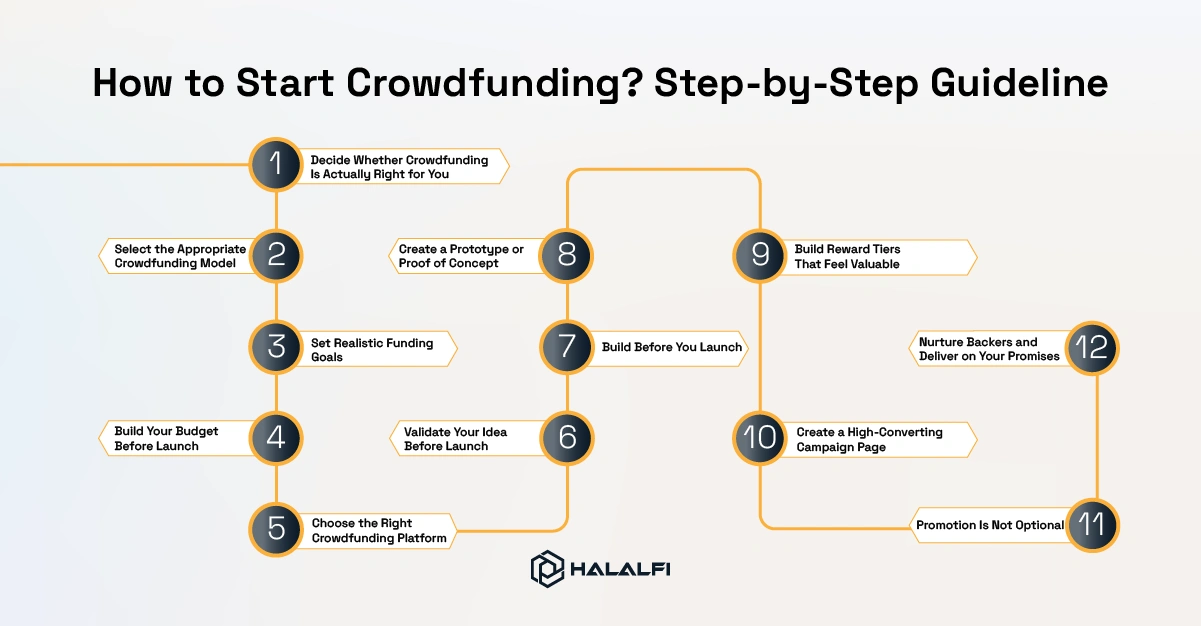
How to Start Crowdfunding? Step-by-Step Guideline
Starting a crowdfunding campaign involves much more than publishing a project page and waiting for contributions.
Successful campaigns are built through careful planning, market validation, audience building, trust creation, and consistent promotion.
Founders who take the time to prepare before launch often have a much better chance of attracting backers and reaching their funding goals.
Let's look at the important steps to start a crowdfunding campaign.
Step 1: Decide Whether Crowdfunding Is Actually Right for You
This step sounds obvious. Many founders skip it. A crowdfunding campaign works best when:
The idea is easy to explain
People understand the value quickly
The founder can build attention
There is community interest
A niche B2B software platform with long sales cycles may struggle. A consumer product, creator project, or mission-driven business often performs better.
An important question is:
Would strangers care enough to support this publicly?
If the answer is uncertain, the campaign may need more refinement before launch.
One of crowdfunding’s most famous stories began with a cooler, not an app, and not AI. Just a cooler.
The campaign combined:
Strong storytelling
Professional visuals
Reward tiers
Product demonstrations
Early momentum
Successful crowdfunding rarely happens overnight. Most “overnight” campaigns were prepared carefully.
Step 2. Select the Appropriate Crowdfunding Model
Before the audit process begins, the project owner must choose the crowdfunding structure that best matches the business model and funding needs.
Depending on the nature of the project, it includes profit-sharing, revenue-sharing, equity-based, donation-based, or other Sharia-compliant funding structures available on the platform.
Choosing the right model helps ensure alignment between investor expectations, project objectives, and Islamic finance principles.
Step 3: Set Realistic Funding Goals
Funding goals influence psychology.
If it is too high, backers hesitate. If it is too low, the campaign may struggle to deliver.
The founder must calculate:
Fixed Costs
These are one-time expenses. Examples:
Tooling
Packaging
Design
Legal setup
Shipping preparation
Variable Costs
These change with production volume. Examples:
Materials
Manufacturing
Fulfillment
Per-unit shipping
Marketing Costs
This category is often underestimated. Campaign promotion costs money. Many founders spend:
Social ads
Influencer fees
PR outreach
Creative production
Ignoring marketing creates unrealistic budgets.
Here is a surprising truth. Many crowdfunding campaigns succeed or fail during the first week.
Strong early traction creates:
Credibility
Urgency
Social proof
People follow crowds because crowds reduce perceived risk. A quiet campaign feels uncertain, and an active campaign feels trusted.
Step 4: Build Your Budget Before Launch
Campaign excitement can create poor decisions. Budgets prevent that. Include:
Budget Area | Typical Costs |
Platform fees | Percentage or flat fee |
Marketing | Ads and promotion |
Production | Manufacturing |
Team | Freelancers or staff |
Fulfillment | Shipping and logistics |
Contingency | Delays or surprises |
Platforms typically charge fees for successful campaigns. Budgeting early prevents painful surprises later.
Step 5: Choose the Right Crowdfunding Platform
Platforms are not interchangeable. Different communities support different projects. Here is a comparison.
Platform | Best For | Funding Model | Considerations |
Kickstarter | Creative projects, consumer products, hardware launches | Reward-based | Uses an all-or-nothing model—strong audience for innovative products and creative projects. Platform fees apply. Best for founders who can generate significant pre-launch momentum. |
Indiegogo | Product launches and flexible fundraising | Reward-based | Offers both fixed and flexible funding options. Suitable for founders who want greater flexibility. Audience interest varies by category. |
GoFundMe | Personal causes, charities, and community fundraising | Donation-based | Designed for donations rather than investments. Strong for social causes and emergency fundraising. Limited fit for startups seeking business capital. |
Equity Crowdfunding Platforms | Startup and business investment | Equity-based | Investors receive ownership stakes. Compliance, securities regulations, and investor verification requirements are typically more extensive. |
Niche Platforms | Industry-specific fundraising | Varies by platform | Can provide access to highly targeted audiences. Evaluate fees, category fit, and platform reach before launching. |
HalalFi | Ethical business fundraising and Shariah-compliant investment | Investment-based | Focuses on audited businesses, transparency, compliance, and profit-sharing models. Includes business verification and Shariah review processes. Designed for founders and investors seeking values-aligned capital rather than speculative fundraising. |
When comparing crowdfunding platforms, ask the following questions:
Is the campaign donation-based, reward-based, equity-based, or investment-focused?
Does the platform support your target country and intended audience?
What platform fees, payment processing fees, or additional costs apply?
Does the platform use an all-or-nothing model or flexible funding?
Does the platform's existing audience actively support your category?
How strong are its compliance, verification, and fraud-prevention processes?
Is the platform designed for your type of product or business, or does it primarily offer general traffic?
What level of transparency and reporting do backers or investors expect?
A report on Entrepreneur shows that Kickstarter alone has attracted more than 24 million backers and generated over $8.7 billion in pledges.
Step 6: Validate Your Idea Before Launch
Do you think a great idea automatically has a market? You wrong. Before investing time and money into a campaign, validate whether people genuinely want what you are offering.
Crowdfunding works best when there is already evidence of interest, not just confidence from the founder.
Start by gathering feedback from potential customers, industry experts, and members of your target audience. Create surveys, conduct interviews, share early concepts, or launch a simple landing page to measure demand. If possible, collect email sign-ups, pre-orders, or waitlist registrations. These actions provide stronger validation than opinions alone.
Pay close attention to recurring questions, objections, and requests. They can reveal gaps in your offer and help refine your messaging before launch.
Validation is not about proving that everyone loves your idea. It is about confirming that a specific group of people finds it valuable enough to support.
The more evidence you gather before launch, the more confidently you can build your campaign, forecast demand, and attract backers. Strong crowdfunding campaigns begin with market validation, not assumptions.
Step 7: Build Before You Launch
Many campaigns fail before launch day. The reason is that they launch cold. It is one of the most expensive mistakes in crowdfunding.
A launch should not introduce the project. It should activate people already interested. Build:
Email subscribers
Social followers
Early supporters
Waiting lists
The campaign should begin with energy, not silence.
People rarely fund products alone. They fund stories. A campaign should answer:
Why does this exist?
Who benefits?
What problem is being solved?
Why now?
Storytelling creates emotional clarity.
One reason LaunchGood gained attention as a community platform is that its campaigns often connect funding to a clear purpose and human impact. Strong storytelling transforms curiosity into support.
Step 8: Create a Prototype or Proof of Concept
Ideas feel risky. Proof reduces fear. A prototype helps potential backers understand:
Functionality
Quality
Usability
Seriousness
This does not require perfection.
People support progress. Not a polished illusion. Even service businesses can demonstrate proof through:
Demos
Pilots
Previews
Case examples
A visible proof-of-concept builds trust.
Kickstarter describes its mission as helping “bring creative projects to life.”
That sentence sounds simple, but it highlights something deeper.
Crowdfunding works best when campaigns feel alive. People support creators and builders who communicate clearly and honestly.
Step 9: Build Reward Tiers That Feel Valuable
Reward-based campaigns need smart pricing.
If it gets too complicated, people leave. If it gets too expensive, participation drops. Simple tiers work best.
Example:
Contribution | Reward |
$15 | Thank you + digital access |
$50 | Early product |
$100 | Premium package |
$250 | Exclusive edition |
Tiered pricing widens participation. It lets people support at different comfort levels. That inclusivity helps campaigns grow.
Step 10: Create a High-Converting Campaign Page
Your campaign page is often the first place potential backers evaluate your project. Even a great idea can struggle if the page is unclear, incomplete, or unconvincing.
The goal is to help visitors understand what you are building, why it matters, and why they should trust you.
Build your campaign page with a clear project description, compelling visuals, a realistic funding goal, reward details, and a transparent explanation of how you will use the funds.
High-quality photos, videos, prototypes, and demonstrations can significantly improve credibility. Just as important, introduce yourself and your team so supporters know who is behind the project.
The page should answer common questions before backers ask them. Explain the problem, your solution, development progress, potential risks, and expected delivery timeline. Clear, honest communication reduces uncertainty and builds confidence. A well-prepared campaign page turns curiosity into trust and trust into funding.
Step 11: Promotion Is Not Optional
This deserves blunt honesty. If nobody sees your campaign, it will struggle. So promotion matters. Founders often imagine that platforms provide automatic traffic.
Usually, they do not. Traffic must be earned. Strong campaigns combine:
Social media
Email
Influencer outreach
Partnerships
PR
Community engagement
Promotion should begin before launch, not after that.
Crowdfunding Promotion Timeline
Crowdfunding Promotion can be done in a timeline, let's check it:
90 Days Before Launch:
Define your target audience and messaging.
Build a landing page and collect email subscribers.
Start publishing content on social media.
Reach out to potential partners, influencers, and industry contacts.
Gather testimonials, case studies, or early user feedback.
Build a waitlist of interested supporters.
30 Days Before Launch:
Announce the upcoming campaign publicly.
Share behind-the-scenes updates and progress on product development.
Secure media coverage and podcast opportunities.
Warm up your email list with regular updates.
Confirm launch-day supporters who can pledge early.
7 Days Before Launch:
Increase posting frequency across channels.
Share campaign previews, rewards, and launch details.
Send countdown emails to subscribers.
Finalize press outreach and influencer collaborations.
Encourage supporters to share the campaign with their networks.
72 Hours Before Launch:
Send final reminder emails.
Publish countdown posts on social media.
Confirm commitments from early backers.
Prepare launch-day content, announcements, and updates.
Test all campaign links, tracking tools, and communication channels.
Step 12: Nurture Backers and Deliver on Your Promises
Reaching your funding goal is not the finish line; it is the beginning of your relationship with supporters.
Successful crowdfunding founders build trust by communicating regularly and delivering on their promises.
Backers want to know how the project is progressing, especially when challenges arise. Share updates about production milestones, timelines, achievements, and any unexpected delays. Transparency helps maintain confidence and reduces uncertainty.
Once rewards, products, or services are ready, focus on efficient fulfillment and a positive supporter experience.
After delivery, continue engaging with your community and gathering feedback. Many successful founders turn first-time backers into long-term customers, advocates, and supporters by staying accountable and keeping communication open even after the campaign ends.
Real Crowdfunding Budget Example
Based on Lunchboom, let's assume a startup is launching a consumer product on Kickstarter with a funding goal of $100,000.
The budget below reflects real-world crowdfunding cost ranges reported by Kickstarter experts, LaunchBoom, and crowdfunding agencies.
Budget Category | Estimated Cost |
Product Prototype & Testing | $8,000 |
Manufacturing Setup & Initial Production | $35,000 |
Packaging Design & Materials | $5,000 |
Shipping & Fulfillment Reserve | $12,000 |
Campaign Video Production | $3,000 |
Product Photography & Creative Assets | $1,500 |
Campaign Page Design & Copywriting | $2,500 |
Pre-Launch Advertising | $7,500 |
Live Campaign Advertising | $10,000 |
Influencer & PR Outreach | $3,500 |
Email Marketing & Software Tools | $1,000 |
Kickstarter Platform Fee (5%) | $5,000 |
Payment Processing Fees (~3%) | $3,000 |
Legal & Compliance | $2,000 |
Contingency Fund (5%) | $5,000 |
Total Budget Required | $104,000 |
Where Does the Money Actually Go?
You shouldn't assume the funding goal should only cover production costs. In reality:
Manufacturing and production consume about 34% of the budget.
Marketing and promotion account for roughly 20–25% of total costs in many successful campaigns.
Kickstarter fees and payment processing typically reduce funds raised by 8–10%.
Shipping and fulfillment are often among the most underestimated expenses.
Item | Amount |
Product & Production Costs | $48,000 |
Marketing & Promotion | $22,000 |
Platform & Payment Fees | $8,000 |
Shipping & Fulfillment | $12,000 |
Legal & Compliance | $2,000 |
Contingency Buffer | $5,000 |
Recommended Funding Goal | $105,000–$110,000 |
So a founder who only needs $50,000 to manufacture a product may actually need to raise over $100,000 once marketing, fulfillment, fees, creative assets, and contingency reserves are included. So successful crowdfunding campaigns budget for the entire journey, not just the product itself.
Why Trust Is the Real Currency?
Money follows trust always. But, in crowdfunding, people invest in the people behind them. A great concept may attract attention, but trust is what convinces supporters to contribute.
Founders must earn that trust through transparency, accountability, and consistent communication.
Start by clearly presenting your identity, background, and experience. Backers want to know who is responsible for the project and why they are qualified to deliver it.
Provide proof whenever possible, including prototypes, product demos, customer feedback, pilot results, or business traction. Evidence reduces uncertainty and shows that the project is more than just an idea.
Transparency should continue throughout the campaign. Share regular updates on milestones, progress, challenges, and key decisions. Equally important, disclose risks honestly.
Every project faces obstacles, and supporters appreciate founders who communicate potential delays or uncertainties upfront rather than making unrealistic promises.
Finally, set timelines and delivery expectations. Overpromising generates short-term excitement, but meeting commitments builds long-term credibility.
The strongest crowdfunding campaigns succeed because founders create confidence through openness, proof, and responsible execution. When backers trust a founder, funding becomes a natural outcome rather than a difficult ask.
According to CrowdSpace, Crowdfunding in 2025 will increasingly reward platforms and founders who build transparency and credibility rather than simply chasing growth.
Where is HalalFi in Modern Crowdfunding?
Let's get to Shariah-compliant investments. Traditional crowdfunding solved one problem: access to capital. But new problems appeared:
Speculation
Weak verification
Unclear project quality
Trust concerns
Here is where HalalFi's position differs. Rather than acting as another generic crypto crowdfunding environment, HalalFi focuses on:
Real businesses
Audits
Blockchain transparency
Profit-sharing
Ethical fundraising
HalalFi operates as a halal crowdfunding and investment platform for values-aligned capital.
The platform tries to connect investors with real, cash-flowing businesses rather than purely speculative activity.

How HalalFi Solves Common Crowdfunding Problems
Traditional crowdfunding pain points include:
Problem | HalalFi Approach |
Weak screening | Dual audits |
Fraud concerns | Verification + KYB |
Low transparency | Smart contracts |
Speculation | Real businesses |
Fixed returns pressure | Performance sharing |
HalalFi for halal investment combines:
Sharia Audit: Projects undergo compliance review.
Business Audit: Operations and revenue are evaluated.
Smart Contracts: Funding terms become transparent and automated.
So it creates a stronger filter, and not every campaign passes. That selectiveness is intentional.
Imagine two businesses:
One launches on a generic platform promising aggressive returns. Another enters a system where audits, transparency, and business fundamentals matter.
The first may raise attention quickly, and the second may build stronger trust.
HalalFi’s approach reflects that second philosophy. The platform describes itself as an infrastructure for conscious capital.
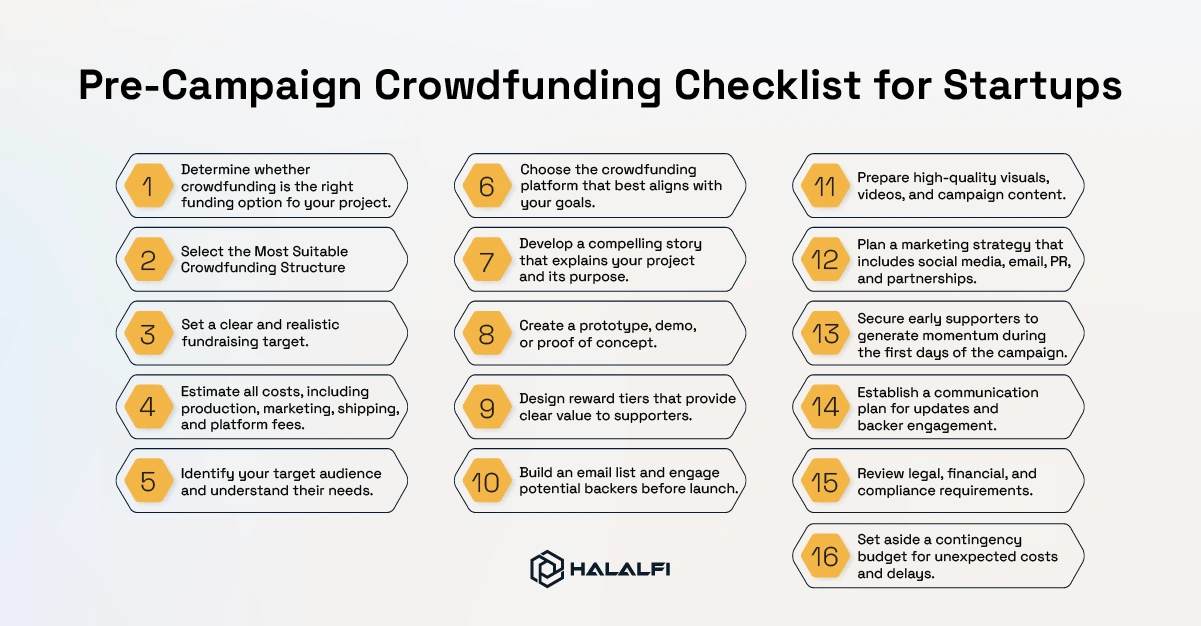
Pre-Campaign Crowdfunding Checklist for Startups
Now you know everything you need to know to start a crowdfunding campaign. Let's take a quick look at the pre-campaign crowdfunding checklist for Startups:
Determine whether crowdfunding is the right funding option for your project.
Select the Most Suitable Crowdfunding Structure
Set a clear and realistic fundraising target.
Estimate all costs, including production, marketing, shipping, and platform fees.
Identify your target audience and understand their needs.
Choose the crowdfunding platform that best aligns with your goals.
Develop a compelling story that explains your project and its purpose.
Create a prototype, demo, or proof of concept.
Design reward tiers that provide clear value to supporters.
Build an email list and engage potential backers before launch.
Prepare high-quality visuals, videos, and campaign content.
Plan a marketing strategy that includes social media, email, PR, and partnerships.
Secure early supporters to generate momentum during the first days of the campaign.
Establish a communication plan for updates and backer engagement.
Review legal, financial, and compliance requirements.
Set aside a contingency budget for unexpected costs and delays.
Conclusion: Crowdfunding Starts Long Before Launch Day
Learning how to start crowdfunding is not about publishing a page and hoping for luck. Successful campaigns are built. They combine:
Planning
Trust
Storytelling
Marketing
Realistic goals
Community
The future of fundraising looks increasingly diverse. Traditional platforms continue growing.
Ethical and blockchain-enabled models are also emerging.
If you are exploring crowdfunding for a small business, startup capital, or mission-driven fundraising, take time to study the model that matches your goals.
And if transparency, real businesses, and values-aligned finance matter to you, see HalalFi Documentation and its model may offer a useful next step in understanding where crowdfunding is heading.
Frequently Asked Questions
How long should a crowdfunding campaign run?
Many campaigns run between 30 and 45 days. Longer campaigns may lose urgency.
Do crowdfunding campaigns need legal protection?
Often yes. Trademarks, agreements, and compliance matter before public launch.
Can service businesses use crowdfunding?
Yes. Services can crowdfund through memberships, access programs, or pre-sales.
What percentage of crowdfunding campaigns fail?
Success varies significantly by platform, preparation, category, and audience engagement.
Can crowdfunding work internationally?
Yes. Many campaigns attract global supporters depending on platform rules and payment access.