
What if your halal investment UK search gave you plenty of products, yet still left one basic doubt: what exactly is your money earning from?
A fund can carry an Islamic label, an ISA can offer a tax advantage, and a property deal can look reassuringly tangible.
None of those things, by themselves, tell you whether the investment fits your goals or meets the Sharia standards you want to follow.
This guide sorts through the choices available to UK investors, from Sharia-screened funds and sukuk to property, savings, and private-business crowdfunding.
Halal Investment in UK Requirements
In the UK, halal investing means using familiar investment routes while ensuring that the underlying assets and contracts comply with Sharia principles.
ISAs: The tax wrapper itself does not make an investment halal. The assets held inside it still need Sharia screening.
Pensions: A pension can include Shariah-compliant funds, but investors should check the fund’s holdings, screening method and fees.
Funds and ETFs: These should avoid prohibited sectors, excessive debt, and interest-based income, in accordance with their stated Sharia methodology.
Property and private businesses: The source of profit, financing structure and contract terms matter as much as the asset itself.
Two checks matter: First, review Sharia compliance. Then review UK tax, FCA rules and platform eligibility.
The Bank of England's Islamic finance puts one part of the idea neatly:
“Profit and risks should be shared.”
That short sentence explains why replacing the word “interest” with “profit” doesn't settle anything. Investors need to know what creates that profit.
A shariah-compliant investment may involve ownership of a company, rental income, trade, or a profit-sharing business arrangement. The contract matters as much as the asset.

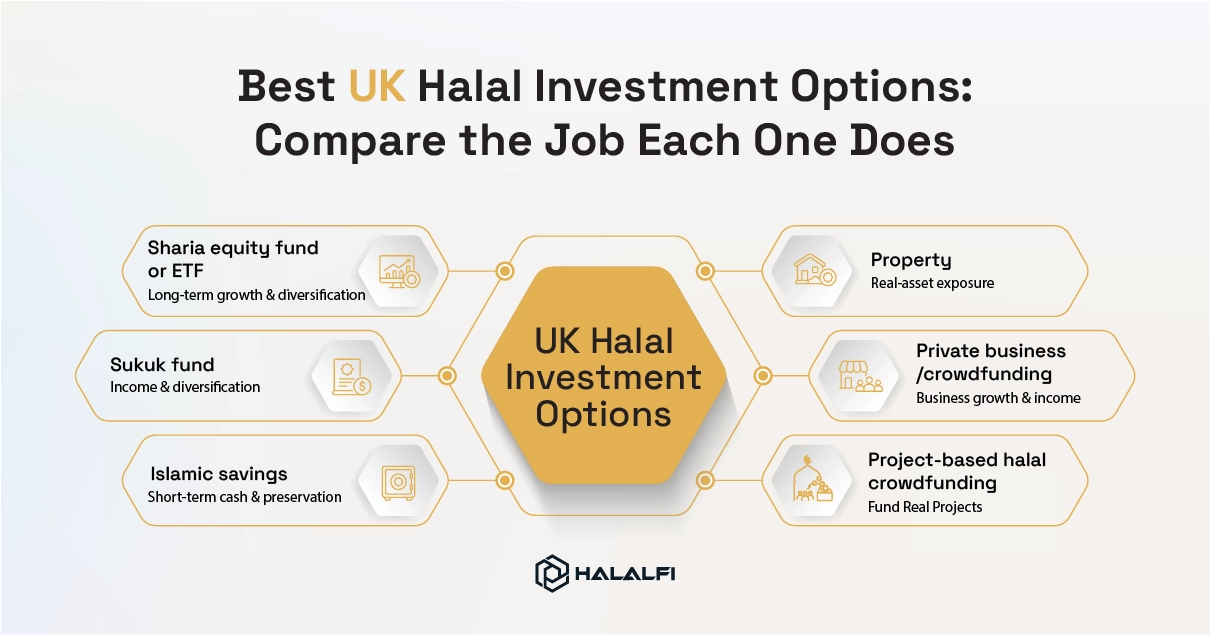
Best UK Halal Investment Options: Compare the Job Each One Does
British investing has a few familiar rituals:
Workplace pensions
ISAs
Property
Investing through an app.
For Muslim investors, the interesting part is that the tools need not change. What sits inside them does.
A Stocks and Shares ISA can hold a Sharia-screened equity fund, or A workplace pension may offer an Islamic fund choice.
Searching for the best halal investment option in UK sends someone down a rabbit hole of funds, apps, and star ratings. A more useful approach starts with the job the money needs to do.
Money needed for a home deposit in two years has a very different job from pension money that may stay invested for 25 years.
In the table below, we see the 6 best halal investment options in UK:
Option | Source of return | Access to money | Main risk | Typical role |
Sharia equity fund or ETF | Share-price growth and dividends | Usually high | Market falls, sector concentration | Long-term growth |
Sukuk fund | Asset, lease or Sharia-compliant financing income | Usually high for listed funds | Credit, rate and market risk | Income and diversification |
Islamic savings | Expected profit from permitted banking structures | Depends on account | Provider and inflation risk | Short-term cash |
Property | Rent and price movement | Low | Vacancy, repairs, falling prices | Real-asset exposure |
Private business/crowdfunding | Business profits | Usually low | Default and business failure | Alternative growth/income |
Project-based halal crowdfunding | Profit from real business activity | Project-dependent | High business, liquidity and smart-contract risk | Small alternative-investment allocation |
Sharia Equity Funds and ETFs
For UK investors, Sharia equity funds and ETFs are usually the easiest way to start. They can be bought through many investment platforms, Stocks and Shares ISAs, or pension accounts that support them.
Funds from providers such as HSBC, iShares and Wahed give exposure to screened global equities.
Before investing, compare fees, sector concentration, fund domicile, and the Sharia screening methodology, rather than choosing solely based on past performance.
Sukuk Funds
UK investors seeking income without conventional bonds can consider sukuk funds available through investment platforms and fund supermarkets.
Some Islamic fund ranges from HSBC and other global managers include diversified sukuk portfolios.
Check whether the fund can sit within an ISA or pension, then review its credit quality, duration, currency exposure, and annual charges.
Sukuk can reduce reliance on equities, but their prices can still move when markets or issuer credit conditions change.
Islamic Savings
Islamic savings accounts suit money that needs lower volatility or quick access. UK banks such as Al Rayan Bank and Gatehouse Bank offer Sharia-compliant savings and fixed-term products based on expected profit rather than conventional interest.
Investors should compare the expected profit rate, withdrawal conditions, deposit term, and whether the provider is covered by UK deposit protection.
These accounts work better for emergency cash and short-term goals than for aggressive long-term growth.
Property
UK investors can approach halal property investing through direct ownership, Sharia-compliant home finance, property funds or private property projects.
The main check is not the building itself but how the purchase and financing work. Conventional interest-bearing debt can create Sharia concerns.
Investors should also examine rental yield, tenant activity, maintenance costs, leverage and exit terms. Property can provide useful real-asset exposure, but it usually takes longer to sell than a listed fund.
Private Business and Crowdfunding
Private business investing gives UK investors direct exposure to companies outside public markets. This can happen through equity crowdfunding platforms, angel networks or private investment deals.
Before committing money, check whether the platform has the appropriate FCA permissions, then review the company’s revenue, valuation, shareholder rights and exit plan.
For halal investing, the business activities and funding structures also require Sharia review. These investments can offer strong upside, but liquidity usually remains limited.
Project-Based Halal Crowdfunding
Project-based halal crowdfunding allows investors to fund a specific commercial activity rather than buy shares in a broad portfolio.
UK investors can use this model to back short-term business projects where profit comes from actual trading or commercial performance.
Before investing, review the project contract, Sharia assessment, expected duration, use of funds, collateral or guarantor terms, and smart-contract risks.
If the platform uses USDT or operates internationally, UK investors should also check FCA rules, crypto exposure and local eligibility before sending funds.
Why UK Halal Investors Are Exploring New Investment Options?
March has its own investing mood in Britain. The tax year ends on 5 April, so ISA adverts suddenly appear everywhere, pension contributions get another look, and investors rush to use allowances before the clock resets.
A Muslim investor may follow the same calendar, but with one extra question: what is actually sitting in the account?
Younger UK investors increasingly expect to manage money from a phone, see where it goes, and invest in smaller amounts rather than wait until they can buy an entire property.
That makes Sharia funds, digital investment platforms, and business-backed models more relevant than they were a generation ago.
So halal investing in Britain does not sit outside mainstream investing. It often uses the same ISAs, pensions, funds, property, and private-business opportunities, but applies a different filter before the money moves.
How HalalFi Brings Real Business Investing to UK Investors
Among the growing halal investment options available to UK investors, most public funds focus on diversification through shares or sukuk.
HalalFi takes a different strategy by giving investors access to business-backed opportunities connected to real commercial activity.
Instead of interest-based lending, HalalFi uses profit-sharing structures (Instead of fixed profit) where returns depend on the performance of the underlying project.
Businesses undergo business and Sharia reviews before being listed, with smart contracts recording investments and distributions.
It does not remove investment risk. Private businesses can face delays, losses, or liquidity challenges, and crowdfunding investments remain higher risk according to the FCA.
For investors who already understand those risks, HalalFi can represent a different part of a halal portfolio alongside funds, property, or sukuk.
How to Compare Halal Investment Options UK Investors Find Online
For halal investment, before putting money into any fund, platform, property deal, or token, work through the parts that marketing pages tend to make small:
Trace the return: Find out whether profit comes from company earnings, rent, trade, asset income, or business performance.
Read the Sharia method: Look for the screening methodology, governance process, and the entity that reviews compliance.
Check concentration: A halal global fund can still carry heavy exposure to a small number of sectors.
Check every fee: Fund charges, platform costs, spreads, exit fees, and token taxes all reduce the amount that compounds.
Match liquidity to the goal: Money needed soon shouldn't depend on finding a buyer for an illiquid private investment.
Check UK regulation separately: Use the FCA Firm Checker and never treat “Sharia compliant” as a replacement for regulatory due diligence.
It works through islamic finance, whether the investment comes through an ETF, an Islamic bank, or a blockchain-based funding platform.
What Are the Best Halal Ways for UK Investors to Invest Money?
There isn't one winner. A long investment horizon can make diversified Sharia equities useful. Sukuk can provide an additional source of return.
Islamic savings can hold money that needs to be accessed quickly. Property can add real-asset exposure.
Private projects can provide investors with business exposure who are willing to accept lower liquidity and higher risk.
The stronger portfolio usually comes from giving each pound a job before choosing the product.
HalalFi deserves attention in that final category because it tries to connect digital investment infrastructure to identifiable commercial projects rather than relying purely on token speculation. That model won't suit every pound in a portfolio. It doesn't need to.
Explore HalalFi, read the project documentation and tokenomics, and judge the underlying activity before deciding whether to participate.
The best investment decision should still look sensible after the excitement wears off.
Frequently Asked Questions
Can I withdraw money from a Sharia Stocks and Shares ISA whenever I want?
A standard Stocks and Shares ISA does not normally lock money until retirement. You can sell investments and withdraw cash, though market prices may be lower by the time you need the money.
Does FSCS protection cover halal crowdfunding?
Do not assume it does. The FCA states that investment-based and P2P crowdfunding do not receive the same level of FSCS protection as bank deposits.
Is halal investing legal in the UK?
Yes. UK investors can use Shariah-compliant funds, sukuk, property investments, and other permitted structures, provided the products comply with UK financial regulations.
Can I hold halal investments inside an ISA?
Yes. A Stocks and Shares ISA can hold eligible Shariah-compliant funds or shares. The ISA gives tax benefits, while the underlying investment determines whether it is halal.
What is the minimum amount needed to start halal investing in the UK?
It depends on the product. Some halal funds and investment platforms allow small monthly contributions, while property or private-business investments may require much larger amounts.
Can UK investors invest in halal crowdfunding projects?
Yes, where the platform and investment structure comply with UK rules. Investors should still check liquidity, business risk, fees, and regulatory status before committing money.