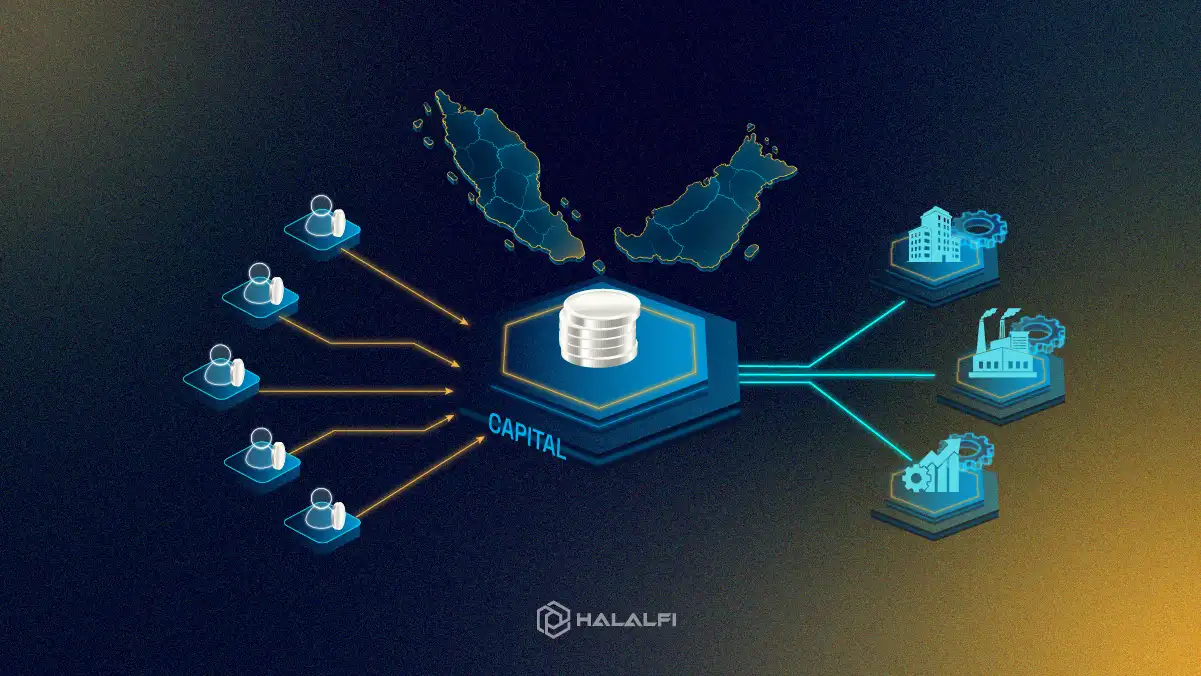
Crowdfunding in Malaysia has already moved far past donation pages and hopeful startup pitches. Malaysia now runs regulated equity crowdfunding, P2P business financing, Shariah-compliant deals and government co-investment schemes.
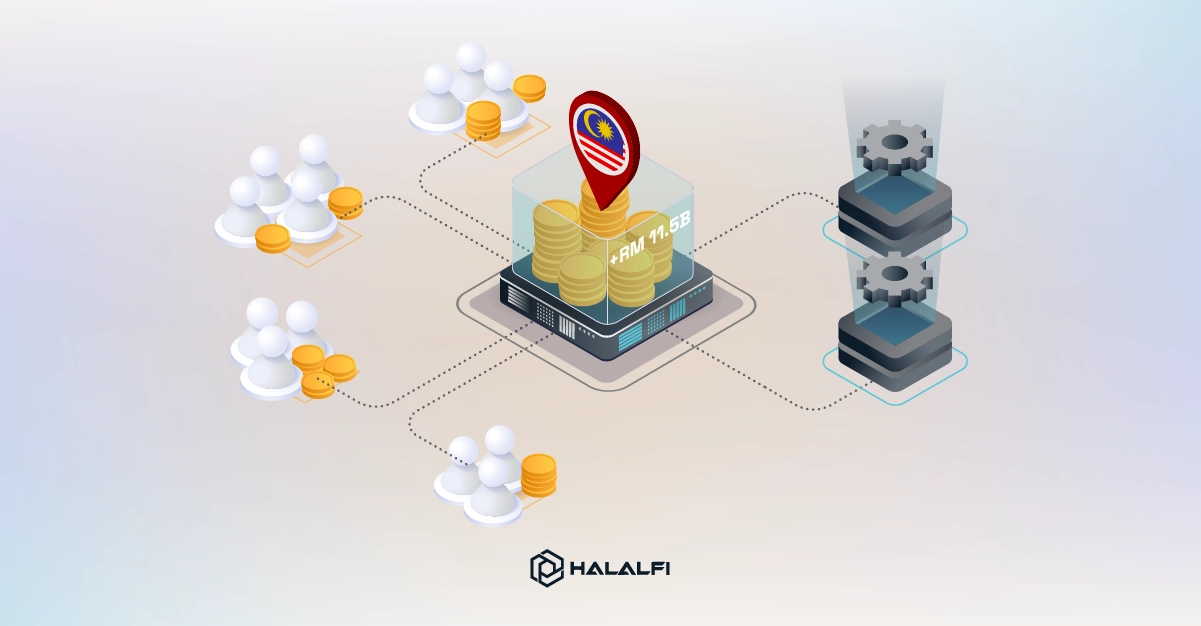
From 2020 through 2025, ECF and P2P platforms channeled more than RM11.5 billion to over 20,000 businesses. P2P alone raised RM2.83 billion during 2025.
That creates an interesting market for both founders and investors. This guide explains what works, which platforms Malaysia regulates, where Islamic crowdfunding fits, and why project-based models deserve a place on the research list for investors exploring opportunities outside conventional crowdfunding.
Crowdfunding in Malaysia Already Moves Billions
Malaysia did something clever with crowdfunding. It did not leave the sector sitting on the edge of finance.
The Securities Commission Malaysia introduced its equity crowdfunding framework in 2015 and P2P financing framework in 2016. By early 2026, Malaysia’s 30 authorized ECF and P2P platforms had facilitated about RM11.9 billion for more than 20,000 MSMEs.
P2P funding alone rose from RM510 million in 2020 to RM2.83 billion in 2025, giving smaller investors wider access to business financing.
Dato’ Mohammad Faiz Azmi, Chairman of the Securities Commission Malaysia, says:
“The MyCIF model synergizes the resilience of public capital with the collective wisdom of the crowd.”
How Does Crowdfunding in Malaysia Work?
Malaysia's regulated investment market relies mainly on two models:
Equity crowdfunding (ECF)
Peer-to-peer financing (P2P)
ECF gives investors company shares and potential future returns. P2P uses investment notes with repayment terms, while Malaysia also permits Shariah-compliant Islamic investment notes for eligible financing.
For crowdfunding for small businesses, that variety matters. A café opening its third outlet has different funding needs from a SaaS startup seeking five years of growth capital. Crowdfunding works best when the contract matches the business problem.
Malaysia Does Something Unusual With the Crowd’s Money
MyCIF provides Malaysia’s crowdfunding market with a strong public-private funding layer by investing alongside private investors rather than relying solely on grants.
Started in 2019, the Ministry of Finance created the Malaysia Co-Investment Fund to support businesses by participating in ECF and P2P platforms.
General co-investment: MyCIF can contribute RM1 for every RM4 raised from private investors.
Scale: By early 2026, MyCIF had passed RM1.5 billion in co-investments.
Total funding: Combined with RM6.2 billion from private investors, the program helped generate RM7.7 billion for more than 11,500 MSMEs.
Strategic sectors: The NIMP fund began with RM131.5 million for industries such as electronics, renewable energy, ICT, food processing, and halal businesses.
Best Crowdfunding Platforms in Malaysia
Searching for the best crowdfunding platforms in Malaysia yields plenty of options. A good way to find a good crowdfunding platform starts with the type of deal, not a ranking.
The SC currently lists recognized operators across ECF and P2P. Examples include pitchIN, MyStartr, Ata Plus, Ethis, Crowdo, Funding Societies, CapBay, microLEAP and several others.
Let’s take a look at each other below:
Palrform | model | What makes it relevant |
pitchIN | ECF | Private-company equity, secondary-market option for eligible funded companies |
MyStartr | ECF | Startup and SME equity fundraising |
Ata Plus | ECF | Private business investment campaigns |
Ethis Malaysia | Shariah ECF | Shariah-screened equity opportunities |
Funding Societies | P2P | SME financing, including Islamic investment products |
microLEAP | P2P | Conventional and Shariah-compliant investment notes |
HalalFi | Islamic blockchain crowdfunding | USDT-based funding for Sharia-reviewed commercial projects, with smart contracts used for funding and distributions |
Malaysia Crowdfunding Investment Rules
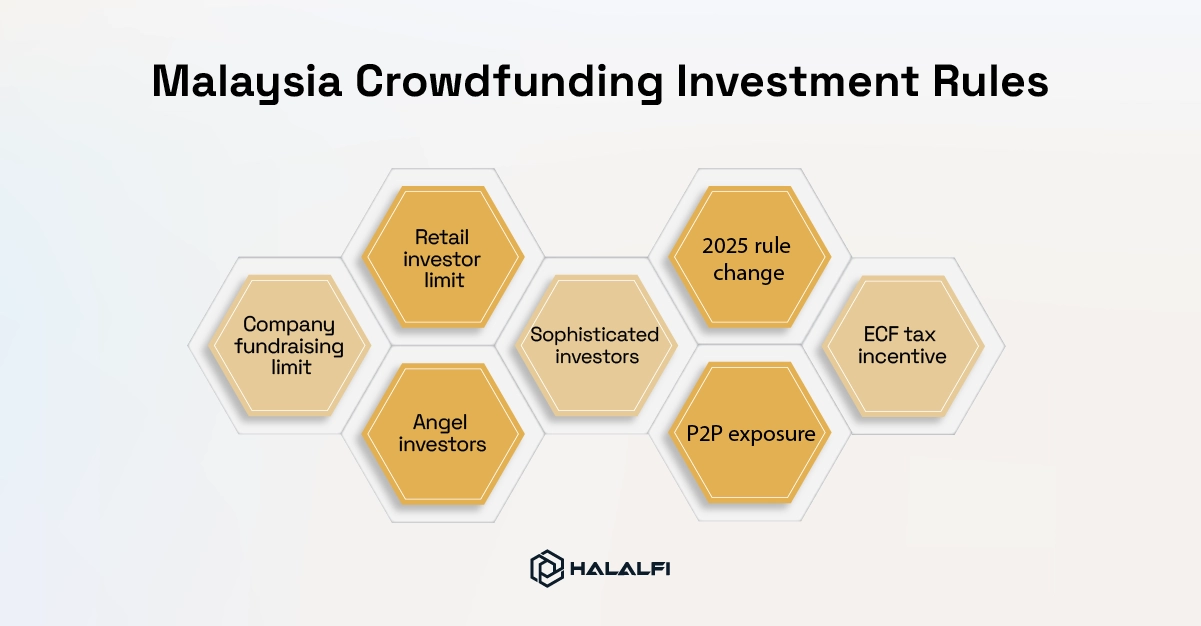
Malaysia regulates ECF through clear limits and investor rules set by the Securities Commission Malaysia.
Company fundraising limit: A company can raise up to RM20 million through ECF platforms over its lifetime, excluding its own capital and private placements.
Retail investor limit: Retail investors can invest up to RM10,000 per issuer and RM50,000 across ECF investments within 12 months.
Angel investors: Angel investors can invest up to RM500,000 per year through ECF.
Sophisticated investors: No specific ECF investment cap applies to sophisticated investors.
2025 rule change: Malaysia increased the retail limit per issuer from RM5,000 to RM10,000 in January 2025, giving individual investors more room to participate.
P2P exposure: The SC encourages retail investors to keep total P2P investments at RM50,000 or below at any one time. This acts as a risk-management guideline rather than a strict legal ceiling.
ECF tax incentive: Qualifying individual investors who invest by December 31, 2026 may claim a tax exemption equal to 50% of the qualifying investment, capped at RM50,000, subject to conditions including a two-year holding period.
The Crowdfunding Issues in Malaysia
Regulation reduces some crowdfunding risks, but it cannot remove them. ECF investors may struggle to sell shares in private companies, face dilution, receive no dividends, or lose capital.
P2P investors face different risks, especially borrower default. Even after credit checks, businesses can still miss payments, and recovery may take months or years, while legal costs can reduce the amount investors ultimately recover.
A high headline return should check:
Who owes the money?
How strong is cash flow?
What happens after default?
Can the investor sell?
Does a guarantee cover the full investment?
Who provides it?
Islamic Crowdfunding in Malaysia Has Moved Into the Main Market
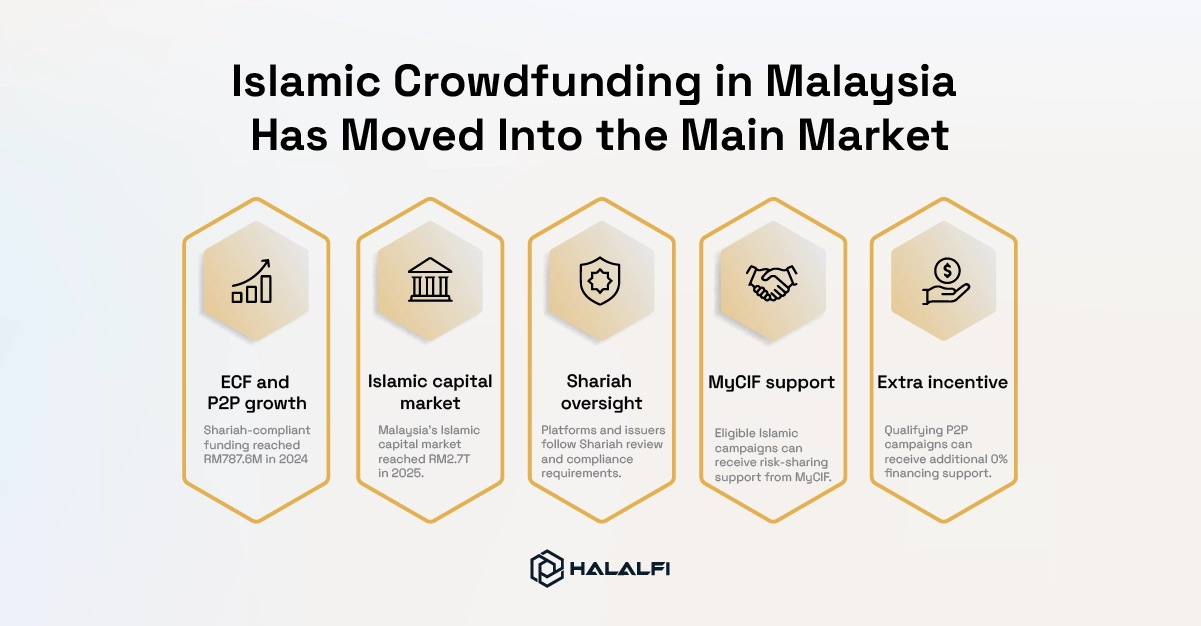
Malaysia has built a Shariah-compliant crowdfunding market alongside its broader Islamic finance sector:
ECF and P2P growth: Shariah-compliant funding reached RM787.6 million in 2024, accounting for 30% of all ECF and P2P fundraising, up from RM524.8 million (24%) in 2023.
Islamic capital market: Malaysia’s Islamic capital market reached RM2.7 trillion in 2025, while sukuk issuance totaled RM284.48 billion.
Shariah oversight: ECF issuers undergo Shariah review, while Islamic P2P platforms must maintain compliant trust accounts.
MyCIF support: Eligible Musharakah and Mudharabah campaigns can access risk-sharing support through 2026.
Extra incentive: MyCIF can take first-loss exposure and provide qualifying P2P campaigns with additional financing at a 0% financing rate.
HalalFi: Malaysian Crowdfunding Meets On-Chain Business Investment
Malaysia already understands the idea behind project-based finance. Investors fund private companies through ECF, finance business activity through P2P, and increasingly participate through Shariah structures. HalalFi takes that idea into crypto crowdfunding.
HalalFi lets users fund specific commercial projects in USDT rather than buying shares in a broad portfolio.
Each project goes through Shariah and business reviews, while smart contracts record funding and settlement on-chain. HalalFi also describes collateral and guarantor mechanisms for selected projects.
The model connects naturally with the country’s existing crowdfunding market. As a Malaysian investor, you can check HalalFi projects and consider them an ethical investment.
Crypto Crowdfunding Is Getting Its Own Malaysian Rulebook
Malaysia's relationship with digital assets deserves a separate mention. According to fintechnews.my, Trading value across regulated Malaysian digital asset exchanges reached RM17.14 billion in 2025, up 23% from RM13.93 billion in 2024.
Malaysia tightened digital-asset rules in May 2026, adding stronger safeguards and governance requirements.
Regulated token fundraising also exists, with platforms such as pitchIN offering token-based capital raising alongside ECF.
That does not make every token-based crowdfunding platform operating online a Malaysian-regulated investment venue.
What Comes Next for Crowdfunding in Malaysia?
In 2026, MyCIF introduced a scheme to bring VC- and private-equity-led deals onto Malaysian ECF platforms. Professional lead investors must commit meaningful capital, while retail investors can join the same opportunities.
Firms such as Gobi Partners and OSK Ventures International have shown interest. This could give crowdfunding investors access to businesses already backed by institutional capital, rather than only companies struggling to attract professional investors.
The SC's 2024–2028 MSME roadmap also calls for more Shariah-compliant ECF and P2P activity, new funding instruments, tokenization experiments, and better pathways from crowdfunding into larger capital markets.
Final Takeaway
Malaysia gives investors something many crowdfunding markets still lack: rules, government co-investment, multiple regulated platforms and a clear route for Shariah-compliant deals.
That does not make every campaign attractive. The opportunity starts when investors can see exactly what their money funds.
Malaysian investors already understand crowdfunding, Islamic risk-sharing and digital finance. HalalFi takes those familiar pieces and connects them to specific commercial projects through USDT and smart contracts.
If you are curious about the next step, explore the live projects, read the contracts, examine how each business intends to earn its profits, and review the terms of protection before committing capital. A good investment should survive the questions asked before the money moves.
Frequently Asked Questions
Can foreigners invest in equity crowdfunding in Malaysia?
Yes. Malaysia's ECF investment limits apply to both local and foreign investors. Foreign investors still need to satisfy the platform's identity, onboarding and legal requirements.
Can a Malaysian company run crowdfunding campaigns on two ECF platforms simultaneously?
No. The SC states that an issuer may use only one ECF platform at a time. A company may use ECF and P2P simultaneously in certain circumstances, but it must meet the applicable disclosure requirements.
What happens if a Malaysian ECF campaign misses its funding target?
Malaysia uses an all-or-nothing approach for ECF. If the issuer fails to meet its minimum funding target, the campaign fails, and the platform returns the funds collected to investors.
Can investors sell shares bought through crowdfunding in Malaysia?
Possibly, but liquidity remains limited. An SC-approved ECF secondary market can allow trading in successfully funded companies, generally at least six months after the completion of the fundraising campaign.
Does SC registration mean a crowdfunding investment cannot fail?
No. SC registration governs the platform and imposes requirements on due diligence, disclosure, governance, and the safeguarding of investor funds.