
Can halal investment options in Singapore compete with the investment choices available to everyone else?
Yes, but finding them takes more effort than opening a brokerage app and buying whatever tops the “most popular” list.
Singapore investors can now choose from Shariah-screened global equities, sukuk funds, Islamic deposits, selected CPF investments and private business opportunities.
The tricky part comes from putting those pieces together. A product can look conservative, profitable, or diversified and still fail to meet the investor's own Shariah criteria.
The good news? Investors no longer need to choose between leaving cash untouched and taking a chance on an investment they barely understand.
What Makes an Investment Halal in Singapore?
A halal investment starts with the source of its return. Shariah screening normally removes companies that earn significant revenue from conventional finance, gambling, alcohol, pork and other prohibited activities. Screening methods also examine financial ratios such as debt and interest-bearing cash.
UOB's current Singapore material gives a useful example. Its Islamic investment guidelines use financial screens that include a 33% threshold for certain debt and interest-bearing assets, alongside business-activity exclusions.
UOB Singapore says:
“Islamic finance is an ethical mode of finance that derives its principles from the Shariah.”
That does not mean every provider applies identical criteria. One Shariah board may reach a different conclusion from another on a company near a financial threshold.
A sensible Shariah-compliant investment, therefore, requires two checks:
First, understand what the company or asset actually does.
Then look at who performed the Shariah screening and which methodology they followed.

Best Halal Investment Options in Singapore
There is no universal winner. The best choice for money needed in three years will look very different from an investment intended to compound until retirement.
Singapore investors who care about Islamic finance now have some choices, and we take a look at them:
Investment option | How returns come in | Current Singapore angle | Often suits |
Shariah global equity fund | Company growth and dividends | CPFIS-OA option exists | Long-term investors |
Global halal ETF | Market growth and dividends | Requires broker access to overseas markets | Cost-conscious DIY investors |
Sukuk fund | Income from Shariah-compliant securities | SGD share classes exist | Investors seeking income diversification |
Islamic term deposit | Profit under Islamic contract | CIMB and Maybank offer local products | Lower-risk capital |
Gold | Price appreciation | Widely accessible | Portfolio diversification |
Private business projects | Profit from commercial activity | Usually outside public markets | Experienced investors |
Singapore Has a Halal Fund Inside CPFIS
The Templeton Shariah Global Equity Fund AS Acc SGD is available for CPF Ordinary Account investing and carries a Moderately Higher Risk rating.
It returned 24.02% annualized over one year by August 27, 2026, but past performance does not guarantee long-term results.
Franklin Templeton reported US$205.15 million in total net assets as of June 30, 2026, for the Templeton Shariah Global Equity Fund. The fund invests primarily in global Shariah-compliant equities.
Fees deserve attention too. The CPF share class carries an annual expense ratio around 1.75%, according to FSMOne's current factsheet.
That makes cost comparison worthwhile when investors can buy lower-cost Shariah ETFs with cash through overseas exchanges.
CPF Board itself offers the right warning:
“All investments come with risks.”
As of September 2025, Singaporeans held S$21.4 billion of OA and SA savings through CPFIS investments.
CPF also plans a new long-term investment scheme, but providers will only arrive in 2027, and the scheme should launch in 2028.
Global Halal ETFs for Singapore Investors
Cash investors do not need to limit themselves to Singapore-distributed funds.
A broker with access to overseas exchanges can open the door to ETFs such as SPUS, HLAL and ISWD.
Each fund follows a Shariah-screened approach, but they differ in geography, costs and domicile.
ETF | Main exposure | Expense ratio | Domicile |
SPUS | U.S. large-cap Shariah stocks | 0.45% | United States |
HLAL | U.S. Shariah-screened equities | 0.50% | United States |
ISWD | Developed-world Islamic equities | 0.30% | Ireland |
SPUS reported about US$2.79 billion in mid-2026. HLAL tracks the FTSE Shariah USA Index, while BlackRock's ISWD held roughly 390 stocks and US$1.62 billion in assets by August 28, 2026.
For a Singapore investor, domicile deserves attention. U.S.-domiciled and Irish-domiciled ETFs can create different dividend withholding and estate-tax considerations. Cheap does not automatically mean efficient after tax.
Halal Investment Apps in Singapore Are Not All Doing the Same Job
A halal investment app Singapore search can create another problem. Some apps screen stocks, some help users build portfolios. Others execute investments. Those roles should not get mixed together.
RizqX currently screens more than 28,000 stocks and 90 funds, according to its website.
Its August 2026 roadmap lists public-market trading through third parties as work in progress and private-market execution for accredited investors as a later step.
Musaffa also appears in Singapore's App Store. It offers stock and ETF screening, purification tools and Shariah compliance reports. Its Singapore listing says the database covers more than 60 global markets.
Neither fact means an investor should assume the app itself holds the necessary Singapore license for every service shown.
Singapore's MoneySense guidance recommends checking a provider through MAS before dealing with it, particularly when money moves through an overseas or unfamiliar company. Investors who choose an unregulated provider give up safeguards available under MAS rules.
The Low-Risk Problem Is More Interesting in Singapore
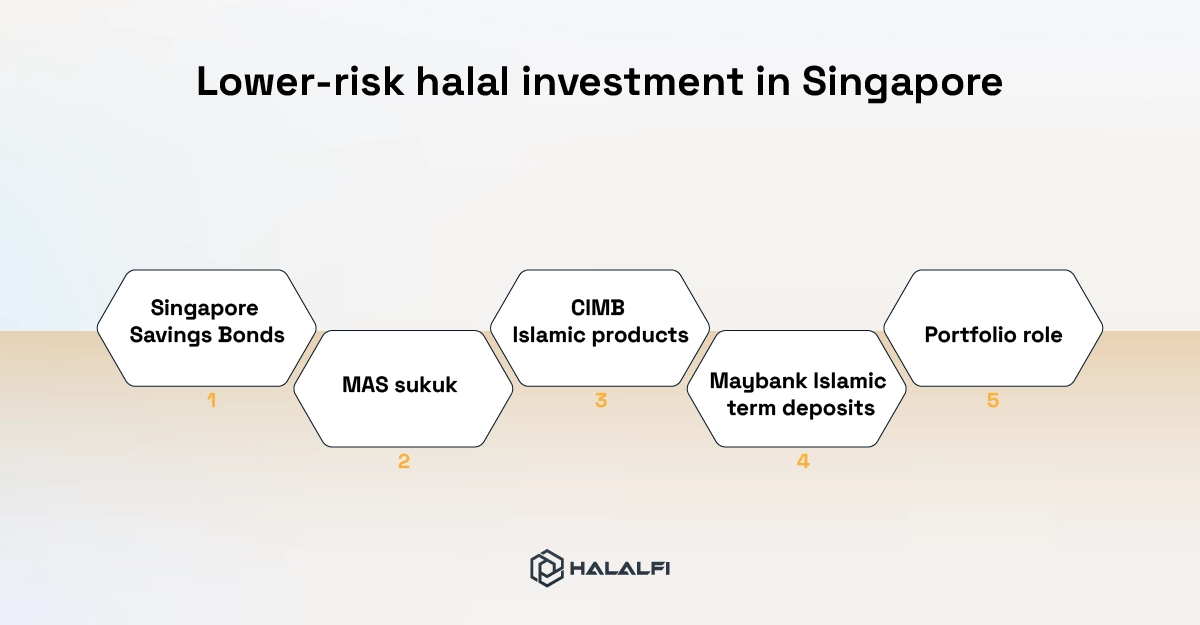
Lower-risk halal investment in Singapore can be harder to find than equity options.
Singapore Savings Bonds: SSBs pay interest. Pergas has previously indicated that they would likely not meet Shariah requirements without an equivalent Shariah-compliant structure.
MAS sukuk: Singapore has an MAS sukuk facility, but retail investors cannot access it as easily as they can buy SSBs.
CIMB Islamic products: CIMB offers Shariah-compliant investment StarSaver-i accounts and Islamic fixed deposits. August 2026 board rates range from 0.10% to 0.35%, depending on tenure and balance.
Maybank Islamic term deposits: Current SGD rates can reach 0.50% for 24 months, with different rates available for some customers aged 55 and above.
Portfolio role: These products will not appeal to investors chasing double-digit returns. Their value comes from stability, liquidity and giving lower-risk capital with a Shariah-conscious place in the portfolio.
SRS Adds a Tax Question to Islamic Investment in Singapore
Singapore's tax system makes portfolio structure worth thinking about.
IRAS allows Singapore citizens and permanent residents to contribute up to S$15,300 annually to SRS.
Foreigners can contribute up to S$35,700. Eligible contributions receive tax relief, subject to Singapore's overall personal relief cap of S$80,000.
Investment gains can grow tax-free inside the account before withdrawal, while Singapore generally taxes only 50% of qualifying retirement withdrawals.
The challenge for Islamic investment in Singapore comes from product choice. A fund that accepts CPF money does not automatically accept SRS money.
FSMOne, for example, currently lists the Templeton Shariah CPF share class as CPFIS-OA-eligible but not SRS-eligible.
Singapore's Tax Rules Make Long-Term Investing Attractive
Singapore does not tax capital gains on personal investments. IRAS says gains from buying and selling shares, financial instruments, and even digital tokens generally count as personal investment gains rather than taxable income. Frequent trading or activity that resembles a business can lead to different treatment.
That gives long-term investors another reason to avoid unnecessary trading. A portfolio does not need constant movement to prove that its owner pays attention.
Your Halal Investment in Singapore Could Fund a Real Business with HalalFi
Most halal investment options in Singapore give investors exposure to funds, ETFs, or deposits. In HalalFi, investors can fund defined business projects in USDT, with each opportunity reviewed for Shariah compliance and commercial viability.
Smart contracts record funding and settlement, while project pages show the target, duration, and expected profit.
As an investor in Singapore looking outside public markets, I find that this creates a better way to study the business behind the return.
So check Halalfi projects, compare their economics and protections, and decide which opportunity actually deserves the capital.
Conclusion
Singapore already gives investors most of the financial plumbing they need. The challenge comes from navigating it without quietly accepting products that conflict with their investment principles.
A strong Muslim investment plan in Singapore might combine a global Shariah equity fund, overseas Islamic ETFs, sukuk exposure, an Islamic cash product, and, for investors who understand the additional risk, selected private commercial projects. No portfolio needs every category.
The goal should remain boringly practical. Know what owns your money, where the return comes from, how quickly you can exit, who checked the Shariah structure, and what happens when the investment does not play out as expected.
HalalFi is for those who want to examine short-duration, real-world business projects rather than stopping at listed funds.
So open a project, review the economics, assess the protections, and decide whether the deal deserves a place alongside the rest of the portfolio.
Frequently Asked Questions
Can foreigners living in Singapore make halal investments?
Yes. Foreign residents can generally access Shariah funds, eligible overseas securities, and various Islamic banking products.
Are Singapore REITs automatically halal?
No. A REIT can own permissible property while still using financing or earning income that creates Shariah concerns.
Do Singapore investors need to purify dividends from halal stocks?
Sometimes. Many Shariah screening methodologies tolerate a limited amount of non-permissible incidental income and calculate a purification amount for investors to donate.
How often should Singapore investors check whether a stock remains Shariah-compliant?
At least whenever the screening provider updates its classification. Companies can change their debt levels, cash positions or sources of revenue.
Can a halal investment in Singapore lose money even with Shariah approval?
Yes. Shariah approval addresses the structure and permitted activities of an investment, not its commercial success.