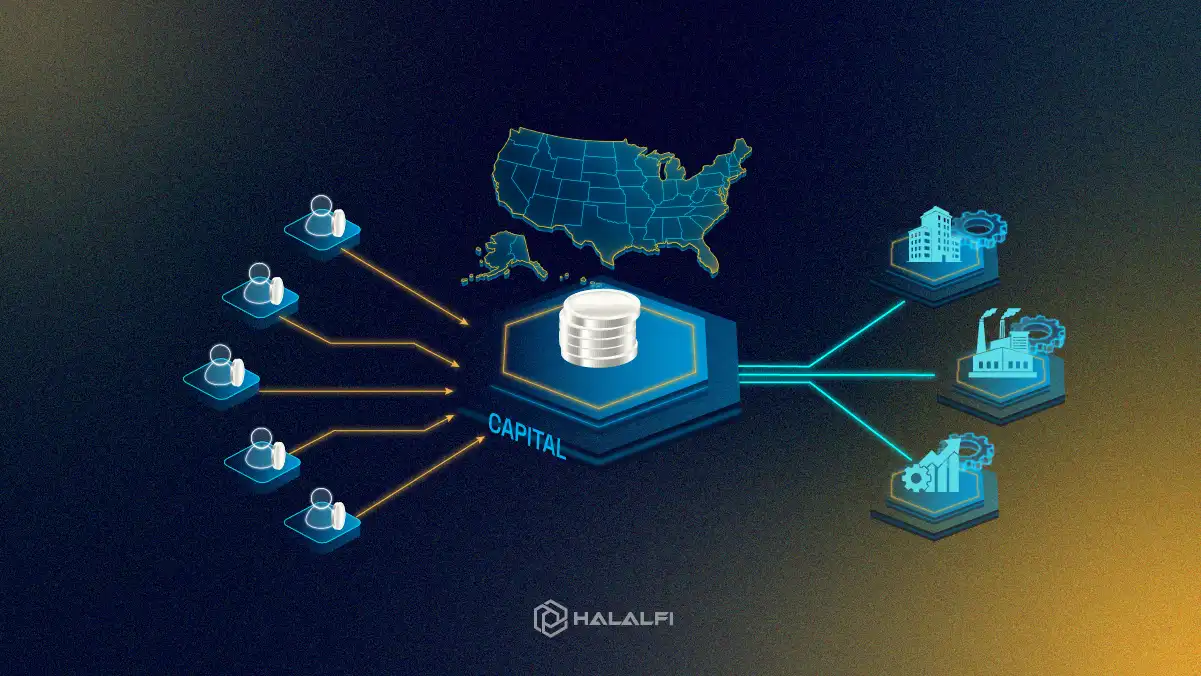
Imagine the first people who financed an American business were its customers, neighbors, or future users. Crowdfunding in America makes that happen.
A founder can collect donations, sell rewards, lend money, or offer securities like shares or SAFEs.
Each model has different legal rules and investor expectations, so understanding these distinctions helps investors assess risks and potential returns.
The timing makes this worth studying. U.S. Regulation Crowdfunding, or Reg CF, attracted about $378.3 million in 2025.
Meanwhile, Federal Reserve data shows that only 42% of small-business financing applicants received everything they sought in the 2025 survey.
For founders, the crowd can provide capital and market proof. For investors, it opens businesses that rarely appear in a brokerage account. So let's see how Crowdfunding in America works.
Is crowdfunding legal in the US?
Yes. Crowdfunding is legal in the United States, but the rules depend on the transaction rather than the label attached to the campaign.
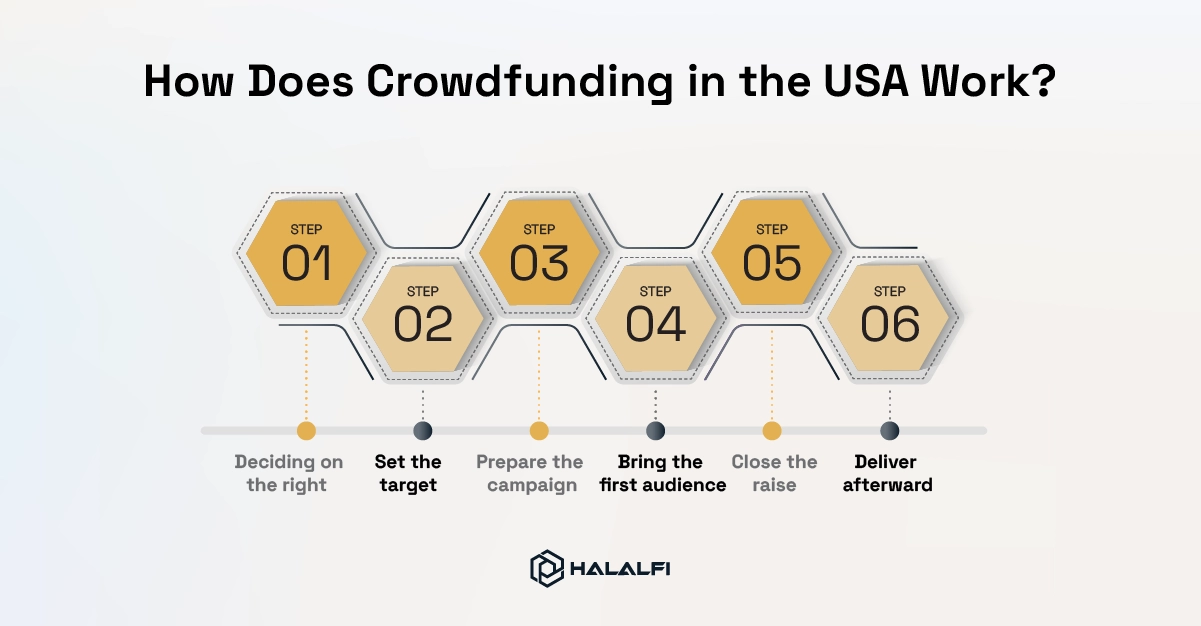
For investment crowdfunding, Regulation Crowdfunding gives eligible companies a defined federal route:
Up to $5 million: A company can raise up to $5 million through Reg CF within the applicable rolling 12-month calculation.
Registered intermediary: The offering must run through an SEC-registered broker-dealer or a FINRA-member funding portal.
Investor limits: Non-accredited investors face annual limits based on income and net worth. Accredited investors are not subject to the same Reg CF cap.
Disclosure: Companies file information with the SEC and provide it to investors.
Resale limits: Investors generally cannot resell Reg CF securities for 1 year, except for specified exceptions.
For the primary rules, see the SEC Regulation Crowdfunding guide.
How Does Crowdfunding in the USA Work?
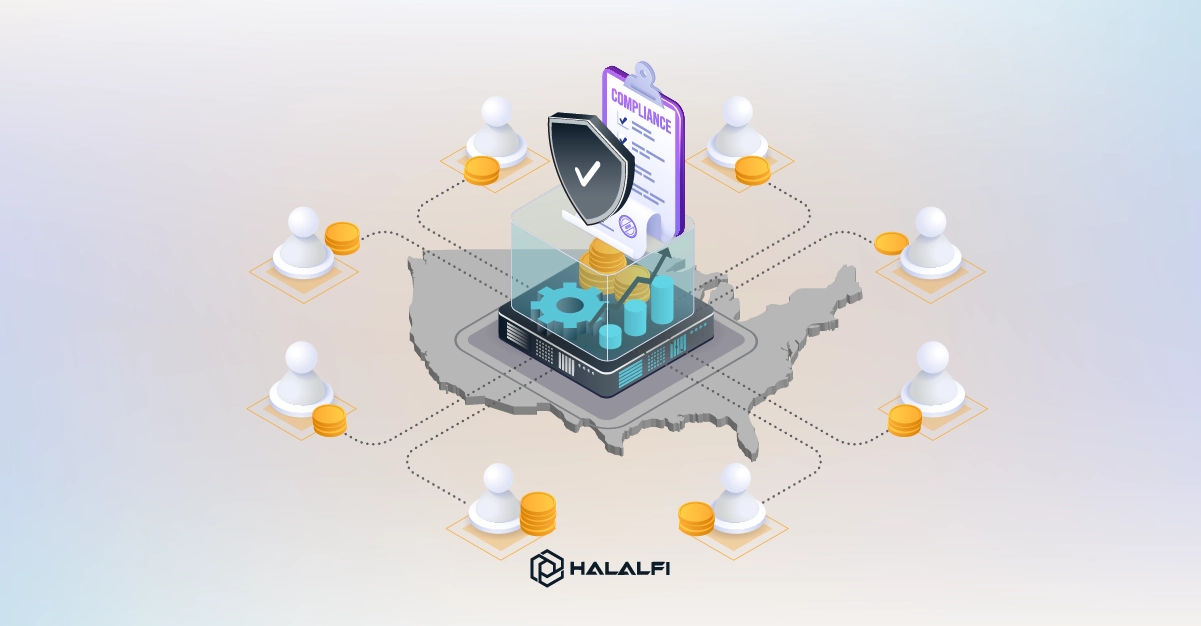
A crowdfunding campaign transforms a large capital need into smaller commitments. The process involves choosing a model, setting a target, preparing disclosures, building early momentum, closing the raise, and delivering rewards or returns-each step requiring careful planning and timing.
Deciding on the right model-donations, rewards, loans, or investments-can motivate entrepreneurs by showing clear pathways to funding, encouraging them to take action.
Set the target: Explain how much the business needs and exactly where the money will go.
Prepare the campaign: Reg CF issuers complete required disclosures before collecting investments.
Bring the first audience: Customers, email subscribers, local supporters, and existing fans often create early momentum.
Close the raise: The company receives funds after satisfying the campaign and regulatory conditions.
Deliver afterward: Founders still need to ship rewards, repay notes, report to investors,s or grow the company.
The point is: In the U.S., investment crowdfunding has one additional requirement: Reg CF campaigns must run through an SEC-registered broker-dealer or a FINRA-member funding portal.
Don't forget Crowdfunding changes the source of capital. It does not remove the work that follows.
U.S. Crowdfunding Got Pickier in 2026
U.S. investment crowdfunding finished 2025 strongly. KingsCrowd recorded $378.3 million through Reg CF and $546.6 million through Reg A+, bringing the combined figure to roughly $924.8 million. Reg CF grew 11% in 2024 even though fewer new offerings launched.
Then 2026 became more selective. Investors committed $139.5 million to Reg CF in the first half of 2026, down 28.1% year over year.
New launches fell to 388, yet 396 of 533 resolved campaigns succeeded, a 74.3% success rate in KingsCrowd's dataset. The median successful raise reached about $147,500.
Why Crowdfunding for Small Businesses Has a Real U.S. Audience
America had 36.2 million small businesses in the SBA Office of Advocacy's 2025 profile, representing almost 46% of private-sector employment. Yet access to capital still creates friction.
Fedsmallbusiness found that 60% of firms sought financing. Only 42% received the full amount they wanted, while 22% received nothing. Expansion or a new opportunity drove 46% of financing demand.
Now picture a neighborhood restaurant that needs a second kitchen, not a Silicon Valley startup chasing a billion-dollar valuation.
Honeycomb reports that Pittsburgh's Bae Bae's Kitchen raised $98,000 from 56 investors. That model lets customers become lenders to a business they already know.
So crowdfunding for small businesses becomes useful rather than theoretical.
Best U.S. Crowdfunding Platforms
Calling one company the best crowdfunding platform misses the point. A medical fundraiser, coffee shop expansion, and a venture-backed software company need different structures.
Let's compare the most popular crowdfunding platforms in America:
Platform | Model | Useful current signal | Better fit for |
GoFundMe | Donation | $40B+ raised through its technology since 2010 | Personal causes and nonprofits |
Kickstarter | Rewards | Several 2026 U.S. campaigns crossed $2M | Products, games and creative launches |
Wefunder | Investment crowdfunding | Led Reg CF H1 2026 volume at $39.4M | Startups and community rounds |
StartEngine | Reg CF / Reg A+ | 1,513 Reg CF offerings had raised $642M+ by Dec. 2025 | Startups and larger public raises |
Republic | Private investment | Reports 3M+ community and 2,500+ ventures funded globally | Startups and broader private assets |
Honeycomb | Small-business debt | 18,000+ investor community | Local operating businesses |
HalalFi | Islamic / blockchain crowdfunding | Uses USDT to fund Sharia-reviewed real-business projects through smart contracts | Investors seeking halal, project-based crowdfunding tied to commercial activity |
HalalFi sits in a different category from most U.S. crowdfunding platforms. Instead of donations, rewards, or conventional interest-based debt, it connects investors with Sharia-compliant commercial projects funded in USDT.
HalalFi is a global platform, with participation from different countries subject to applicable regulations and platform requirements.
U.S. investors should therefore confirm their eligibility and the legal status of a specific offering before participating.
What Do Investors Own in a Reg CF Deal?
A Reg CF page can look like an online store, but the checkout button may buy something much more complicated than a product.
Investors might receive common shares, preferred shares, a SAFE, a convertible note, or another security.
In H1 2026, equity-like structures, including shares, SAFEs, and convertible notes, accounted for roughly 96.3% of tracked Reg CF and Reg A+ investment volume.
That detail affects almost everything: Shares create ownership immediately; a SAFE usually converts after a future financing or another defined event; and Debt creates repayment obligations.
Before clicking “invest,” read the actual security terms. A $100 investment in a SAFE and $100 in common stock can yield very different rights, even when the two companies sit side by side on the same website.
What Makes a Crowdfunding Campaign Worth Opening?
A slick video can attract a click. Numbers make the next ten minutes worthwhile. Before launch, a founder should be able to answer:
Who already cares? A customer list, local following, or online community gives the campaign somewhere to start.
What will the money buy? “Growth” says almost nothing. New equipment, inventory, hiring, or a second location says much more.
What happens if only the minimum arrives? The business still needs an executable plan.
How much does the raise cost? Platform, legal, accounting,g and marketing costs reduce usable proceeds.
What happens after funding? Investors or backers expect communication long after campaign day.
Crypto Crowdfunding in America Is Entering Another Regulatory Test
Crypto crowdfunding is legal because using blockchain does not automatically take a fundraising transaction outside securities law.
On August 18, 2026, the SEC proposed “Regulation Crypto Assets.” The proposal includes potential exemptions for certain covered investment-contract offerings, including one route up to $5 million over four years and another up to $75 million in 12 months.
Halal Crowdfunding Has a Product Gap in the American Market
The U.S. already offers regulated investment portals, but Regulation Crowdfunding does not, by itself, screen a business for compliance with Islamic finance principles. Some local-business crowdfunding models also rely on interest-bearing debt.
At the same time, Islamic investing has reached serious scale internationally. LSEG reported $5.98 trillion in global Islamic finance assets in 2024, up 21% year over year.
So we have a concept here: halal crowdfunding. Investors may want the direct business access of crowdfunding without interest-based financing or for businesses that fail Sharia screening.
How HalalFi Expands Halal Crowdfunding in the USA
HalalFi targets investors through project-based business funding rather than a standard U.S. equity portal. Investors use USDT to fund defined commercial projects.
In HalalFi, each project undergoes Sharia and business reviews, while smart contracts record funding, distributions, and settlement.
If you are a U.S. investor, HalalFi addresses the Sharia-screening gap that mainstream American platforms do not automatically cover.
But HalalFi does not appear on FINRA's current list of registered funding portals by name, so U.S. users should verify each project's legal eligibility and structure before participating.
Before Putting Money Into United States Crowdfunding
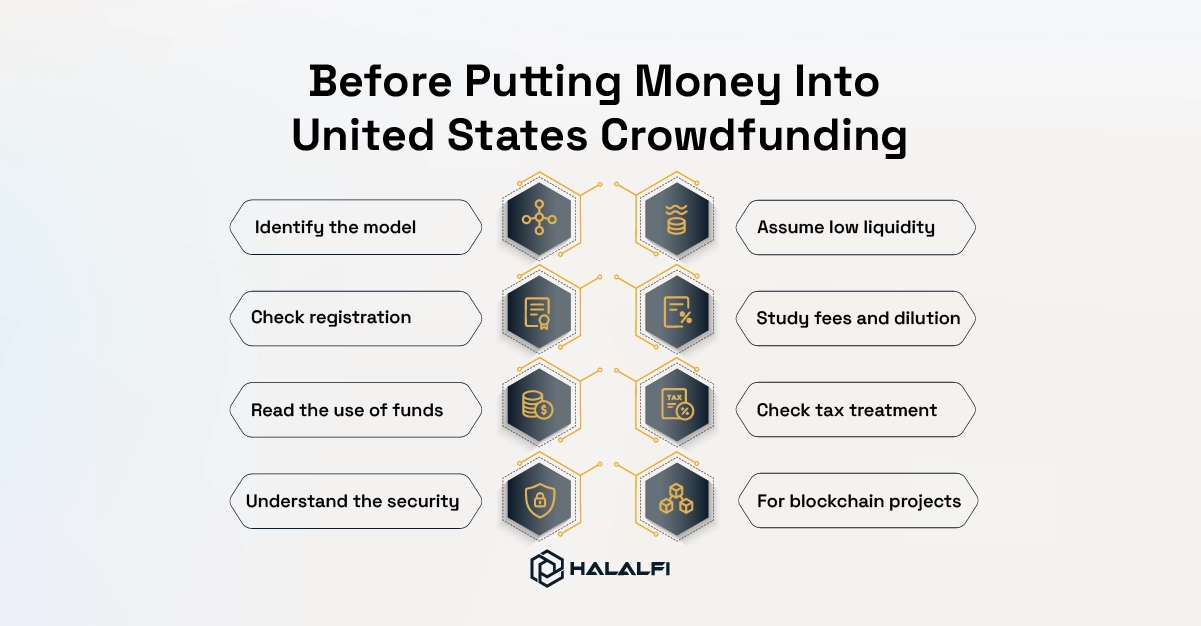
A campaign deserves more than a glance at the percentage funded. Investors should check the underlying economics.
Identify the model: Donation, reward, equity, debt, and project funding create different rights.
Check registration: For Reg CF, verify the intermediary through FINRA and review the issuer's SEC filings.
Read the use of funds: Look for specific purchases or operating needs rather than broad promises.
Understand the security: Shares, SAFEs, and notes do not behave the same way.
Assume low liquidity: Private investments may stay private for years.
Study fees and dilution: Both can change the eventual economics.
Check tax treatment: The IRS says crowdfunding tax treatment depends on the facts and circumstances.
For blockchain projects: Add stablecoin, smart contract, and jurisdictional risk to the checklist.
After taking action against a Kickstarter creator who misused campaign money, then-Consumer Protection Director Jessica Rich said:
“Consumers should be able to trust their money will actually be spent on the project they funded.”
Conclusion
Crowdfunding in America now stretches from a neighborhood café borrowing from regular customers to a startup selling securities nationwide.
The market has enough history to prove the model works, and enough failed or illiquid investments to prove that the platform cannot replace due diligence.
Founders should ensure that the business provides the crowd with sufficient evidence to believe it should. HalalFi Projects also offers an additional option:
fund identifiable commercial projects, assess the economics, and compare the stated protections before committing capital.
Frequently Asked Questions
Can a non-U.S. citizen invest in American crowdfunding?
Some U.S. crowdfunding platforms accept international investors, but eligibility depends on the platform, the offering, and the investor's home-country rules.
Is crowdfunding legal in America?
Yes. Crowdfunding is legal in the United States, but different rules apply to donation-, reward-, debt-, and investment-based campaigns.
What is the best crowdfunding platform in America?
It depends on the goal. Kickstarter suits product and creative campaigns; GoFundMe focuses on donations. For investors seeking halal crowdfunding, HalalFi offers an alternative model.
How much can a company raise through crowdfunding in the USA?
Under Regulation Crowdfunding, eligible U.S. companies can raise to $5 million over 12 months through a registered funding portal or broker-dealer.
Can anyone invest in crowdfunding in America?
Most people can participate in U.S. investment crowdfunding. Non-accredited investors can invest as well, though federal rules may limit how much they can invest based on their income and net worth.
Is crowdfunding in America risky for investors?
Yes. Startups and small businesses can fail, private securities can be difficult to sell, and returns are never guaranteed.
Can startups use crowdfunding instead of venture capital?
Yes. Many U.S. startups use crowdfunding to raise capital from customers and individual investors instead of relying entirely on venture capital.
How long does a crowdfunding campaign usually run in America?
Campaign length varies by platform and funding model. Reward campaigns may run for several weeks, while investment crowdfunding rounds can remain open for months.