
Whether mutual funds are halal in Islam depends less on the word “fund” and more on what the fund owns, how it earns, and how managers handle non-permissible income.
A mutual fund itself is only a container. One fund might own alcohol producers, conventional banks and bonds.
Another might hold Shariah-screened companies and sukuk under independent scholarly supervision. In this article, we explain more about halal mutual funds in Islam.
Is Mutual Fund Halal or Haram?
A mutual fund can qualify as halal when its assets, investment process, and income treatment follow accepted Shariah principles. A conventional mutual fund does not automatically meet those conditions.
The Islamic Financial Services Board defines an Islamic collective investment scheme as one that involves pooled ownership, profit-and-loss participation, and management in accordance with Shariah rules.
That means a fund holding conventional bonds creates an obvious riba problem. A fund heavily invested in banks, gambling companies or alcohol producers creates another.
An equity fund can work differently. If its managers screen businesses, financial ratios, and non-permissible income using a recognized Shariah methodology, scholars may approve it as a halal investment.

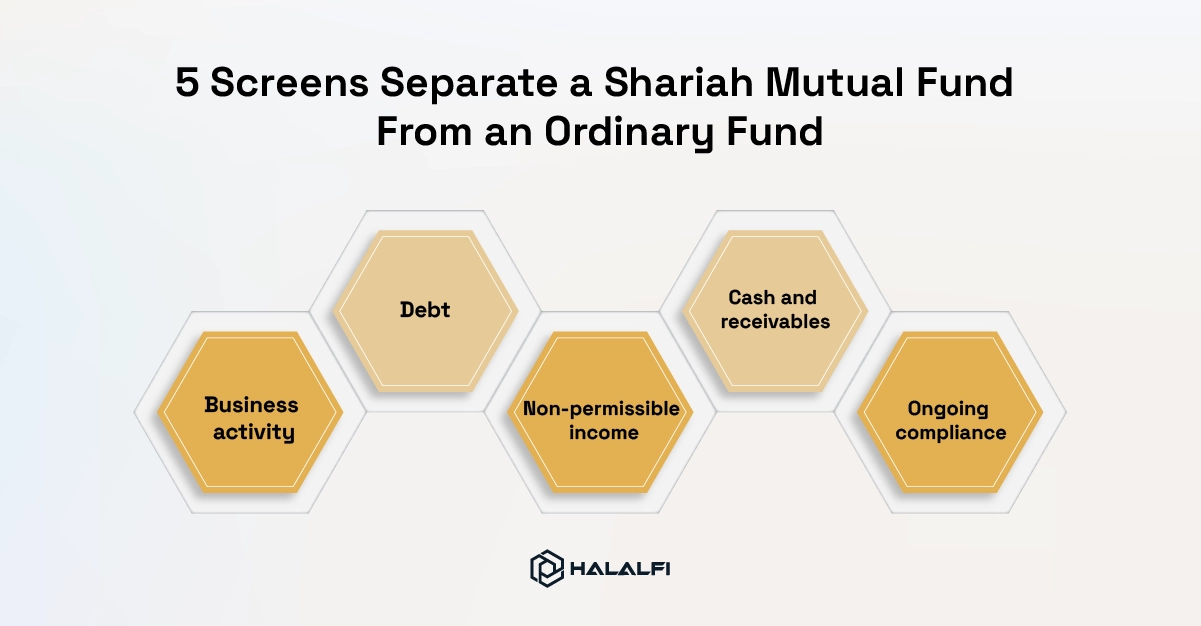
5 Screens Separate a Shariah Mutual Fund From an Ordinary Fund
Fund managers need to look deeper than company names. A technology company, for example, may sell a permissible product while carrying enough interest-bearing debt to fail a Shariah financial screen. A credible Shariah mutual fund checks:
Business activity: It excludes businesses centered on alcohol, gambling, pork, conventional finance, and other prohibited activities.
Debt: Screening methodologies limit interest-bearing leverage.
Non-permissible income: Many methodologies use a threshold around 5%.
Cash and receivables: Some standards apply additional balance-sheet tests.
Ongoing compliance: Managers must keep checking holdings because company finances change.
Does the 5% Rule Mean Interest Becomes Halal?
The 5% threshold does not mean scholars consider riba permissible below 5%. Screening methodologies use a threshold to address incidental non-compliant income within otherwise permissible businesses.
Different standards also use different calculations. FTSE, for example, requires non-compliant income to be below 5% and applies financial-ratio screens, including debt below 33.333% of total assets.
That is why two Shariah screening services can occasionally reach different conclusions about the same company.
Why Many Conventional Mutual Funds Fail the Halal Test
A fund does not need to own a casino to create a Shariah problem. The trouble often hides in less obvious parts of the portfolio. Watch for:
Conventional bonds: Their returns normally depend on interest-bearing debt.
Financial stocks: Traditional banks and insurers commonly fail Shariah business screens.
Prohibited industries: Alcohol, gambling and pork-related businesses create direct conflicts.
Interest-bearing cash: Fund managers may park unused cash in conventional money-market instruments.
High-debt companies: A permissible core business can still fail the financial screens.
Mutual Funds vs Halal Mutual Funds: The Difference Is Under the Hood
Both products pool money from many investors. The investment rules separate them. Don't forget that “Halal” describes how the investment operates. It does not promise that the investment will make money.
Let's compare Mutual Funds & Halal Mutual Funds in the table below:
Feature | Conventional Mutual Fund | Shariah Mutual Fund |
Conventional banks | Usually allowed | Generally excluded |
Alcohol and gambling | May be included | Excluded under Shariah screens |
Conventional bonds | Common | Generally excluded |
Debt screening | Not required | Required by methodology |
Shariah board | No | Common in dedicated Islamic funds |
Purification | No | May apply |
Market risk | Yes | Yes |
Guaranteed return | No | No |
A List of Halal Mutual Funds Investors Can Research
The market now includes established funds in the United States, Pakistan, Europe, and other regions.
Availability depends on the investor’s country and broker, so this is a research list rather than a universal recommendation. Let’s check the list:
Fund | Market / Focus | Current Detail |
Amana Growth Fund | U.S. large-cap growth | Investor share expense ratio 0.86% |
Amana Income Fund | U.S. equity income | Investor share expense ratio 1.01% |
Amana Developing World Fund | Emerging markets | Investor share expense ratio 1.20% |
Templeton Shariah Global Equity Fund | Global equities | $202.8M net assets at July 31, 2026 |
Meezan Islamic Fund | Pakistan equities | Rs65.51B fund size at July 31, 2026 |
Are Islamic Mutual Funds Automatically Halal?
The IFSB’s governance guidance for Islamic collective investment schemes specifically addresses portfolio screening, Shariah scholars’ oversight and purification of tainted income. A good review based on Islamic Finance should cover:
Shariah advisers: Who reviews the portfolio and how independent are they?
Methodology: Which business and financial screens does the fund follow?
Review frequency: How quickly does the manager respond when a company no longer qualifies?
Purification: Who calculates and removes non-permissible income?
Prospectus: Do the legal investment rules match the marketing language?
In July 2025, the IFSB adopted a new standard focused on effective supervision of Shariah governance across Islamic financial institutions and capital markets. The paperwork matters because compliance needs to continue after launch day.
Fixed Profit Is Not What a Mutual Fund Promises
The term "fixed profit" create the wrong expectation around Islamic investments. An equity mutual fund does not know what stocks will trade for next year.
Its NAV rises and falls with the assets it owns. Even an Islamic income fund carries investment, credit or market risks depending on its holdings.
Franklin Templeton states that investors in its Shariah Global Equity Fund may receive less than the amount they originally invested. Islam does not prohibit profit; the concern centers on how that profit arises.
Ownership, trade, and investment risk differ from an interest-bearing loan, where a lender demands a predetermined return simply for lending money.
So when someone asks whether investing is halal, we should say that the source of the return counts as much as the percentage.

Mutual Funds Solve Diversification
A mutual fund solves a problem beautifully. But Investors rarely choose what each company does with their specific dollar.
Someone buying a global Islamic fund may see Microsoft, Samsung and dozens of other companies in the portfolio, but the investment remains pooled.
That creates room for another form of Islamic investing: directly funding a defined business activity.
How HalalFi Gives Investors What a Mutual Fund Cannot
HalalFi does not operate like a mutual fund. It connects investors with specific commercial projects funded in USDT.
HalalFi Projects undergo Shariah and business reviews. Project pages show the funding target, duration, expected return, business activity and available protection mechanisms, while smart contracts record parts of funding and settlement on-chain. HalalFi’s smart contracts also received an Immunefi audit dated November 20, 2025.
For someone who finds a mutual fund too distant from the underlying business, project-level investing allows inspection of a single commercial activity before deciding whether it warrants capital.
Conclusion
So, are mutual funds haram? Not as a category. A conventional fund that relies on interest-bearing bonds, prohibited businesses or other non-compliant assets can create clear Shariah problems.
A properly governed Islamic mutual fund can offer diversified market exposure while applying business screens, financial ratios, ongoing supervision and purification.
You should open the portfolio before opening the wallet. Mutual funds work well when diversification matters most.
Investors who want to see exactly which business receives their capital can also examine project-based alternatives.
HalalFi lets investors study defined commercial projects rather than a broad basket of companies.
Explore previous projects, compare their economics, and join the notification list if the next Shariah-reviewed opportunity aligns with your risk tolerance.
Frequently Asked Questions
Is a monthly SIP into a halal mutual fund permissible?
The recurring payment method does not determine Shariah compliance. If the underlying mutual fund follows acceptable Islamic investment rules, regularly investing a fixed amount does not automatically create a Shariah problem.
Can an index mutual fund be halal?
Yes, if the index itself applies appropriate Shariah screens and the fund follows that index accurately.
What happens when a company inside an Islamic fund becomes non-compliant?
The fund’s methodology normally determines how and when the manager removes that company.
Do halal mutual funds pay dividends?
They can. Equity funds may receive dividends from portfolio companies and distribute income according to the fund’s policy.
Can a retirement account hold a Shariah mutual fund?
Potentially, yes. The tax or retirement wrapper does not decide whether the underlying fund follows Shariah.
Are halal mutual funds only for Muslims?
No. Islamic funds generally do not restrict investors by religion. Their low-debt screens, prohibited-sector exclusions and other investment rules can also appeal to investors who prefer a values-based portfolio.