
What if a business could raise capital without selling ownership or promising the same payment during good and bad months?
Revenue sharing offers that possibility, but one vague word can turn a fair deal into a costly mistake. Clear, detailed agreements help ensure confidence and reduce risks for all parties.
A revenue-sharing agreement starts with a contribution. One party may provide capital, customers, content, or technology.
Instead of receiving only a fixed fee, taxes are handled to avoid disputes over what constitutes 'connected' to the contribution.
It's important to specify how refunds, discounts, and taxes are handled to avoid disputes over what constitutes 'revenue.'
In this article, we explain everything about revenue sharing.
What Is Revenue Sharing?
Revenue sharing means distributing an agreed portion of business income among two or more parties.
The recipients may include investors, business partners, employees, creators, distributors, governments, or financial intermediaries.
According to Sprintlaw, Abinaja Yogarajah says:
“This is the heart of the agreement. You want definitions that reduce ambiguity, not create it.”
The agreement usually applies a percentage to a defined revenue figure:
Revenue-share payment = eligible revenue × agreed percentage
Suppose a software company agrees to pay a distribution partner 8% of monthly subscription revenue. If eligible subscriptions produce $50,000, the partner receives $4,000.

How Does Revenue Sharing Work?
A revenue-sharing model starts with a contribution. One party may provide capital, customers, content, technology, intellectual property, distribution, or specialist work.
Instead of receiving only a fixed fee, that party earns a portion of the revenue connected to the contribution.
The contract should identify five moving parts:
The revenue source
The percentage or calculation formula
The payment schedule
The end date or repayment cap
The reporting and audit process
Revenue Sharing vs. Profit Sharing: One Word Changes the Deal
Profit sharing spreads money after the business deducts agreed expenses. Revenue sharing usually calculates payment before most operating costs.
The table below compares revenue sharing and profit sharing across some aspects:
Question | Revenue sharing | Profit sharing |
What does the percentage apply to? | Gross or adjusted revenue | Net profit |
When can a recipient earn? | When the business records eligible sales | Only when the business produces profit |
Can the business pay while losing money? | Yes | Usually no |
Which figure is easier to verify? | Revenue often looks clearer | Profit depends heavily on expense rules |
What worries the recipient? | Underreported sales | Inflated costs that reduce profit |
What worries the business? | Payments during low-margin periods | Disputes over legitimate expenses |
What Is a Revenue Sharing Agreement?
A revenue-sharing agreement explains which income the parties will divide, how they will calculate each payment, and when the arrangement ends.
Here is what the agreement should cover:
Contract term | Question it must answer |
Revenue definition | Which sales, customers, products, and territories count? |
Deductions | Can the company subtract refunds, taxes, discounts, or processing fees? |
Percentage | Does one rate apply throughout the agreement? |
Payment timing | Does the company pay monthly or quarterly? |
Cap | What is the maximum total the recipient can collect? |
Term | Does the agreement end on a specific date, a repayment amount, or an event? |
Reporting | Which statements support the calculation? |
Audit rights | Can the recipient inspect records? |
Late reporting | What happens when the company misses a statement? |
Sale of business | Does an acquisition end or accelerate the agreement? |
Disputes | Which law, court, or arbitrator applies? |
The parties should also decide whether they calculate revenue when the company sends an invoice or when it actually collects cash.
A business may invoice $100,000 and receive only $70,000. “Billed revenue” and “collected revenue” produce very different payments.
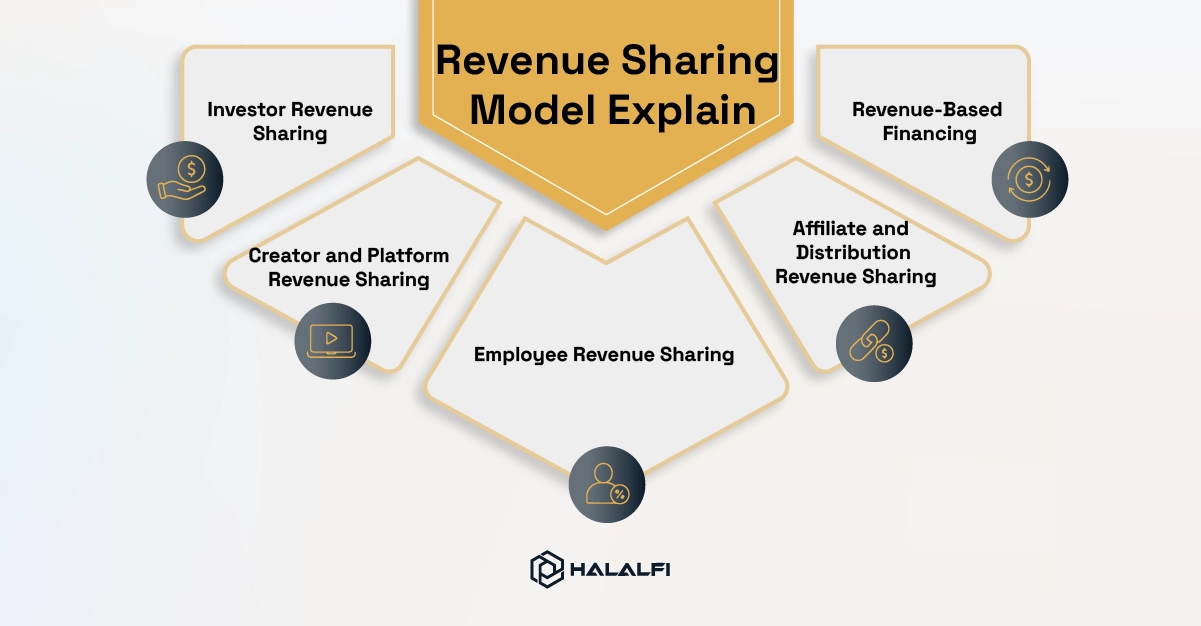
Revenue Sharing Model Explain
A revenue-sharing model turns a percentage of income into compensation, financing repayment, or partnership income. Companies use some versions:
Investor Revenue Sharing: An investor provides capital and receives part of future revenue. The arrangement may end after a set period or when cumulative payments reach a cap.
Creator and Platform Revenue Sharing: A video, music, or software platform may share advertising, subscription, or transaction revenue with creators and developers.
Employee Revenue Sharing: A company may reward staff with a percentage of sales from the accounts, products, or locations they help grow.
Affiliate and Distribution Revenue Sharing: A partner introduces customers and receives a percentage of each qualifying sale.
Revenue-Based Financing: A business receives capital without selling equity. It then pays a percentage of revenue until it reaches a stated repayment total.
Is Revenue Sharing Good or Bad?
Revenue sharing works well when both sides contribute to the same income stream and can measure it fairly.
It works badly when one party controls every number, the percentage ignores business margins, or the agreement never ends.
Here is where It Helps:
Payments move with business activity.
Founders may avoid selling company shares.
Partners gain a direct reason to increase sales.
Revenue often creates fewer accounting disputes than net profit.
Investors may receive payments earlier than they would under a profit-sharing arrangement.
Here is where It Hurts:
The business may owe money before covering wages and overhead.
A high percentage quietly destroys a thin margin.
Seasonal businesses may face large payments during short sales periods.
Vague definitions can lead to disputes over refunds and discounts.
Long or uncapped agreements become more expensive than equity or debt.
Revenue sharing does not automatically create fair risk sharing.
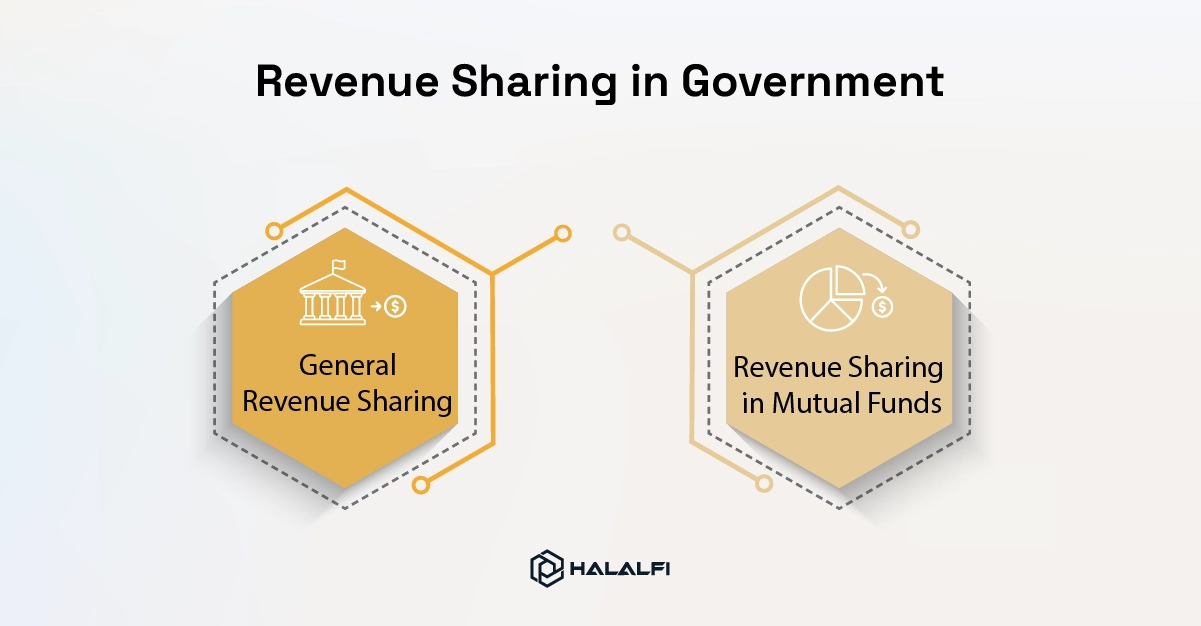
Revenue Sharing in Government
Government revenue sharing occurs when one level of government distributes tax income or other public revenue to another level.
A national government may send money to states, provinces, cities, or districts. The formula may consider population, poverty, tax capacity, unemployment, regional inequality, or the cost of public services.
General Revenue Sharing
General revenue sharing gives local governments broad discretion over how to spend transferred funds.
It differs from a narrow grant that funds only one road, school program, or health service.
Revenue Sharing in Mutual Funds
In mutual funds, “revenue sharing” often describes payments that fund managers, distributors, brokers, or other intermediaries receive for selling or servicing fund shares.
It does not usually mean that ordinary shareholders receive an extra slice of the fund company’s business revenue.
Mutual funds may charge 12b-1 fees from fund assets to cover distribution and sometimes shareholder services.
These payments can compensate brokers, sellers, and firms that market the fund. Investor.gov notes that 12b-1 fees usually apply to mutual funds rather than ETFs.
Can Revenue Sharing Fit Islamic Finance?
Revenue sharing can support Islamic commercial principles, but the name alone does not make the agreement halal.
A halal investment should fund lawful activity, define each party’s rights, avoid riba, limit excessive uncertainty, and connect compensation with a genuine contribution or commercial risk.
A revenue-sharing structure may fit when an investor contributes to a lawful venture and receives a clearly defined share of genuine business income. The parties still need to determine which Sharia contract governs the relationship.
A musharakah or mudarabah usually shares actual profit rather than gross revenue. A wakalah arrangement may pay an agent for genuine services.
Another commercial agreement may connect compensation with sales, distribution, licensing, or usage.
A fixed percentage of gross revenue can raise Sharia concerns when it functions as guaranteed income on a cash loan and leaves the business bearing every loss.
A qualified reviewer must examine the full contract rather than approve the phrase “revenue sharing” by itself.
How HalalFi Addresses Revenue Sharing?
HalalFi does not claim that every listed project uses a pure revenue-sharing agreement. Each project may follow its own reviewed commercial structure.
HalalFi focuses on the deeper problem that revenue-sharing models try to solve:
Capital providers need a clear link between their capital and the activity that generates the return.
Here, the business must complete the project and generate the commercial result, and profits are performance-based.
Share the Right Number
Revenue sharing connects payment with performance. It rewards partners, funds growth, distributes public income, and compensates financial intermediaries.
It also drains a low-margin business, hides mutual-fund conflicts, or disguises a fixed financial obligation beneath flexible language.
The right model begins with the right number. Revenue measures sales, and Profit measures what remains after costs.
HalalFi brings this discipline into project-based digital funding. Investors inspect a real business opportunity, fund it with USDT, follow on-chain activity, and separate performance-based return from Principal Protection.
Visit the HalalFi Projects and open a project. Follow the USDT to the business activity, then identify which sale, service, or trade must create the return. Do not start with the percentage; start with the money it measures.
Frequently Asked Questions
Does revenue sharing confer ownership on the recipient?
Not automatically. A person can receive a percentage of revenue without owning shares, voting rights, or company assets.
Can a company owe revenue sharing when it makes a loss?
Yes. Revenue can exist even when costs exceed income.
What percentage makes a fair revenue share?
No universal percentage exists. The parties should consider gross margin, contribution, risk, duration, payment cap, expected sales, and alternative financing costs.
How can a recipient verify reported revenue?
The agreement can require regular statements, access to payment-processor reports, accountant certification, audit rights, and record-retention rules.
What happens to a revenue-sharing agreement after an acquisition?
The contract should state whether the buyer assumes the agreement, pays a termination amount, or triggers the remaining cap.
Can employees receive revenue sharing instead of wages?
Businesses may use revenue sharing as additional compensation where local employment law allows it.
How do taxes apply to revenue-sharing payments?
Tax treatment depends on the contract, the recipient, the jurisdiction, and whether the payment is treated as compensation, royalty, business income, financing cost, or investment income.