
Your second income can grow without turning into a second job. Sounds good, no? The best passive income ideas in 2026 are inside software, blockchain, digital assets, and automated investment structures.
It means putting either capital or upfront work into something that can keep producing value after you stop touching it every day.
Here are eight ideas worth understanding: what actually pays you, where each can go wrong, and which ones work with little starting capital.
Stop Calling Every Side Hustle Passive Income
A second income becomes passive only when earnings no longer depend heavily on how many hours you work.
That rules out day trading, freelancing, delivery apps, and most “AI side hustles” that require constant posting. A useful passive income setup has:
A clear source of revenue
Low recurring manual work
Costs that do not eat most of the return
Risks you can explain without jargon
A way to exit when circumstances change
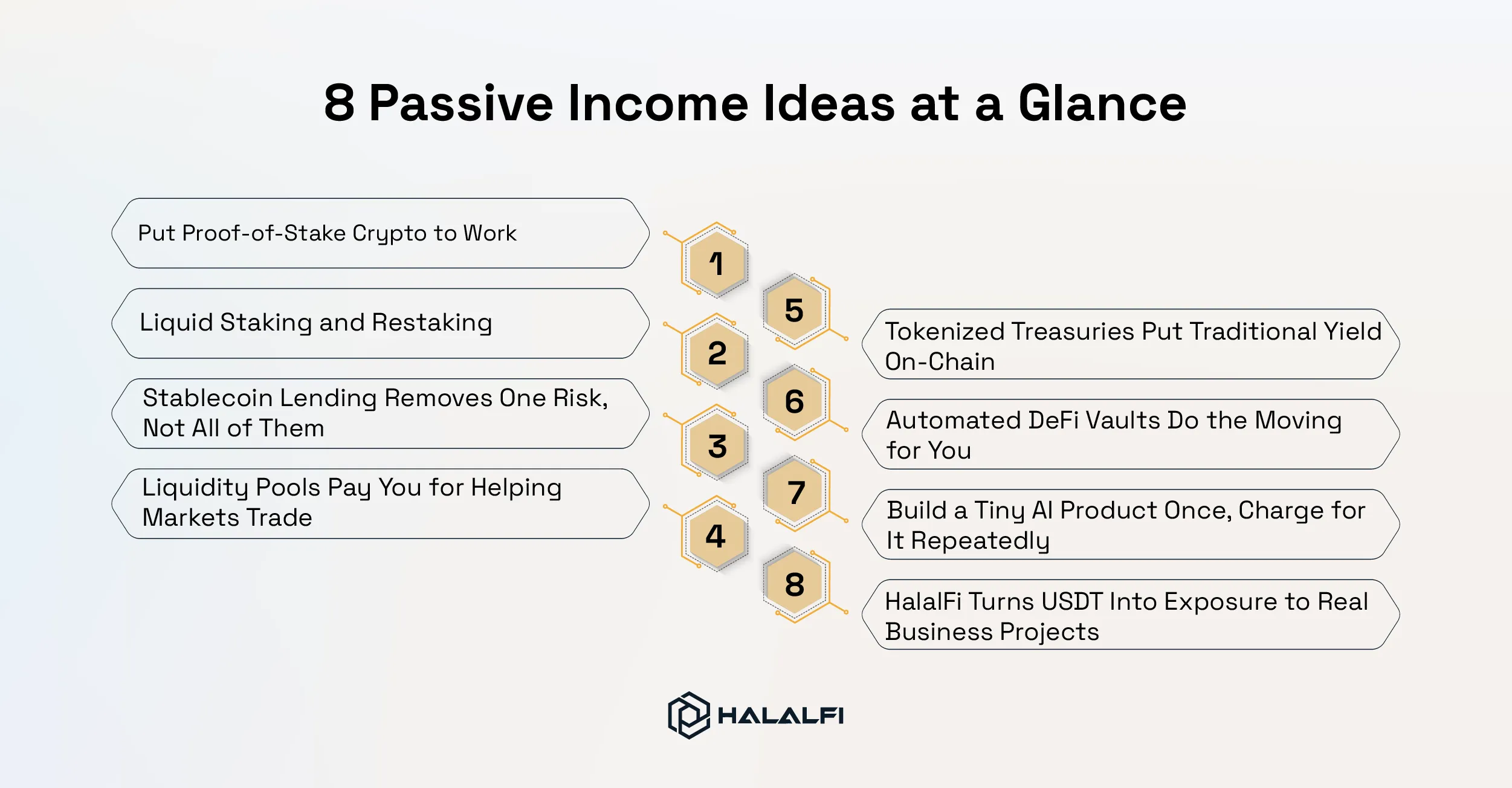
8 Passive Income Ideas at a Glance
In the table below, you can see 8 passive income ideas:
Idea | Starting Capital | Ongoing Effort | Where Income Comes From | Main Catch |
Crypto staking | Low | Low | Network rewards | Token price risk |
Liquid staking & restaking | Low | Low–Medium | Staking + additional network rewards | Extra smart-contract risk |
Stablecoin lending | Low | Low | Borrower payments | Protocol, counterparty and depeg risk |
Liquidity pools | Low–Medium | Medium | Trading fees + incentives | Impermanent loss |
Tokenized real-world assets | Varies | Low | Underlying Treasury or asset income | Eligibility and issuer risk |
Automated DeFi vaults | Low | Low–Medium | Automated yield strategies | Strategy and smart-contract risk |
AI microtools | Mostly time | Medium at first | Subscriptions or usage fees | Finding paying users |
HalalFi projects | Project-dependent | Low after investing | Commercial project profit | Business and execution risk |
The first seven show where digital passive-income opportunities are headed. The eighth takes a different route: blockchain infrastructure tied to real commercial activity.
Idea 1: Put Proof-of-Stake Crypto to Work
Staking remains one of the clearest crypto passive income models. Instead of leaving a proof-of-stake asset idle, holders commit it to network security and receive rewards.
For example, Ethereum lets smaller holders join staking pools rather than needing the 32 ETH required to run a solo validator. It says pooled staking lets people “stake and earn rewards with any amount of ETH.”
Low daily effort, transparent network mechanics, and accessibility with smaller balances through pools are good points.
But there are Bad things: ETH, SOL, or another token can fall far more than the staking reward. Providers also introduce custody, operator, or smart-contract risk. A 5% reward does little to help if the token loses 30%.
Idea 2: Liquid Staking and Restaking
Traditional staking locks capital into network security. Liquid staking gives the investor a token representing the staked position, which can sometimes be used in other DeFi applications.
Restaking goes further. Ethereum describes restaking as using already-staked ETH to secure additional decentralized services and earn extra rewards. Ethereum also warns that this puts the same ETH at additional risk.
A good point is that capital can earn multiple streams of reward, and liquid staking can improve flexibility. But the downside is that every extra layer introduces another contract, operator, protocol, or failure point.
The idea suits someone who already understands wallets and DeFi. It makes less sense as somebody's first $50 crypto experiment. More yield means more things can break.
Idea 3: Stablecoin Lending Removes One Risk, Not All of Them
Stablecoin lending attracts people who dislike watching a volatile token swing 15% while they wait for a 5% staking reward.
A lender deposits assets such as USDC into a protocol. Borrowers pay to use that liquidity, and part of that payment reaches lenders.
The dollar peg reduces the direct price volatility that comes with assets such as ETH or SOL. But "stable” does not mean insured or risk-free.
Depegs, smart-contract bugs, bad collateral, protocol failures, and centralized issuer risk remain.
Whenever somebody offers stablecoin yield, check who pays it and why. If nobody answers that, keep the stablecoin in your wallet.
Idea 4: Liquidity Pools Pay You for Helping Markets Trade
Decentralized exchanges require assets to be available on both sides of a trade.
Liquidity providers supply those assets and receive a share of trading fees, sometimes alongside token incentives.
That generates income without having to trade all day, but the problem appears when prices move.
Someone who deposits ETH and USDC may end up with a different asset mix than they started with.
Traders call this an impermanent loss, although it can become permanent when the investor exits.
Here are good points:
Income can come from real trading activity
Small investors can access many pools
High-volume pools may generate regular fees
But there are Bad points:
Impermanent loss can overwhelm fee income
Token incentives can collapse in value
Smart-contract bugs can put deposited assets at risk
High APYs often disappear as more liquidity arrives
Idea 5: Tokenized Treasuries Put Traditional Yield On-Chain
One of the biggest 2026 trends does not look like old-school crypto at all.
In this way, investors access yield tied to recognizable real-world assets while using blockchain settlement.
Also, the disadvantages are that legal structure, country eligibility, KYC, custody, and redemption terms vary widely. Some products exclude certain jurisdictions or retail investors.
For investors who follow Islamic finance rules, conventional Treasury interest also creates a Sharia issue, so an on-chain wrapper does not automatically make an asset halal.
Idea 6: Automated DeFi Vaults Do the Moving for You
A DeFi vault can automate work that an active yield farmer would otherwise perform manually.
Depending on the strategy, software may move liquidity, compound rewards, rebalance positions, or route assets toward different markets.
That can turn a high-maintenance strategy into something much closer to passive income.
Automation reduces repetitive wallet transactions and can compound returns without constant intervention.
On the other side, the investor now trusts both the underlying protocols and the vault's strategy code. Fees matter too.
A clever strategy with high management or performance fees can leave the user with much less than the headline yield.
Idea 7: Build a Tiny AI Product Once, Charge for It Repeatedly
Not every technology-based passive income idea needs investment capital. Think more limited than “start an AI business.”
The economics work because customer number 200 does not require rebuilding the product from scratch.
The starting cost stays low, and subscription or usage revenue sharing continues after the main development work ends.
AI microtools are among the more realistic passive income ideas for young adults, but only after the creator solves a problem that someone will actually pay to have solved.
Idea 8: HalalFi Turns USDT Into Exposure to Real Business Projects
The previous ideas produce income from networks, borrowers, market-making, financial assets, or software customers. HalalFi uses commercial business activity.
Its crowdfunding platform allows qualified investors to fund Sharia-reviewed business projects using USDT.
The business executes the project, and investors participate in performance-linked returns under the project's terms. HalalFi also performs business assessment before listing an opportunity.
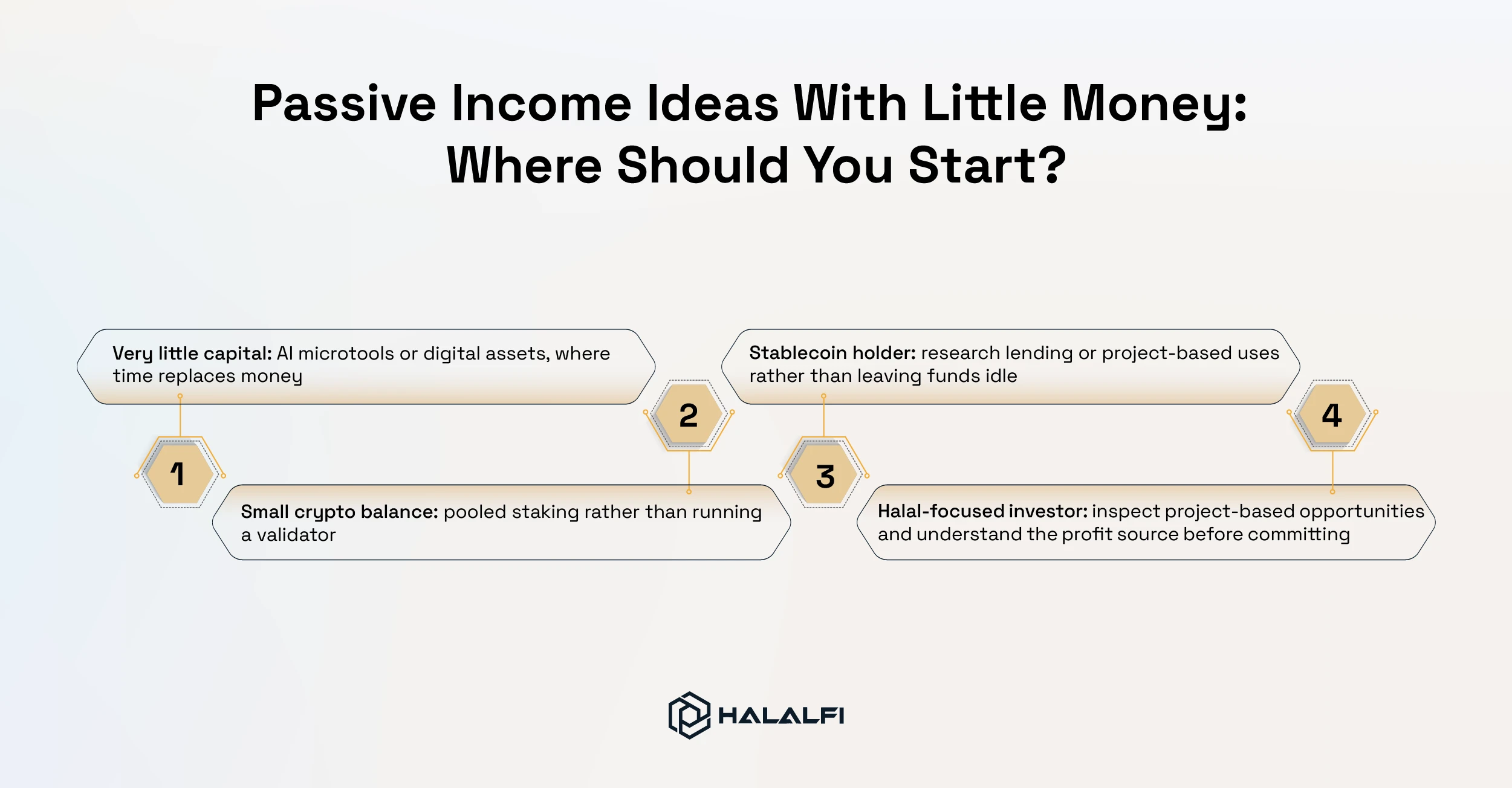
Passive Income Ideas With Little Money: Where Should You Start?
Small capital changes the strategy. Of course, someone with $100 cannot expect a $1,000 monthly income from investments without taking absurd risk. Young investors have one advantage instead: time.
With a small budget, consider:
Very little capital: AI microtools or digital assets, where time replaces money
Small crypto balance: pooled staking rather than running a validator
Stablecoin holder: research lending or project-based uses rather than leaving funds idle
Halal-focused investor: inspect project-based opportunities and understand the profit source before committing; is it profit sharing or fixed profit?
Which Passive Income Idea Works for Which Person?
Here we guide you quickly:
Situation | Idea Worth Researching First | Why |
Has $50–$500 and technical skills | AI microtool | Time can replace capital |
Already holds ETH | Pooled or liquid staking | Uses an asset already owned |
Holds stablecoins | Lending or vetted project investing | Capital can generate a return instead of sitting idle |
Understands DeFi well | LPs or automated vaults | More strategy choices, more technical risk |
Wants on-chain traditional assets | Tokenized RWAs | Connects blockchain with established asset classes |
Wants Sharia-conscious business exposure | HalalFi | Profit can connect to reviewed commercial activity |
What I Would Watch in 2026?
Three trends deserve more attention than another list. First, investors want to know where yield comes from.
Second, real-world assets continue to move on-chain, and Third, project-based investment gives blockchain users another destination for digital capital: real businesses rather than another token loop.
HalalFi belongs in that third category because investors can inspect how their USDT funds are used.
Follow HalalFi, Not Chasing the Highest APY
See HalalFi projects. Instead of rushing into an unfamiliar project because a funding bar is moving, first inspect previous deals.
Look at what the business did; compare the forecast versus actual profit; read the duration, funding target, and protection structure.
Then decide whether project-based income deserves a place beside staking, DeFi, or another second-income strategy.
Conclusion
The best passive income ideas are inside technology. You can stake crypto, lend stablecoins, Supply liquidity, Own tokenized assets, build tiny software products, or connect digital capital to commercial projects.
HalalFi gives the last option a Sharia-focused structure through USDT-funded projects, business review, and performance-based profit.
Start with the clearest source of return and then put your money where the explanation still makes sense after you have read the fine print.
Frequently Asked Questions
Can passive income really start with $10 or $50?
Yes, but expect learning rather than meaningful monthly cash flow at first. Some crypto pools and digital platforms accept small amounts.
Is crypto staking taxable?
Tax treatment depends on jurisdiction and circumstances. Staking rewards can trigger taxable events in many countries, sometimes when the user receives or controls them.
Can passive income disappear even if the principal stays intact?
Yes. Variable rewards can fall sharply. Borrowing demand can decrease, trading volume can dry up, token incentives can end, or a commercial project can produce less profit than forecast.
Is yield on stablecoins safer than staking volatile crypto?
It removes some direct token-price volatility but introduces other risks. Stablecoin depegging, issuer exposure, lending defaults, smart-contract vulnerabilities, and platform failures can all affect positions.
How many passive income streams should someone build?
There is no magic number. Two understandable income sources usually make more sense than six complicated strategies nobody has time to monitor.