
From family gold tucked away for weddings to capital tied up in small businesses and property, many Indian Muslim households already think in tangible assets; halal investing gives that instinct a more structured path.
But can halal investment in India stay easy, useful, and profitable without forcing you to inspect dozens of stocks, funds, and contracts every weekend?
It can, although the choices look different from a conventional portfolio. That is where this guide starts.
What Makes an Investment Shariah-Compliant in India?
In India, where gold, family-run businesses, and property have long carried both financial and cultural value, halal investing asks investors to look one layer more seriously: not only at what they own, but at how the business earns, borrows, and grows its money.
A halal investment usually starts with the business. Companies centered on conventional lending, gambling, alcohol, and other prohibited activities fail the first test. But sector screening alone doesn't finish the job.
Financial structure matters too. A company that sells an acceptable product can still carry levels of interest-bearing debt or non-permissible income that push it outside a screening methodology.
Different Shariah boards and index providers may apply slightly different detailed tests, which explains why two screening services can occasionally disagree about the same stock.

Best Halal Investment Options in India
For many Indian Muslim families, investing is tied to more than returns. It often carries the weight of family tradition and wealth passed from one generation to the next.
Gold, for example, may sit in a locker for years, then appear at a wedding, become a gift, or quietly serve as a long-term store of value.
That familiarity with tangible assets also explains why some investors feel cautious about complex financial products when they cannot clearly see where the money goes or how profits are made.
The menu has improved. Older articles often reduce Indian halal investing to two ethical mutual funds and physical gold.
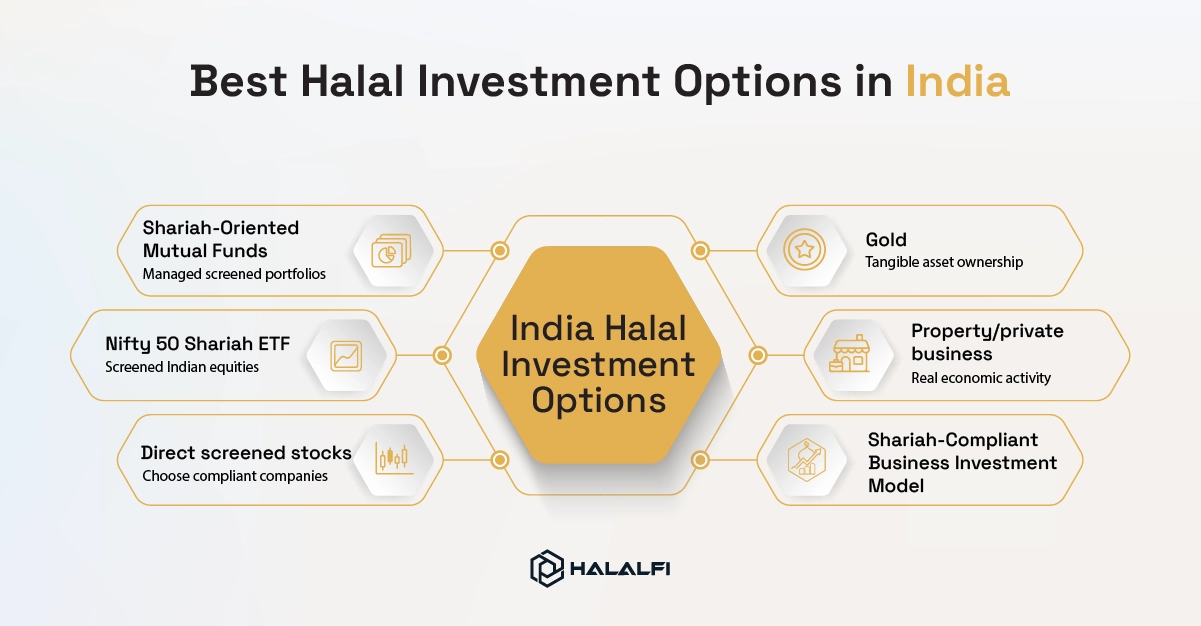
That picture no longer reflects the full market. Indian investors can explore several routes:
Investment route | What you actually own or fund | Liquidity | Main point to check |
Shariah-oriented mutual funds | A managed portfolio of screened shares | Usually high | Fund methodology, holdings, fees |
Nifty 50 Shariah ETF | Units tracking screened Indian equities | Exchange liquidity | Tracking error, concentration, market risk |
Direct screened stocks | Shares in individual companies | Usually high | Ongoing Shariah status and valuation |
Gold | Physical or properly structured gold exposure | Medium to high | Ownership, settlement and product structure |
Property/private business | A physical asset or business interest | Usually low | Financing, contracts and income source |
Shariah-Compliant Business Investment Model | Funding for selected real-world businesses | Project-dependent | Contract terms, business risk, USDT participation, guarantee structure |
No single investment deserves the title of the best halal investment in India for every investor.
A person saving for ten years has a different problem from someone seeking short-term business exposure. Let's explain each one:
Shariah-Oriented Mutual Funds
India now has funds that explicitly follow ethical or Shariah-oriented investment rules.
Tata Ethical Fund remains one of the better-known examples. Tata Mutual Fund reported assets of about ₹3,920.79 crore as of August 13, 2026, and its direct plan had an expense ratio of 0.61%.
Its one-year return stood at -1.89% through July 31, a useful reminder that compliance doesn't protect investors from market losses.
Taurus Ethical Fund also follows Shariah-oriented norms. Quantum Ethical Fund joined the category later, while The Wealth Company now offers an Ethical Fund too.
Quantum's fund launched in December 2024 and uses the Nifty500 Shariah TRI as its benchmark.
If we consider halal investing for beginners, a managed fund can eliminate much of the stock-by-stock screening work. It does not remove normal equity risk.
The Nifty 50 Shariah ETF
Nippon India ETF Nifty 50 Shariah BeES provides a listed alternative. The ETF tracks the Nifty50 Shariah index and has operated since March 2009. Its NAV stood at ₹469.5613 on August 14, 2026.
Its recent numbers also make a useful point. Through June 30, 2026, the ETF returned -14.21% over one year and 1.55% annualized over five years. Since inception, it has reported an annualized return of 11.71%.
Halal does not mean low-risk. And it certainly doesn't mean every year ends in green.
Direct Shariah-Screened Stocks
Direct stocks give investors more control than funds or ETFs. Here, instead of buying an entire basket, you choose individual Indian companies that pass your preferred Shariah screen.
A company may operate in an acceptable industry and still fail because of its debt levels, interest income, or other financial ratios.
Compliance also changes from one reporting period to another, so buying a stock once does not end the screening process.
India's large listed market gives investors plenty to research across technology, healthcare, consumer goods, industrials, and other sectors.
The Nifty500 Shariah index itself included 198 companies as of July 31, 2026, showing that the investable universe extends far beyond a handful of familiar names.
Direct investing suits people who want more control over valuation, portfolio weight, and company selection. You save on the fund management fee, but you take over the research yourself.
According to Darul Uloom Deoband:
“Buying shares can be permissible when the company itself does not engage in prohibited activities such as interest-based banking or alcohol.”
Gold
Gold already has a natural place in Indian households. It appears at weddings, festivals, family celebrations, and sometimes sits in lockers for decades. For a halal investor, however, the familiar metal still needs the right investment structure.
Physical gold is the best example because ownership is clear. Gold bars and coins give investors direct exposure to the asset, although storage, making charges, purity, and resale spreads can reduce the final return.
Financial gold products require more attention. Investors should check whether the structure provides genuine ownership or proper backing, how settlement works, and whether the product complies with the Shariah rules they follow.
A product containing the word “gold” does not automatically settle the compliance question.
Gold can also serve a different purpose from shares. It does not depend on company earnings, which can make it useful for diversification.
But it produces no operating cash flow on its own. Its return mainly depends on the price another buyer will pay later.
Property and Private Businesses
Property and private businesses align more closely with the way many families in India have traditionally built wealth.
A shop, warehouse, apartment, manufacturing unit, or family enterprise represents something tangible. Investors can see where the money goes and, in many cases, understand how the income is generated.
That does not make every property or private-business deal automatically halal.
Private investments bring another practical issue: liquidity. Selling a listed stock may take seconds.
Exiting a stake in a small manufacturing company in Pune or a commercial property in Hyderabad may take months.
Still, this route appeals to investors who prefer real economic activity over price movements on a screen.
That same preference helps explain the growing interest in project-based Islamic finance.
How HalalFi Addresses a Missing Piece in Islamic Investment Options in India
The most common Islamic investment options in India include listed shares, funds, gold, and property. HalalFi focuses on financing identifiable businesses.
The platform examines the business model, cash flow, revenue, and operations as part of its Shariah review. Projects also use off-chain collateral or on-chain guarantee structures depending on their terms.
The return should come from the business activity, not from charging interest on a loan. HalalFi’s profit depends on performance, and investors should not treat expected profit as guaranteed.
The difference makes HalalFi interesting for investors who already understand funds but want halal investment ideas in India beyond another basket of public equities.
The India-Specific Catch: USDT, Tax and Regulation
HalalFi adds flexibility, but Indian investors need to examine one extra layer of scrutiny because the platform uses USDT.
India's Income Tax Department states that income from the transfer of virtual digital assets is subject to a 30% tax rate, plus applicable surcharge and a 4% health and education cess. Section 194S also creates a 1% TDS framework for qualifying VDA transfers, subject to its conditions and thresholds.
Cross-border payments may raise further tax, FEMA, banking, or reporting questions depending on how someone acquires USDT, sends funds, and receives proceeds.
So a Shariah review answers only one part of the decision. Indian investors should also consult qualified professionals on the current tax and regulatory treatment before funding an overseas or crypto-linked structure.
This matters especially for anyone seeking halal ways to invest in India and assuming “halal” also means “simple from a tax perspective.” It doesn't.
Conclusion
A sensible approach to halal investment options in India doesn't require turning investing into a second job.
India now offers screened equity funds, a Shariah ETF, direct shares, and real-asset routes. Each solves a different problem.
HalalFi offers something less common: the chance to examine individual real-business funding opportunities rather than owning only another public-market portfolio.
For investors who want that project-level exposure, the sensible next move isn't to chase the highest percentage on the screen.
Open the project, understand what the business actually does, check how it generates profit, read the guarantee terms, and decide whether the risk makes sense.
Explore HalalFi's projects and compare them for yourself. A good investment should survive questions before it receives funding.
Frequently Asked Questions
Do dividends from Shariah-screened Indian shares always count as fully permissible income?
Not necessarily under every methodology. Some screening approaches recognize small amounts of incidental non-permissible income and use purification rules.
Can an NRI invest in Indian Shariah mutual funds?
It depends on the fund house, the investor's country of residence, KYC requirements, FATCA rules, and the payment route.
What are the safest halal investment options in India for beginners?
Beginners often start with Shariah-screened mutual funds, ETFs, gold, or a small basket of compliant stocks. The right choice depends on the investor's risk tolerance and how much research they want to do.
How can I check whether an Indian stock is halal?
Start by checking the company’s main business activity, debt levels, interest-based income, and other financial ratios used in Shariah screening.
Are SIP investments halal in India?
An SIP is only a way to invest money regularly. Its Shariah status depends on the fund or asset behind it.
Which is better for halal investing in India: mutual funds or direct stocks?
Mutual funds suit investors who want professional management and less day-to-day screening. Direct stocks provide more control but require regular research and monitoring.
Can halal investors in India invest in real businesses instead of the stock market?
Yes. Investors can consider private businesses, trade-based ventures, property, and other structures that generate returns from real commercial activity.