Traditional crowdfunding can be incredibly powerful, but it’s far from risk-free. Have you ever dreamed of launching a game-changing idea or backing an innovative project, only to wake up to the reality that something went wrong?
You’re not alone. In the early days of crowdfunding, people poured money into ambitious ventures with optimistic ads and viral campaigns, only to sometimes lose everything.
We have built something modern in the fintech world, but before explaining what Halalfi is, it is essential to understand the risks in traditional crowdfunding.
Whether you’re an entrepreneur raising capital or an investor exploring alternative finance, knowing where crowdfunding can go wrong will help you protect your financial future when you would like to benefit from crowdfunding platforms powered with emerging technology like blockchain.
There’s a particular kind of silence that follows a failed campaign. It usually starts with excitement and a dopamine rush, countdown timers, flashy videos, and bold promises about “revolutionising” an industry or making a profit that sounds considerable. Friends share the link. Early backers and deployers rush in. The numbers climb fast. Then updates slow down. Deadlines shift. Comments begin with polite concern, then turn to frustration.
Eventually, the page just stops moving, no dramatic ending. Just unanswered questions and a lesson learned the hard way. Those who’ve watched it unfold know the feeling:
crowdfunding can be inspiring, but without proper scrutiny, it can just as quickly turn into an expensive lesson in risk, especially when it is about crowdfunding in ICO or IDO campaigns.
In this article, you’ll get information on traditional crowdfunding risks, real stories of failures and fraud, issues like non-payment and lack of due diligence, and practical steps you can take.
By the end, you’ll be equipped to assess crowdfunding examples way better, understand crowdfunding regulations, and make smarter funding decisions, perhaps even using tools like HalalFi to enhance transparency and investor protection.
What Is Traditional Crowdfunding?
Before we discuss the risks, let’s clarify what crowdfunding really means. At its core, crowdfunding is raising capital from many investors online rather than through a single bank, angel investor, or private equity firm.
These platforms allow startups and small businesses to access funds quickly, with options ranging from equity crowdfunding and lending to reward-based models.
Despite its amazing potential to democratize finance, traditional crowdfunding is not without pitfalls, especially when platforms lack robust governance and investor protections.
Related Article: Crowdfunding for Small Businesses
Why Understanding Crowdfunding Risks Matters?
It’s easy to get swept up in the excitement of crowdfunding. A slick video, a compelling story, a promise of something “revolutionary”, and suddenly, you’re in.
Crowdfunding isn’t just about opportunity; it’s about uncertainty. When you understand the risks, you start to see beyond the marketing. You ask better questions. Who’s behind the project? Is the timeline realistic? What happens if things go wrong?
Many people assume small investments mean small risks. But those small amounts add up quickly, especially if you’re backing multiple campaigns. And unlike traditional investments, there’s often little to no protection.
Taking a few extra minutes to evaluate risks won’t kill the excitement; it actually makes you a smarter backer. Because in crowdfunding, optimism is great… but awareness is what protects you.
Top Risks in Traditional Crowdfunding
Here, we explain the risks that investors and entrepreneurs should understand before engaging with crowdsourced capital.
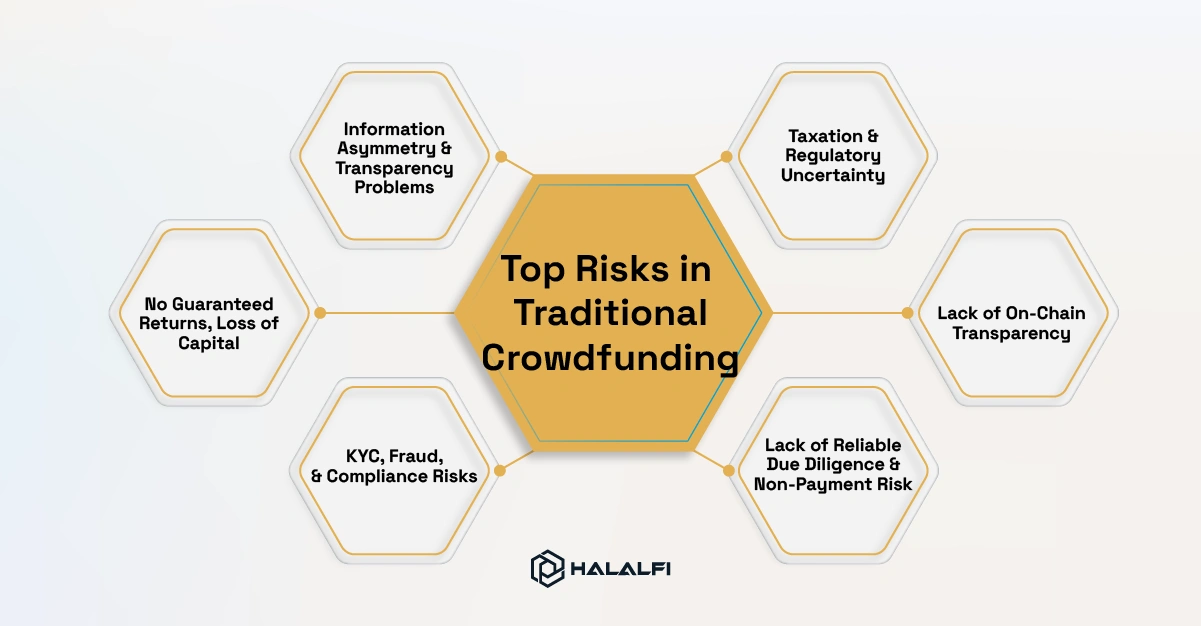
1. No Guaranteed Returns, Loss of Capital
In traditional crowdfunding, especially equity and lending models, there is no guarantee that you will get your money back, and they generally rely on floundering reputations and social trust.
At the same time, on some platforms, we witness collateral regimes. Regulatory watchdogs like France’s Autorité des Marchés Financiers (AMF) warn that investors may face partial or total capital loss, and even have difficulty reselling their illiquid crowdfunding shares.
This is a huge shift from traditional banking or venture capital, where legal protections and contracts are in place.
According to Wikipedia, a well-known example is the Zano drone project on Kickstarter, which raised over $3.4 million but ultimately collapsed, delivering only a fraction of the promised products. Most backers lost their money entirely.
2. Lack of Reliable Due Diligence & Non-Payment Risk
Many crowdfunding campaigns lack rigorous vetting. Platforms often rely on entrepreneurs to self-report business plans, leaving room for misinformation and insufficient due diligence.
Limited due diligence can lead investors to support unvetted projects, increasing the risk of non-delivery, fraud, or misuse of funds.
In some documented cases, failed campaigns have left backers with neither product nor financial return, eroding trust in the model as a whole.
Wikipedia cites an example: The Code Hero game project raised around $170,000 on Kickstarter but failed to deliver the promised product. Backers later discovered funds had been used without completing development, leaving them with no return or product.
3. Information Asymmetry & Transparency Problems
One of the biggest structural risks comes from informational asymmetry: entrepreneurs know more about their project than investors do. This makes it hard to judge a campaign's true viability, even with disclosed information.
Platforms may provide only limited details, leaving critical gaps that experienced investors simply wouldn’t tolerate in traditional finance.
In the Web 2.0 world and on centralised, non-distributed servers, even when they show you information, it might change or be deleted in the near future. Let's have an example.
According to Wikipedia, the Godus game project, led by a high-profile developer, raised about $800,000 but failed to meet key promises and stopped communicating clearly with backers. Supporters later questioned how funds were used and whether the original vision was ever achievable.
4. KYC, Fraud, and Compliance Risks
“Know Your Customer” (KYC) protocols are vital for verifying the identities of investors and entrepreneurs and for preventing fraud, especially when it comes to individuals collecting funds.
Still, many crowdfunding platforms lack robust KYC systems, heightening the risk of financial crime, fraud, and even money laundering. Also, when it comes to the project, verification should go beyond KYC and address the Know Your Business (KYB) principles.
Experts highlight this as a vulnerability, especially when platforms are unregulated or fail to implement robust verification and anti-money laundering (AML) checks.
According to Wikipedia, in 2020, two European crowdfunding platforms, Kuetzal and Envestio, disappeared with investor funds. Together, they caused losses exceeding €13 million and impacted thousands of investors.
5. Taxation & Regulatory Uncertainty
Traditional crowdfunding platforms operate under a patchwork of regulations that differ by country. This can lead to surprises around tax liabilities, compliance standards, and investor protections.
Without clear guidance, both project owners and investors may unintentionally breach tax laws or platform rules. So, in some cases, we want to benefit from revenue, but we have issues with it.
6. Lack of On-Chain Transparency
Unlike blockchain-based crypto crowdfunding, many traditional crowdfunding models lack immutable logs or transparent transaction records.
This makes it harder to track fund flow, confirm deliveries, or resolve disputes, leaving participants vulnerable.
OKTA Data shows that during events like the Surfside condo collapse (2021), multiple fake GoFundMe campaigns appeared, and authorities flagged at least 21 fraudulent pages collecting donations under pretences.
Risk Category | What It Means | Example |
Capital Loss | Potential total loss of investor funds | AMF warns investors may lose all capital |
Due Diligence Gaps | Projects not vetted deeply before listing | Risk of funding fraudulent or weak projects |
Transparency Issues | Limited or incomplete information provided | Information asymmetry between founders & backers |
KYC / AML Failures | Inadequate identity verification | Increased fraud & compliance risk |
Tax & Regulation | Ambiguous rules across jurisdictions | Unclear tax liabilities for investors |
Liquidity Barrier | Hard to exit investment early | Investors must hold until the project concludes |
Comparing Types of Traditional Crowdfunding by Risk
Not all crowdfunding models carry the same level of risk, and many people only realise this after a bad experience. On paper, they may look similar. In reality, they behave very differently.
Reward-based crowdfunding is often seen as the “safer” entry point. You’re not investing, you’re essentially pre-ordering a product. Still, delays, underdelivery, or complete failure are surprisingly common. You might not lose a large sum, but you can easily end up with nothing.
Equity crowdfunding raises the stakes. Here, you’re buying a share in a startup, which sounds exciting, until you remember that most startups fail. Add in illiquidity and limited regulatory protection, and your capital can be locked or lost for years.
Lending-based crowdfunding (peer-to-peer lending) introduces default risk. If borrowers can’t repay, investors take the hit.
Across all models, issues like weak due diligence, information asymmetry, and limited transparency persist. The format changes, but the underlying risks don’t disappear.
Crowdfunding risk checklist before investing
Before you hit that “Back This Project” button, it’s worth pausing for a quick reality check. Excitement is part of the experience, but a simple checklist can save you from learning things the hard way.
Start with the basics: Who’s behind the project? Look beyond the pitch and dig into the founders’ track record. If you can’t verify their experience, that’s already a signal. Next, ask yourself whether the business model actually makes sense. Big promises are easy; sustainable execution is not.
Then, consider transparency. Are there clear updates, realistic timelines, and detailed use of funds?
Vague language often hides bigger issues. Also, don’t ignore regulatory and tax implications—they’re rarely highlighted in campaigns but can affect your returns.
Finally, accept the uncomfortable truth: you could lose everything.—no guarantees, limited protection, and sometimes no accountability.
A good rule you can follow is, if something feels rushed or overly polished, slow down. In crowdfunding, a few extra minutes of scepticism can save months of regret.
Real Stories of Crowdfunding Gone Wrong
Let’s start with a story that sent shockwaves through the industry:
The Estonia Crowdfunding Collapse (Kuetzal & Envestio)
According to Wikipedia, in 2020, two European crowdfunding platforms, Kuetzal and Envestio, disappeared virtually overnight, leaving over 2,300 investors without access to their funds.
Kuetzal’s collapse affected more than 550 retail investors, while Envestio’s bankruptcy impacted over 1,800 people, with total losses in the tens of millions of euros.
These incidents are stark reminders that a crowdfunding platform, unlike regulated banks, can present risks of fraud, non-payment, and platform failure if oversight is weak or due diligence is insufficient.
Spectacular crowdfunding failures continue into 2026
According to toptal.com, a recent expert review updated in January 2026 looked at the state of crowdfunding failures and highlighted a pattern; while crowdfunding continues to attract money, there’s still:
Insufficient vetting on many platforms before campaigns launch.
A tendency for campaigns to raise big money with little accountability.
Platforms often seem more focused on growth than on filtering out weak or fraudulent projects.
Risks in Traditional Crowdfunding vs Traditional Finance
Traditional finance sources like banks, business angels, and venture capital are well-established, heavily regulated, and offer risk-mitigation structures.
While they have higher entry barriers and may require collateral or detailed business plans, they generally offer:
Structured due diligence
Legal contracts and protections
Regulatory oversight
Clear tax reporting requirements
Crowdfunding may be accessible and flexible, but it comes with greater uncertainty and potential loss, especially for retail investors without safeguards.
Tips to Navigate Crowdfunding Risks
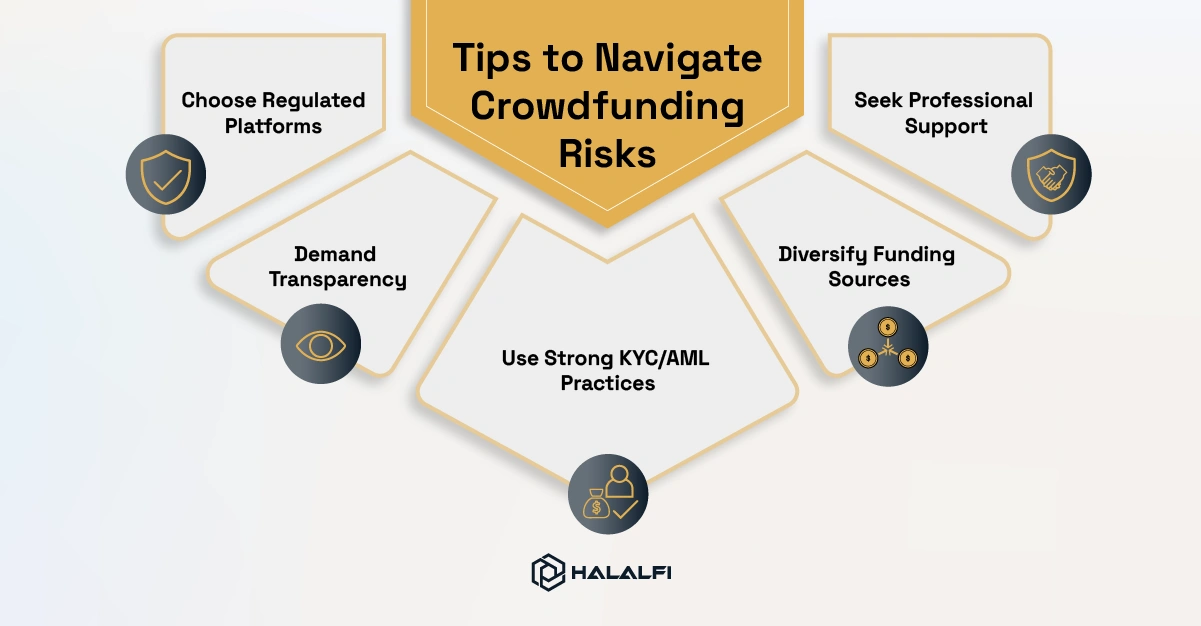
With the right awareness, you don’t have to avoid crowdfunding entirely. Instead, consider these best practices:
Choose Regulated Platforms: Opt for platforms that comply with securities laws and require thorough project vetting, or use platforms that employ transparency.
Demand Transparency: Look for campaigns with clear financials, product plans, and realistic timelines, backed by a proven revenue track record.
Use Strong KYC/AML Practices: Verify you understand the identity checks and compliance measures for both the investor and the creator.
Diversify Funding Sources: Instead of relying solely on crowdfunding, combine it with traditional finance when possible to make your investment portfolio more diversified.
Seek Professional Support: Financial advisors, legal counsel, or platform experts can help you understand complex risks.
Crowdfunding’s Potential, Not All Risks
Despite the risks, crowdfunding has played an extraordinary role in democratizing access to capital, especially for entrepreneurs who lack traditional backing.
Studies show platforms can enable innovation, community engagement, and broader participation in finance, but only if combined with education, stronger safeguards, and evolving crowdfunding regulations.
According to Research and Markets, a 2026 industry report estimates that the market will expand from about $20.34 billion in 2025 to $23.82 billion in 2026, growing at roughly a 17.1% annual rate.
Over the medium term, some forecasts predict it will nearly double again by 2030, reaching an estimated $44.75 billion, as digital payment adoption rises and online fundraising embeds itself more deeply in startup ecosystems.
Also, Marketdataforecast shows the market could swell from around $24.05 billion in 2024 to a massive $108 billion+ by 2033, reflecting an annual growth rate of over 18% across the decade.
These are the reasons that the neo bank, crypto, and fintech revolution will employ crowdfunding as the foundation of many financial activities, whether it is about project financing, tokenisation, or equity financing.
Traditional Crowdfunding and Halal Finance
Crowdfunding didn’t appear out of nowhere. It grew out of frustration. For decades, access to capital was filtered through banks, venture capital firms, and tightly guarded investor networks. If you weren’t in the room or didn’t know someone in the room, you were out of luck. Then platforms like Kickstarter arrived, quietly shifting the balance.
Suddenly, entrepreneurs in small towns, students with prototypes, and family-owned businesses could raise money directly from the crowd.
But here’s the catch, democratisation without structure can become disorder. Traditional crowdfunding, especially lending-based and equity-based models, carries recurring weaknesses:
Limited pre-listing due diligence
Fixed-interest obligations regardless of performance
Lack of legal and enforceable structure
Weak governance once funds are raised
Limited transparency in capital deployment
Halal Investing: Risk Sharing Instead of Risk Transfer
Islamic finance isn’t new. In fact, it’s built on principles that predate modern venture capital:
shared risk, asset-backed activity, and the prohibition of guaranteed interest (riba), while it empowers transparency and mandates the elimination of any uncertainty or volatility in contracts. What’s interesting is how these principles intersect with crowdfunding.
Traditional lending and crowdfunding often transfer risk downward, while investors receive fixed returns if things go well, but businesses still owe payments even if they struggle. When performance dips, default risk spikes, and it seems unfair to us.
Halal investing flips that logic. Instead of fixed interest, it emphasises profit-and-loss sharing. Returns are tied to real business outcomes. Investors participate in performance, not promises. There’s no guaranteed interest mechanism, because guarantees can distort incentives and increase structural fragility.
It’s not about eliminating risk. That’s impossible in any entrepreneurial ecosystem. It’s about aligning it and ensuring that parties do what they are obliged to do.
This is where platforms like HalalFi attempt to connect the two worlds:
preserving crowdfunding’s accessibility while integrating on-chain smart contract-based governance, having both sharia and business compliance screening and audit, and performance-based structures rooted in Islamic finance principles. In a way, it’s less of a replacement and more of an evolution.
Traditional crowdfunding cleared the way. Halal investment asks a harder question: What if access to capital were paired with built-in accountability and shared economic responsibility?
That bridge, from open participation to structured, ethics-driven investment, is where the real innovation may be happening.
From Traditional Risk to a Different Model
By now, a pattern starts to emerge. Whether it’s reward-based campaigns that never deliver, equity deals that lock your money for years, or lending models exposed to default risk, the core issue isn’t just the format.
It’s how risk is distributed, or more accurately, how it’s often pushed onto the wrong side.
If traditional crowdfunding tends to transfer risk downward while keeping returns unevenly structured, is there a way to redesign the system itself?
Not by removing risk entirely, that’s unrealistic, but by reshaping how it’s shared, tracked, and enforced.
This is exactly where ideas like Halal investing begin to feel less theoretical and more practical.
Instead of relying on promises, hype, or loosely enforced obligations, the focus moves toward alignment: shared outcomes, clearer accountability, and structures that reflect real performance.
So can crowdfunding evolve into a model where risk feels fair, not hidden? That’s the bridge to HalalFi.
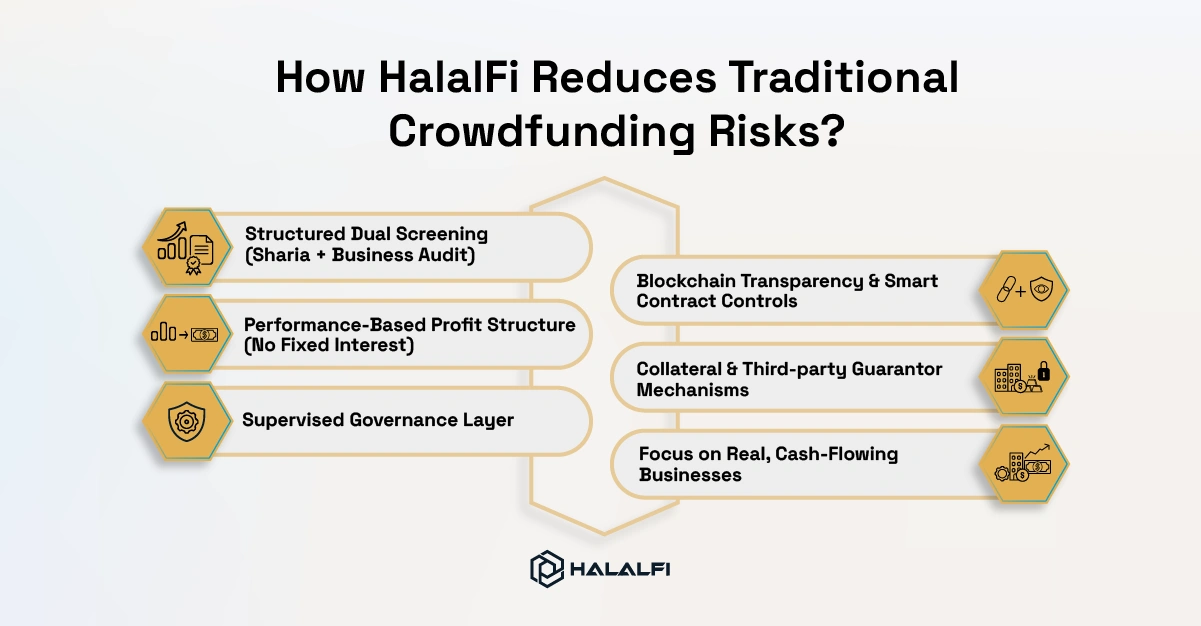
How HalalFi Reduces Traditional Crowdfunding Risks?
Can crowdfunding be redesigned to feel fairer and more transparent? That’s the question HalalFi leans into, quite deliberately.
While no platform can eliminate risk (and honestly, any that claims it can should raise eyebrows), HalalFi focuses on reducing the structural weaknesses that make traditional models fragile in the first place.
It does this by combining Sharia-compliant financial principles with blockchain-based infrastructure, introducing clearer accountability, verifiable transactions, and performance-linked returns.
Instead of relying solely on trust, the model builds in mechanisms for transparency and shared responsibility.
In that sense, HalalFi isn’t just another platform; it’s an attempt to rethink how crowdfunding should work from the ground up.
1. Structured Dual Screening (Sharia + Business Audit)
One of the recurring problems in traditional crowdfunding is insufficient vetting before projects are listed. HalalFi introduces a dual-layer audit process:
Sharia compliance review to ensure alignment with Islamic finance principles
Business fundamentals audit focusing on cash flow, revenue model, sustainability, and operational viability
This reduces the risk of purely speculative listings and strengthens early-stage filtering, addressing the “due diligence gap” often seen on traditional platforms.
2. Performance-Based Profit Structure (No Fixed Interest)
Traditional lending-based crowdfunding can expose investors to non-payment risk with fixed obligations, regardless of business performance.
HalalFi operates on a performance-based profit-sharing model rather than a fixed-interest model. While this does not remove business risk, it aligns incentives:
Investors participate in real economic outcomes
Returns are linked to actual performance
There is no guaranteed interest mechanism
This structure attempts to avoid the rigidity that often amplifies default risk in debt-based crowdfunding.
3. Supervised Governance Layer
Many traditional crowdfunding failures stem from weak oversight and platform collapse. HalalFi integrates:
DAO-supervised verification mechanisms
Multi-signature confirmations for project approvals and fund releases
Structured governance participation
This governance layer serves as an additional safeguard beyond basic platform hosting, aiming to reduce unilateral decision-making and opaque fund management.
4. Blockchain Transparency & Smart Contract Controls
A major weakness in traditional crowdfunding is the absence of immutable transaction records. HalalFi leverages:
On-chain transaction logs and offering on-chain proof of investment and profit distribution
Smart contracts with predefined conditions
Automated distribution mechanisms
5. Collateral & Third-party Guarantor Mechanisms
Traditional crowdfunding often leaves investors at risk of total loss if projects fail. HalalFi introduces additional defensive structures, including:
Collateral mechanism in the form of Sharia-aligned
A third-party guarantor marketplace that offers insurance
Structured principal-protection considerations when the investees do not respect their obligations through the use of a liquidation damage mechanism
While risk cannot be eliminated, layered protection reduces exposure to fraud and mismanagement.
6. Focus on Real, Cash-Flowing Businesses
One consistent pattern in crowdfunding failures is overfunding of high-visibility but under-validated ideas. HalalFi emphasises:
Existing revenue streams
Real business operations
Growth capital for expansion, not just concept funding
This shifts the model from speculative early-stage hype toward performance-linked participation.
Make Smart Funding Choices
Risks in traditional crowdfunding exist, but they don’t mean crowdfunding is doomed. They simply call for greater diligence, regulatory advancement, and informed participation in innovative models.
If you’re thinking about launching a campaign or investing in one, understanding these dangers, from non-payment to lack of due diligence, KYC challenges, and tax complexity, is your first line of defence.
Ready to evaluate crowdfunding opportunities with clearer insight and security? Explore tools like HalalFi to assess investment transparency, compliance, and risk, so your next financial move is more confident and better informed. You may get profit while it is principled.
Frequently Asked Questions
Can I lose all my money in crowdfunding?
Yes, some crowdfunding models carry a risk of total capital loss if a project fails or the owner defaults.
Does regulation protect crowdfunders?
It depends on the platform and jurisdiction. Some regions have stronger crowdfunding regulations than others.
Why is due diligence important in crowdfunding?
Lack of thorough vetting can lead to funds being allocated to weak or fraudulent projects.
Does traditional finance have fewer risks?
Generally, yes, due to strong legal frameworks and oversight, but it has higher entry barriers.
Are KYC requirements in crowdfunding?
Many reputable crowdfunding platforms require KYC to reduce fraud and verify investor identities.